
Quick Answer
Turkey Tail (Trametes versicolor) is a functional mushroom studied mainly for its immune-modulating polysaccharides, particularly PSK (polysaccharide-K) and PSP (polysaccharide-peptide). Most of the strongest research comes from Japan, where PSK has been used clinically as an adjunct alongside conventional cancer treatment under medical supervision, distinct from how the mushroom is typically sold as a general wellness supplement in the UK. For everyday supplement use, it’s studied mainly for general immune support and antioxidant activity rather than as a treatment for any condition.
What Is Turkey Tail Mushroom?
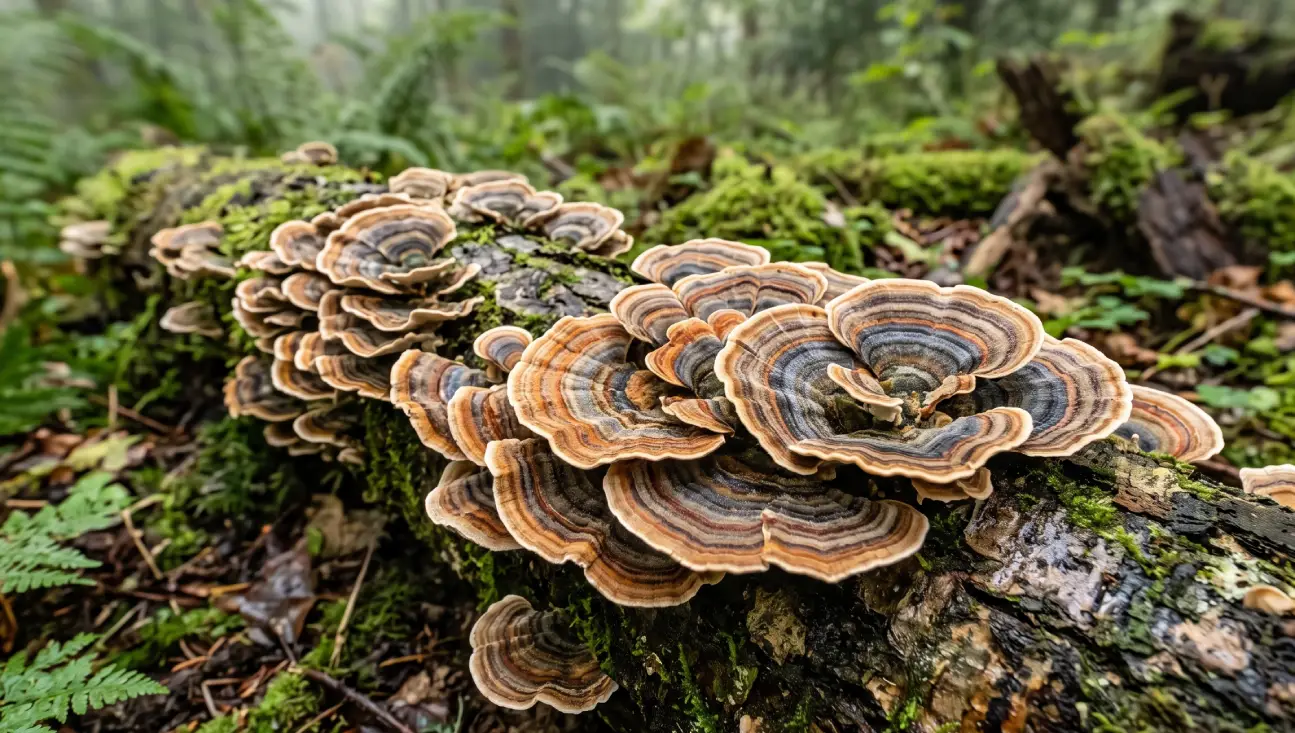
Turkey Tail gets its name from the fan-shaped, banded caps that resemble a turkey’s tail feathers, and it’s one of the most recognisable fungi found on decaying hardwood logs across the UK and much of the world. Unlike many functional mushrooms grown specifically for supplements, Turkey Tail is genuinely common in the wild, though supplement-grade products come from controlled cultivation rather than foraging.
Its research profile centres on two polysaccharide compounds: PSK, marketed under the name Krestin and used clinically in Japan, and PSP, a closely related compound studied more in China. Both are thought to work primarily by modulating immune activity rather than acting directly on disease processes themselves.
For a wider view of where Turkey Tail sits alongside other functional mushrooms in current research, our functional mushroom research update tracks findings across Lion’s Mane, Cordyceps, Reishi, and Turkey Tail together.
What Does the Research Say?
Immune modulation. This is Turkey Tail’s best-established area of research. Laboratory studies have shown that compounds from the mycelium and its fermented growing substrate can activate immune cells including lymphocytes and monocytes, and stimulate a range of immune-signalling molecules. Some of this immune-activating effect appears to come specifically from the fermented substrate the mushroom grows on, not just the mushroom tissue itself, which is a detail that’s shaped how some modern extracts are prepared.
PSK and cancer-adjunct research in Japan. This is the area with the most extensive clinical history, and it’s worth being precise about what it does and doesn’t show. PSK has been studied as an adjunct to conventional treatment in gastric cancer patients, with research involving hundreds of participants reporting improved antitumour immune activity and, in some studies, longer overall survival when PSK was used alongside standard treatment. Separate research has also explored natural killer cell activity in breast cancer patients using Turkey Tail mycelium. It’s important to understand that this research involves a specific, standardised pharmaceutical-grade extract used under medical supervision as part of a treatment plan, not a general wellness supplement taken independently, and it should never be treated as a substitute for medical care or used to self-manage a cancer diagnosis.
Antioxidant and nutritional profile. Beyond immune effects, analytical studies of Turkey Tail have documented its phenolic compound content and general nutritional composition, contributing to its antioxidant activity alongside the immune-modulating polysaccharides.
Antiviral research. Some laboratory research has looked at beta-glucans derived from Turkey Tail for their potential role in supporting resistance to viral infection, an area that remains at an early, mostly preclinical stage.
Why This Matters: Turkey Tail sits in an unusual position compared to most functional mushrooms, because part of its research base comes from serious clinical oncology settings rather than general wellness studies. That’s genuinely interesting from a research perspective, but it also means it’s especially important not to conflate a supplement bought online with the standardised, medically supervised extract used in that clinical research. Anyone considering Turkey Tail alongside cancer treatment, or for any serious health condition, should speak to their treating clinician first rather than relying on general guidance like this.
PSK is approved and used clinically as an adjunct cancer therapy in Japan, but this reflects a specific, standardised pharmaceutical preparation and treatment context, not general over-the-counter supplement use.
Traditional Use and Modern Research
Turkey Tail has a long history in traditional Chinese and Japanese medicine, generally prepared as a tea or decoction from the dried fruiting body well before the specific polysaccharide compounds within it were isolated and studied in a laboratory setting. That traditional use is part of what originally drew researchers to investigate the mushroom’s bioactive components more closely.
Modern research has largely built on that starting point, isolating and studying PSK and PSP specifically, then testing standardised extracts in both laboratory and clinical settings. It’s a useful example of how traditional use and modern pharmacological research can inform each other, even though the specific standardised extracts studied clinically today are considerably more concentrated and controlled than a simple traditional preparation would be.
Choosing a Turkey Tail Product
Check whether it’s fruiting body or mycelium-based. Similar to other functional mushrooms, extraction source affects which compounds you’re actually getting, and products vary in whether they use fruiting body, mycelium, fermented substrate, or a combination.
Look for polysaccharide content where available. Some suppliers specify beta-glucan or polysaccharide percentages, which can help with comparing products, though standardisation varies considerably across the market.
Consider your reason for buying it. General immune-support supplement use is a very different context from anything related to active illness or ongoing medical treatment, and expectations should be set accordingly.
Pro Tip: if general wellness and immune support is your goal, a straightforward dried mushroom, powder, or tincture is a reasonable starting point. If you’re exploring Turkey Tail in the context of a serious health condition, that conversation belongs with a healthcare professional, not a product description.
Pro Tip: look at how a supplement is grown and prepared, not just its marketing claims. Given how much of Turkey Tail’s studied bioactivity comes from specific fermentation and extraction processes, sourcing and preparation genuinely matter here more than with some other functional mushrooms.
Common Mistakes
Assuming supplement-grade Turkey Tail matches clinical-grade PSK. The extract used in Japanese oncology research is a specific, standardised pharmaceutical preparation, not equivalent to a general wellness capsule or tincture bought online.
Using it as a substitute for medical treatment. None of the available research supports replacing conventional medical care with a Turkey Tail supplement, and doing so could delay appropriate treatment for a serious condition.
Overlooking the fermented substrate detail. Some of Turkey Tail’s studied immune activity has been linked specifically to the substrate it’s fermented on, not the mushroom tissue alone, so it’s worth understanding how a given product is actually prepared.
Foraging without proper identification. While Turkey Tail is common in UK woodland, several lookalike bracket fungi exist, and misidentification carries real risk. Supplement-grade, cultivated sources avoid this problem entirely.
Expecting a single “immune boost” from short-term use. Most of the supporting research involves sustained use over weeks, in the context of a broader health picture, rather than an isolated short-term effect.
FAQ
Is Turkey Tail mushroom legal and available in the UK? Yes. Turkey Tail is a legal, widely available supplement mushroom, sold as dried mushroom, powder, capsules, or tincture, with no controlled status.
Can Turkey Tail cure or treat cancer? No. While a specific standardised extract (PSK) has been studied clinically as an adjunct alongside conventional cancer treatment in Japan under medical supervision, general wellness supplements are not equivalent to that pharmaceutical preparation, and Turkey Tail should never be used as a substitute for medical care.
What’s the difference between PSK and PSP? Both are polysaccharide compounds studied for immune-modulating activity. PSK has been researched and used clinically mainly in Japan, while PSP has been studied more extensively in China. They’re closely related but distinct preparations.
How is Turkey Tail typically taken as a supplement? Common forms include dried mushroom for tea or decoction, powder for mixing into food or drinks, capsules, and tinctures, with dosing varying by product and preparation method.
Can I forage Turkey Tail myself in the UK? It’s a genuinely common woodland fungus, but accurate identification against lookalike bracket fungi takes real experience. Most people interested in Turkey Tail’s studied compounds are better served by a cultivated, supplement-grade product.
Is Turkey Tail safe to take alongside other functional mushrooms? Many people include it as part of a broader functional mushroom routine alongside mushrooms like Lion’s Mane or Cordyceps. As with any supplement combination, check with a healthcare professional if you’re on medication or managing a health condition.
Does Turkey Tail have any known side effects? Turkey Tail is generally well tolerated in supplement form, though mild digestive upset has been reported by some users. As with any new supplement, introducing it gradually and monitoring how you respond is a sensible approach.
Related Guides
- Functional Mushroom Research Roundup
- Functional Mushroom Research Update: Lion’s Mane, Cordyceps, Reishi & Turkey Tail
- Lion’s Mane Mushroom: Benefits, Dosage & UK Buying Guide
- Mushroom Nutrition Science Topics: 10 Key Findings
- Functional & Gourmet Mushrooms: Cultures, Tinctures & Dried Mushrooms
About This Guide
SporeBuddies stocks Turkey Tail alongside our wider functional mushroom range and tracks published research on functional mushrooms on an ongoing basis. This guide draws on that research tracking to give a clear, honest picture of what Turkey Tail’s research base actually shows, including where the clinical evidence sits in a medical context rather than general supplement use.
In Summary
Turkey Tail’s research profile is genuinely distinctive among functional mushrooms, with immune-modulating polysaccharides supported by both laboratory research and, for a specific standardised extract, real clinical use in oncology settings in Japan. For everyday supplement use, that translates mainly to general immune support and antioxidant activity, not a treatment claim of any kind. Understanding the difference between clinical-grade PSK and a general wellness product, and choosing a supplement with clear sourcing information, matters more here than with many other functional mushrooms.
Browse our full range of Turkey Tail products, or read our functional mushroom research update for the latest findings across Lion’s Mane, Cordyceps, Reishi, and Turkey Tail.