
🧫 Spore Prints & Agar
Explore beginner-friendly education on mushroom spore prints, agar workflows, observation, transfer concepts, and clean mycology practice. This SporeBuddies hub is designed for readers who want to understand how spore prints are made, studied, and used in agar-based mycology learning.
Spore prints and agar sit at the meeting point between practical mycology, microscopy, sterile technique, and fungal observation. This page brings the core learning path together in a calm, laboratory-inspired format for beginners and curious researchers.
Start Here: Choose Your Spore Print & Agar Path
Spore prints and agar can feel technical at first, but the learning journey is simple when broken into stages. First, readers need to understand what a spore print is and how spores are deposited. Then they can move into agar, where observation, transfer technique, and clean working habits become more important.
Jump to Spore Print Basics →
Jump to Agar Workflow →
Jump to Clean Technique →
Featured Spore Prints & Agar Guides
These two core guides form the foundation of the SporeBuddies spore print and agar learning pathway: first understanding spore prints, then exploring how prints are introduced into agar-based beginner workflows.
How to Make a Spore Print
A beginner-friendly guide to understanding spore prints, how spores are deposited, and why prints are useful in mycology education.
How to Use a Spore Print on Agar
Learn the beginner pathway from spore print to agar, including observation, transfer concepts, and clean working habits.
Spore Print Basics: What Is a Mushroom Spore Print?
A mushroom spore print is the visible deposit of spores released from a mushroom’s gills, pores, or other spore-bearing surface. When spores fall onto paper, foil, glass, or another suitable surface, they can form a pattern that reflects the structure of the mushroom’s underside.
Spore prints are important in mycology because they can help with education, observation, photography, species discussion, and microscopy preparation. The colour and pattern of a spore print may provide useful clues, although a print alone should not be treated as complete identification evidence.
Why spore prints matter
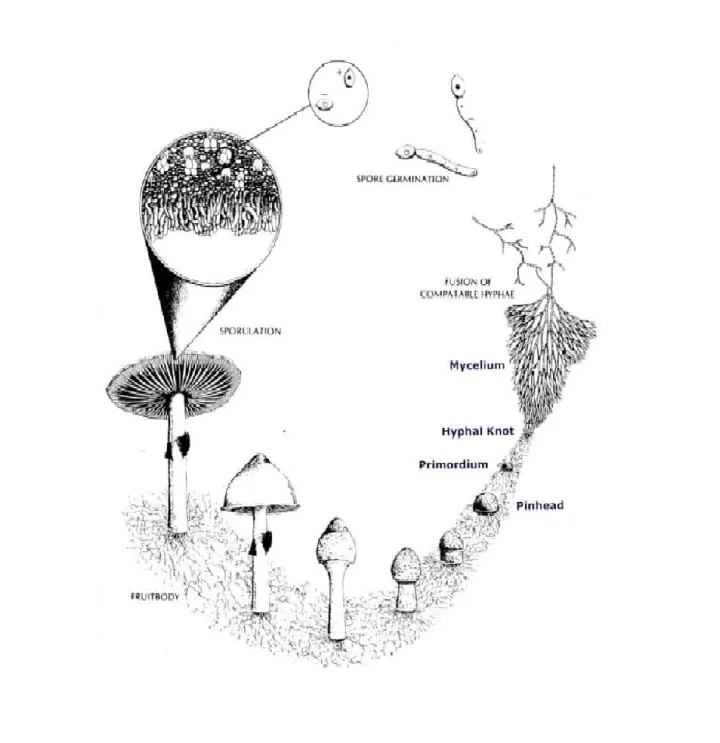
Spore prints create a bridge between visible mushroom features and microscopic study. They help beginners understand that mushrooms are reproductive structures and that spores are part of the fungal life cycle. For many readers, making a spore print is one of the first practical steps into deeper mycology education.
Spore Print to Agar: Understanding the Learning Path
Agar is a gel-like medium used in mycology and microbiology to observe fungal growth, separate growth patterns, and support controlled study. In beginner mycology discussions, agar is often introduced after spore prints because it allows readers to think more carefully about transfer technique, visual assessment, and clean handling.
Using a spore print on agar is not just about moving spores from one place to another. It introduces several important concepts: surface cleanliness, contamination awareness, labelling, observation over time, and recognising that fungal growth can look different depending on species, age, medium, and conditions.
Clean Technique, Labelling, and Observation
Clean technique is one of the most important ideas in agar work. Agar plates can show fungal growth clearly, but they can also show unwanted growth if handling is careless. For beginners, this makes agar a useful teaching tool because it gives visual feedback about process, patience, and preparation.
Good Beginner Habits
- Work slowly and deliberately
- Label plates clearly
- Keep surfaces clean
- Record dates and observations
- Compare changes over time
- Avoid overhandling materials
What Agar Can Teach
- Growth patterns
- Contamination awareness
- Transfer discipline
- Visual comparison
- Patience and observation
- Basic mycology workflow thinking
Agar work rewards consistency. The more carefully observations are recorded, the easier it becomes to understand what is happening on the plate and how different samples or methods compare.
Spore Prints, Agar, and Microscopy
Spore prints, agar, and microscopy are closely connected learning areas. A spore print can help readers understand spore deposition. Agar can help readers observe growth behaviour and clean technique. Microscopy can then help readers study spores and fungal features at a smaller scale.
Together, these topics create a strong foundation for mycology education. They teach observation, patience, record keeping, comparison, and responsible scientific thinking.
Responsible Spore Print & Agar Education
Spore print and agar content should always be approached with legal and safety context in mind. Laws vary depending on species, country, intended use, and local regulations. Educational mycology should be framed around observation, research, identification, and responsible learning.
SporeBuddies publishes spore print and agar information for education, mycology learning, microscopy context, and beginner-friendly scientific understanding. Readers should check local laws and avoid treating educational content as legal, medical, or restricted-use guidance.
Related SporeBuddies Knowledge Hubs
Spore prints and agar connect naturally with microscopy, strain comparisons, mycology science, mushroom identification, and legal education. Continue exploring the wider SporeBuddies knowledge base below.
Spore Prints & Agar FAQs
What is a mushroom spore print?
A mushroom spore print is the visible deposit of spores released from a mushroom onto a surface such as paper, foil, or glass. It can help with education, observation, and species discussion.
Why are spore prints useful in mycology?
Spore prints help learners understand spore colour, deposition patterns, mushroom reproduction, and the connection between visible mushroom features and microscopy.
What is agar used for in mycology?
Agar is used as a medium for observing fungal growth, comparing growth patterns, and practising clean technique in educational mycology workflows.
Can spore print colour identify a mushroom by itself?
No. Spore print colour can be useful, but responsible identification should consider multiple features, habitat, morphology, microscopy, and expert guidance where needed.
Does SporeBuddies provide legal or medical advice?
No. SporeBuddies publishes educational mycology content only. Readers should check local laws and seek qualified advice where needed.
Continue Exploring Mycology Workflows
SporeBuddies brings together spore print guides, agar education, microscopy resources, strain comparisons, mycology science, and safety-aware learning pathways for curious mushroom researchers.
Explore the Full Knowledge Base