
Quick Answer
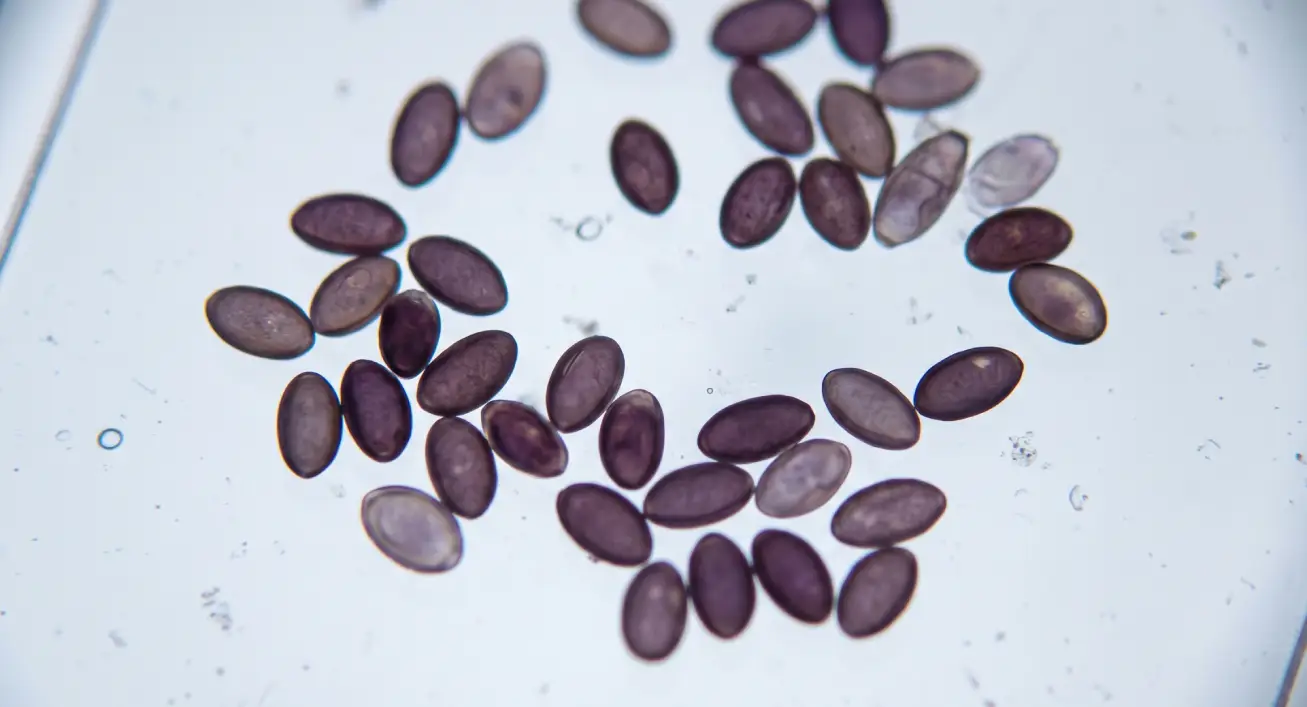
Golden Teacher is one of the most widely documented Psilocybe cubensis strains, and its spores show the ellipsoid shape, purple-brown colouration, and smooth-to-finely-textured surface typical of the species. Under a compound microscope at 400x or higher, Golden Teacher spores are generally observed within a fairly consistent size range for the species, though some natural variation exists between individual samples. This guide covers what to look for, how to examine spores properly, and how morphology fits into wider identification practice.
Why Spore Morphology Matters for Identification
Spore characteristics sit alongside cap shape, gill attachment, and habitat as core identification criteria in mycology, and they’re particularly useful because they don’t change with growing conditions the way some visual traits can. Colour, shape, size, and surface ornamentation together give a far more reliable picture than any single trait viewed in isolation.
Morphological identification, including detailed assessment of spore shape, size, and ornamentation, remains one of the most widely used approaches in fungal identification precisely because it’s accessible without needing laboratory-grade equipment or specialist training. For anyone comparing or documenting Psilocybe cubensis strains, spore morphology is often the most consistent characteristic available for comparison, more so than cap colour or size, which can vary considerably with growing conditions.
Our magic mushroom spore strains comparison guide looks at how Golden Teacher compares to other documented strains more broadly, while this guide focuses specifically on the microscopy side of identification.
Golden Teacher Spore Characteristics
Shape. Golden Teacher spores are typically ellipsoid, meaning elongated with rounded ends, a shape broadly consistent across Psilocybe cubensis strains generally.
Colour. Under transmitted light, mature spores usually appear a dark purple-brown, which is a defining characteristic of the species when viewed en masse on a spore print, and appears as a more subtle brown tone when examining individual spores under magnification.
Surface texture. The spore surface is generally smooth to very finely textured, without the pronounced ornamentation seen in some other fungal genera, which is typical of Psilocybe species more broadly.
Size. Spore dimensions for Psilocybe cubensis strains, including Golden Teacher, generally fall within a documented size range for the species, though exact measurements can show minor variation between individual samples and growing conditions. Precise measurement under magnification, rather than relying on visual estimation alone, gives the most reliable comparison.
Why This Matters: because strain names like Golden Teacher describe a specific lineage rather than a formally distinct taxonomic classification, spore morphology alone won’t definitively distinguish one named cubensis strain from another in every case. It’s most useful as a tool for confirming general species-level characteristics and for comparing your own samples consistently over time, rather than as a way to verify strain identity with certainty.
Spore size is typically measured in micrometres and requires a calibrated microscope or measurement software to record accurately. Estimating by eye alone introduces meaningful error, particularly for anyone building a reference collection for comparison.
Strain Names and Morphological Variation
It’s worth understanding why morphology alone has limits when it comes to named strains specifically. “Golden Teacher” describes a particular cultivated lineage within Psilocybe cubensis, passed down and propagated by growers and suppliers, rather than a formally recognised taxonomic classification with fixed, universally distinguishing characteristics.
That means two samples both labelled Golden Teacher, sourced from different suppliers, could show minor natural variation in spore size or subtle colour tone, while still both being genuinely representative of the strain. This isn’t a sign that one sample is somehow more “authentic” than the other. It reflects normal biological variation within a cultivated lineage, similar to how individual plants of the same cultivated variety can show minor differences depending on growing conditions and genetic drift over successive generations.
For anyone building a comparison collection across multiple named strains, this is exactly why documenting your own methodology, calibration, and measurement approach consistently matters more than chasing an exact published figure. Your own internal consistency across samples is often more useful for meaningful comparison than any single external reference point.
Equipment for Spore Morphology Study
- A compound microscope capable of at least 400x magnification, with oil immersion at 1000x giving the clearest detail on surface texture
- Glass slides and cover slips, cleaned thoroughly before use to avoid mistaking debris for spore structures
- A calibrated scale or measurement software, if you want to record accurate spore dimensions rather than relying on visual comparison alone
- A reference source, such as published mycological literature or a strain comparison guide, to compare your observations against documented characteristics
- A notebook or digital log, to record observations consistently across samples if you’re building a comparison collection
How to Examine Spores Under the Microscope
- Prepare your sample. Draw a small droplet from a spore syringe or take a small sample from a fresh spore print using a clean tool.
- Mount on a clean slide. Place the droplet or sample onto a glass slide and add a cover slip, avoiding air bubbles where possible.
- Start at lower magnification. Locate your sample at 100x or 400x before moving to higher magnification for detailed observation.
- Assess shape and colour first. These are usually the easiest characteristics to observe consistently across a sample.
- Move to higher magnification for surface detail. Oil immersion at 1000x is typically needed to properly assess fine surface ornamentation.
- Measure a representative sample. Rather than measuring a single spore, assess several from across the slide to account for natural size variation.
- Record your observations. Note shape, colour, approximate size, and any other distinguishing features alongside the date and sample source.
Pro Tip: examine spores from several different areas of your slide rather than just the first ones you find. Spore distribution isn’t always even, and a small, unrepresentative cluster can give a misleading impression of the sample as a whole.
Pro Tip: keep your reference literature open alongside the microscope rather than trying to recall documented characteristics from memory. Direct comparison reduces the risk of confirmation bias when assessing subtle morphological features.
Common Mistakes
Relying on colour alone for identification. Spore colour is a strong supporting characteristic, but genuine identification considers shape, size, and surface texture together rather than any single trait.
Skipping calibration when measuring size. Without a calibrated scale, spore size estimates can be significantly inaccurate, particularly at higher magnifications where small errors compound.
Examining too few spores. A single spore isn’t representative of a whole sample. Assessing multiple spores across different areas of the slide gives a far more reliable picture.
Using a dirty or scratched slide. Debris or scratches can be mistaken for spore surface features by less experienced eyes, particularly at higher magnification.
Assuming strain name confirms taxonomic identity. Named strains like Golden Teacher describe cultivated lineages, not distinct taxonomic classifications, so morphology alone can’t always confirm a specific named strain with certainty.
Discarding samples that don’t match published figures exactly. Minor variation from documented ranges is normal and expected. A sample sitting slightly outside a published range isn’t automatically a misidentified or mislabelled sample.
FAQ
What magnification do I need to see spore ornamentation clearly? Oil immersion at 1000x is generally needed for fine surface detail, while shape and colour are usually visible at 400x.
Are Golden Teacher spores different from other Psilocybe cubensis strains? Morphologically, Golden Teacher spores are broadly consistent with Psilocybe cubensis characteristics generally. Named strains often show subtle variation rather than distinct, reliably identifiable morphological differences.
Do I need a spore print or a spore syringe to study morphology? Either works. A print gives a dry, storable sample, while a syringe gives a ready-to-use liquid suspension. Our spore print guide covers the print method if you’d like a long-term reference sample.
Can I compare my measurements against published data? Yes, and this is good practice. Comparing your own observations against documented ranges in mycological literature helps validate your findings and builds confidence in your identification skills over time.
Is spore morphology enough to identify a mushroom species on its own? Not on its own. Reliable identification considers spore characteristics alongside cap shape, gill attachment, habitat, and other features together, rather than any single characteristic in isolation.
Why do some sources report slightly different spore measurements for the same strain? Natural variation between individual samples, differences in measurement technique, and even calibration differences between microscopes can all contribute to minor discrepancies between sources.
Related Guides
- Magic Mushroom Spore Strains Comparison Guide
- Golden Teacher vs Penis Envy Spores
- Golden Teacher vs Jedi Mind Fuck
- Double-Density Spore Syringes: Microscopy & Research Use
- Who Is the Best Spore Syringe Supplier in the UK?
About This Guide
SporeBuddies has supported UK mycology enthusiasts and researchers with spores, microscopy supplies, and identification guidance for years, drawing on hands-on experience with spore handling and morphological study. This guide reflects that background, helping anyone studying Golden Teacher or other Psilocybe cubensis strains approach spore morphology with a clear, methodical technique.
In Summary
Golden Teacher spore morphology follows the broad characteristics typical of Psilocybe cubensis: ellipsoid shape, purple-brown colouration, and a smooth to finely textured surface. Careful microscopy technique, calibrated measurement, and comparison against documented reference material all matter more than any single observation in isolation. Whether you’re building a personal reference collection or comparing strains for research purposes, consistent, methodical examination gives far more reliable results than a quick glance under the microscope.
Explore our full range of spore syringes for microscopy and research, or browse our strain comparison guide to see how Golden Teacher compares to other documented strains.