
Liberty Caps vs Lookalikes (UK Safety Guide 2026)
This educational guide explains the differences between Liberty caps (Psilocybe semilanceata) and visually similar mushrooms often called little brown mushrooms (LBMs). The goal is safety education and poisoning prevention.
Quick Answer: Liberty caps (Psilocybe semilanceata) have a distinctive pointed, nipple-like cap and a purple-brown spore print, while common lookalikes such as Panaeolus, Galerina, and Conocybe species vary in cap shape and spore print colour. Because several lookalikes carry a poisoning risk, visual identification alone is not considered safe. A spore print, combined with expert verification, is the recommended approach for anyone studying these species.
In the UK, liberty caps typically fruit from September to November in damp grassland.
What Is a Liberty Cap (Psilocybe semilanceata)?
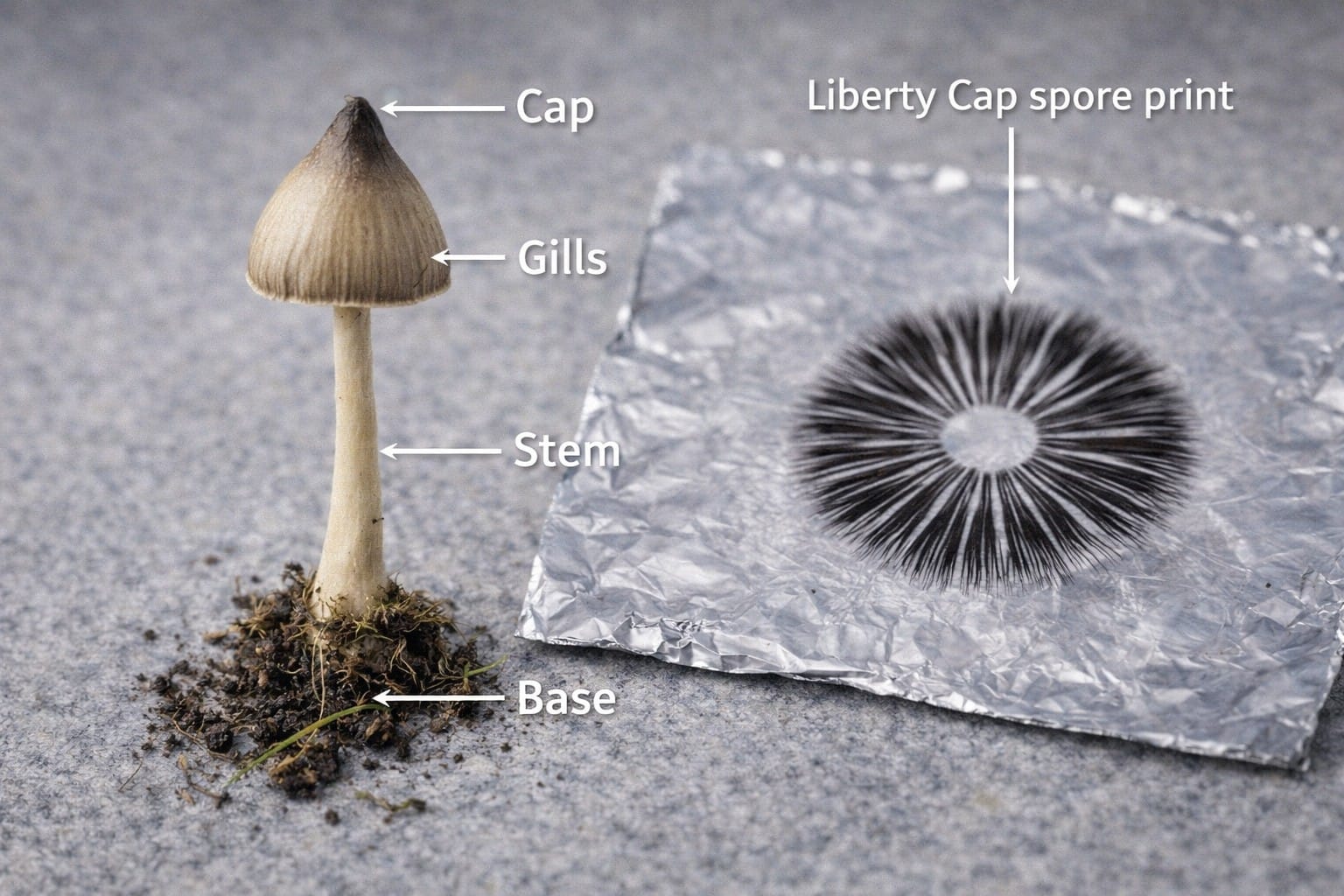
A liberty cap (Psilocybe semilanceata) is a small psilocybin-containing mushroom found in UK grassland. It has a conical to bell-shaped cap with a pointed, nipple-like tip, a slender stem, and a dark purple-brown spore print. It fruits in autumn and is a Class A controlled species in the UK. Below, learn how to separate it from its toxic lookalikes.
Start here: For the complete UK overview, read our guide to Identify Magic Mushrooms in the UK.
Many mushrooms that resemble Liberty caps are harmless, but some may cause illness if eaten. UK poisoning guidance warns that people sometimes become ill after misidentifying wild mushrooms. Never consume mushrooms unless they are identified by an expert.
What Are “Little Brown Mushrooms” (LBMs)?
The phrase little brown mushrooms is commonly used by mycologists to describe small mushrooms with similar colours and shapes. These mushrooms are often brown, tan, or beige and may grow in grassland, woodland, or gardens.
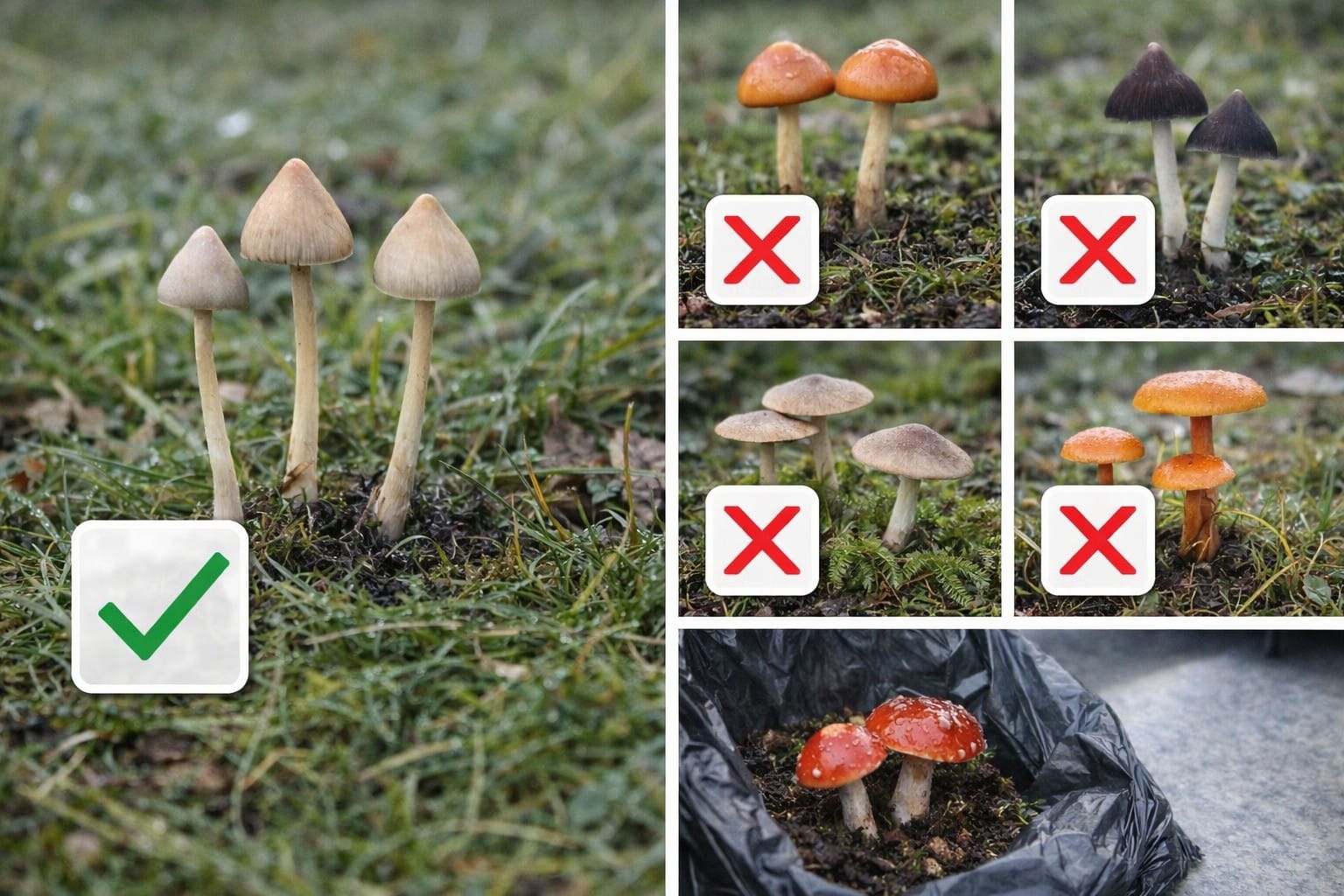
Because many species share these characteristics, LBMs are notoriously difficult to identify without careful observation or microscopic study.
Why Liberty Caps Are Often Confused With Other Mushrooms
Liberty caps are small grassland mushrooms that appear during the autumn mushroom season in parts of the UK. Their size and colour mean they are easily confused with other species that grow in similar environments.
- small conical caps
- brown to tan colour
- thin stems
- growth in grassland
However, these characteristics are shared by many other mushrooms, which is why misidentification is common.
Liberty Caps vs Lookalikes – Key Differences
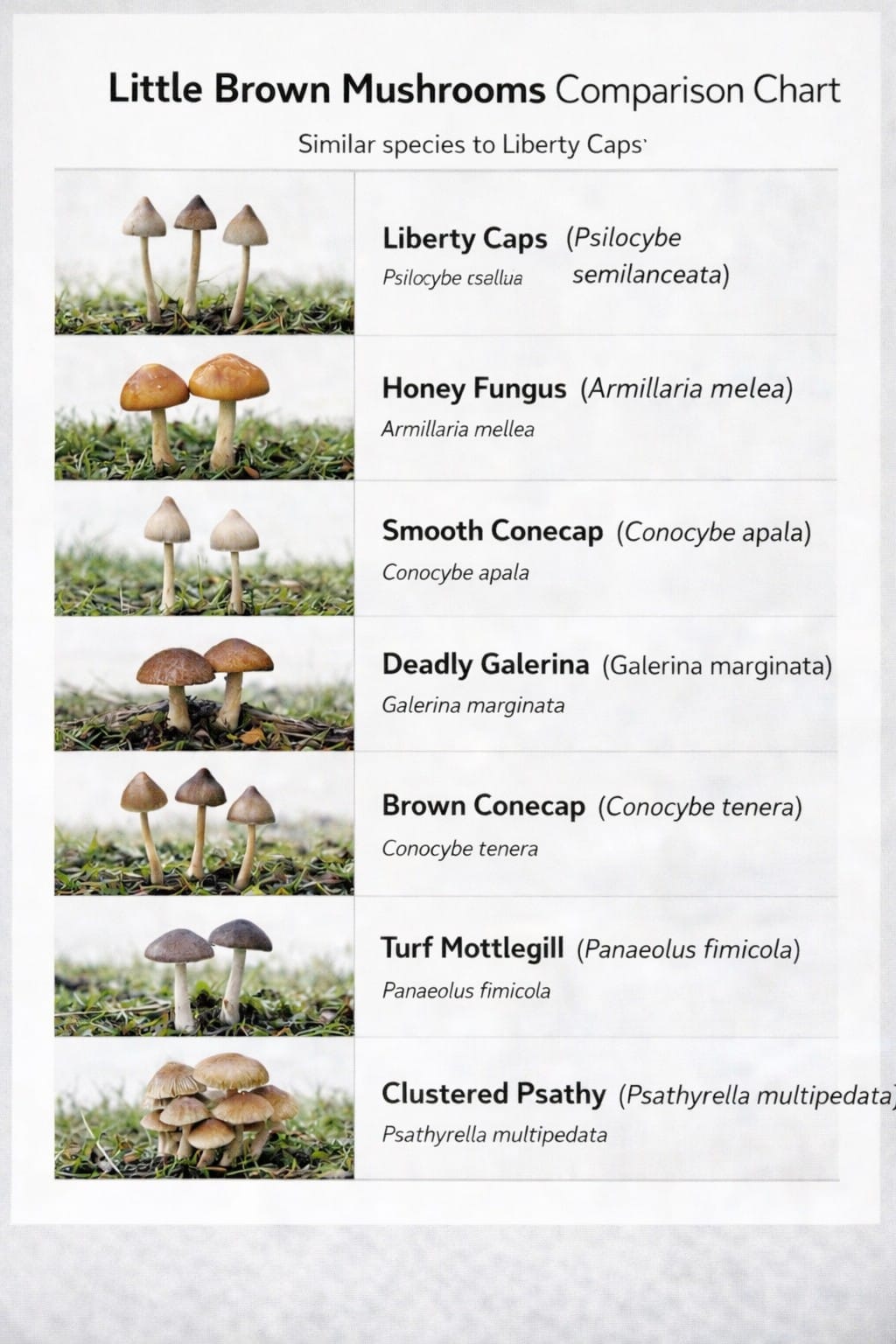
| Feature | Liberty Cap | Common Lookalikes (LBMs) |
|---|---|---|
| Cap Shape | Distinct pointed cap with nipple-like tip | Often rounded or bell-shaped |
| Cap Surface | Smooth and sometimes slightly sticky when wet | Often dry or textured |
| Stem | Thin, flexible stem | Often thicker or more brittle |
| Spore Colour | Purple-brown | Varies widely depending on species |
| Habitat | Typically grassland environments | Many habitats including lawns and woodland |
What Do Liberty Cap Gills Look Like?
Liberty cap gills are narrow, crowded and attached to the stem (adnexed to almost free). They start pale grey-brown and darken to a mottled purple-black as the purple-brown spores mature. Blackening gills plus a dark spore print help separate liberty caps from pale-gilled toxic lookalikes.
Common Liberty Cap Lookalikes
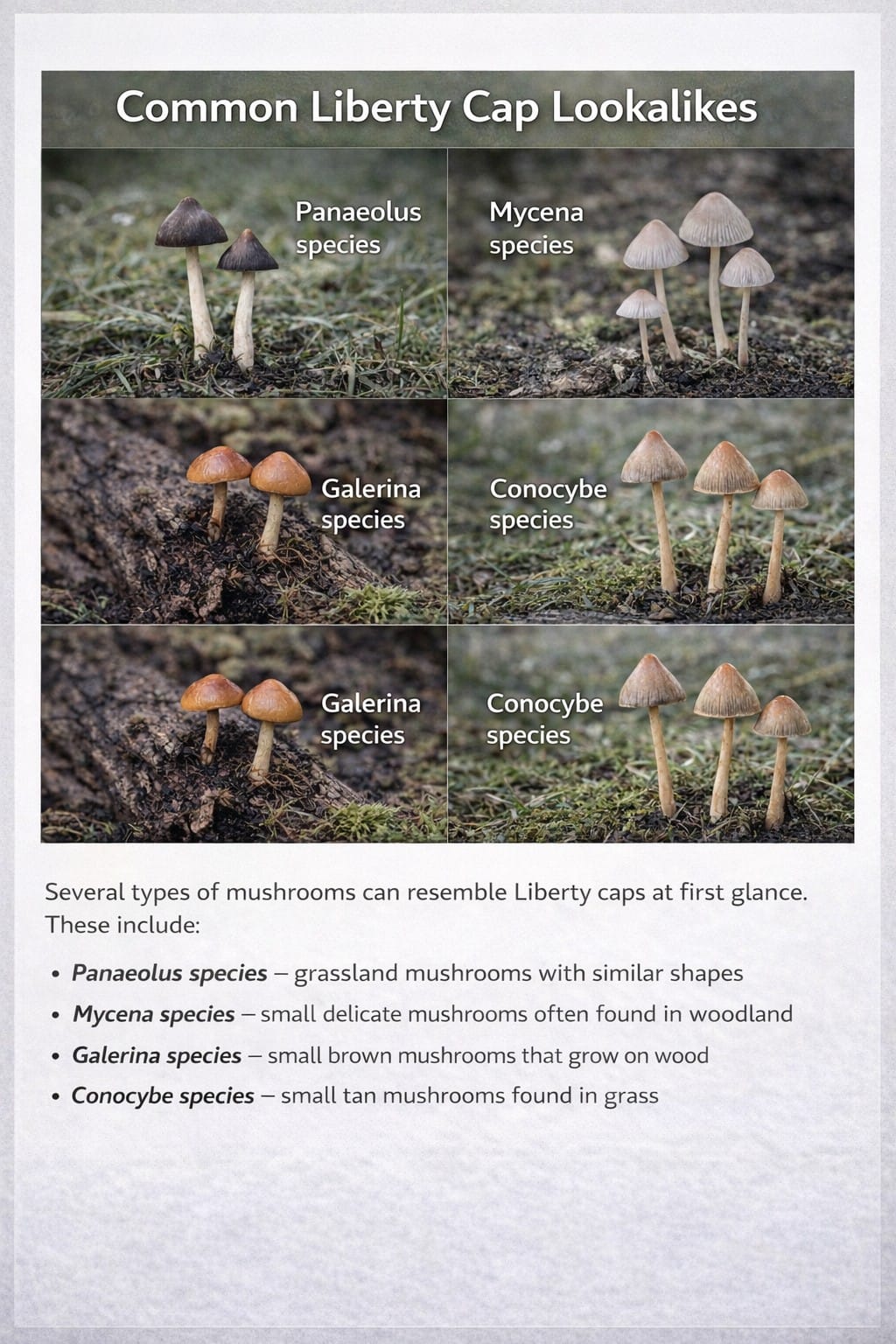
Several types of mushrooms can resemble Liberty caps at first glance. These include:
- Panaeolus species – grassland mushrooms with similar shapes
- Mycena species – small delicate mushrooms often found in woodland
- Galerina species – small brown mushrooms that grow on wood
- Conocybe species – small tan mushrooms found in grass
These mushrooms can look similar in photographs, which is why relying on images alone is not considered a reliable identification method.
Why Photograph Comparison Is Not Reliable
Many online guides attempt to identify mushrooms using photographs. However, mushrooms change appearance depending on:
- age
- moisture level
- lighting conditions
- weather
This means that two mushrooms may look similar in photographs even if they are different species.
Spore-Print Visual Identification: Liberty Cap vs Lookalikes
Spore colour is one of the most useful tools mycologists use to narrow down a little brown mushroom, because colour and shape can be deceptive but spore deposits are far more consistent between individual mushrooms of the same species.
A liberty cap spore print is purple-brown to blackish-purple, made by resting the cap gill-side down on foil or glass for several hours until spores fall and settle into a visible pattern.
| Mushroom | Typical Spore Print Colour |
|---|---|
| Liberty cap (Psilocybe semilanceata) | Purple-brown to blackish-purple |
| Panaeolus species | Black to blackish-brown |
| Galerina species | Rusty brown |
| Conocybe species | Rusty brown to cinnamon |
| Mycena species | White to pale cream |
Why This Matters: Galerina and Conocybe species produce a rusty-brown print that clearly separates them from liberty caps, but Panaeolus produces a dark print similar enough to liberty caps that spore colour alone cannot distinguish the two safely. Some Galerina species are seriously toxic, which is exactly why relying on a single feature, whether that's cap shape, colour, or spore print, is not considered safe practice.
A spore print is best used as one part of a broader identification process, alongside cap structure, stem features, habitat, and ideally microscopic examination of the spores themselves. Our beginner's guide to mycology microscopy covers how to examine spore shape and size once a print has been taken.
Poisoning Risk and Safety Advice
The biggest danger with wild mushrooms is misidentification. Public health advice warns that eating unidentified wild mushrooms can lead to serious illness.
If someone has eaten an unknown mushroom and becomes unwell, seek medical help immediately.
For general poisoning guidance see NHS advice on poisoning symptoms and treatment.
Can’t find liberty caps in the fields? Try our shop.
SporeBuddies.com was founded after one long, wet and unsuccessful search for liberty caps in the wild. If your own search ended empty-handed, visit our store to explore the lab-prepared spore syringes and prints we have created for microscopy and research.
Learn More About Mushroom Identification
If you are interested in learning more about fungi safely, these educational resources explain the science behind mushroom identification.
FAQ
How do you tell a liberty cap from a lookalike?
Check four features together: a pointed nipple-tipped conical cap, a thin flexible stem, gills that blacken with age, and a dark purple-brown spore print. No single feature is enough, and toxic little brown mushrooms can look similar, so never rely on photographs alone.
What time of year do liberty caps appear in the UK?
Liberty caps typically fruit in autumn, from around September to late November, in damp grassland and pasture after rain. This guide is for identification and safety education only; picking or possessing psilocybin mushrooms is illegal in the UK.
Are liberty caps poisonous?
Liberty caps are not classed as poisonous, but they contain psilocybin and are a Class A controlled drug in the UK. The bigger safety risk is misidentification, because several toxic 'little brown mushrooms' look similar and can cause serious poisoning.
What are little brown mushrooms?
Little brown mushrooms (LBMs) are small brown fungi that are difficult to identify because many species share similar shapes and colours.
Why are Liberty caps confused with other mushrooms?
Liberty caps are small and brown, which makes them visually similar to many other grassland mushrooms.
Are mushroom lookalikes dangerous?
Some mushrooms that resemble Liberty caps may cause illness if eaten. Misidentification is a common cause of mushroom poisoning.
Can photographs identify mushrooms accurately?
No. Lighting, age, and environmental conditions can change the appearance of mushrooms.
What colour is a liberty cap spore print?
A liberty cap spore print is purple-brown to blackish-purple. This is a useful reference point, but several lookalikes, particularly Panaeolus species, also produce a dark print, so spore colour alone cannot confirm identification.
Can a spore print alone confirm a liberty cap identification?
No. A spore print narrows down the possibilities but should be combined with cap structure, stem features, habitat, and ideally microscopic examination rather than used as a standalone test.
What should I do if I've found a mushroom I can't identify?
Do not eat it. Take a spore print and clear photographs from multiple angles, note the habitat, and consult an expert or a regional mycological society before drawing any conclusions.