
Reviewed by: SporeBuddies Research Team
Last Reviewed: June 2026
Wood Lover's Paralysis Explained: Symptoms, Theories, Risks & Research
Wood Lover's Paralysis, often abbreviated as WLP, is a poorly understood reported weakness syndrome associated with some wood-loving Psilocybe species. It is most often discussed in relation to species such as Psilocybe azurescens, Psilocybe cyanescens and Psilocybe subaeruginosa.
This guide explains what WLP is, what people report, which species are most often discussed, what scientists know, what remains unresolved, and why any severe neurological, respiratory or consciousness-related symptoms should be treated seriously.
Quick definition: Wood Lover's Paralysis is a reported transient weakness syndrome associated with some lignicolous, wood-loving Psilocybe mushrooms. Reports often involve muscle weakness, coordination problems or difficulty walking. The exact biological mechanism remains unresolved.
If any person experiences breathing difficulty, airway obstruction, chest pain, seizures, loss of consciousness, severe confusion, severe weakness or rapidly worsening symptoms after exposure to any wild mushroom, seek emergency medical help immediately. Do not assume severe symptoms are normal or harmless.
Quick Answer: What Is Wood Lover's Paralysis?
Wood Lover's Paralysis is a reported syndrome involving temporary weakness, poor coordination, difficulty walking or paralysis-like symptoms after exposure to some wood-loving Psilocybe mushrooms. It is most often discussed with lignicolous species such as Psilocybe azurescens, Psilocybe cyanescens and Psilocybe subaeruginosa.
The cause remains unknown. Researchers have discussed possible roles for unknown secondary metabolites, minor alkaloids, environmental factors, individual sensitivity, microbial interactions or a combination of factors. No single explanation has been conclusively proven.
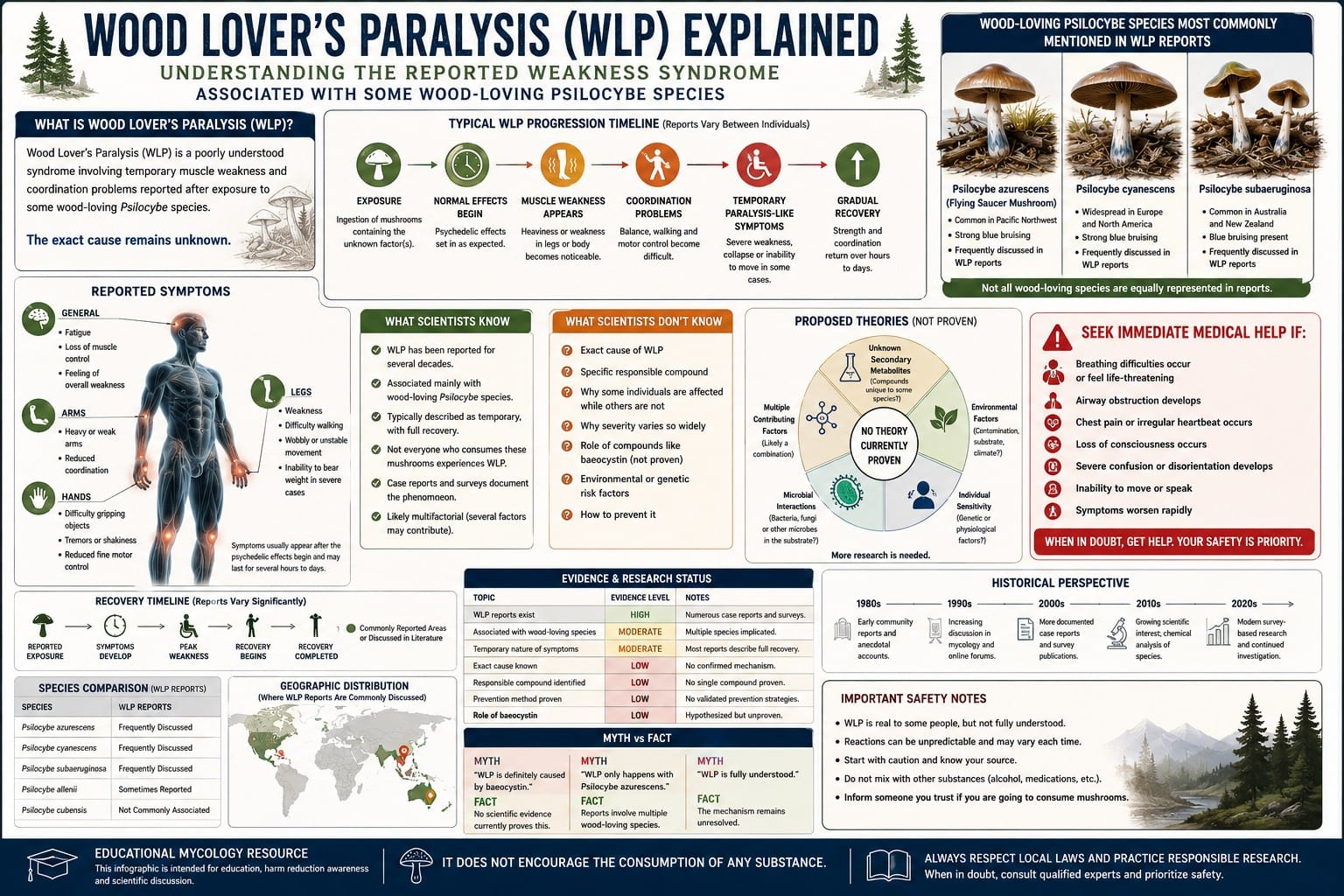
Wood Lover's Paralysis Explained Infographic
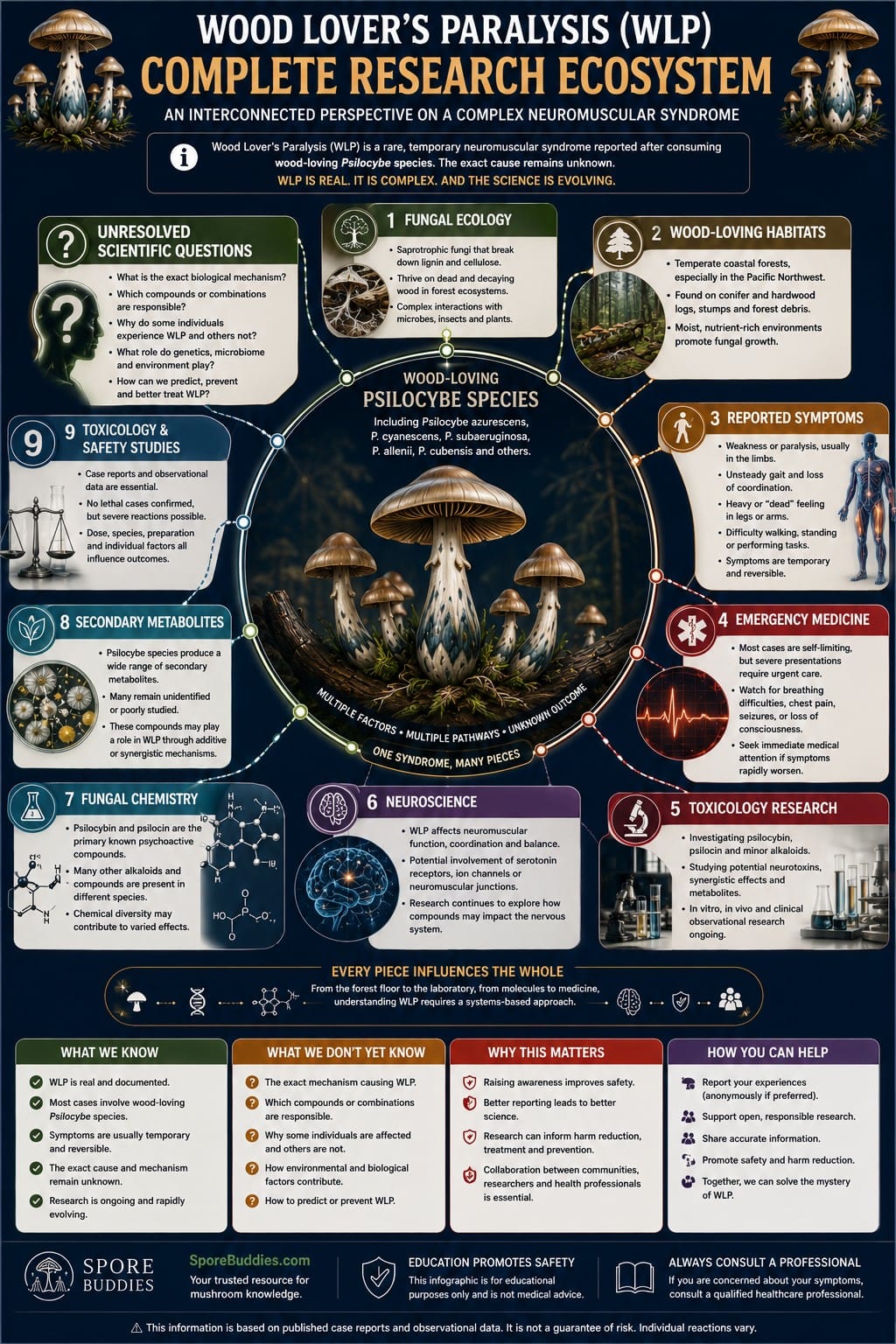
This infographic summarises the major ideas around WLP, including reported symptoms, species most often discussed, possible mechanisms, emergency warning signs and current scientific uncertainty.
What Is Wood Lover's Paralysis?
Wood Lover's Paralysis is best described as a reported weakness syndrome associated with some wood-loving Psilocybe species. The term is commonly used in mycology, harm-reduction and toxicology discussions to describe episodes where people report unusual muscle weakness or impaired movement after exposure to certain lignicolous mushrooms.
The name comes from the fact that the species most often discussed are wood-loving mushrooms. These fungi grow from wood chips, woody debris, mulch, coastal wood fragments or lignin-rich habitats rather than dung-associated habitats. This ecological pattern is one reason researchers are interested in whether species-specific chemistry, habitat factors or wood-associated variables could be involved.
WLP should not be treated as fully understood. It is not a simple, neatly explained phenomenon. The most responsible scientific position is that WLP is a reported toxidrome with a still-unresolved mechanism.
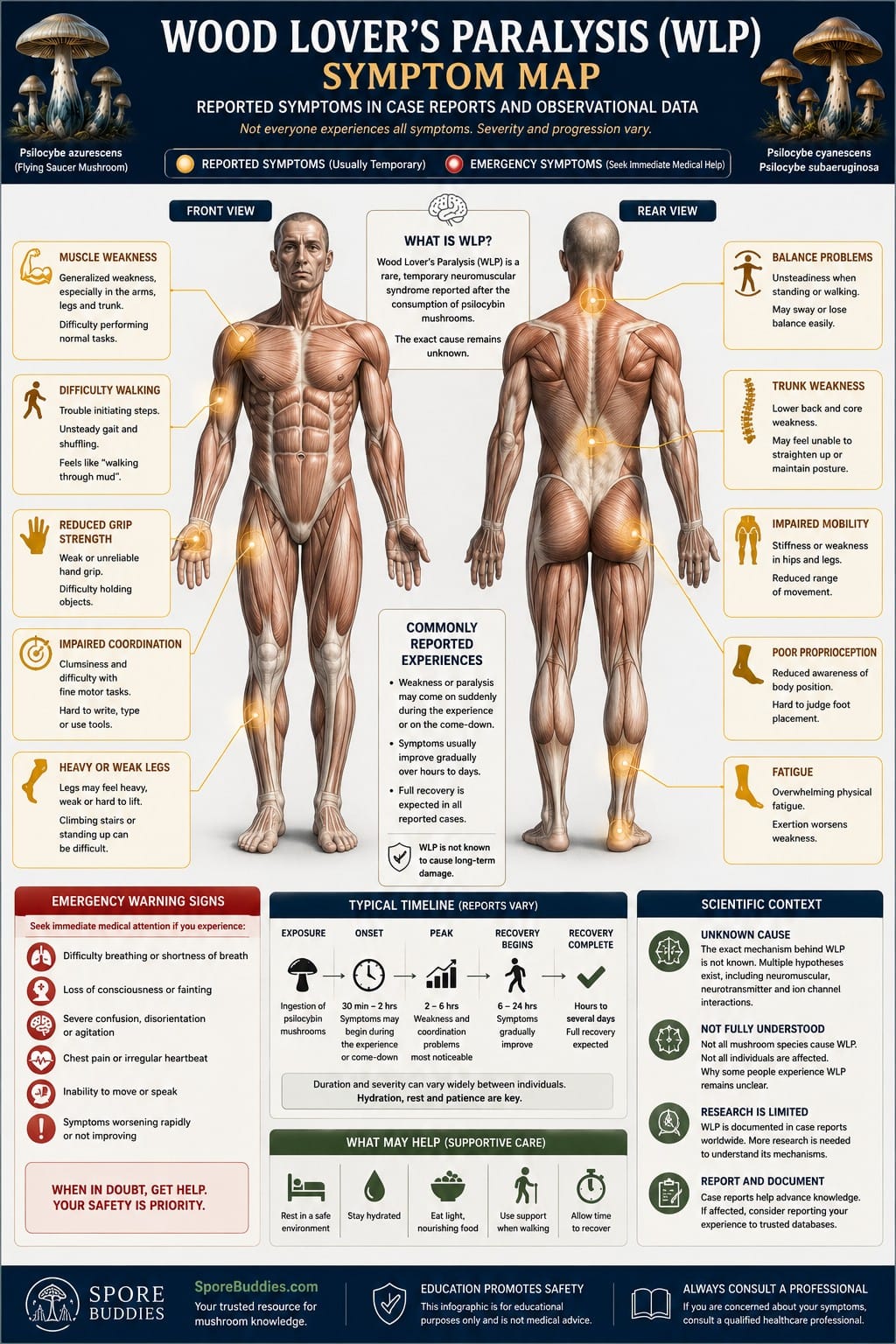
Reported Symptoms of Wood Lover's Paralysis
Reports vary between individuals, but WLP is generally discussed in relation to weakness, coordination difficulty and impaired movement. Some reports describe symptoms that feel different from ordinary anxiety or disorientation because the problem appears to involve physical movement and muscle control.
| Reported Symptom | Description | Important Caution |
|---|---|---|
| Muscle weakness | Heavy limbs, reduced strength or difficulty standing | Severity varies; worsening weakness should be taken seriously |
| Difficulty walking | Stumbling, poor balance or inability to walk normally | Fall risk may be significant |
| Coordination problems | Difficulty with ordinary movements or fine motor tasks | May be mistaken for intoxication or panic |
| Temporary paralysis-like symptoms | Reports of limbs feeling unresponsive or difficult to control | Any severe neurological symptom warrants caution |
| Fatigue or heaviness | Body feels unusually heavy or difficult to move | Should be monitored if symptoms intensify |
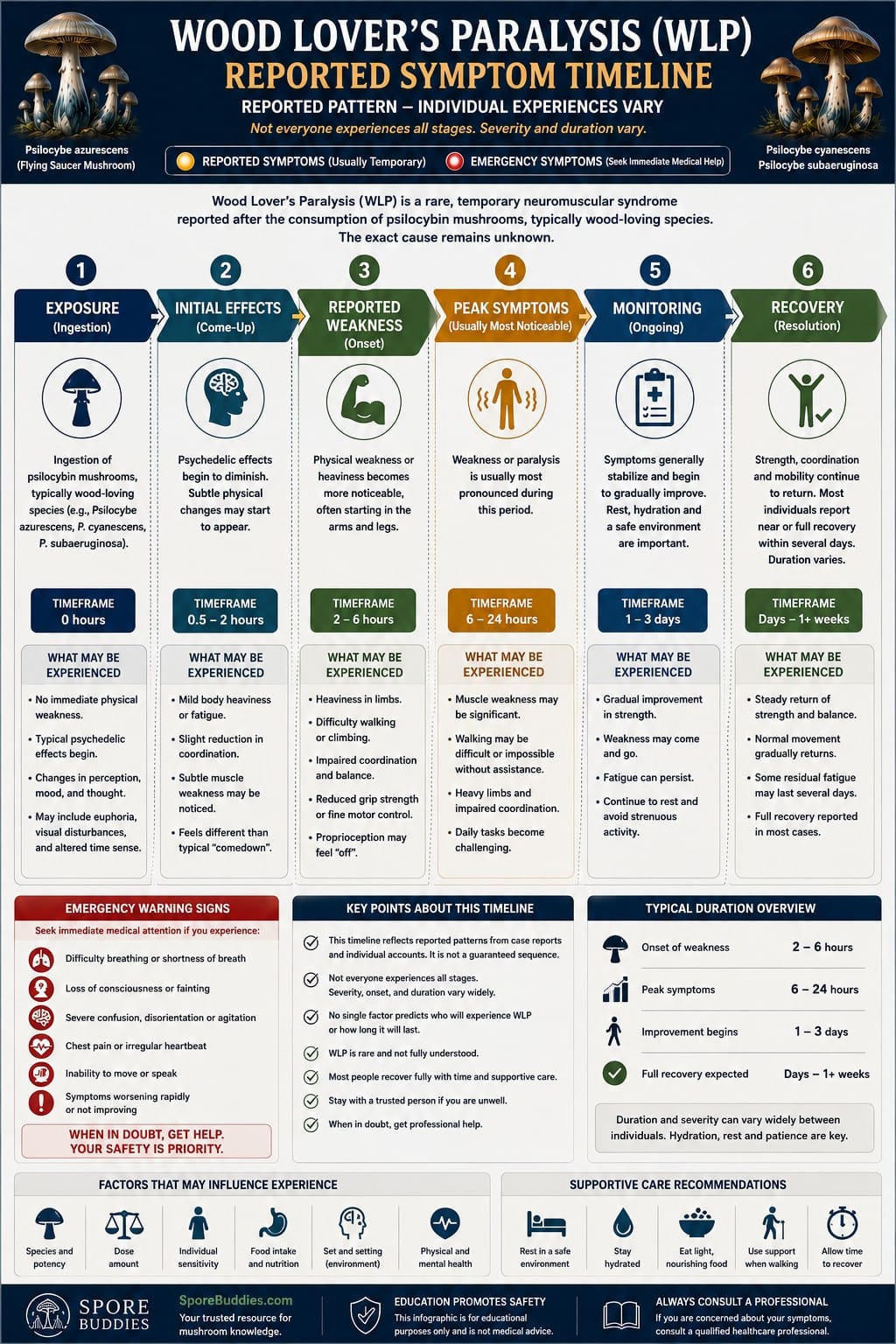
Reported Timeline: How WLP May Develop
There is no single fixed WLP timeline. Reports vary considerably. Some describe weakness after other effects have already begun, while others describe symptoms appearing later. Because the pattern is inconsistent, any timeline should be presented as a reported pattern rather than a universal sequence.
Typical Reported Pattern
- Exposure
Person has encountered or consumed a wood-loving species. - Initial effects
Other effects may begin first. - Weakness develops
Muscle heaviness or coordination difficulty may appear. - Peak symptoms
Walking or movement may become difficult. - Monitoring period
Support and safety become important. - Recovery
Reports often describe symptoms as temporary, but medical help is needed for severe signs.
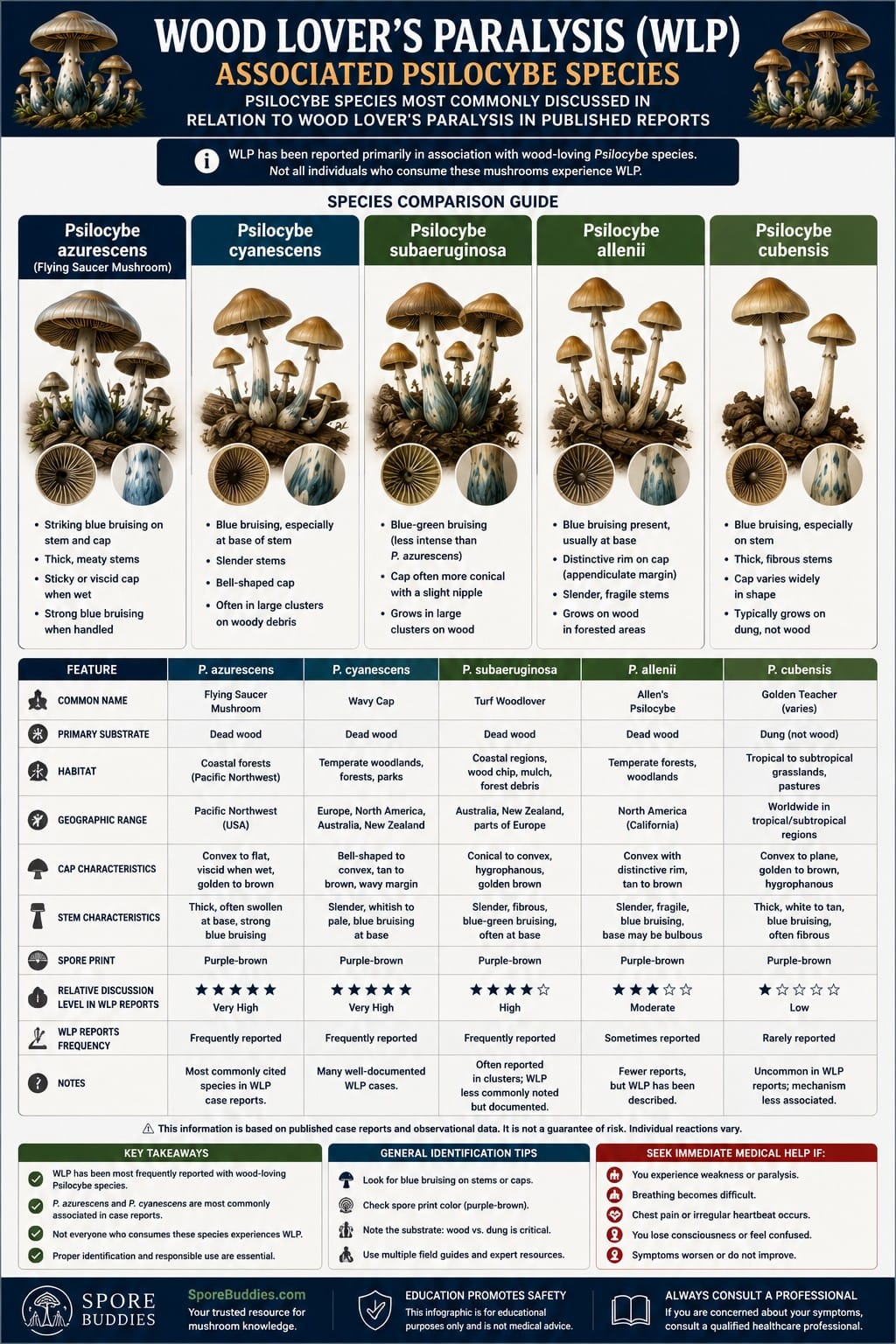
Species Most Often Discussed in WLP Reports
Wood Lover's Paralysis is most strongly associated with wood-loving Psilocybe species. This does not mean every wood-loving species causes WLP, and it does not mean every exposure leads to weakness. It means that reports and discussions have repeatedly involved certain lignicolous species.
| Species | Common Name / Context | WLP Discussion Level |
|---|---|---|
| Psilocybe azurescens | Flying Saucer Mushroom; Astoria-associated coastal wood-loving species | Frequently discussed |
| Psilocybe cyanescens | Wavy Cap Mushroom; wood-chip and mulch-associated species | Frequently discussed |
| Psilocybe subaeruginosa | Wood-loving Southern Hemisphere species | Commonly discussed in WLP context |
| Psilocybe allenii | Wood-loving species compared with Cyanescens and Azurescens | Less commonly discussed |
| Psilocybe cubensis | Dung-associated species with many named strains | Not typically a main WLP species |
Psilocybe Azurescens and Wood Lover's Paralysis
Psilocybe azurescens is one of the species most frequently named in WLP discussions. This matters because Azurescens is already notable for several reasons: it is wood-loving, associated with coastal habitats, linked with Astoria, Oregon, and widely discussed for its reported alkaloid profile.
The key point is not that Azurescens has a proven unique WLP mechanism. The responsible point is that Azurescens sits at the intersection of wood-loving ecology, unusual chemistry, high scientific interest and WLP reports. That makes it important for safety-focused education.
For the full species overview, see the SporeBuddies guide to Psilocybe azurescens.
Psilocybe Cyanescens and Wood Lover's Paralysis
Psilocybe cyanescens, the Wavy Cap Mushroom, is another species frequently discussed in WLP reports. Cyanescens is often associated with wood-chip beds, mulch-rich habitats and introduced temperate environments. Its wood-loving ecology places it within the same broad risk conversation as Azurescens.
Because Cyanescens and Azurescens are frequently compared, WLP is an important part of any responsible comparison between the two species.
For a side-by-side species guide, see Psilocybe Azurescens vs Cyanescens.
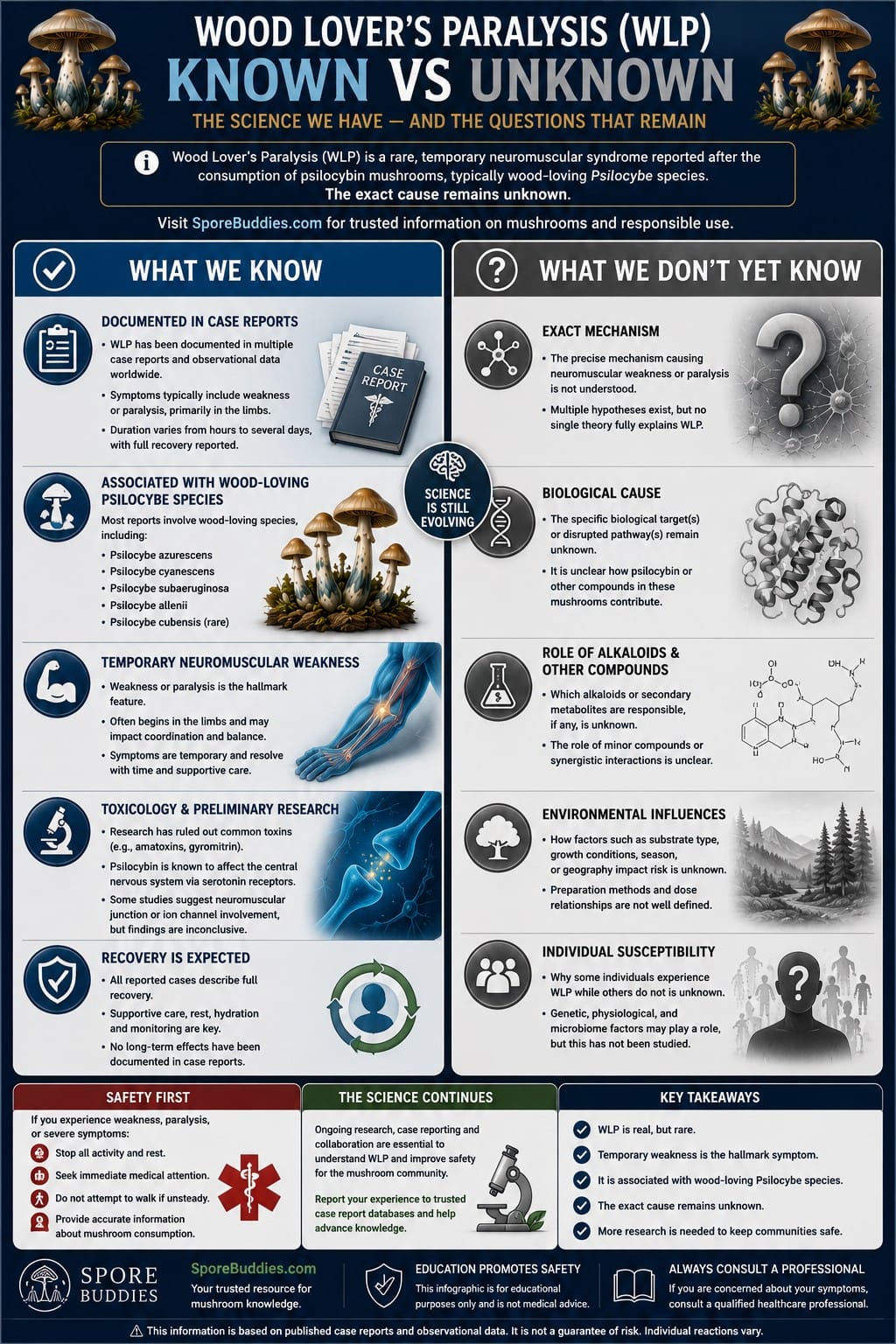
Known Facts vs Unanswered Questions
One of the most important things about WLP is that some things are reasonably clear, while many others remain unresolved. A good educational article should be honest about both.
What We Know
- WLP has been reported in association with wood-loving Psilocybe species.
- Reports often involve weakness, coordination problems or difficulty walking.
- Symptoms are often described as temporary.
- Azurescens, Cyanescens and Subaeruginosa are frequently discussed.
- The topic has attracted toxicology and harm-reduction interest.
What We Don't Know
- The exact biological cause remains unknown.
- Why some individuals are affected and others are not is unresolved.
- The role of alkaloids is not proven.
- The role of environmental factors is not clear.
- Whether WLP has one cause or multiple causes is unknown.
Theories Under Investigation
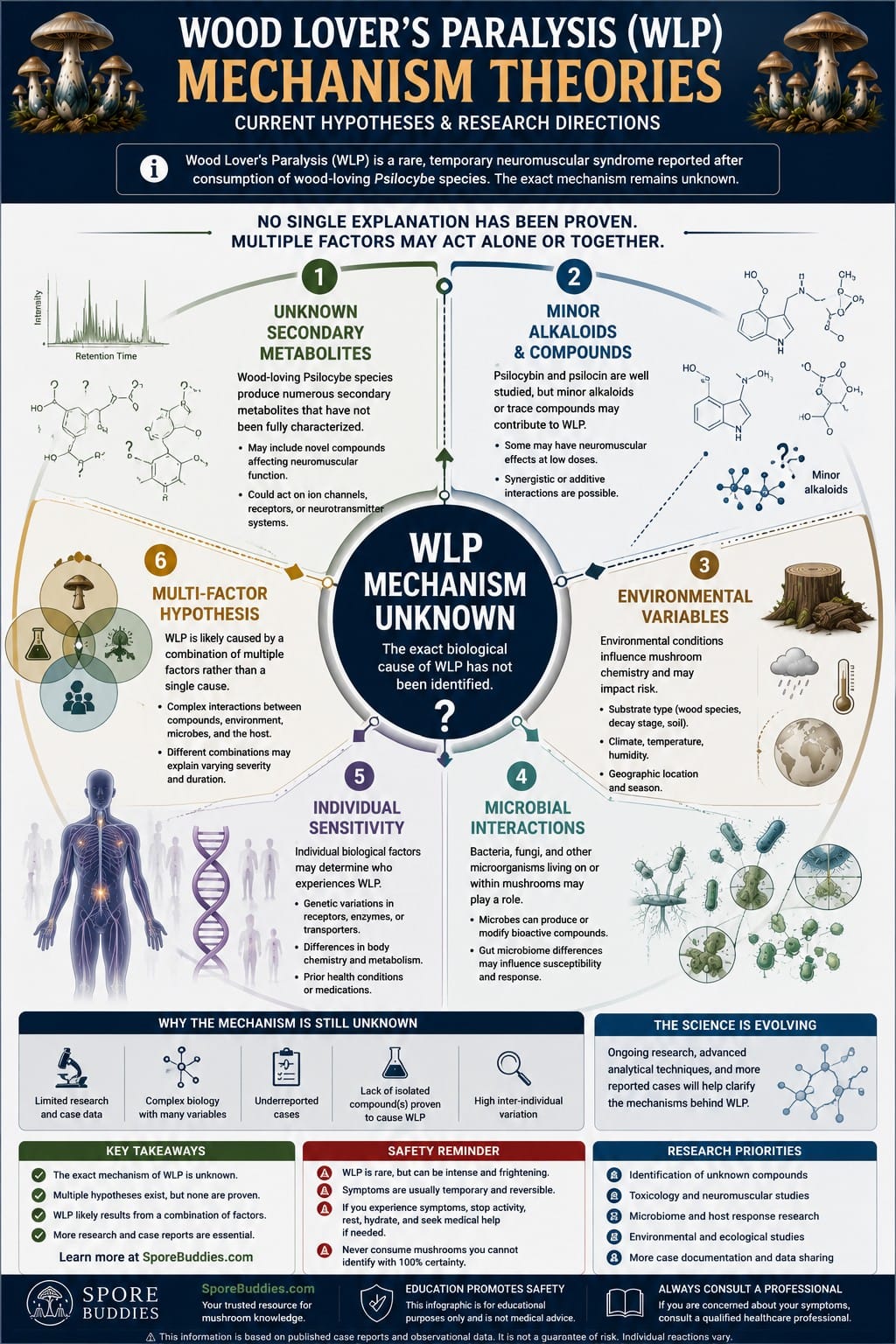
Several theories have been proposed to explain WLP, but none should be presented as proven. The best approach is to treat these as hypotheses or areas for future research.
| Theory | Explanation | Current Status |
|---|---|---|
| Unknown secondary metabolites | Wood-loving species may contain compounds that are not fully understood. | Plausible but unproven |
| Minor alkaloids | Compounds such as baeocystin are sometimes discussed, but causation is not proven. | Unresolved |
| Environmental variables | Wood substrates, microbes, habitat or contamination may influence chemistry. | Unresolved |
| Individual sensitivity | Some people may be more susceptible to weakness symptoms. | Likely relevant but incomplete |
| Multiple-factor hypothesis | WLP may involve several contributing factors rather than a single cause. | Cautious and plausible framing |
Could Alkaloids Be Involved?
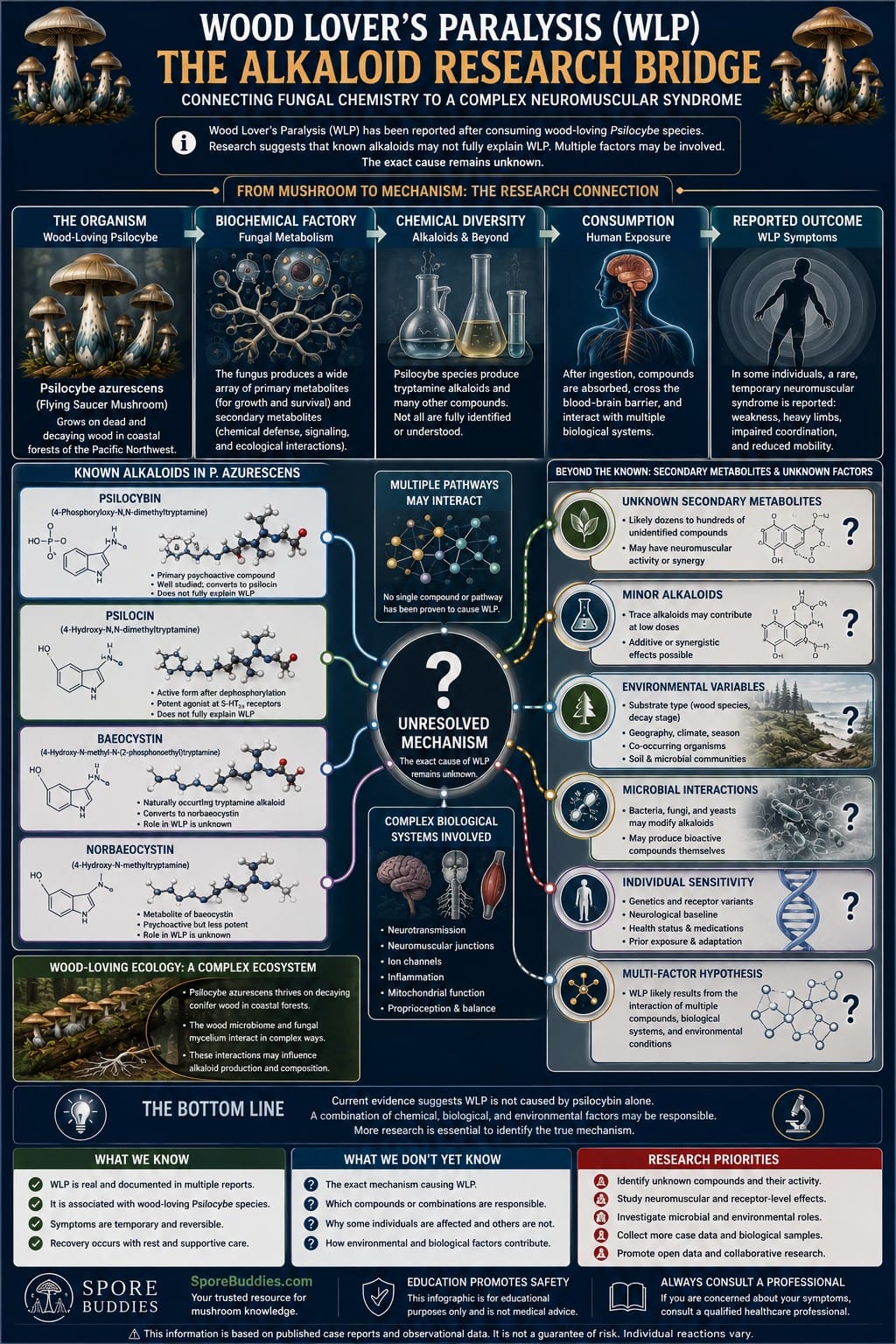
Because WLP is associated with wood-loving Psilocybe species, many readers naturally wonder whether alkaloids could be involved. This is a reasonable scientific question, but the answer is not settled.
Psilocybe azurescens contains several alkaloids including psilocybin, psilocin, baeocystin and norbaeocystin. Baeocystin is sometimes mentioned in community speculation because Azurescens is known for notable reported baeocystin interest. However, there is no definitive evidence proving that baeocystin causes WLP.
It is fair to say that alkaloids and secondary metabolites are relevant to WLP research questions. It is not responsible to claim that any single compound has been proven to cause Wood Lover's Paralysis.
For a deeper chemistry-focused companion article, see Explore the Azurescens Alkaloid Profile
Emergency Warning Signs
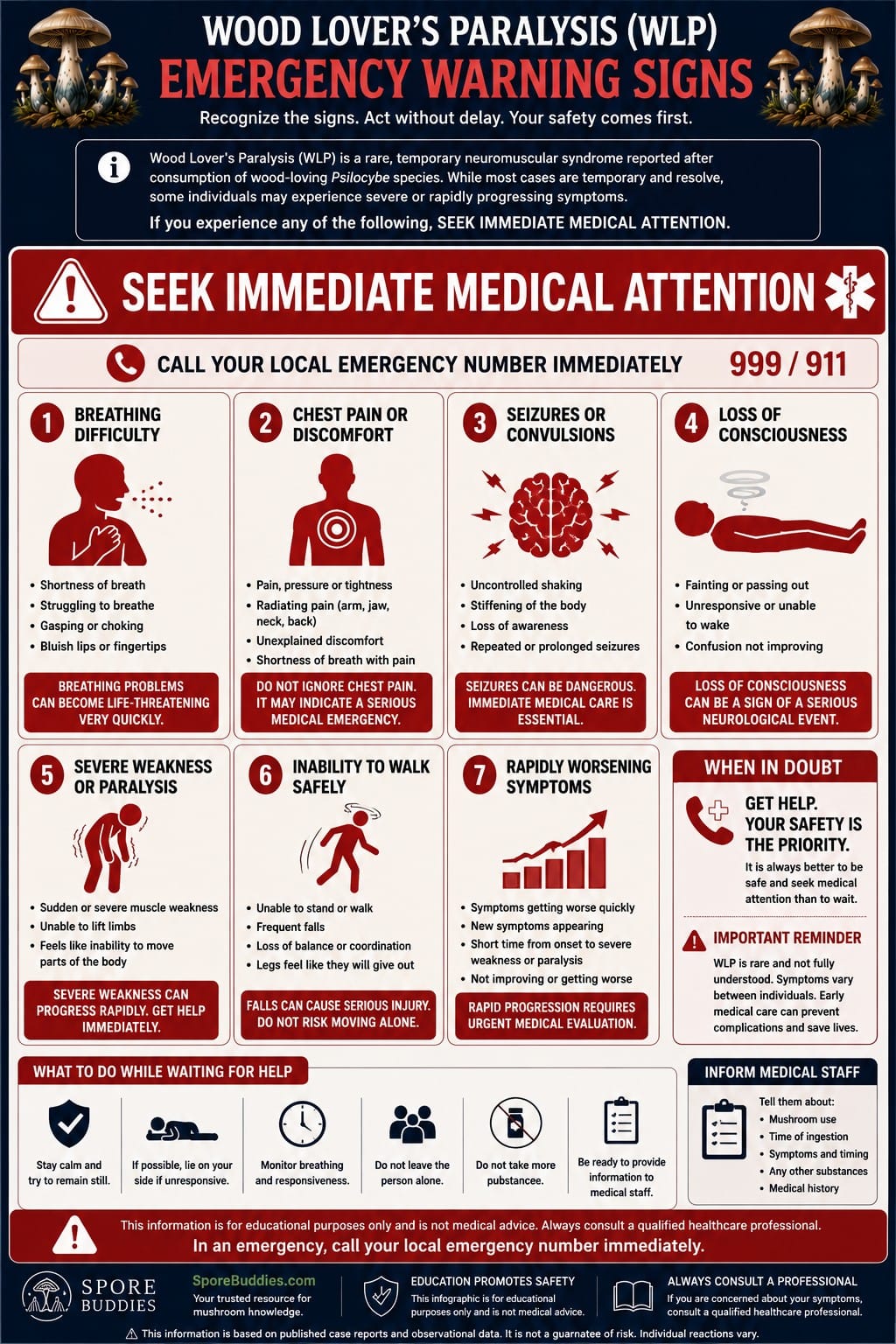
WLP is often described as temporary, but severe symptoms should never be dismissed. Respiratory problems, loss of consciousness, chest pain, severe confusion or rapidly worsening weakness require urgent medical attention.
- Difficulty breathing
- Airway obstruction or choking risk
- Chest pain
- Seizures
- Loss of consciousness
- Severe confusion
- Severe or worsening weakness
- Inability to walk safely
- Rapidly deteriorating symptoms
Why a Sober Observer Is Often Discussed
In harm-reduction discussions around wood-loving species, a sober observer is often mentioned because weakness or impaired movement can create practical safety risks. Someone who is sober can help prevent falls, monitor symptoms, seek medical help if necessary and recognise when symptoms go beyond ordinary confusion or anxiety.
This point is not intended to encourage use. It is included because WLP discussions often involve real-world safety concerns such as mobility, breathing, consciousness and the ability to call for help.
WLP vs Ordinary Psychedelic Effects
One reason WLP matters is that it may be confused with ordinary psychological effects, anxiety or disorientation. However, WLP reports often focus on physical weakness and impaired movement, which makes the phenomenon distinct enough to require serious attention.
| Topic | Ordinary Psychological Effects | WLP-Type Reports |
|---|---|---|
| Main issue | Perception, emotion, cognition, anxiety or confusion | Weakness, coordination difficulty, movement impairment |
| Physical mobility | May be affected indirectly | Often central to the report |
| Safety concern | Panic, confusion, unsafe environment | Falls, inability to move, worsening weakness, emergency signs |
| Response | Calm environment and support may help | Monitor closely; seek medical help for severe symptoms |
Common Myths About Wood Lover's Paralysis
Myth: WLP is just anxiety
Reality: Some reports describe objective weakness, walking difficulty and impaired movement that may differ from ordinary anxiety.
Myth: Scientists know the exact cause
Reality: The mechanism remains unresolved. Several hypotheses exist, but none has been conclusively proven.
Myth: Only Azurescens is involved
Reality: Several wood-loving species are discussed, including Azurescens, Cyanescens and Subaeruginosa.
Myth: Baeocystin definitely causes WLP
Reality: Baeocystin is sometimes discussed, but no definitive evidence proves it is the cause.
Myth: WLP is always harmless
Reality: Many reports describe temporary symptoms, but severe or worsening symptoms need medical attention.
Myth: Habitat alone explains it
Reality: Habitat may be relevant, but chemistry, species, environment and individual sensitivity may all matter.
Why Scientists Are Interested in WLP
Wood Lover's Paralysis is scientifically interesting because it may point toward something still poorly understood about wood-loving fungi. Unexplained biological phenomena often drive research because they reveal gaps in current knowledge.
WLP may help researchers ask better questions about fungal chemistry, ecological adaptation, secondary metabolites, species-level differences, environmental variation and individual human sensitivity. It also reminds readers that mushrooms are biologically complex organisms rather than simple lists of one or two known compounds.
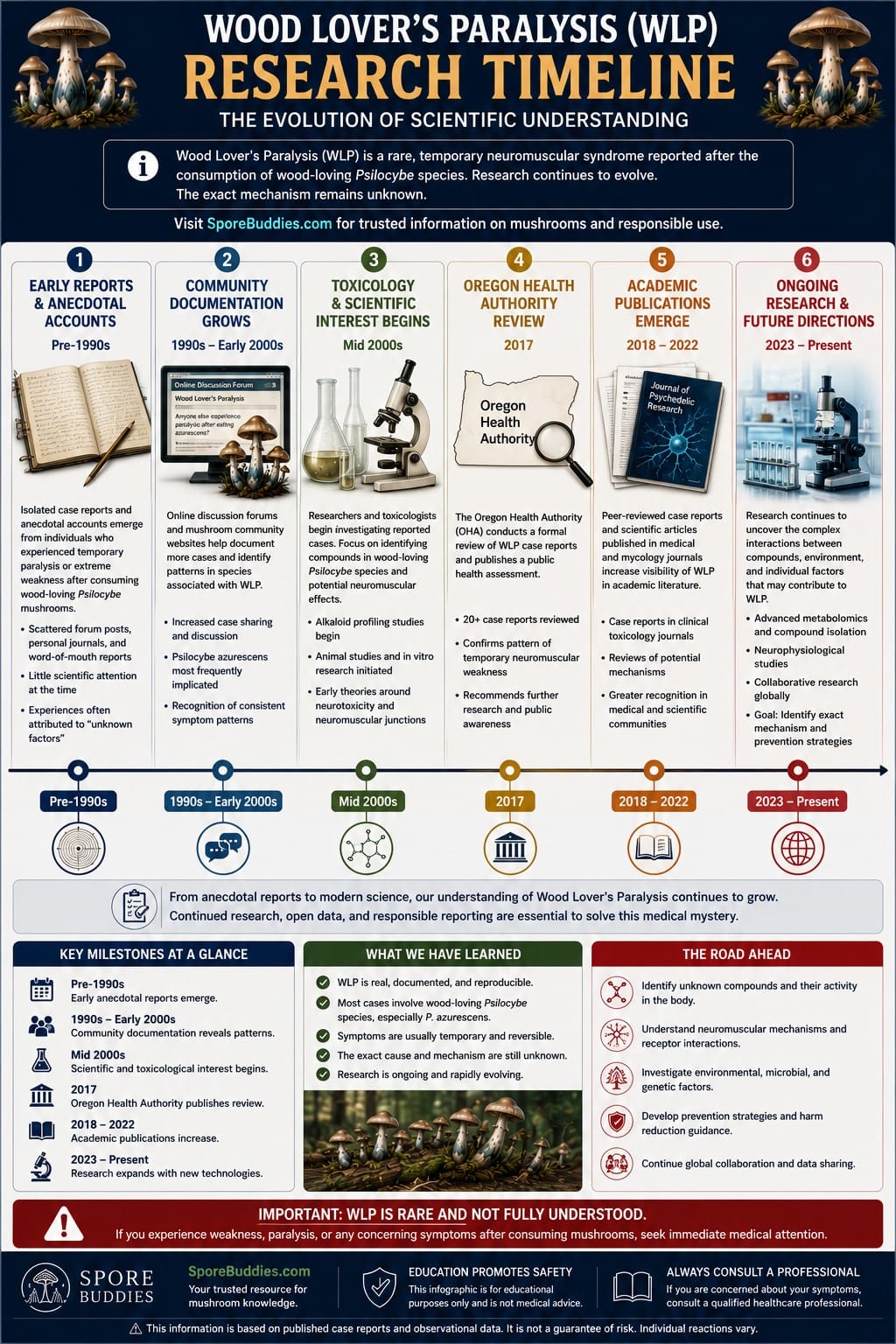
Could WLP Help Discover New Fungal Chemistry?
Possibly. One of the most exciting scientific possibilities is that WLP could help researchers discover overlooked chemistry in wood-loving fungi. That does not mean the cause is known, and it does not mean any one compound should be blamed. It means that unexplained reports can encourage deeper study.
Wood-loving Psilocybe species may differ from dung-associated species in ecology, metabolism, substrate interaction and minor compound profiles. Future research may reveal whether WLP relates to known alkaloids, unknown metabolites, environmental influences or a complex interaction of factors.
Final Summary: What Readers Should Remember
Wood Lover's Paralysis is a reported transient weakness syndrome associated with some wood-loving Psilocybe species. It is most often discussed in relation to Azurescens, Cyanescens and Subaeruginosa. Reports commonly involve weakness, poor coordination, difficulty walking or paralysis-like symptoms.
The exact cause remains unknown. Responsible educational content should avoid claiming that WLP is fully understood, avoid blaming one compound without evidence, and clearly state when medical attention is needed. For SporeBuddies, the strongest approach is science-led, safety-conscious and honest about uncertainty.
Wood Lover's Paralysis FAQs
What is Wood Lover's Paralysis?
Wood Lover's Paralysis is a reported weakness syndrome associated with some wood-loving Psilocybe mushrooms. It may involve muscle weakness, coordination problems and difficulty walking.
What species are associated with WLP?
The species most often discussed include Psilocybe azurescens, Psilocybe cyanescens and Psilocybe subaeruginosa.
What causes Wood Lover's Paralysis?
The exact cause remains unknown. Theories include unknown secondary metabolites, minor alkaloids, environmental factors, individual sensitivity and multiple-factor explanations.
Is baeocystin the cause of WLP?
No definitive evidence proves that baeocystin causes WLP. It is sometimes discussed, but the mechanism remains unresolved.
Is Wood Lover's Paralysis dangerous?
Reports often describe symptoms as temporary, but severe symptoms such as breathing difficulty, chest pain, seizures, loss of consciousness or worsening weakness require emergency medical help.
Is WLP the same as anxiety?
No. Anxiety can occur in many contexts, but WLP reports often focus on physical weakness, impaired movement and coordination problems.
Why is it called Wood Lover's Paralysis?
The name refers to its association with wood-loving, lignicolous Psilocybe species.
Can Psilocybe cubensis cause WLP?
Psilocybe cubensis is not typically the main species discussed in WLP reports. WLP is more strongly associated with wood-loving species.
Can WLP be prevented?
There is no proven prevention method because the cause is unknown. The safest approach is legal compliance, avoidance of unknown wild mushrooms and seeking medical help for severe symptoms.
Is this page medical advice?
No. This page is educational and should not be interpreted as medical advice, legal advice, dosage guidance or encouragement to consume any substance.
Article Version: 1.0
First Published: June 2026
Last Reviewed: June 2026
This guide is reviewed periodically by the SporeBuddies Research Team to maintain accuracy and reflect current scientific understanding. Content is intended for educational, safety-awareness, toxicology and mycological reference purposes only.
References & Further Reading
The information in this WLP guide is informed by published toxicology, mycology, taxonomy and public health resources relating to Wood Lover's Paralysis and wood-loving Psilocybe species.
Wood Lover's Paralysis Research
Beck, S.A., Barlow, C., Engel, L. & Barratt, M.J. (2025).
"Wood-lover paralysis": describing a toxidrome with symptoms of weakness caused by some lignicolous "wood-loving" Psilocybe mushrooms.
View Reference
Oregon Health Authority WLP Review
Present, S. (2024).
Wood Lover's Paralysis Review.
View Reference
Taxonomy & Species Description
Stamets, P. & Gartz, J. (1995).
A New Caerulescent Psilocybe from the Pacific Coast of Northwestern America.
View Reference
NCBI Taxonomy Database
National Center for Biotechnology Information (NCBI).
Psilocybe azurescens Taxonomy Browser.
View Reference
Fungal Taxonomy & Ecology Review
Bradshaw, M. et al. (2022).
An Overview on the Taxonomy, Phylogenetics and Ecology of the Psychedelic Fungi.
View Reference
Psilocybin Biosynthesis
Fricke, J., Blei, F. & Hoffmeister, D. (2017).
Enzymatic Synthesis of Psilocybin.
View Reference
Explore More Psilocybe Azurescens Resources
This guide is part of the SporeBuddies Psilocybe azurescens knowledge hub. Continue your research with our related educational guides: