
Reviewed by: SporeBuddies Research Team
Last Reviewed: June 2026
Flying Saucer Mushroom Identification: Complete Psilocybe Azurescens ID Guide
The Flying Saucer Mushroom is the common name for Psilocybe azurescens, a wood-loving species strongly associated with coastal habitats of the Pacific Northwest and the Astoria, Oregon region. It is widely discussed because of its distinctive broad cap shape, dark purple-brown spore print, strong blue bruising reaction, wood-rich habitat and high scientific interest among microscopy and taxonomy researchers.
This guide explains the key identification features of Psilocybe azurescens, including cap shape, gills, stem, blue bruising, spore print colour, microscopy characteristics, habitat clues and lookalike risks. It is written as an educational identification-awareness resource, not as a foraging or consumption guide.
Quick definition: The Flying Saucer Mushroom is Psilocybe azurescens, a wood-loving Psilocybe species known for its broad, often umbonate cap, coastal wood-debris habitat, dark purple-brown spores and strong blue bruising reaction.
This article is not a foraging guide and should not be used to decide whether a wild mushroom is safe. Wild mushroom identification requires multiple features, microscopy where appropriate and expert verification. Many small brown mushrooms can appear superficially similar, and some wood-associated species are toxic or potentially deadly.
Quick Answer: How Is the Flying Saucer Mushroom Identified?
The Flying Saucer Mushroom, Psilocybe azurescens, is identified by a combination of features rather than one single trait. Important clues include a broad caramel to chestnut-brown cap that may develop a saucer-like shape, dark purple-brown spore print, pale stem that may bruise blue, gills that darken as spores mature, and a strong association with wood-rich coastal habitats.
However, none of these traits is enough on its own. Blue bruising does not prove identity. A brown cap does not prove identity. Habitat does not prove identity. Responsible identification depends on a full set of macroscopic, microscopic and ecological observations.
Psilocybe Azurescens Identification Infographic
This infographic summarises the most important identification features of Psilocybe azurescens, including cap structure, gills, stem, blue bruising, spore print, microscopy and coastal wood-loving habitat.
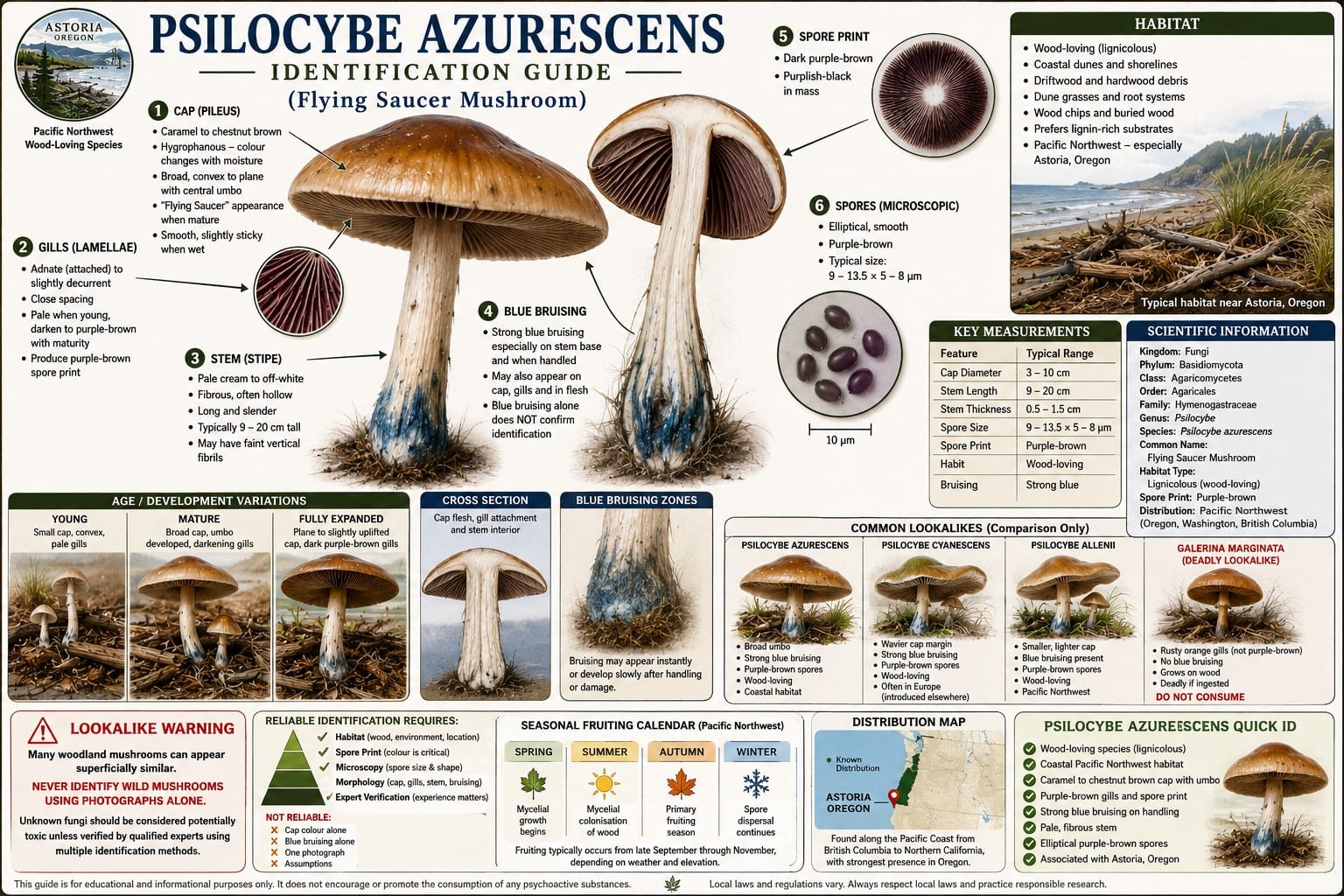
Flying Saucer Mushroom Quick ID Summary
- Species:
Psilocybe azurescens - Common Name:
Flying Saucer Mushroom - Cap:
Caramel to chestnut-brown; broad and often umbonate - Stem:
Pale to whitish; may bruise blue - Spore Print:
Dark purple-brown to purplish black - Habitat:
Wood-rich coastal environments and woody debris - Ecology:
Lignicolous, wood-loving decomposer - Identification Rule:
Never rely on one feature alone
Cap Identification: Why It Is Called the Flying Saucer Mushroom
The cap is one of the most recognisable features of Psilocybe azurescens. Mature specimens are often described as having a broad, saucer-like appearance, which is where the common name Flying Saucer Mushroom comes from. The cap may begin more conic or convex when young and become broader with age.
Colour is commonly described in caramel, ochre-brown, chestnut-brown or golden-brown tones. Like many Psilocybe species, the cap may be hygrophanous, meaning its colour can change as it gains or loses moisture. This makes colour useful but not definitive.
| Cap Feature | Typical Description | Identification Caution |
|---|---|---|
| Shape | Conic to convex when young, often broader and saucer-like with age | Shape changes during development and should not be used alone |
| Umbo | A central raised area may be visible in many specimens | Not all specimens show the same form |
| Colour | Caramel, chestnut-brown, ochre-brown or golden-brown tones | Moisture and age can alter colour |
| Surface | Smooth and sometimes sticky or viscous when moist | Surface texture varies with weather and condition |
Add a close-up image showing young, mature and fully expanded Flying Saucer Mushroom cap stages.
Suggested filename:
flying-saucer-mushroom-cap-identification.jpgSuggested alt text:
Flying Saucer Mushroom cap identification showing young mature and expanded Psilocybe azurescens cap shapesGill Identification
The gills of Psilocybe azurescens are located beneath the cap and are important for spore production. As the mushroom matures, the gills darken as spores develop. Gill structure, colour and attachment can provide useful information, but they should be interpreted alongside the cap, stem, spore print and habitat.
Gills are especially important because they are where the basidia produce spores. In microscopy and taxonomy contexts, gill tissue and spore-bearing structures can provide additional evidence for species-level study.
Stem Identification
The stem, or stipe, of Psilocybe azurescens is usually described as pale, whitish or cream-coloured and may become fragile or hollow with age. A blue bruising reaction may appear on the stem after handling or damage, although bruising intensity can vary.
Stem features are useful, but they are not enough to confirm identity. Many mushrooms have pale stems, and bruising reactions can be misunderstood. The stem should be assessed as part of a complete profile that includes cap shape, gills, spore print, microscopy and habitat.
Add a close-up image showing the pale stem and blue bruising response in educational context.
Suggested filename:
psilocybe-azurescens-stem-blue-bruising-identification.jpgSuggested alt text:
Psilocybe azurescens stem identification showing pale stem and blue bruising reactionBlue Bruising: Useful Clue, Not Proof
Blue bruising is one of the most discussed features of Psilocybe azurescens. Damaged tissue may show a blue or blue-green reaction, especially around the stem, cap margin or injured areas. This reaction is commonly associated with many psilocybin-containing mushrooms and is one reason the species is widely recognised in mycology discussions.
Blue bruising alone does not prove a mushroom is Psilocybe azurescens. It should be treated as one supporting feature only. Safe and accurate identification requires multiple observations and expert verification where appropriate.
Spore Print Colour
The spore print of Psilocybe azurescens is typically described as dark purple-brown to purplish black. This is one of the most important identification and microscopy features because spore colour helps separate many mushroom groups.
However, spore print colour is still not a complete identification method by itself. Several related species can produce similar spore print colours, so spore prints must be interpreted alongside morphology, microscopy and habitat information.
| Spore Feature | Educational Observation | Why It Matters |
|---|---|---|
| Print Colour | Dark purple-brown to purplish black | Important taxonomic and microscopy feature |
| Spore Shape | Typically described as ellipsoid | Useful under magnification |
| Spore Size | Often reported around 9-13.5 x 5-8 micrometres | Supports species comparison |
| Research Value | High for microscopy and taxonomy | Useful for comparing wood-loving Psilocybe species |
Add a high-quality spore print photograph for microscopy-focused readers.
Suggested filename:
psilocybe-azurescens-spore-print-identification.jpgSuggested alt text:
Psilocybe azurescens spore print showing dark purple brown spores for microscopy identificationMicroscopy Characteristics
Microscopy is one of the strongest educational angles for identifying and studying Psilocybe azurescens. Under magnification, researchers may examine spore shape, spore dimensions, colour, surface features and comparison points with other wood-loving species such as Psilocybe cyanescens and Psilocybe allenii.
For SporeBuddies readers, microscopy helps move the discussion beyond simple visual identification. It encourages a more scientific approach based on observation, comparison and responsible research.
Add a microscope view or educational illustration of Psilocybe azurescens spores.
Suggested filename:
psilocybe-azurescens-spores-under-microscope.jpgSuggested alt text:
Psilocybe azurescens spores under microscope showing ellipsoid purple brown sporesHabitat Identification: Coastal Wood-Loving Ecology
Psilocybe azurescens is best understood as a lignicolous, or wood-loving, species. It is associated with wood-rich coastal environments rather than dung-rich grassland habitats. This ecological identity separates it from common Psilocybe cubensis strain discussions and helps explain why it is treated as a species-level authority topic.
Typical Habitat Associations
Educational descriptions often associate Azurescens with coastal dune systems, driftwood, hardwood debris, dune grasses, decaying branches, wood chips and other lignin-rich organic material.
Astoria and Pacific Northwest Identity
The species is strongly linked with Astoria, Oregon and the Pacific Northwest coast. This geographic story gives the Flying Saucer Mushroom a distinct place-based identity within mycology.
Add a coastal wood-debris habitat image showing dune grasses, driftwood, hardwood fragments or Pacific Northwest coastal habitat.
Suggested filename:
flying-saucer-mushroom-coastal-wood-habitat.jpgSuggested alt text:
Flying Saucer Mushroom habitat showing coastal wood debris dune grasses and Pacific Northwest ecologyLookalike Risk: Why Identification Must Be Careful
Many small brown mushrooms can look similar to inexperienced observers. Wood-rich habitats may contain multiple fungi at different stages of maturity, including species that are not closely related. Some lookalikes may be toxic or dangerous, so identification should be approached cautiously.
Online photographs, colour descriptions and single-feature comparisons are not enough to identify wild mushrooms safely. Expert verification, multiple identification features and microscopy are important when dealing with similar-looking fungi.
Common Identification Mistakes
- Assuming blue bruising confirms identity.
- Using cap colour alone.
- Ignoring habitat and substrate context.
- Confusing young and mature specimens.
- Failing to take a spore print or examine microscopic features.
- Relying on one photograph or one online description.
Flying Saucer Mushroom vs Wavy Cap Mushroom
The Flying Saucer Mushroom is Psilocybe azurescens, while the Wavy Cap Mushroom is Psilocybe cyanescens. These species are often compared because both are wood-loving Psilocybe mushrooms with dark purple-brown spores and strong blue bruising reactions.
The most memorable difference is cap shape and habitat identity. Azurescens is associated with a broader, saucer-like cap and coastal Astoria/Oregon habitat. Cyanescens is associated with a wavy cap margin and wood-chip or mulch-rich habitats.
For the full side-by-side comparison, see the SporeBuddies article on Psilocybe Azurescens vs Cyanescens.
Final Summary: Identifying Psilocybe Azurescens
Psilocybe azurescens, the Flying Saucer Mushroom, is identified through a combination of macroscopic, microscopic and ecological features. The most important characteristics include a broad caramel-brown cap, possible central umbo, pale stem, blue bruising reaction, dark purple-brown spore print and strong association with wood-rich coastal habitats.
The most important rule is that no single feature is enough. Responsible identification requires a full evidence-based approach, especially because dangerous lookalikes may occur in similar environments. For educational mycology, the species is best studied through taxonomy, microscopy, habitat context and careful comparison with related wood-loving Psilocybe species.
Flying Saucer Mushroom Identification FAQs
What is the Flying Saucer Mushroom?
The Flying Saucer Mushroom is the common name for Psilocybe azurescens, a wood-loving mushroom species associated with Pacific Northwest coastal habitats and the Astoria, Oregon region.
Why is Psilocybe azurescens called the Flying Saucer Mushroom?
The name is linked to the broad, often umbonate cap shape, which can appear saucer-like as the mushroom matures.
What colour is a Psilocybe azurescens spore print?
The spore print is typically described as dark purple-brown to purplish black.
Does blue bruising prove a mushroom is Psilocybe azurescens?
No. Blue bruising is a useful clue but does not confirm identity. Identification requires multiple features and expert verification where appropriate.
What habitat is Psilocybe azurescens associated with?
It is associated with wood-rich coastal habitats, including dune systems, driftwood, hardwood debris, dune grasses and lignin-rich organic material.
Is Psilocybe azurescens the same as Psilocybe cyanescens?
No. Psilocybe azurescens is the Flying Saucer Mushroom, while Psilocybe cyanescens is the Wavy Cap Mushroom. They are separate wood-loving species.
Can this guide be used for foraging?
No. This guide is for education, taxonomy, microscopy and identification awareness only. It should not be used to determine whether a wild mushroom is safe to consume.
Article Version: 1.0
First Published: June 2026
Last Reviewed: June 2026
This guide is reviewed periodically by the SporeBuddies Research Team to maintain accuracy and reflect current scientific understanding. Content is intended for educational, microscopy and taxonomic reference purposes only.
References & Further Reading
The information in this guide is informed by published taxonomy, biodiversity, microscopy and toxicology resources relating to Psilocybe azurescens and related wood-loving Psilocybe species.
Taxonomy & Species Description
Stamets, P. & Gartz, J. (1995).
A New Caerulescent Psilocybe from the Pacific Coast of Northwestern America.
View Reference
NCBI Taxonomy Database
National Center for Biotechnology Information (NCBI).
Psilocybe azurescens Taxonomy Browser.
View Reference
GBIF Species Record
Global Biodiversity Information Facility (GBIF).
Psilocybe azurescens species occurrence and biodiversity records.
View Psilocybe azurescens Record
Fungal Taxonomy & Ecology Review
Bradshaw, M. et al. (2022).
An Overview on the Taxonomy, Phylogenetics and Ecology of the Psychedelic Fungi.
View Reference
Wood Lover's Paralysis Research
Beck, S.A., Barlow, C., Engel, L. & Barratt, M.J. (2025).
"Wood-lover paralysis": describing a toxidrome with symptoms of weakness caused by some lignicolous "wood-loving" Psilocybe mushrooms.
View Reference
Oregon Health Authority Review
Present, S. (2024).
Wood Lover's Paralysis Review.
View Reference
Explore More Psilocybe Azurescens Resources
This guide is part of the SporeBuddies Psilocybe azurescens knowledge hub. Continue your research with our related educational guides: