
Reviewed by: SporeBuddies Research Team
Last Reviewed: June 2026
Psilocybe Azurescens Spores Guide: Prints, Swabs, Syringes & Microscopy
Psilocybe azurescens spores are of high interest to microscopy researchers because the species is rare, wood-loving, historically linked with Astoria, Oregon and biologically distinct from common Psilocybe cubensis strains. Known as the Flying Saucer Mushroom, Psilocybe azurescens produces dark purple-brown to purplish-black spores that are useful for taxonomy, spore print comparison and microscopy-focused study.
For a detailed breakdown of habitat, morphology and microscopy features, see our complete Psilocybe azurescens guide.This guide explains the educational significance of Azurescens spores, including spore formation, spore print colour, microscopic morphology, spore prints, swabs, syringes, research use, lawful microscopy context and how spores fit into the wider life cycle of this famous wood-loving species.
Quick definition: Psilocybe azurescens spores are microscopic reproductive cells produced by the Flying Saucer Mushroom. They are typically associated with a dark purple-brown to purplish-black spore print and are studied for taxonomy, microscopy and species comparison.
This article is for education, taxonomy and microscopy context only. Laws around spores, possession, importation, germination and cultivation vary by jurisdiction and can change. Do not germinate, cultivate, possess, import, sell or distribute controlled mushroom material where unlawful. Always check current local law and seek professional legal advice if unsure.
Quick Answer: What Are Psilocybe Azurescens Spores?
Psilocybe azurescens spores are microscopic reproductive cells produced on the gills of mature Flying Saucer Mushroom fruiting bodies. In educational and microscopy contexts, they are valued because the species has a distinctive wood-loving ecology, strong Astoria/Oregon association and dark purple-brown to purplish-black spore print.
For researchers and microscopy enthusiasts, Azurescens spores are mainly studied for morphology, spore print colour, comparison with related wood-loving Psilocybe species and taxonomic context. Spores should always be discussed responsibly and within the law of the relevant jurisdiction.
Psilocybe Azurescens Spore Summary
- Species:
Psilocybe azurescens - Common Name:
Flying Saucer Mushroom - Spore Print:
Dark purple-brown to purplish black - Spore Shape:
Typically described as ellipsoid - Reported Size:
Often around 9-13.5 x 5-8 micrometres - Research Context:
Microscopy, taxonomy and species comparison - Ecology:
Wood-loving, lignicolous species - Key Distinction:
Separate species, not a cubensis strain
Add a hero-style infographic explaining Psilocybe azurescens spores, spore prints, microscopy, swabs, syringes and lawful research context.
Suggested filename:
psilocybe-azurescens-spores-guide-infographic.jpgSuggested alt text:
Psilocybe azurescens spores guide infographic showing spore prints swabs syringes microscopy and dark purple brown sporesHow Psilocybe Azurescens Spores Are Formed
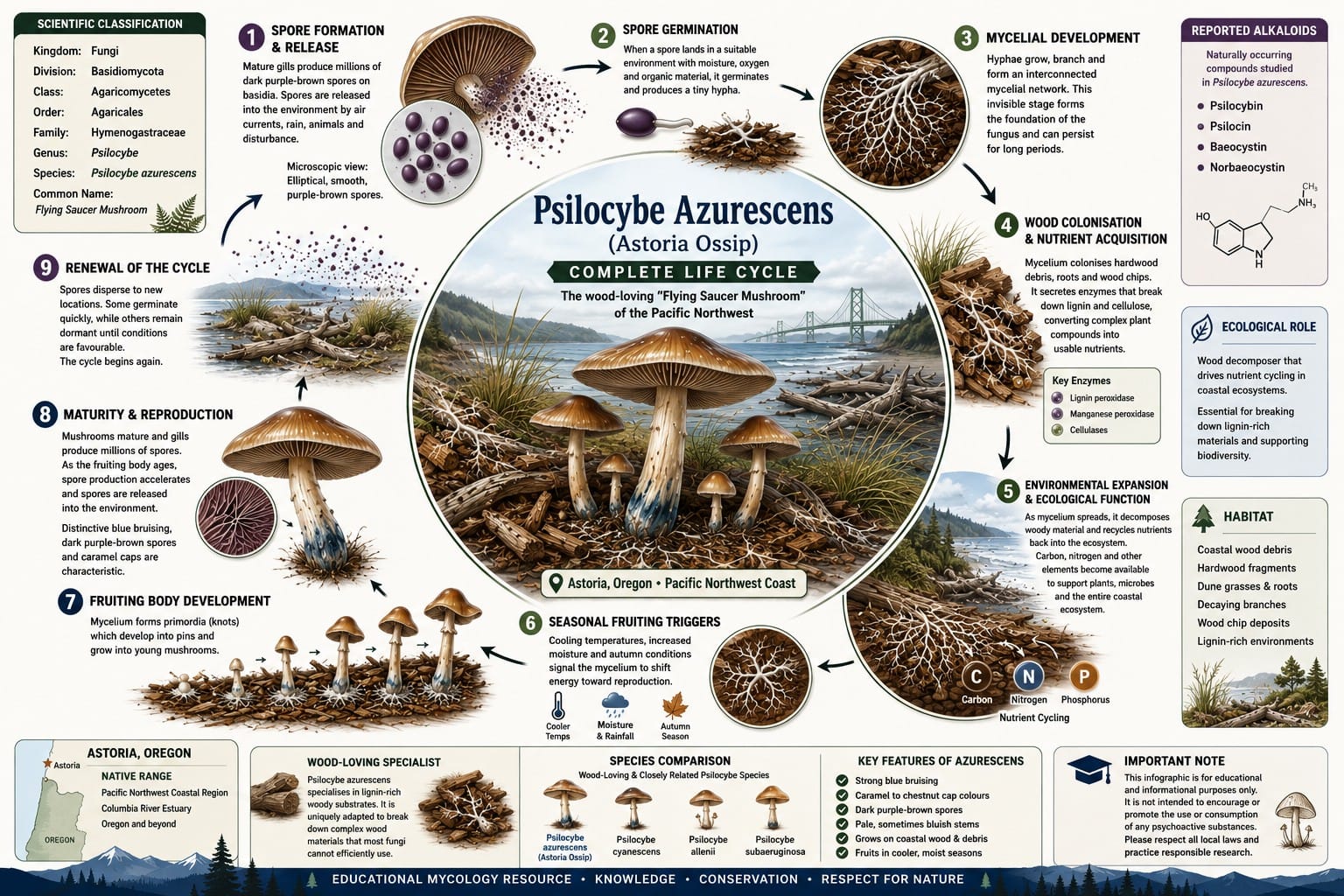
Spores are produced by mature fruiting bodies as part of the fungal reproductive cycle. In gilled mushrooms, spores develop on microscopic structures called basidia, which are located on the gill surfaces beneath the cap. As the fruiting body matures, spores are released into the surrounding environment and dispersed by air movement, rain splash, animals or physical disturbance.
In Psilocybe azurescens, the spore stage is important because it connects the visible mushroom to the wider fungal life cycle. The mushroom itself is only the reproductive structure of a larger organism. The main body of the fungus is the mycelium, which grows through wood-rich substrates and supports later fruiting when environmental conditions are suitable.
Add an educational diagram showing gills, basidia, spore release and dispersal from a mature Flying Saucer Mushroom.
Suggested filename:
psilocybe-azurescens-spore-formation-and-release.jpgSuggested alt text:
Psilocybe azurescens spore formation and release diagram showing gills basidia and purple brown sporesSpore Morphology: Colour, Shape and Size
Spore morphology is one of the most important microscopy topics for Psilocybe azurescens. Educational descriptions commonly describe the spores as dark purple-brown in print, ellipsoid in shape and useful for comparison with other wood-loving Psilocybe species.
| Microscopy Feature | Educational Observation | Why It Matters |
|---|---|---|
| Spore Print Colour | Dark purple-brown to purplish black | Important for taxonomy and comparison with related species |
| Spore Shape | Typically described as ellipsoid | Useful under microscope for species comparison |
| Reported Spore Size | Often around 9-13.5 x 5-8 micrometres | Supports microscopic comparison and taxonomic study |
| Surface | Commonly described as smooth in educational references | Useful when comparing microscopy observations |
| Research Value | High for rare wood-loving species comparison | Useful for distinguishing species-level identity from strain-level language |
Microscopic observations should be interpreted with care. Spore colour, shape and size can support identification and taxonomy, but reliable species-level analysis depends on multiple observations and comparison with published descriptions.
Add a microscope image or scientific illustration showing ellipsoid purple-brown spores with a scale bar.
Suggested filename:
psilocybe-azurescens-spores-under-microscope.jpgSuggested alt text:
Psilocybe azurescens spores under microscope showing ellipsoid purple brown spore morphologyPsilocybe Azurescens Spore Prints
A spore print is a visible deposit of spores released from the gills of a mature mushroom. In educational microscopy contexts, spore prints are useful because they preserve visible spore colour and provide a reference point for comparison. Psilocybe azurescens spore prints are typically described as dark purple-brown to purplish black.
Azurescens spore prints are often considered interesting because the species is less commonly encountered than many Psilocybe cubensis varieties and has a stronger locality-linked identity. For researchers, the print is not only a colour reference; it is part of a wider species profile involving habitat, morphology, microscopy and taxonomy.
| Spore Print Topic | Why It Matters |
|---|---|
| Visible Spore Colour | Helps document the dark purple-brown to purplish-black print associated with the species |
| Microscopy Preparation | Can provide material for lawful microscopy study where permitted |
| Taxonomic Context | Useful as one part of a larger species identification profile |
| Collector Interest | Azurescens is often treated as rare or specialist compared with common cubensis varieties |
Add a high-quality photograph of a dark purple-brown Psilocybe azurescens spore print.
Suggested filename:
psilocybe-azurescens-spore-print.jpgSuggested alt text:
Psilocybe azurescens spore print showing dark purple brown spores for microscopy researchPsilocybe Azurescens Spore Swabs
Spore swabs are another format used in microscopy and collection contexts. A swab can collect spores from a spore-bearing surface and preserve them in a compact format. For rare or specialist species, swabs may be discussed where prints are limited, fragile or not available in large quantity.
For SporeBuddies-style educational wording, spore swabs should be clearly framed as microscopy or taxonomy material only. Avoid implying cultivation, germination or unlawful use. The strongest content angle is to explain how swabs fit into comparison study, lawful microscopy and species documentation.
Why Researchers Use Swabs
Swabs may be compact, easy to document and useful when comparing spores from rare or limited material. They can support educational microscopy where lawful.
Why Clear Labelling Matters
Because laws vary, spore swabs should be labelled and described responsibly. Educational use, taxonomy and microscopy context should be stated clearly.
Add an educational comparison image showing a spore print beside a sterile-style swab for microscopy context.
Suggested filename:
psilocybe-azurescens-spore-print-vs-spore-swab.jpgSuggested alt text:
Psilocybe azurescens spore print and spore swab comparison for microscopy researchPsilocybe Azurescens Spore Syringes
A spore syringe suspends spores in sterile water for microscopy slide preparation and handling in lawful research contexts. In jurisdictions where spores may be studied legally, spore syringes can be discussed as a microscopy format. The wording must remain carefully educational and should not provide germination or cultivation instructions.
For Psilocybe azurescens, the spore syringe format may be of interest because the species is less common than ordinary cubensis varieties and is valued by researchers for its species-level identity, wood-loving ecology and spore morphology.
Do not include instructions for germination, cultivation or production of controlled mushroom material. Keep spore syringe discussion focused on lawful microscopy, slide preparation, taxonomy and educational research where permitted.
Microscopy Use: What Researchers Can Study
Microscopy allows researchers to examine the characteristics of Psilocybe azurescens spores beyond what is visible to the eye. This includes spore shape, dimensions, colour, surface appearance and comparison with related wood-loving species such as Psilocybe cyanescens, Psilocybe allenii and Psilocybe subaeruginosa.
Spore Shape
Azurescens spores are commonly described as ellipsoid, making shape an important microscopy comparison feature.
Spore Size
Reported measurements help compare Azurescens with related species, although results should be interpreted carefully.
Spore Colour
The dark purple-brown to purplish-black print colour is one of the most recognisable educational features.
Microscopy is especially valuable because Psilocybe azurescens is a true species, not a strain of Psilocybe cubensis. Studying its spores helps reinforce that distinction and gives researchers a more accurate understanding of species-level taxonomy.
How Spores Fit Into the Azurescens Life Cycle
Spores are the starting point of a new fungal generation. When spores are released from a mature fruiting body, most will never establish. A small number may land in suitable environments where conditions such as moisture, oxygen and organic material allow germination. In natural contexts, successful development also depends on compatible hyphae, substrate availability and environmental triggers.
The life cycle of Psilocybe azurescens is strongly shaped by its wood-loving ecology. The species is adapted to woody debris, coastal plant material and lignin-rich substrates. This makes the spore-to-mycelium-to-fruiting-body cycle very different from dung-associated species such as Psilocybe cubensis.
Spore Storage and Viability: Educational Overview
Spore storage is often discussed by collectors and microscopy researchers because spores can degrade over time if exposed to unsuitable conditions. In general educational terms, spores are best understood as biological material that may be affected by heat, moisture, contamination, light exposure, age and handling.
This guide does not provide cultivation or germination advice. From a microscopy perspective, careful labelling, clean handling, lawful storage and accurate record keeping are the most important principles.
| Storage Factor | Why It Matters for Microscopy |
|---|---|
| Labelling | Supports traceability, species comparison and accurate records |
| Light Exposure | Biological materials are often protected from unnecessary light exposure |
| Moisture | Excess moisture may increase contamination risk in some formats |
| Heat | Unstable temperatures may reduce sample quality over time |
| Age | Older samples may become less useful for some microscopy purposes |
Legal Context for Psilocybe Azurescens Spores
Laws relating to spores vary significantly by country, region and intended use. In some places, spores may be treated differently from germinated material or fruiting bodies. In other places, possession, importation, sale, germination or cultivation may be restricted or prohibited.
Because Psilocybe azurescens is associated with controlled compounds in mature material, all content should be framed carefully. The safest and most responsible SporeBuddies wording is educational, microscopy-focused, taxonomy-focused and jurisdiction-aware.
Do not germinate, cultivate, possess, import, sell, consume or distribute controlled mushroom material where unlawful. This page is not legal advice. Always check current local law and seek professional legal guidance if unsure.
Why Psilocybe Azurescens Spores Are Considered Rare
Azurescens spores are often viewed as rare or specialist compared with common cubensis varieties because the species has a more specific ecological identity and a stronger association with wild coastal habitats. Its Astoria/Oregon history, wood-loving biology and high research interest make it a more distinctive species for microscopy-focused collections.
That rarity should be handled carefully in content. It is reasonable to explain that Azurescens attracts specialist interest, but the article should avoid unsupported claims about specific lineages, availability or performance. The strongest positioning is educational: rare, species-level, wood-loving and microscopy-relevant.
Azurescens Spores vs Cubensis Spores
One of the most important educational points is that Psilocybe azurescens is not a strain of Psilocybe cubensis. It is a separate species. This distinction matters when discussing spores because cubensis strain pages usually focus on named varieties, while Azurescens content should focus on species-level identity, wood-loving ecology, microscopy and taxonomy.
| Comparison Point | Psilocybe azurescens | Psilocybe cubensis |
|---|---|---|
| Taxonomic Status | Separate species | Separate species with many named strains |
| Ecology | Wood-loving, coastal, lignicolous | Often dung-associated tropical/subtropical ecology |
| Spore Print | Dark purple-brown to purplish black | Often purple-brown to dark purple-brown |
| Content Angle | Species guide, microscopy, taxonomy, ecology | Strain comparison, microscopy, variety-level pages |
| Research Interest | High due to rarity, Astoria identity, alkaloid profile and wood-loving ecology | High due to wide distribution and many named varieties |
Final Summary: Psilocybe Azurescens Spores
Psilocybe azurescens spores are important in educational mycology because they connect the Flying Saucer Mushroom's visible fruiting body with its microscopic reproductive biology. Their dark purple-brown to purplish-black spore print, ellipsoid morphology, wood-loving species context and Astoria/Oregon association make them especially interesting for microscopy and taxonomy study.
For SporeBuddies, the strongest way to present Azurescens spores is as part of a responsible scientific resource: lawful microscopy, species comparison, spore morphology, ecology and taxonomic education. This keeps the content useful, compliant and genuinely valuable to readers interested in the biology of wood-loving Psilocybe species.
Psilocybe Azurescens Spores FAQs
What colour are Psilocybe azurescens spores?
Psilocybe azurescens spores are associated with a dark purple-brown to purplish-black spore print.
What shape are Psilocybe azurescens spores?
They are typically described as ellipsoid under microscopy.
Are Psilocybe azurescens spores the same as cubensis spores?
No. Psilocybe azurescens and Psilocybe cubensis are separate species. Their spores may share some broad colour similarities, but they belong to different species with different ecology and taxonomy.
What is a Psilocybe azurescens spore print?
A spore print is a visible deposit of spores released from the gills of a mature mushroom. Azurescens spore prints are usually described as dark purple-brown to purplish black.
What is a Psilocybe azurescens spore swab?
A spore swab is a compact format used to collect spores for microscopy and research context where lawful. It should be clearly described as microscopy material only.
Can Psilocybe azurescens spores be studied under a microscope?
In jurisdictions where lawful, spores may be studied for microscopy and taxonomy. Local law should always be checked before possession, importation or study.
Are Psilocybe azurescens spores rare?
They are often considered specialist or rare compared with common cubensis varieties because Azurescens has a more restricted ecological identity and stronger locality-linked history.
Does this guide provide cultivation instructions?
No. This guide is for education, taxonomy and microscopy context only. It does not provide germination or cultivation instructions.
Article Version: 1.0
First Published: June 2026
Last Reviewed: June 2026
This guide is reviewed periodically by the SporeBuddies Research Team to maintain accuracy and reflect current scientific understanding. Content is intended for educational, microscopy and taxonomic reference purposes only.
References & Further Reading
The information in this spores guide is informed by published taxonomy, biodiversity, microscopy and toxicology resources relating to Psilocybe azurescens and related wood-loving Psilocybe species.
Taxonomy & Species Description
Stamets, P. & Gartz, J. (1995).
A New Caerulescent Psilocybe from the Pacific Coast of Northwestern America.
View Reference
NCBI Taxonomy Database
National Center for Biotechnology Information (NCBI).
Psilocybe azurescens Taxonomy Browser.
View Reference
GBIF Species Record
Global Biodiversity Information Facility (GBIF).
Psilocybe azurescens species occurrence and biodiversity records.
View Psilocybe azurescens Record
Fungal Taxonomy & Ecology Review
Bradshaw, M. et al. (2022).
An Overview on the Taxonomy, Phylogenetics and Ecology of the Psychedelic Fungi.
View Reference
Wood Lover's Paralysis Research
Beck, S.A., Barlow, C., Engel, L. & Barratt, M.J. (2025).
"Wood-lover paralysis": describing a toxidrome with symptoms of weakness caused by some lignicolous "wood-loving" Psilocybe mushrooms.
View Reference
Oregon Health Authority Review
Present, S. (2024).
Wood Lover's Paralysis Review.
View Reference
Explore More Psilocybe Azurescens Resources
This guide is part of the SporeBuddies Psilocybe azurescens knowledge hub. Continue your research with our related educational guides: