
Even experienced foragers have been caught out by a convincing lookalike. The UK is home to thousands of fungal species, and some of the most dangerous share striking visual similarities with edible favourites. A single misidentification can have serious consequences, which is why a reliable, step-by-step checklist is not just helpful but essential. This guide walks you through the core criteria, a practical identification sequence, common pitfalls, and the best reference resources available to UK amateur mycologists, so you can build genuine confidence in the field.
Table of Contents
- Core criteria for mushroom identification in the UK
- Step-by-step mushroom identification checklist
- Common pitfalls and advanced tips for accurate mushroom ID
- Reference resources for confirmation and learning
- Why mushroom identification checklists must evolve with your experience
- Expand your mycology skills and toolkit
- Frequently asked questions
Key Takeaways
| Point | Details |
|---|---|
| Multiple checks | Never rely on a single feature or app—use habitat, cap, gills, and spore print for safe ID. |
| Record observations | Take note of habitat and season for every find to spot patterns and avoid confusion. |
| Spore print value | Making a spore print is a critical but often skipped step, especially for UK lookalikes. |
| Consult experts | Authoritative resources such as Kew Fungarium and peer consultation safeguard against fatal errors. |
Core criteria for mushroom identification in the UK
Before you can use a checklist effectively, you need to know what you are actually looking for. Safe mushroom identification is never about one standout feature. It is about building a complete picture from multiple observations, each one narrowing down the possibilities until you reach a confident conclusion.
UK-appropriate checklists emphasise habitat, season, macro traits, and spore prints, and they consistently recommend cross-checking rather than relying on a single feature. This matters because many toxic UK species have evolved to look almost identical to edible ones. The death cap (Amanita phalloides), for example, can resemble the paddy straw mushroom to an untrained eye, and it is responsible for the majority of fatal mushroom poisonings worldwide.
Here are the core criteria you should examine with every find:
- Habitat and substrate: Is it growing from soil, wood, leaf litter, or dung? Is it in a broadleaf woodland, conifer forest, grassland, or heathland?
- Cap shape and surface: Convex, flat, umbonate (with a central bump), or funnel-shaped? Smooth, sticky, scaly, or fibrous?
- Gills, pores, or teeth: Are there gills underneath, or a spongy pore surface (as in boletes), or downward-pointing teeth (as in hedgehog mushrooms)?
- Stem characteristics: Hollow or solid? Bulbous base? Presence of a ring (annulus) or a cup-like volva at the base?
- Colour and texture changes: Does the flesh bruise blue, red, or black when cut? Does the cap change colour when wet?
- Smell and taste: Some species have distinctive odours (anise, radish, honey). Never swallow; a tiny taste and spit is acceptable only for species you are already confident about.
- Seasonal context: Many UK species fruit only in specific windows. Chanterelles appear from summer into autumn; velvet shanks fruit in winter.
- Spore print colour: White, cream, pink, brown, purple-brown, or black. This single test rules out entire genera.
Beginner resources support a spotter approach: learn a core set of common forms first, then deepen your knowledge with more detail as your confidence grows. This incremental method is far safer than trying to identify everything at once.
Critical reminder: No single feature is ever enough. A white-gilled mushroom with a ring and a bulbous base should always trigger caution, regardless of how familiar it looks. Cross-checking every criterion is the only reliable method.
Pro Tip: Every time you find a specimen, record the GPS location, date, surrounding tree species, and substrate. This contextual log will become invaluable as you build your personal identification database over time.
Understanding health applications of mushrooms can also motivate you to identify correctly, since many edible UK species carry genuine nutritional and bioactive benefits worth pursuing safely.
Step-by-step mushroom identification checklist
With the core criteria in mind, here is a practical, sequential checklist to follow with every find. Work through these steps in order rather than jumping to a conclusion early.
- Photograph in situ before touching. Capture the cap top, underside, stem, base, and surrounding habitat. These images are your reference if you need to consult an expert later.
- Note the substrate and surroundings. What is the mushroom growing from? Which tree species are nearby? Mycorrhizal fungi (those that form partnerships with tree roots) will only grow near specific host trees.
- Examine the cap. Measure the diameter if possible. Note shape, colour, surface texture, and any distinctive markings or zones.
- Check the underside. Identify whether you are looking at gills, pores, teeth, or folds. Note gill colour, spacing, and attachment to the stem (free, adnate, or decurrent).
- Inspect the stem. Note height, width, colour, texture, and whether it is hollow or solid when snapped. Look for a ring (annulus) and a volva at the base by carefully digging around the base.
- Smell the specimen. Many UK species have diagnostic odours. The aniseed funnel (Clitocybe odora) smells strongly of anise; the stinkhorn (Phallus impudicus) is unmistakable.
- Cut through the flesh. Observe colour, firmness, and any colour changes on exposure to air. Note any latex (milky fluid) that may seep from the cut.
- Take a spore print. Place the cap gill-side down on a piece of paper (use half white, half black to capture all print colours) and cover with a bowl for at least two hours. Sequential ID steps including spore prints are highlighted by multiple authoritative sources as non-negotiable for safe identification.
- Cross-reference with at least two field guides. Never rely on a single book or app.
- Check for lookalikes specifically. Many guides list known dangerous lookalikes for each species. Read these sections carefully.
Woodland Trust’s identification cues illustrate how distinct features such as the rays on earthstars, the jelly-like texture of yellow brain fungus after rain, and the necessity of microscopy for some species all contribute to a thorough identification process.
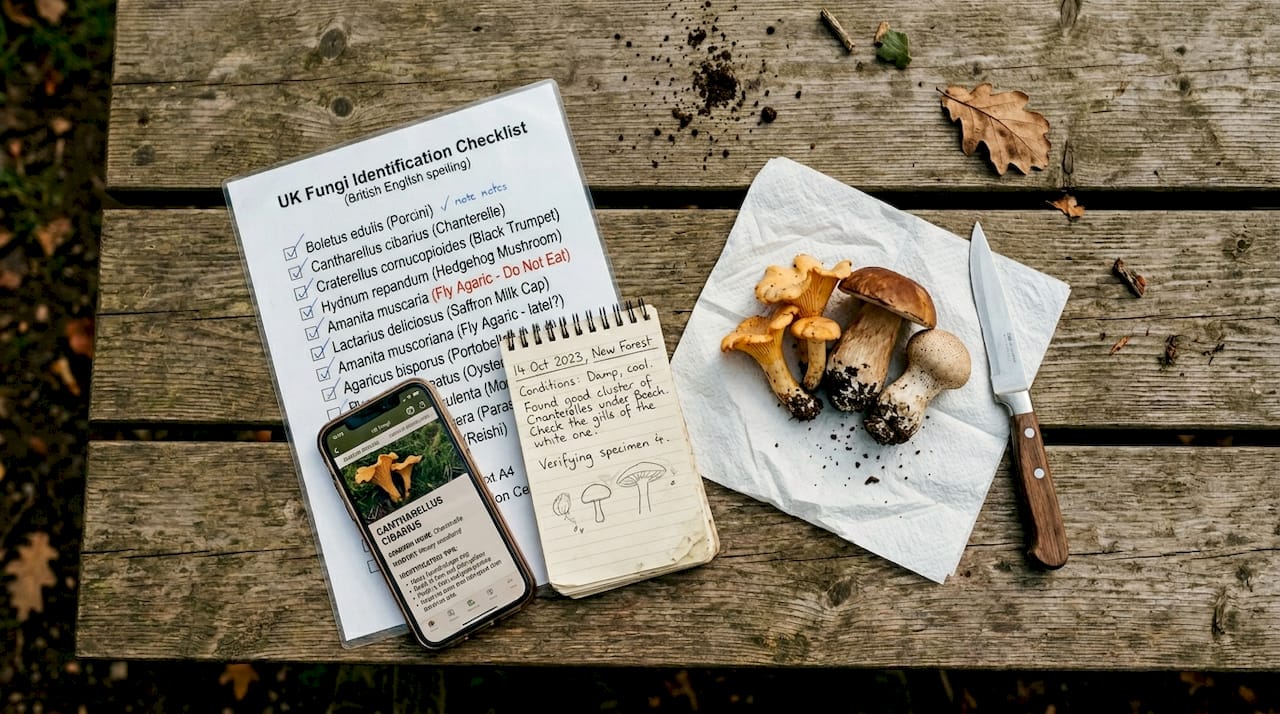
Here is a quick-reference table showing how the checklist applies to five common UK species:
| Species | Cap colour | Underside | Stem features | Spore print | Key habitat |
|---|---|---|---|---|---|
| Chanterelle (Cantharellus cibarius) | Golden yellow | False gills (forked ridges) | Solid, pale yellow | White to cream | Broadleaf and conifer woodland |
| Field mushroom (Agaricus campestris) | White to grey-brown | Pink then chocolate-brown gills | Ring present, no volva | Dark brown | Grassland, pastures |
| Fly agaric (Amanita muscaria) | Red with white warts | White free gills | Ring and volva present | White | Birch and pine woodland |
| Hedgehog mushroom (Hydnum repandum) | Pale cream to tan | Downward-pointing teeth | Solid, pale | White | Broadleaf and mixed woodland |
| Oyster mushroom (Pleurotus ostreatus) | Grey to blue-grey | White decurrent gills | Short, off-centre stem | Lilac-white | Dead or dying broadleaf trees |
Pro Tip: For your spore print, always use both white and black paper simultaneously. A white print on white paper is invisible; a lilac-white print on black paper is immediately obvious. This simple habit saves real confusion.
Building your essential mycology basics knowledge will help you interpret these features more accurately as you gain experience. And if you want to understand the broader context of what you are finding, mushroom safety guides from Spore Buddies offer detailed species-specific advice for UK foragers.
Common pitfalls and advanced tips for accurate mushroom ID
Even careful foragers make mistakes. Knowing where errors typically occur is just as important as knowing the correct method.
Common mistakes to avoid:
- Skipping the spore print because the mushroom “looks obvious.” This is how experienced foragers poison themselves.
- Over-relying on photo identification apps. AI identification tools can fail at rates that present genuine safety risks, and should never be used as the sole method for confirming edibility.
- Ignoring habitat and season. A chanterelle-shaped mushroom in a conifer plantation in February is almost certainly not a chanterelle.
- Identifying from the cap alone without checking the base. Many deadly Amanita species have a distinctive volva that is buried in soil and easily missed.
- Assuming that a species safe in one region is safe everywhere. Regional variations and subspecies exist, and some lookalikes are more common in certain parts of the UK.
DOs and DON’Ts for safe identification:
- Do collect the whole specimen including the base.
- Do use at least two independent field guides.
- Do take a spore print for every unfamiliar species.
- Do consult a local mycological society or expert when uncertain.
- Don’t eat anything you are not 100% certain about.
- Don’t rely on colour alone. Many species vary dramatically depending on age, moisture, and light.
- Don’t assume that cooking destroys all toxins. Some mushroom toxins, including amatoxins from the death cap, are heat-stable.
Statistical callout: AI photo ID tools have been shown to produce incorrect results in approximately 15% of cases in research conditions. In a life-or-death context like mushroom edibility, a 15% error rate is unacceptable as a sole identification method.
When lookalikes can only be distinguished using microscopic traits, you need to escalate beyond field observation. Microscopic confirmation involves examining spore shape (ellipsoid, subglobose, or cylindrical), surface texture (smooth, verrucose meaning warty, or reticulate meaning net-patterned), and hyphal structure. This level of analysis requires a compound microscope and some training, but it is the gold standard for ambiguous finds.
Pro Tip: When you are genuinely uncertain, do not eat the specimen. Instead, preserve it in a paper bag (not plastic, which accelerates decay) and contact your local fungus group or submit a query to the British Mycological Society. Kew’s Fungarium also accepts enquiries for serious or unusual finds.
For further poisoning risk guidance, Spore Buddies provides species-specific safety information relevant to UK foragers.
Reference resources for confirmation and learning
No checklist replaces the depth of a good reference collection. When you encounter something unfamiliar or ambiguous, knowing where to turn is critical.
Kew’s Fungarium holds over one million imaged specimens as part of its digitisation project, making it one of the most significant reference resources available to UK mycologists. You can access digitised specimens online to compare your find against verified, labelled material. This is particularly useful for unusual or rare species where field guides may offer limited coverage.
Reputable UK resources for fungi identification:
- Collins Fungi Guide by Stefan Buczacki: widely regarded as the most comprehensive single-volume field guide for UK species.
- Mushrooms by Roger Phillips: exceptional photography and broad species coverage, excellent for visual cross-referencing.
- The British Mycological Society (BMS) website and regional fungus groups: offer expert forums, forays, and identification support.
- iRecord and iNaturalist: citizen science platforms where expert verifiers can confirm or query your identification submissions.
- The First Nature website: free, detailed species accounts with photographs, specifically focused on UK and European fungi.
| Resource type | Pros | Cons |
|---|---|---|
| Printed field guides | Portable, no battery needed, curated by experts | Can go out of date, limited to photographed species |
| Digital tools and apps | Fast, image-based, broad databases | AI error rates, no substitute for physical examination |
| Reference collections (e.g., Kew) | Verified specimens, scientific authority | Requires online access or physical visit |
| Local mycological societies | Expert human judgement, regional knowledge | Availability varies, not always immediate |
Building your expertise incrementally means using reference tools every time you are unsure, not just when you are completely lost. Even experienced mycologists regularly consult references. That habit is a sign of competence, not weakness.
Revisiting the basics of mushroom mycology periodically also helps you notice gaps in your knowledge before they become problems in the field.
Why mushroom identification checklists must evolve with your experience
Here is something most beginner guides will not tell you: a checklist is a starting point, not a destination. The foragers who get into trouble are often not complete beginners. They are people who have used a checklist successfully enough times that they begin to shortcut it.
Confidence is not the same as competence. Recent mycology research consistently highlights that even trained professionals encounter edge cases where standard macro features are ambiguous, where a specimen does not match its expected habitat, or where a known species presents in an atypical form due to environmental stress. The assumption that you have “seen enough” of a species to stop checking is precisely where errors creep in.
True identification skill is not about memorising a checklist and executing it flawlessly every time. It is about learning from the specimens that did not fit neatly into the expected pattern, updating your mental model, and knowing when to stop and seek confirmation rather than pushing through uncertainty. The foragers and mycologists we respect most are those who say “I am not sure” most readily, because that honesty reflects genuine understanding of how complex fungal identification actually is.
‘There are no shortcuts. Only careful method and evolving scrutiny ensure safe and confident identification.’
Your checklist should grow with you. Add notes from your own finds. Record the times a species surprised you. Build in personal reminders for the lookalikes that have caught you out or nearly caught you out. A living, annotated checklist that reflects your actual field experience is far more valuable than a generic printed one.
If you are ready to take your knowledge further, mycology home growing insights from Spore Buddies offer a practical way to deepen your understanding of fungal biology from the substrate up, which in turn sharpens your identification skills considerably.
Expand your mycology skills and toolkit
If this guide has sparked your curiosity, the next step is getting hands-on. At Spore Buddies, we stock everything UK-based mycologists and home cultivators need to practise and grow. From spore syringes for microscopy and research to complete grow kits for oyster, shiitake, and lion’s mane, our range is built for both beginners and more experienced enthusiasts. You will also find agar plates, sterilised substrates, and compound microscopes to support serious identification work at home. Browse our full range of mycology equipment and pair your field skills with the right tools to keep learning safely and confidently.
Frequently asked questions
Can you trust mushroom identification apps in the UK?
No. AI identification tools have been shown to produce incorrect results in roughly 15% of cases, making them unsafe as a sole identification method for edibility decisions.
Is a spore print always needed for safe mushroom identification?
A spore print is strongly recommended for most UK species, and it is essential when toxic lookalikes are common or when identification is uncertain.
How do I confirm a rare or unfamiliar mushroom find in the UK?
Compare your specimen against verified material in Kew’s Fungarium and consult a mycological expert or the British Mycological Society for microscopic analysis when needed.
What are the most important features to check for mushroom ID?
Habitat, cap shape and surface, gills or pores, stem features, ring or volva, season, and spore print are all essential. UK checklists consistently emphasise that combined macro traits and context are far more reliable than any single feature.
Recommended
- Common UK Mushrooms: 100 Species Identification Guide Spore Buddies
- UK Mushroom Identifier Tool | Free Fungi Identification Calculator UK Spore Buddies
- UK Mushroom Identification Quiz -UK Mushroom Identification Quiz | Identify 10 Common British Fungi Spore Buddies
- Mushroom mycology basics: your essential UK guide