
SporeBuddies UK Identification Hub
Common UK Mushrooms: 100 Species Identification Guide
Learn how to identify common mushrooms found in the UK using habitat, season, cap and gill features, spore print colour, and basic microscopy clues. This guide is designed for beginners, hobbyists, and anyone building a practical mushroom identification workflow.
Instead of relying on one feature alone, the safest and most useful approach is this: habitat + macro features + spore print colour + spore shape + season = likely genus or species group.
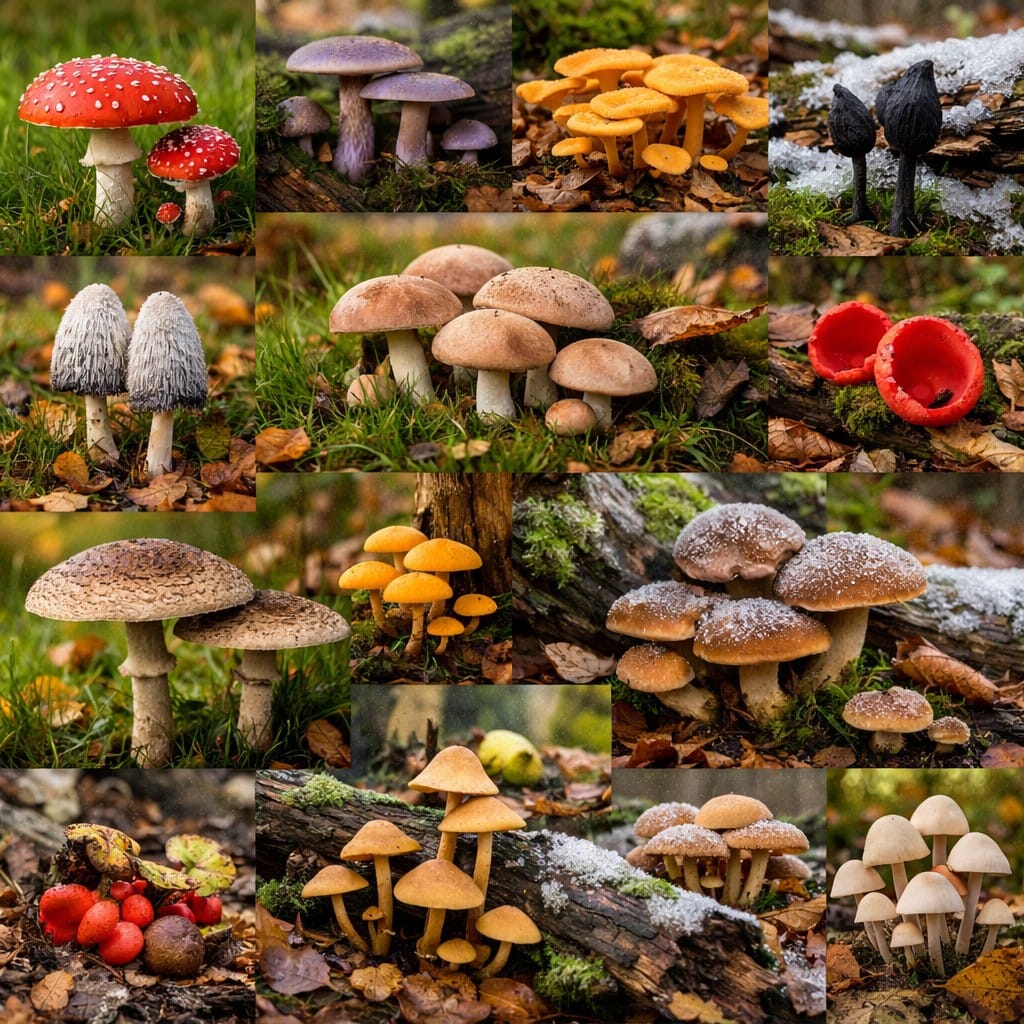
The UK has a huge range of fungi, from common lawn mushrooms and meadow species to bracket fungi on logs and classic woodland mushrooms in autumn. Some are easy to recognise in the field, while others need closer study. In practice, the most reliable beginner method is to start broad and narrow down: where it is growing, what season it appeared, what the cap and gills look like, what colour the spore print is, and whether microscope work supports the ID.
This page is a field-style reference guide. For deeper microscopy instruction, see How to Study Mushroom Spores Under a Microscope and Beginner Guide to Mycology Microscopy UK.
How to identify mushrooms in the UK
A good mushroom identification system does not depend on one clue. It works by building up a profile from several observations. This reduces errors and helps you sort lookalikes into the correct genus or species group.
1. Habitat
Grassland, woodland floor, dead wood, compost, mulch, lawns, boggy ground, dunes, heath, or dung.
2. Season
Spring, summer, autumn, or winter. Many UK mushrooms fruit in very predictable windows.
3. Macro features
Cap shape, texture, smell, bruising, gill attachment, stem ring, veil remnants, and colour changes.
4. Spore print colour
White, pink, brown, purple-brown, black, rusty-brown, and other shades can quickly narrow possibilities.
5. Spore shape
Round, oval, elliptical, angular, or ornamented spores can support the final identification.
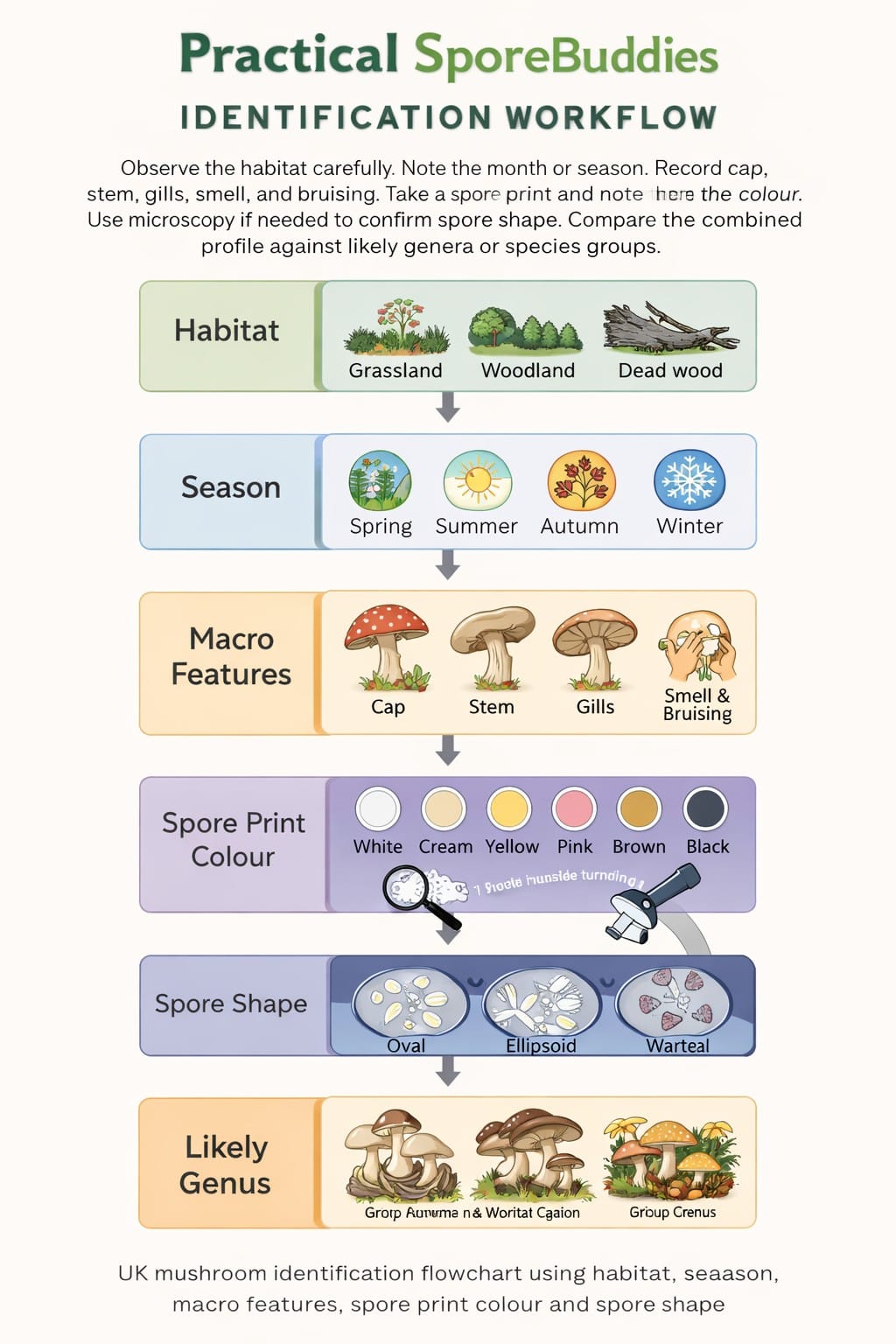
The practical SporeBuddies identification workflow
- Observe the habitat carefully.
- Note the month or season.
- Record cap, stem, gills, smell, and bruising.
- Take a spore print and note the colour.
- Use microscopy if needed to confirm spore shape.
- Compare the combined profile against likely genera or species groups.
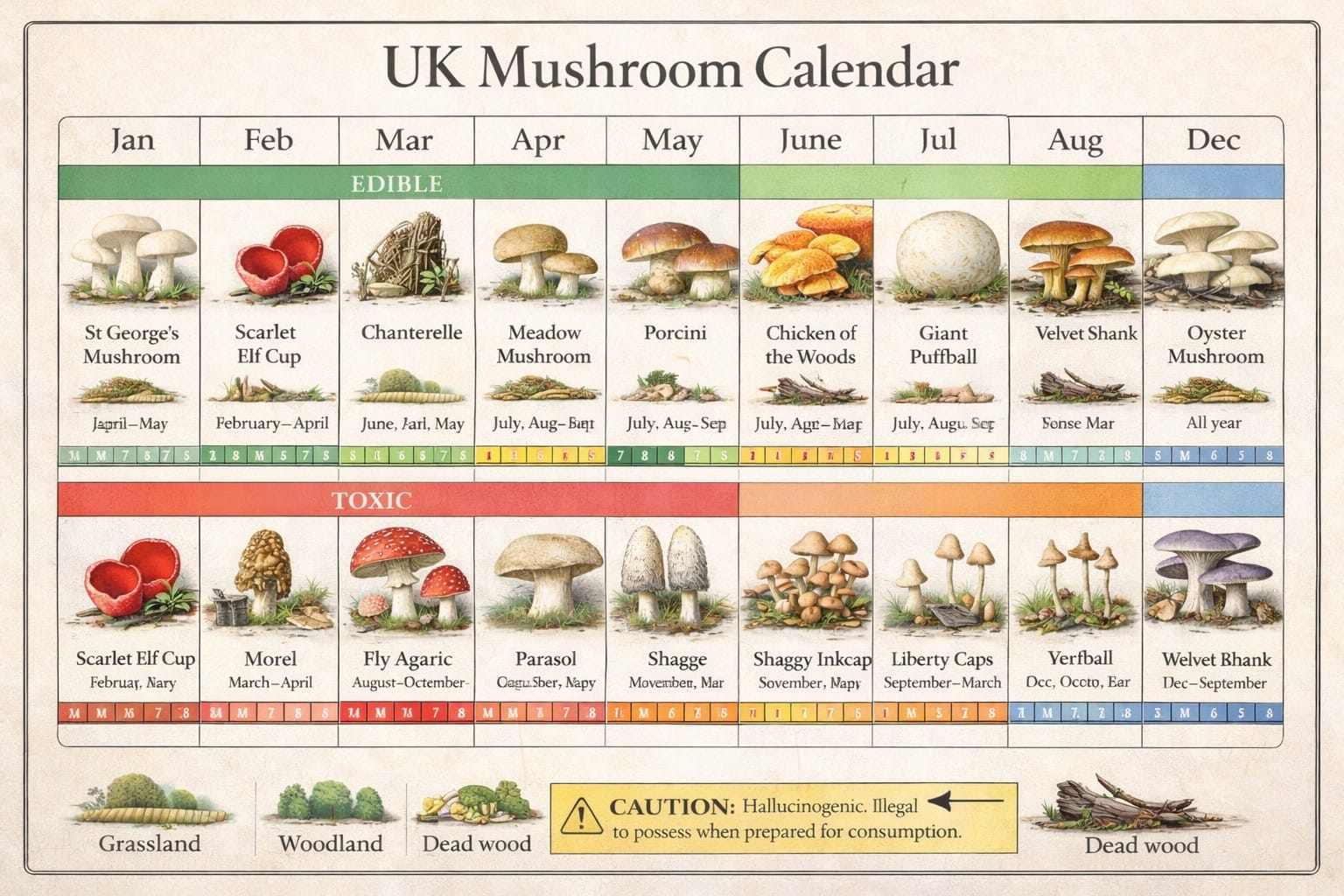
UK mushroom season calendar
Seasonality is one of the strongest mushroom identification variables in Britain. Autumn is the main mushroom season, but there are good spring indicators, summer grassland species, and several winter fungi that appear when other species have vanished.
| Season | Months | Typical UK groups |
|---|---|---|
| Spring | March – May | Morels, St George’s mushroom, scarlet elf cup, dryad’s saddle |
| Summer | June – August | Agaricus species, meadow fungi, fairy ring mushrooms, some boletes and chanterelles |
| Autumn | September – November | Russula, Amanita, Psilocybe, Panaeolus, honey fungus, many woodland mushrooms |
| Winter | December – February | Velvet shank, jelly ear, oyster mushroom, turkey tail, some wood-decay species |
UK mushroom identification matrix
This matrix is not a final ID tool on its own, but it is excellent for narrowing down possibilities. It works especially well when you already know the habitat and season.
Example identification walkthrough
Here is a practical example of how combining features helps.
| Country | UK |
|---|---|
| Habitat | Grassland |
| Season | Late summer |
| Cap | Cap skin peels easily |
| Smell | Aniseed |
| Gills | Pink becoming dark brown |
| Spore print | Dark brown |
| Spore shape | Oval |
| Likely genus | Agaricus |
| Likely candidate | Horse mushroom (Agaricus arvensis) |
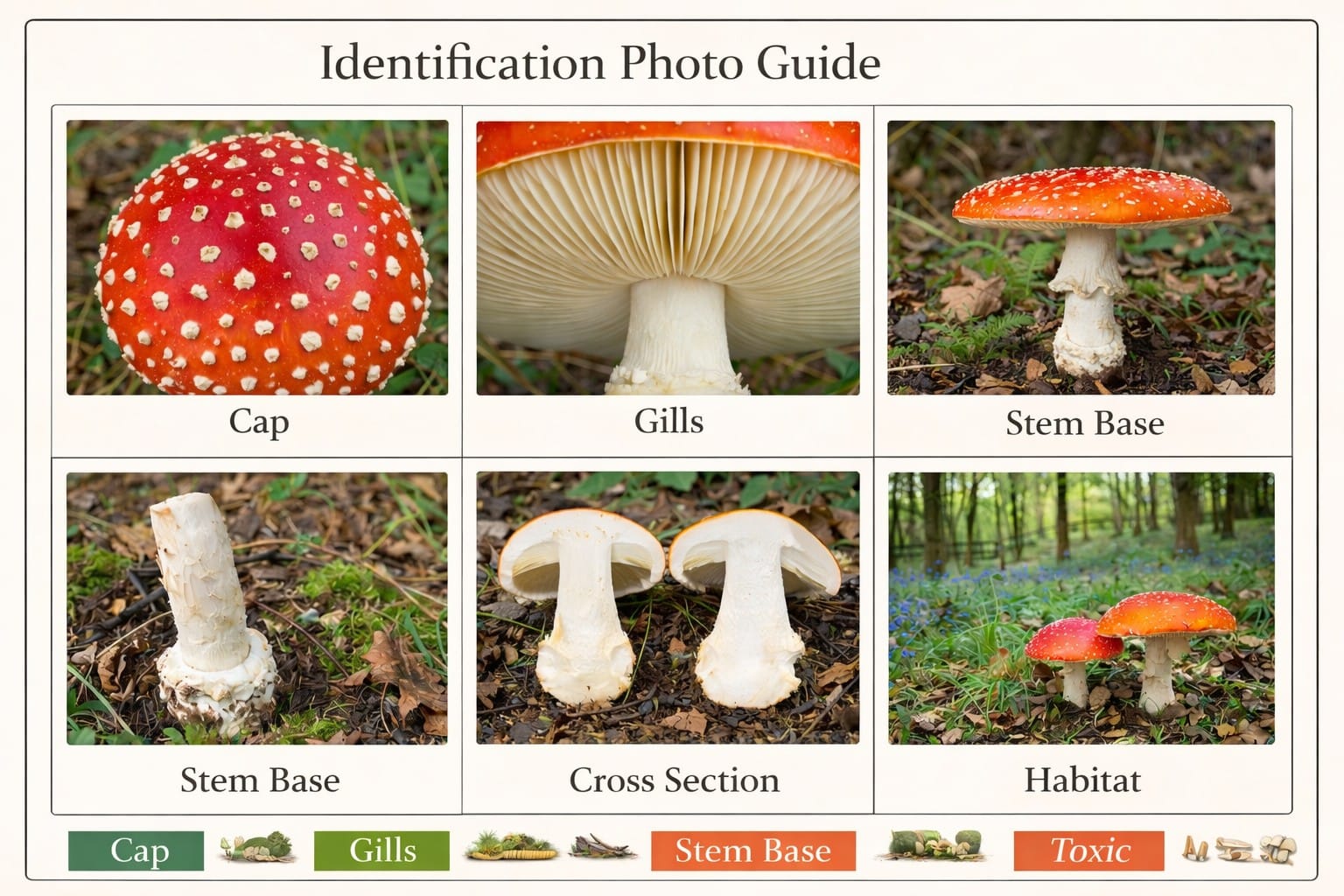
What to photograph in the field
Good identification photos usually show the cap, stem, gills, habitat, and a side profile. If possible, also photograph a sliced specimen and the collection site from a short distance.
100 common UK mushrooms by habitat
The list below is grouped by where mushrooms are most often found. This makes it easier for readers to move from a real-world observation to a likely group. Each entry includes a quick identification snapshot rather than a long botanical description.
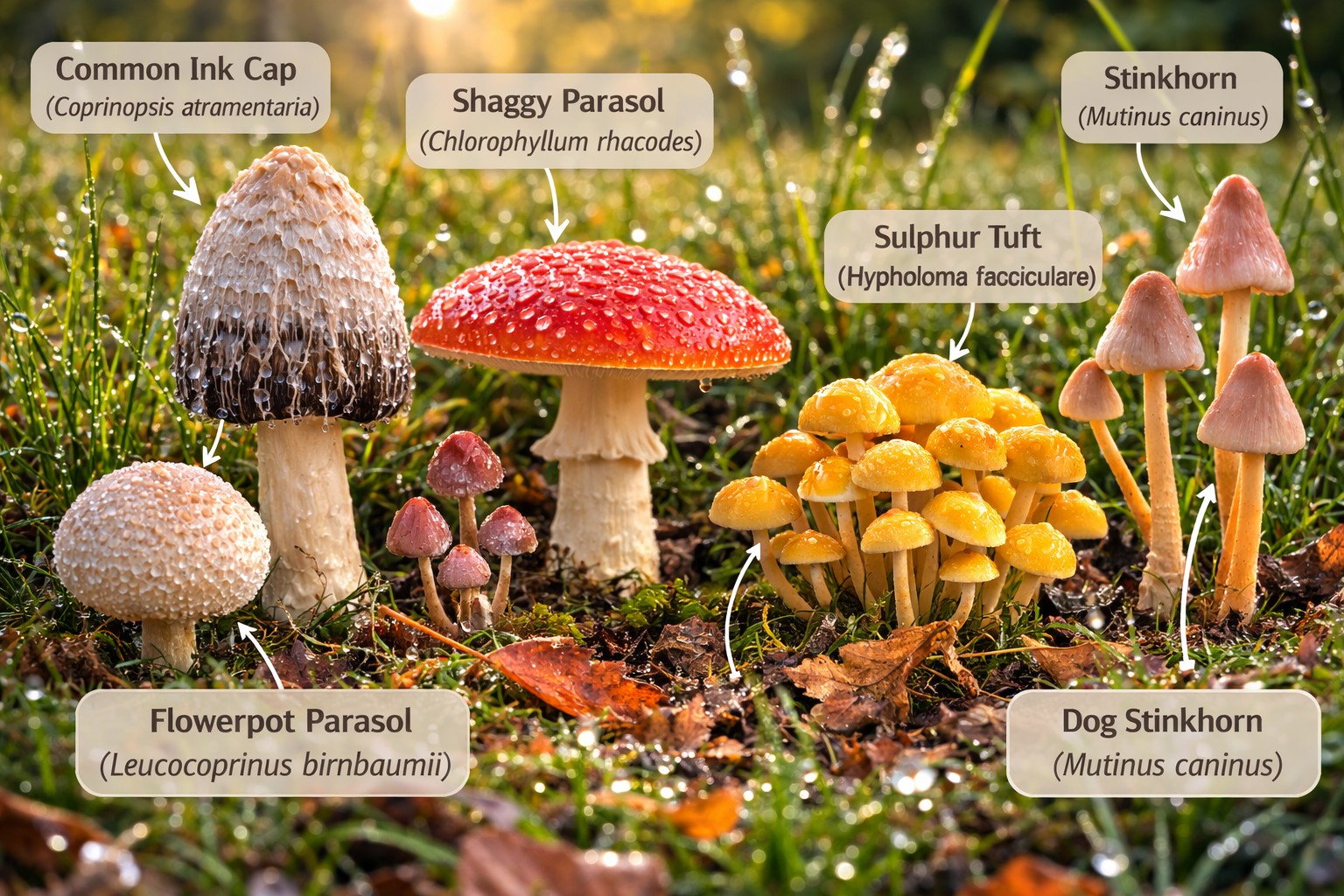
Grassland mushrooms
Lawns, meadows, parks, horse fields, rough grass, and unfertilised pasture can all produce distinctive UK fungi.
1. Field mushroom (Agaricus campestris)
Habitat: grassland. Season: summer–autumn. Gills: pink to chocolate brown. Spore print: dark brown. Notes: classic field Agaricus, often in pasture.
2. Horse mushroom (Agaricus arvensis)
Habitat: pasture, field edges. Season: summer–autumn. Gills: pink then dark brown. Spore print: dark brown. Notes: large, often with an aniseed smell.
3. Yellow stainer (Agaricus xanthodermus)
Habitat: gardens, lawns, grassland. Season: summer–autumn. Gills: pink to brown. Spore print: dark brown. Notes: yellows strongly, often with an inky or phenolic smell.
4. Fairy ring mushroom (Marasmius oreades)
Habitat: lawns and meadows. Season: spring–autumn. Gills: pale cream. Spore print: white. Notes: often grows in rings in short grass.
5. Liberty cap (Psilocybe semilanceata)
Habitat: unimproved grassland. Season: autumn. Gills: pale to darker brown. Spore print: purple-brown. Notes: small, conical, strongly associated with wet autumn pasture.
6. Mottlegill (Panaeolina foenisecii)
Habitat: lawns. Season: spring–autumn. Gills: mottled brown. Spore print: dark brown. Notes: one of the most common lawn mushrooms.
7. Banded mottlegill (Panaeolus cinctulus)
Habitat: rich grass, composty ground. Season: spring–autumn. Gills: dark mottled. Spore print: black. Notes: brown cap with darker band when moist.
8. Turf mottlegill (Panaeolus fimicola)
Habitat: lawns, rich pasture. Season: autumn. Gills: mottled grey-black. Spore print: black. Notes: small dark grassland Panaeolus.
9. Common puffball (Lycoperdon perlatum)
Habitat: grassland and woodland edges. Season: summer–autumn. Interior: white when young. Spore print: olive-brown mass when mature. Notes: surface with small spines or pearls.
10. Meadow waxcap (Cuphophyllus pratensis)
Habitat: unimproved grassland. Season: autumn. Gills: pale buff. Spore print: white. Notes: waxy feel, often in species-rich grassland.
11. Parrot waxcap (Gliophorus psittacinus)
Habitat: old grassland. Season: autumn. Gills: pale greenish-yellow. Spore print: white. Notes: slimy cap, often green when young.
12. Scarlet waxcap (Hygrocybe coccinea)
Habitat: grassland. Season: autumn. Gills: red to orange-red. Spore print: white. Notes: vivid red species in unimproved turf.
13. Snowy waxcap (Cuphophyllus virgineus)
Habitat: short grass. Season: autumn. Gills: white. Spore print: white. Notes: smooth white waxcap in species-rich grassland.
14. Blackening waxcap (Hygrocybe conica)
Habitat: grassland. Season: summer–autumn. Gills: yellow-orange. Spore print: white. Notes: often blackens with age or handling.
15. Shaggy inkcap (Coprinus comatus)
Habitat: lawns, pathsides, rough grass. Season: summer–autumn. Gills: white then black. Spore print: black. Notes: tall shaggy cap that deliquesces into ink.
16. Haymaker (Panaeolina foenisecii)
Habitat: mown lawns. Season: long season in mild weather. Gills: mottled. Spore print: brown. Notes: a very common small brown lawn mushroom.
17. Field blewit (Lepista saeva)
Habitat: grassy places. Season: autumn. Gills: pale lilac to buff. Spore print: pale pink-buff. Notes: stout stem, often with lilac shades.
18. Fool’s funnel (Clitocybe rivulosa)
Habitat: lawns and grass. Season: summer–autumn. Gills: white. Spore print: white. Notes: common white lawn funnel; a good reminder that grassland can contain dangerous species.
19. Giant puffball (Calvatia gigantea)
Habitat: pasture and field edges. Season: late summer–autumn. Interior: white when young. Notes: huge white fruitbody on grassland.
20. Meadow coral (Clavulinopsis corniculata)
Habitat: grassland. Season: autumn. Form: yellow coral-like branches. Spore print: white. Notes: useful for readers learning that not all fungi are typical cap-and-stem mushrooms.
Woodland mushrooms
Broadleaf woodland, conifer plantations, mixed woods, and mossy leaf litter produce some of the most recognisable British fungi.
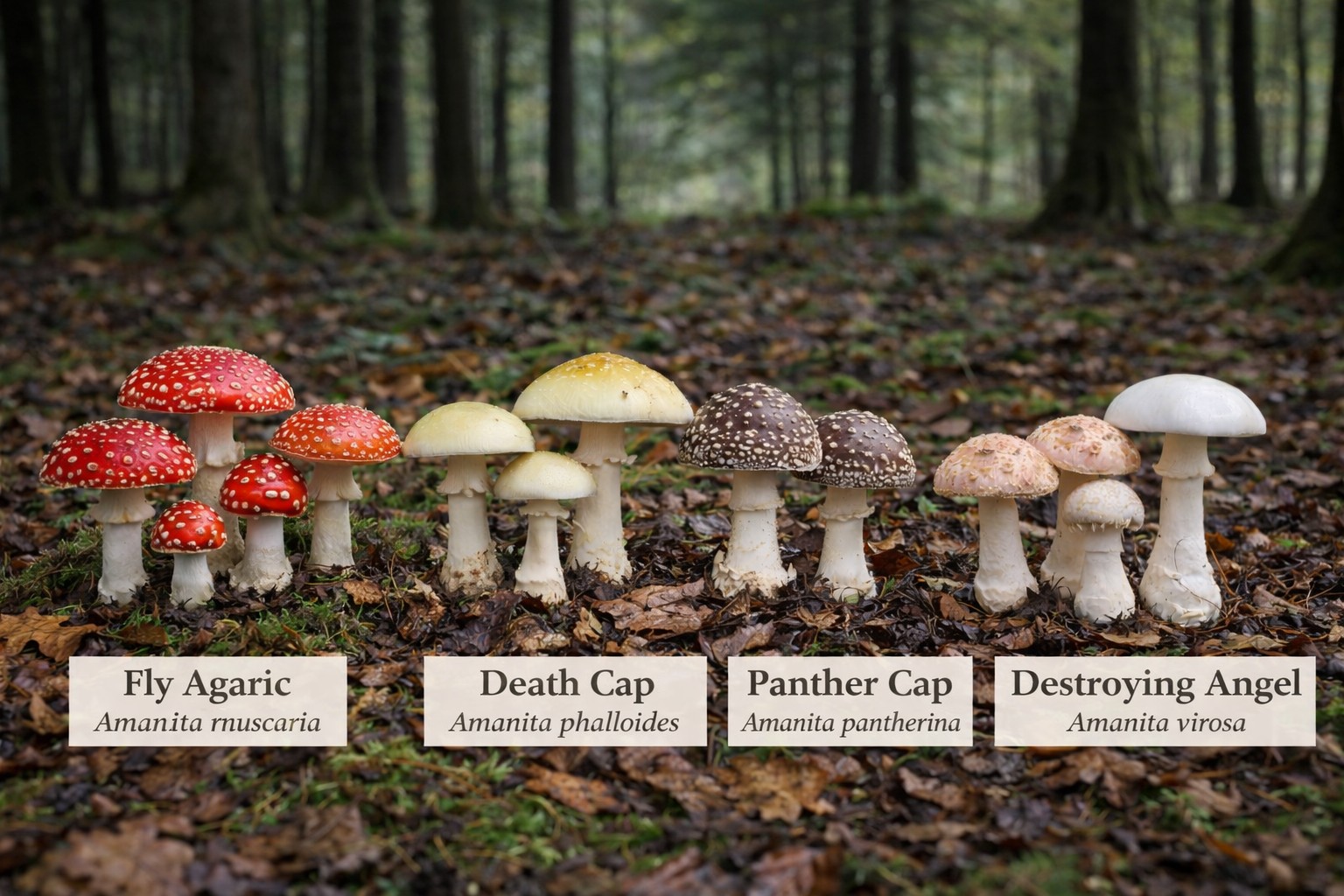
21. Fly agaric (Amanita muscaria)
Habitat: birch, pine, mixed woodland. Season: late summer–autumn. Gills: white. Spore print: white. Notes: red cap with white warts, one of the most iconic woodland fungi.
22. Death cap (Amanita phalloides)
Habitat: broadleaf woodland. Season: summer–autumn. Gills: white. Spore print: white. Notes: olive to greenish cap, volva at stem base. Extremely important from a safety perspective.
23. Panther cap (Amanita pantherina)
Habitat: woodland. Season: summer–autumn. Gills: white. Spore print: white. Notes: brown cap with white veil patches and a marginate bulb.
24. Blusher (Amanita rubescens)
Habitat: woodland. Season: summer–autumn. Gills: white. Spore print: white. Notes: flesh often blushes pinkish-red when damaged.
25. Destroying angel (Amanita virosa)
Habitat: conifer and acid woodland. Season: summer–autumn. Gills: white. Spore print: white. Notes: all-white Amanita with extreme identification importance.
26. Birch bolete (Leccinum scabrum)
Habitat: with birch. Season: summer–autumn. Pores: pale to brownish. Spore print: olive-brown. Notes: roughened stem with scabers.
27. Cep / penny bun (Boletus edulis)
Habitat: broadleaf and conifer woodland. Season: summer–autumn. Pores: white to olive. Spore print: olive-brown. Notes: thick bulbous stem and pale netting.
28. Bay bolete (Imleria badia)
Habitat: conifer and mixed woodland. Season: summer–autumn. Pores: yellowish, often blue slightly when bruised. Spore print: olive-brown.
29. Slippery jack (Suillus luteus)
Habitat: pine woodland. Season: summer–autumn. Pores: yellow. Spore print: olive-brown. Notes: sticky cap and ring on stem.
30. Larch bolete (Suillus grevillei)
Habitat: with larch. Season: summer–autumn. Pores: bright yellow. Spore print: olive-brown. Notes: yellow cap and association with larch.
31. Chanterelle (Cantharellus cibarius)
Habitat: woodland. Season: summer–autumn. Ridges: forked rather than true gills. Spore print: pale yellowish-white. Notes: golden-yellow, fruity smell.
32. False chanterelle (Hygrophoropsis aurantiaca)
Habitat: conifer litter and rotting wood debris. Season: autumn. Gills: orange and more forked than chanterelle. Spore print: white. Notes: common lookalike.
33. Hedgehog fungus (Hydnum repandum)
Habitat: woodland. Season: autumn. Underside: spines rather than gills. Spore print: white. Notes: easy to recognise by tooth-like structures.
34. Wood blewit (Lepista nuda)
Habitat: leaf litter, woodland edges. Season: autumn–winter. Gills: lilac to buff. Spore print: pale pinkish-buff. Notes: distinctive lilac shades when fresh.
35. Trooping funnel (Infundibulicybe geotropa)
Habitat: woodland edges, grassy woods. Season: autumn. Gills: cream. Spore print: white. Notes: large funnel often in troops or arcs.
36. Fool’s webcap (Cortinarius bolaris)
Habitat: woodland. Season: autumn. Gills: pale then rusty. Spore print: rusty-brown. Notes: webcaps teach the value of spore print colour in woodland IDs.
37. Common earthball (Scleroderma citrinum)
Habitat: woodland. Season: summer–autumn. Interior: dark purplish-black when mature. Notes: rough yellow-brown skin and hard feel.
38. The sickener (Russula emetica)
Habitat: damp woodland. Season: autumn. Gills: white. Spore print: cream to pale ochre. Notes: brittle white gills, red cap.
39. Charcoal burner (Russula cyanoxantha)
Habitat: deciduous woodland. Season: summer–autumn. Gills: flexible, cream. Spore print: white to cream. Notes: multicoloured cap tones and less brittle gills than many Russula.
40. Beechwood sickener (Russula nobilis)
Habitat: beech woodland. Season: summer–autumn. Gills: white. Spore print: cream. Notes: red-capped Russula tied closely to beech.
41. Woolly milkcap (Lactarius torminosus)
Habitat: with birch. Season: summer–autumn. Gills: cream. Spore print: pale cream. Notes: hairy cap margin and milky latex.
42. Saffron milkcap (Lactarius deliciosus)
Habitat: conifers. Season: autumn. Gills: orange. Spore print: pale cream. Notes: orange latex and green staining with age.
43. Peppery milkcap (Lactifluus piperatus)
Habitat: broadleaf woods. Season: summer–autumn. Gills: crowded, white. Spore print: white to cream. Notes: white cap and very peppery taste in literature references.
44. Green elfcup (Chlorociboria aeruginascens)
Habitat: dead wood in woodland. Season: mainly damp periods. Notes: tiny blue-green cups that stain wood turquoise.
45. Scarlet elf cup (Sarcoscypha austriaca)
Habitat: damp woodland debris. Season: winter–spring. Form: red cup fungus. Notes: one of the easiest seasonal woodland fungi.
Mushrooms found on wood, logs and stumps
Dead wood is one of the richest fungal habitats in the UK. Many wood-decay species persist well into winter.
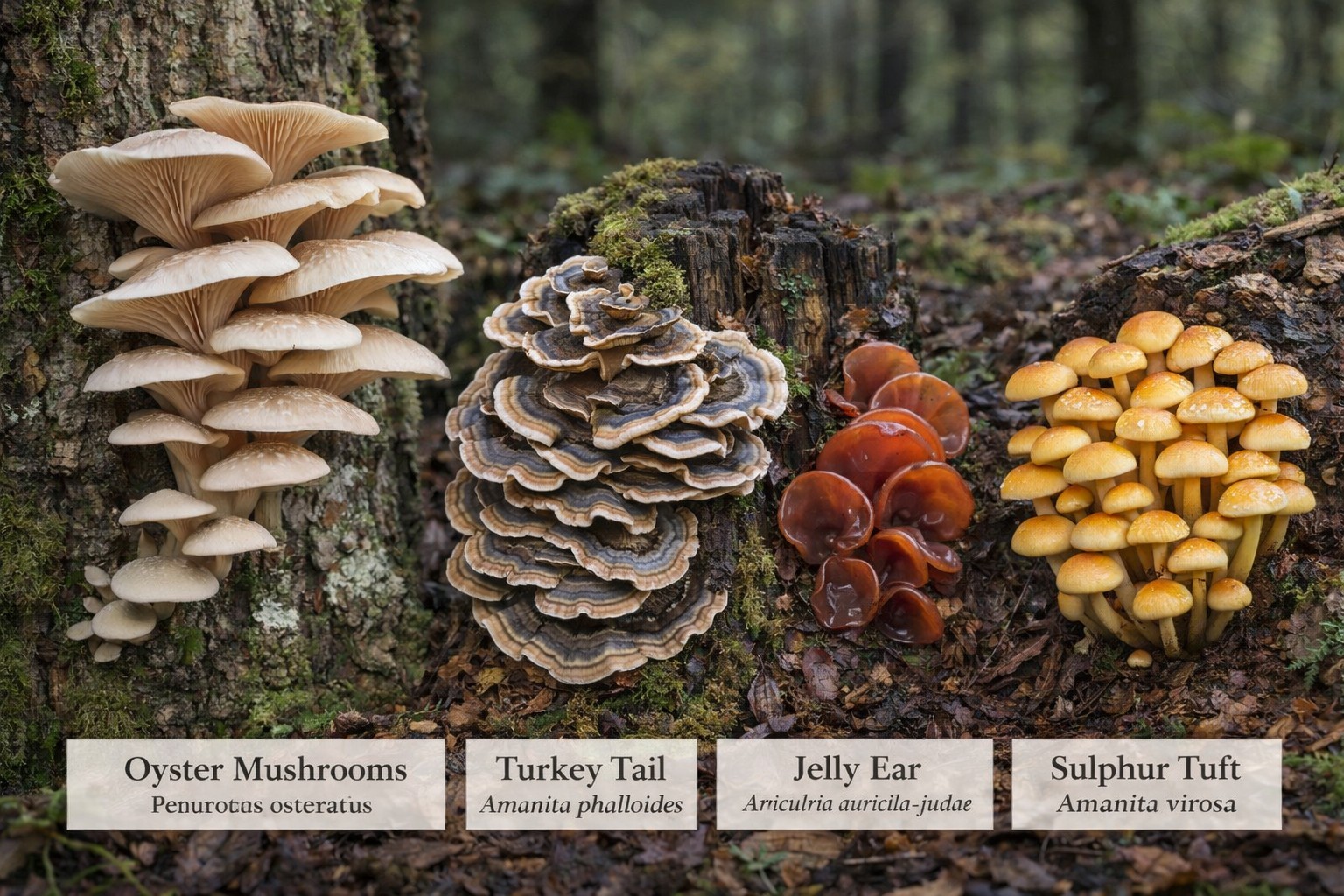
46. Oyster mushroom (Pleurotus ostreatus)
Habitat: dead hardwood. Season: autumn–winter. Gills: white, decurrent. Spore print: pale lilac-white. Notes: shelf-like clusters on trunks and logs.
47. Velvet shank (Flammulina velutipes)
Habitat: dead wood. Season: autumn–winter. Gills: pale cream. Spore print: white. Notes: sticky orange cap, dark velvety stem base.
48. Sulphur tuft (Hypholoma fasciculare)
Habitat: stumps and roots. Season: most of year, especially autumn. Gills: yellow then greenish-dark. Spore print: purple-brown. Notes: dense yellow clusters on wood.
49. Brick tuft (Hypholoma lateritium)
Habitat: hardwood stumps. Season: autumn. Gills: pale then greyish. Spore print: purple-brown. Notes: brick-red cap centre.
50. Honey fungus (Armillaria mellea group)
Habitat: roots, stumps, buried wood. Season: autumn. Gills: pale. Spore print: white. Notes: clustered stems and dark bootlace rhizomorphs.
51. Sheathed woodtuft (Kuehneromyces mutabilis)
Habitat: dead hardwood. Season: spring–autumn. Gills: pale then cinnamon. Spore print: brown. Notes: clustered wood species with ring zone.
52. Turkey tail (Trametes versicolor)
Habitat: dead hardwood. Season: year-round. Form: thin zoned brackets. Notes: one of the most common UK bracket fungi.
53. Artist’s bracket (Ganoderma applanatum)
Habitat: trunks and stumps. Season: perennial. Form: large woody bracket. Notes: underside bruises brown when scratched.
54. Southern bracket (Ganoderma australe)
Habitat: broadleaf trees. Season: perennial. Form: large thick bracket. Notes: common on living and dead trees.
55. Dryad’s saddle (Cerioporus squamosus)
Habitat: deciduous wood. Season: spring–summer. Form: large fan-shaped cap with scales. Notes: often one of the first conspicuous spring brackets.
56. Chicken of the woods (Laetiporus sulphureus)
Habitat: broadleaf trunks. Season: summer–autumn. Form: bright sulphur-yellow brackets. Notes: vivid colour makes it unmistakable.
57. Jelly ear (Auricularia auricula-judae)
Habitat: elder and other broadleaf wood. Season: year-round, best in damp weather. Form: brown ear-shaped jelly fungus.
58. Candlesnuff fungus (Xylaria hypoxylon)
Habitat: dead wood. Season: year-round. Form: black-and-white antler-like clubs. Notes: common in damp woodland.
59. Dead man’s fingers (Xylaria polymorpha)
Habitat: buried wood, tree bases. Season: year-round. Form: black finger-like stromata.
60. Split gill (Schizophyllum commune)
Habitat: dead wood. Season: year-round. Gills: split and hairy. Spore print: white. Notes: small fan-like brackets on sticks and logs.
61. Birch polypore (Fomitopsis betulina)
Habitat: dead birch. Season: year-round. Form: pale hoof-like brackets. Notes: very common on birch trunks.
62. Hoof fungus (Fomes fomentarius)
Habitat: birch and beech. Season: perennial. Form: hard hoof-shaped bracket.
63. Clustered bonnet (Mycena inclinata)
Habitat: stumps. Season: summer–autumn. Gills: pale. Spore print: white. Notes: clustered small brownish bonnets on decaying wood.
64. Common bonnet (Mycena galericulata)
Habitat: stumps and logs. Season: spring–autumn. Gills: pale greyish. Spore print: white. Notes: larger than many Mycena.
65. Bleeding fairy helmet (Mycena haematopus)
Habitat: decaying wood. Season: autumn. Gills: pale. Spore print: white. Notes: exudes reddish juice when cut.
Garden, mulch, compost and disturbed-ground mushrooms
Urban gardens, bark mulch, compost heaps, flowerbeds and disturbed soils often produce very different fungi from old meadow or woodland habitats.
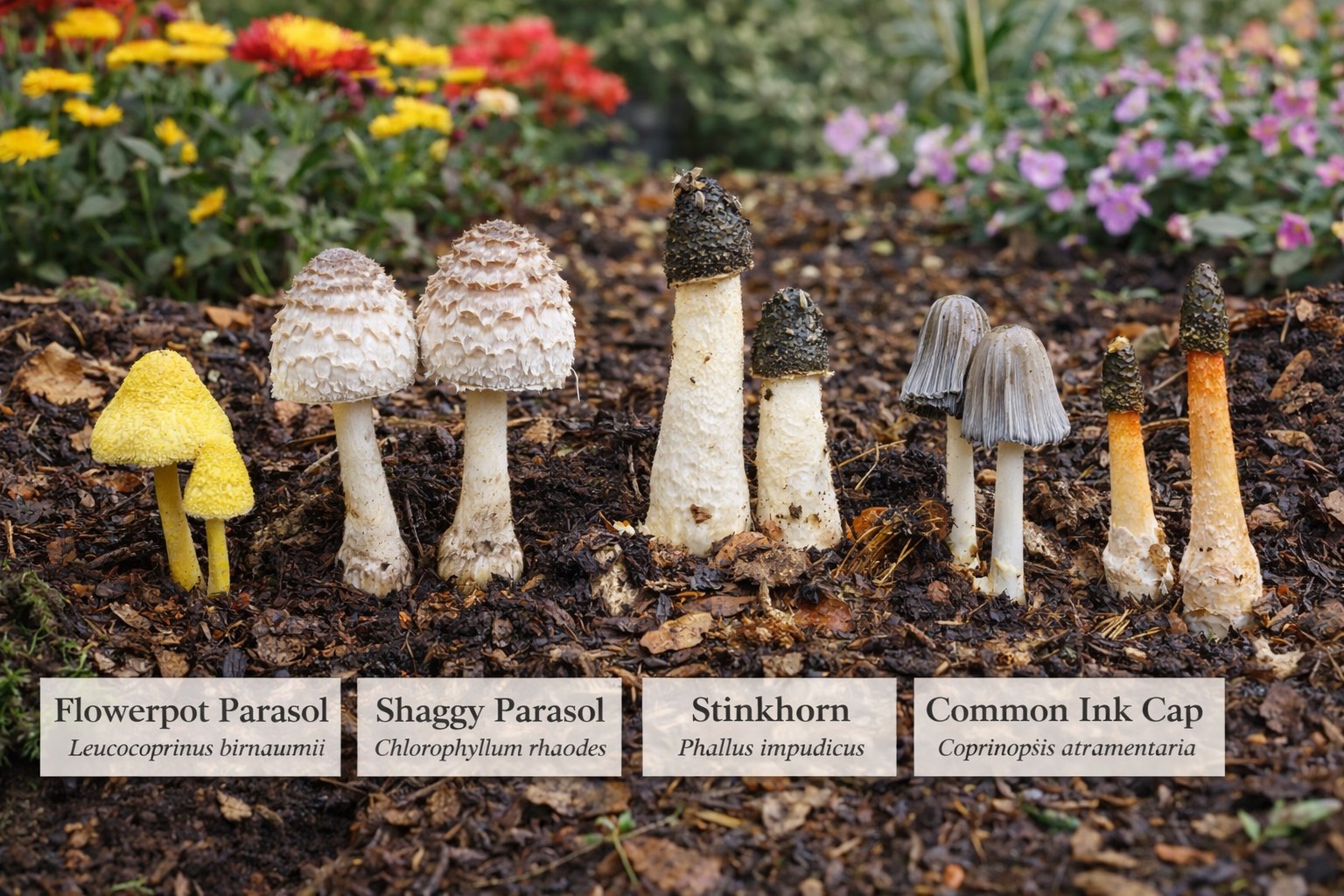
66. Flowerpot parasol (Leucocoprinus birnbaumii)
Habitat: plant pots, greenhouses. Season: indoors any time. Gills: yellow. Spore print: white. Notes: bright yellow greenhouse species.
67. Shaggy parasol (Chlorophyllum rhacodes)
Habitat: gardens, compost-rich places. Season: summer–autumn. Gills: white to cream. Spore print: white. Notes: shaggy cap scales and reddening flesh.
68. Parasol (Macrolepiota procera)
Habitat: grassland edges, heaths, open places. Season: summer–autumn. Gills: white. Spore print: white. Notes: tall, snakeskin stem pattern.
69. Stinkhorn (Phallus impudicus)
Habitat: mulch, woodland, rich soils. Season: summer–autumn. Notes: foul smell, olive gleba at tip, emerges from an egg stage.
70. Dog stinkhorn (Mutinus caninus)
Habitat: mulch, woody debris. Season: summer–autumn. Notes: slender orange stinkhorn.
71. Common inkcap (Coprinopsis atramentaria)
Habitat: buried wood, gardens, pathsides. Season: spring–autumn. Gills: grey then black. Spore print: black. Notes: clustered inkcap on disturbed ground.
72. Magpie inkcap (Coprinopsis picacea)
Habitat: rich woodland and parkland soil. Season: autumn. Gills: pale to blackening. Spore print: black. Notes: striking black and white scaly cap.
73. Glistening inkcap (Coprinellus micaceus)
Habitat: buried wood, gardens, stumps. Season: spring–autumn. Gills: pale then blackening. Spore print: black. Notes: clustered amber-brown caps with mica-like granules.
74. Hare’s foot inkcap (Coprinopsis lagopus)
Habitat: woody debris, compost. Season: spring–autumn. Gills: pale then black. Spore print: black. Notes: hairy white young caps.
75. Trooping crumble cap (Psathyrella multipedata)
Habitat: rich soil and garden beds. Season: autumn. Gills: brown. Spore print: dark brown. Notes: delicate clustered Psathyrella.
76. Brown roll-rim (Paxillus involutus)
Habitat: woodland edges, gardens with birch. Season: summer–autumn. Gills: decurrent, brownish when bruised. Spore print: brown. Notes: rolled-in cap margin when young.
77. Rooting shank (Hymenopellis radicata)
Habitat: buried wood and roots. Season: summer–autumn. Gills: white. Spore print: white. Notes: long rooting stem.
78. Tawny grisette (Amanita fulva)
Habitat: birch-rich wet ground, edges. Season: summer–autumn. Gills: white. Spore print: white. Notes: ringless Amanita with volva and tawny cap.
79. Woodchip fieldcap (Agrocybe rivulosa)
Habitat: bark mulch and woodchip. Season: spring–autumn. Gills: pale to brown. Spore print: brown. Notes: common on landscaped mulch beds.
80. Spring fieldcap (Agrocybe praecox group)
Habitat: gardens, parks, mulch. Season: spring–early summer. Gills: pale then tobacco-brown. Spore print: brown.
81. Pleated inkcap (Parasola plicatilis)
Habitat: lawns, compost-rich soils. Season: spring–autumn. Gills: blackening. Spore print: black. Notes: delicate pleated umbrella-like cap.
82. Common fieldcap (Agrocybe pediades)
Habitat: lawns, pathsides, disturbed ground. Season: spring–autumn. Gills: pale then brown. Spore print: brown.
83. Scarlet caterpillarclub (Cordyceps militaris)
Habitat: woodland litter, parasitic on buried insect pupae. Season: summer–autumn. Notes: bright orange club fungus that stands out strongly on moss or litter.
Heathland, moorland, dune and specialist habitats
These habitats often contain species that readers may miss if they only search lawns and woodland.
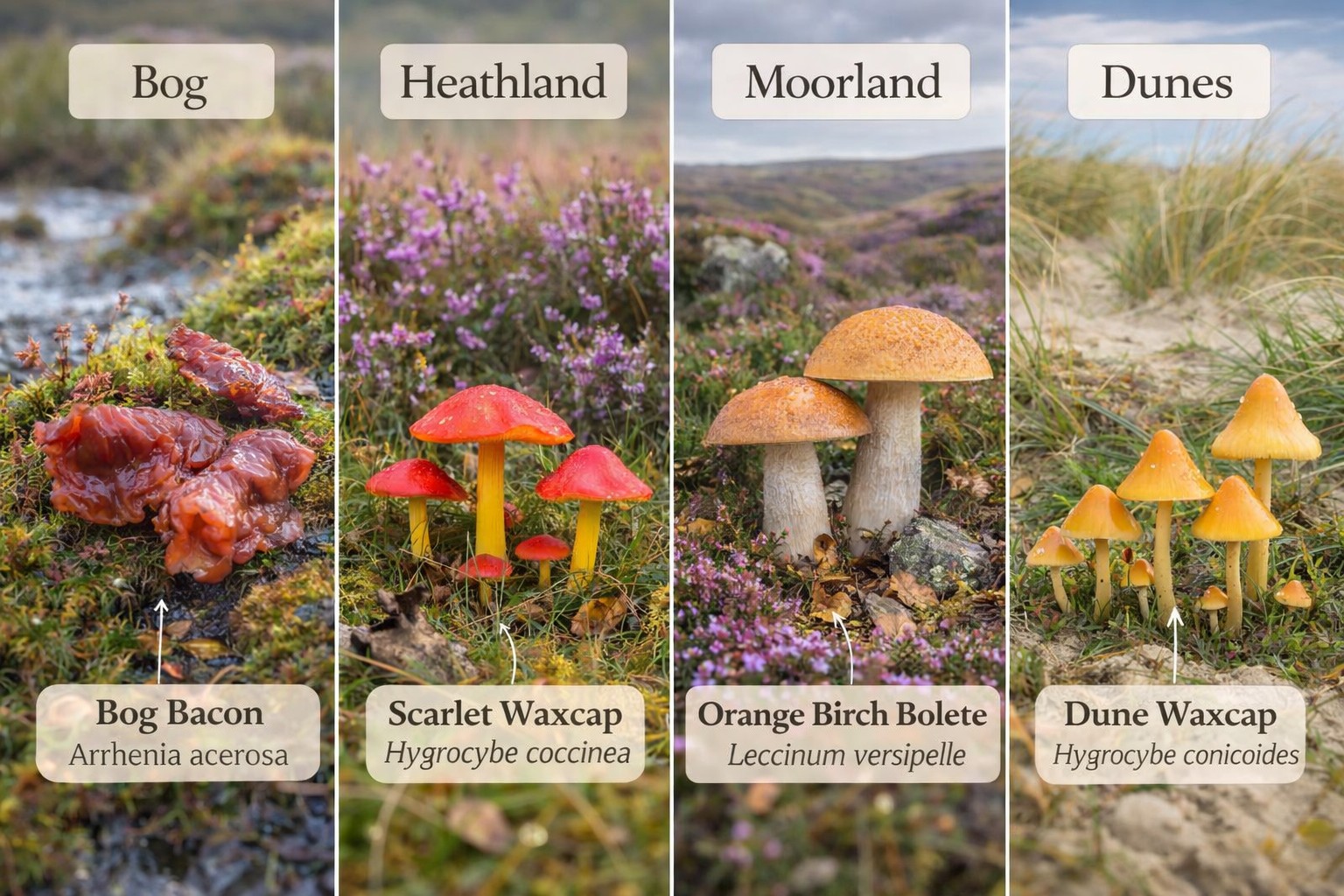
84. Bog beacon (Mitrula paludosa)
Habitat: very wet mossy streams and bogs. Season: spring–summer. Notes: bright yellow club on submerged debris.
85. Bog waxcap (Hygrocybe helobia)
Habitat: marshy grassland and bog edges. Season: autumn. Gills: pale orange. Spore print: white.
86. Heath waxcap (Hygrocybe laeta)
Habitat: heath and acid grassland. Season: autumn. Gills: waxy, pale. Spore print: white.
87. The deceiver (Laccaria laccata)
Habitat: woodland and heathland. Season: summer–autumn. Gills: thick, distant. Spore print: white. Notes: variable colour, hence the name.
88. Amethyst deceiver (Laccaria amethystina)
Habitat: woodland, often beech. Season: summer–autumn. Gills: purple then fading. Spore print: white.
89. Heath navel (Lichenomphalia umbellifera)
Habitat: acidic heath and mossy places. Season: summer–autumn. Gills: pale. Spore print: white.
90. Dune brittlestem (Psathyrella ammophila)
Habitat: coastal dunes. Season: autumn. Gills: brown. Spore print: dark brown. Notes: tied closely to marram grass roots.
Spring and winter mushrooms worth learning first
These species help readers build a seasonal mental map instead of assuming every mushroom appears in autumn.
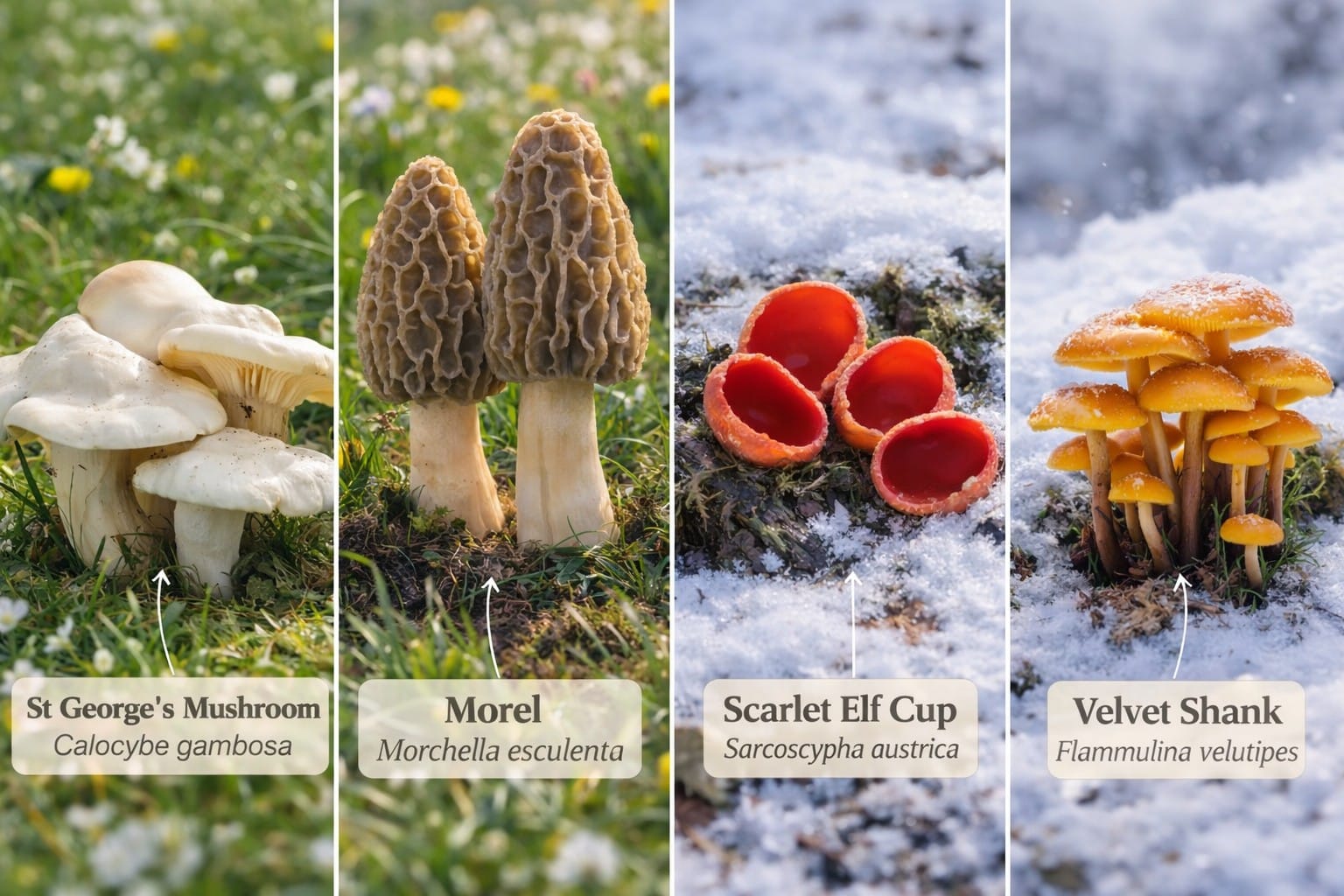
91. St George’s mushroom (Calocybe gambosa)
Habitat: grassland and edges. Season: spring. Gills: pale cream. Spore print: white. Notes: one of the classic spring mushrooms in the UK.
92. Morel (Morchella species)
Habitat: woodland edges, disturbed ground, old orchards. Season: spring. Form: honeycomb cap. Notes: one of the best-known spring fungi.
93. Verpa / early morel-type fungi (Verpa species)
Habitat: damp woodland. Season: spring. Notes: helpful as a comparison group when discussing morel-like species.
94. Scarlet elf cup (Sarcoscypha austriaca)
Habitat: damp woodland sticks. Season: winter–spring. Notes: vivid red cup fungus, often one of the easiest cold-season finds.
95. Velvet shank (Flammulina velutipes)
Habitat: dead wood. Season: autumn–winter. Gills: pale cream. Spore print: white. Notes: one of the best winter mushrooms to memorise.
96. Oyster mushroom (Pleurotus ostreatus)
Habitat: hardwood logs. Season: autumn–winter. Gills: white and decurrent. Spore print: pale lilac-white. Notes: another excellent winter wood species.
97. Jelly ear (Auricularia auricula-judae)
Habitat: elder wood. Season: year-round, especially wet winter weather. Notes: one of the easiest winter fungi to recognise.
98. Turkey tail (Trametes versicolor)
Habitat: dead hardwood. Season: year-round. Notes: visible in every season, useful for new foragers and photographers.
99. Birch polypore (Fomitopsis betulina)
Habitat: birch. Season: year-round. Notes: useful year-round birch indicator species.
100. Candlesnuff fungus (Xylaria hypoxylon)
Habitat: dead wood. Season: year-round. Notes: often easiest to see in colder, leaf-free months when dead wood stands out clearly.
Common spore print colours and what they suggest
Spore print colour is one of the quickest ways to narrow down a mushroom group. It is especially helpful when two mushrooms look similar in the field.
| Spore print colour | Often seen in | Examples in this guide |
|---|---|---|
| White | Amanita, Marasmius, many woodland species | Fly agaric, fairy ring mushroom, oyster mushroom |
| Cream to ochre | Russula, Lactarius | Sickener, woolly milkcap |
| Pinkish-buff | Blewits and some pink-spored groups | Wood blewit, field blewit |
| Brown | Agrocybe, some lawn mushrooms | Fieldcaps, haymaker |
| Dark brown | Agaricus | Field mushroom, horse mushroom |
| Purple-brown | Psilocybe, Hypholoma | Liberty cap, sulphur tuft |
| Rusty-brown | Cortinarius | Webcaps |
| Black | Inkcaps, Panaeolus | Shaggy inkcap, common inkcap, banded mottlegill |
For the full spore workflow, see How to Study Mushroom Spores Under a Microscope. For beginner microscope setup and practical gear notes, see Beginner Guide to Mycology Microscopy UK.
Related SporeBuddies guides
Frequently asked questions
What is the best way to identify common UK mushrooms?
The best beginner method is to combine habitat, season, cap and gill features, spore print colour, and where needed, microscopy. One clue alone is rarely enough.
When is mushroom season in the UK?
Autumn is the main mushroom season in the UK, especially from September to November, but spring, summer and winter all have distinctive fungi of their own.
Why does spore print colour matter?
Spore print colour can quickly rule out many lookalikes. For example, white-spored Amanita are very different from dark brown-spored Agaricus or black-spored inkcaps.
Can season really help identify a mushroom?
Yes. In the UK, season is a major variable. Some fungi are strongly tied to spring, others peak in autumn, and several wood-decay species are best found in winter.
Where can I learn more about mushroom spores?
Start with SporeBuddies’ microscopy guides on studying mushroom spores under a microscope and beginner mycology microscopy in the UK.
Final notes
The fastest way to improve at mushroom identification is to build repeatable habits: note the habitat, note the season, photograph the mushroom properly, and compare multiple features rather than chasing a single match.
This page is designed as a broad reference hub. Your next supporting article should go deeper into mushroom spore shapes so readers can move from field observation into microscopy with a clear pathway.
About this guide
This article is written for educational use on SporeBuddies.com and is designed to support UK readers learning practical mushroom identification, spore work, and beginner mycology microscopy.