
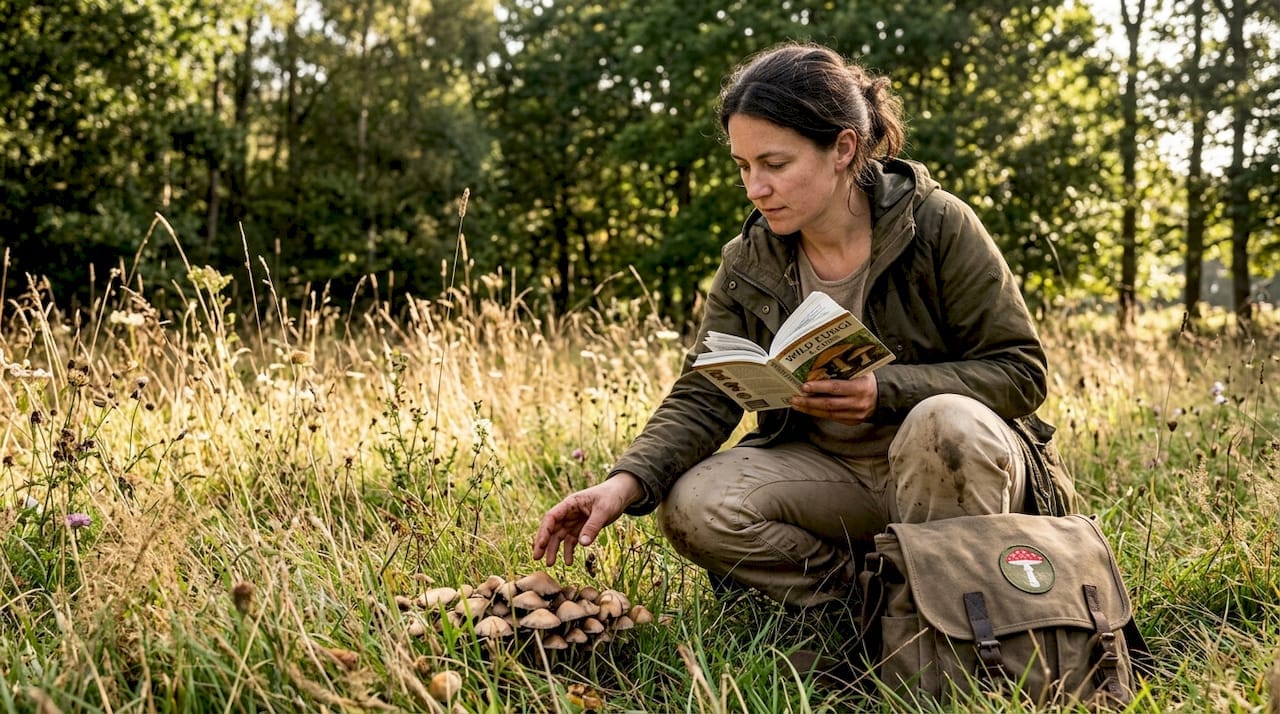
Foraging for wild mushrooms feels deeply satisfying, but it carries real consequences when things go wrong. Since November 2025, California recorded 47 toxic mushroom incidents, resulting in 4 deaths and multiple liver transplants, nearly all linked to death cap misidentification. Knowing the right examples of edible mushrooms, what they look like, where they grow, and how they taste, is what separates a rewarding forage from a dangerous one. This guide covers the best edible mushrooms with clear identification markers, culinary uses, and the safety knowledge you need before you eat anything from the wild.
Table of Contents
- Key takeaways
- 1. How to identify edible mushrooms safely
- 2. Button, portobello, and cremini mushrooms
- 3. Chanterelle mushrooms
- 4. Shiitake mushrooms
- 5. Oyster mushrooms
- 6. Chicken of the woods
- 7. Morel mushrooms
- 8. Porcini mushrooms
- 9. Enoki mushrooms
- 10. Honey mushrooms
- Comparing popular edible mushrooms at a glance
- My honest take on foraging and risk
- Grow your own edible mushrooms with Sporebuddies
- FAQ
Key takeaways
| Point | Details |
|---|---|
| Identification requires multiple signs | Never rely on a single feature; check cap, gills, spore print, stem, and habitat together. |
| Popular edible mushrooms vary widely | Button, chanterelle, shiitake, and oyster are among the most recognisable and widely available. |
| Lookalikes pose serious risk | Species like the death cap closely resemble edible fungi, making confident ID non-negotiable. |
| Start with small portions | Always eat a small amount of any newly foraged mushroom first to test your individual reaction. |
| Growing your own removes the guesswork | Home cultivation of edible species is the safest way to enjoy fresh mushrooms with full confidence. |
1. How to identify edible mushrooms safely
Before you memorise a list of edible fungi, you need a reliable identification method. No single feature tells the whole story. You must cross-reference several physical characteristics together.
What to examine on every mushroom:
- Cap (pileus): Note the shape, colour, texture, and whether it changes with age or moisture. A flat cap may look very different when young and dome-shaped.
- Gills or pores: Look underneath the cap. True gills run in thin blades; false gills (like those on chanterelles) appear as forked ridges. Some edible species have pores instead of gills entirely.
- Spore print: Place the cap gill-side down on white paper for a few hours. The colour of the deposit tells you a great deal. White spore prints combined with certain gill attachments can signal a dangerous species.
- Stem characteristics: Check for a ring (annulus) or a cup at the base (volva). The death cap has both, and misidentification of this species is responsible for the majority of fatal mushroom poisonings worldwide.
- Bruising reactions: Some species change colour when cut or pressed. Boletes that turn blue immediately when sliced are generally best avoided until you know the exact species.
- Habitat and season: A chanterelle in a conifer woodland in autumn is one thing; the same golden colour on a cluster from a rotting stump near a lamp-post is another matter entirely.
Foraging experts consistently recommend using multiple identification signs rather than relying on any single characteristic. If a mushroom does not clearly match every feature you expect, leave it behind.
Pro Tip: Take a field guide specific to the UK or your local region. Identification guides from other countries may describe species that look similar but are not present in your area, which creates a false sense of familiarity.
Always check our dedicated resource on mushroom identification safety before heading out, especially if you are new to foraging.
2. Button, portobello, and cremini mushrooms
Agaricus bisporus is arguably the most familiar name in the list of edible fungi. In its young form it is the white button mushroom; slightly more mature, it becomes the brown cremini; fully grown with a wide, flat cap, it is the portobello. All three are the same species at different life stages.
Agaricus bisporus is cultivated in more than 70 countries, making it the most widely grown edible mushroom on the planet. The white variety we know today even came about by accident: it originated from a chance mutation discovered in 1925, spotted by a Pennsylvania farmer who noticed a cluster of white-capped mushrooms among his usual brown crop.
For identification, look for pink to dark-brown gills that turn chocolatey with age, a ring on the stem, and a firm white flesh that does not change colour when cut. In the wild, avoid confusing them with Agaricus xanthodermus, which smells of ink or phenol and causes stomach upset.
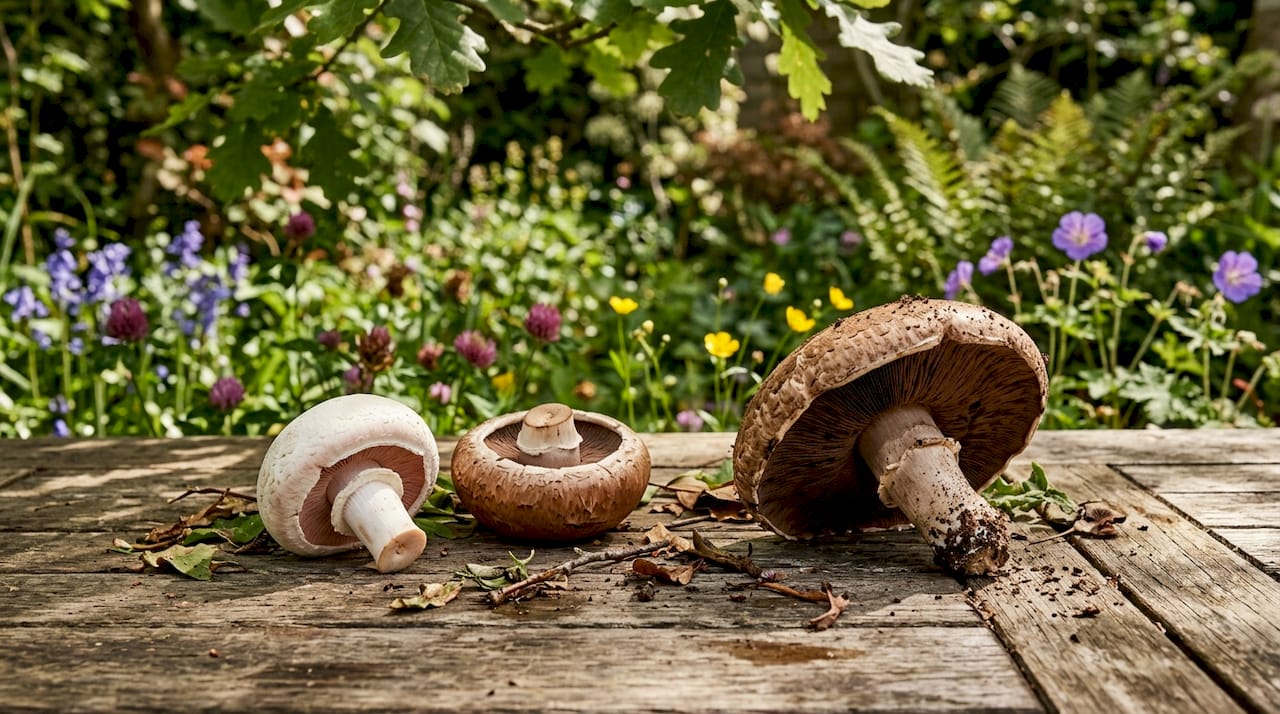
In the kitchen, button mushrooms sauté quickly and take on other flavours well. Portobellos are thick and meaty enough to grill whole as a burger substitute. Cremini sit in between, with a slightly earthier depth than white buttons.
3. Chanterelle mushrooms
The chanterelle (Cantharellus cibarius) is the golden prize of late summer and autumn foraging in the UK. It grows in deciduous and mixed woodland, often near oak and beech, and its colour ranges from pale yellow to a rich egg-yolk orange.
The most important identification feature is its false gills and golden-yellow colour. Unlike true gills, chanterelle ridges are forked, blunt-edged, and run partway down the stem. They cannot be cleanly separated from the cap flesh, whereas true gills on many species can be peeled away.
The dangerous lookalike here is the jack-o’-lantern mushroom (Omphalotus olearius). It has sharp, true gills and, famously, bioluminescent gills that glow faintly in the dark. It grows in clusters on or near buried wood, while chanterelles grow singly from the ground. That habitat difference alone is one of the clearest separators.
Chanterelles have a fruity, mildly peppery aroma and cook beautifully in butter with thyme. They hold their shape well and pair particularly well with eggs, cream sauces, and game.
4. Shiitake mushrooms
Lentinula edodes is one of the most popular edible mushrooms used in cooking across East Asia and increasingly across Europe. Wild shiitake grow on dead or dying hardwood logs, typically oak or chestnut, though the vast majority in supermarkets are cultivated.
The cap is brown, often with a slightly scaly surface, and curves under at the edges when young. The gills are white and fine, and the stem is tough and fibrous, particularly at the base, which you should discard rather than eat. The flavour is distinctively smoky and umami-rich, far more pronounced when dried and rehydrated.
Shiitake are one of the best examples of edible mushrooms to grow at home because they colonise hardwood substrates reliably and produce well across multiple flushes. Sporebuddies stocks everything you need to get started, including the substrate and cultivation equipment suited to shiitake production.
5. Oyster mushrooms
Pleurotus ostreatus is a shelf-forming mushroom that grows in fan-shaped clusters on dying or dead hardwood trees. The cap colour varies considerably across strains: pale grey, white, yellow, and even pink oyster varieties exist, though the grey-blue form is most commonly found in British woodland.
Oyster mushrooms have white, crowded gills that run down a short, off-centre stem. The flesh is white, tender, and has a mild, slightly sweet flavour. One practical point worth knowing is that oyster mushrooms become acrid if harvested too late, so collect them when the cap edges are still slightly curled inward.
They cook very quickly and are ideal for stir-fries, soups, and as a substitute for pulled meat due to their stringy texture when torn. Oyster mushrooms are also one of the best examples of edible mushrooms to grow indoors, requiring minimal equipment and producing fast results.
6. Chicken of the woods
Laetiporus sulphureus is impossible to mistake once you have seen it. It grows in large, bright orange and yellow shelf-like brackets on oak, cherry, and occasionally yew. The largest recorded specimen weighed 100 pounds, which gives you an idea of how substantial these fungi can be.
There are no realistic lookalikes for chicken of the woods when it is young and brightly coloured. As it ages it fades and becomes tough and crumbly, so harvest it when the flesh is still soft and the colour is vivid. Specimens on yew or robinia (false acacia) can cause reactions in some people, so stick to those growing on oak or cherry if you are new to this species.
The texture genuinely resembles cooked chicken breast when young. It shreds, fries, and absorbs marinades well, making it a legitimate meat substitute in a range of dishes.
7. Morel mushrooms
Morels (Morchella species) are one of the most sought-after examples among foragers and professional chefs alike. The cap looks like a sponge or honeycomb, with a network of ridges and hollow pits, and the entire fruiting body is hollow when sliced in half.
They appear in spring, often near ash, elm, and dying orchard trees. Their distinctive cap shape means they are genuinely hard to confuse, though false morels (Gyromitra species) do exist. False morels have a wrinkled, brain-like cap rather than true pits, and the stem is not fully hollow throughout. The difference is clear if you cut the mushroom lengthways before eating.
Morels are prized for their deep, earthy flavour. Never eat them raw as they contain heat-sensitive toxins; a thorough cook removes these entirely.
8. Porcini mushrooms
Boletus edulis, known as porcini or cep, is revered in Italian and French cooking. The cap is brown and bun-shaped, the stem is thick and bulging with a pale net-like pattern, and the underside shows a spongy pore surface rather than gills.
The key identification point is the pore layer. It starts white, turns yellow, and eventually becomes greenish with age. The flesh is white and does not change colour significantly when cut, which is a useful reassurance. Avoid any bolete that turns strongly blue when cut and has a red pore surface, as these include toxic species.
Porcini are exceptional dried. The drying process concentrates their flavour dramatically, and even a small amount rehydrated into a risotto or pasta sauce adds real depth.
9. Enoki mushrooms
Cultivated enoki (Flammulina filiformis) look nothing like their wild counterpart. Shop-bought enoki are white, long-stemmed, and grow in tight clusters due to low-light conditions during cultivation. Wild enoki are orange-brown with a sticky cap and grow on dead elm and other hardwoods in autumn and winter.
Both forms are mild in flavour with a pleasant crunch. Cultivated enoki are used raw in salads, in hot pot, and as a garnish. They are one of the most visually distinctive examples on any list of edible fungi.
10. Honey mushrooms
Armillaria species are common in UK woodland, growing in dense clusters at the base of trees and on stumps. The caps are honey-coloured to brown, the gills are white and run slightly down the stem, and most species have a ring.
Honey mushrooms have tough stalk tips that should be discarded before cooking. They also require thorough cooking; eating them undercooked causes digestive upset. Some people react badly to them regardless of preparation, so this is a species where the first-time small portion test recommended by experts is not optional. It is genuinely necessary.
“When in doubt, throw it out.” This forager’s motto sounds simple, but applying it consistently is what keeps experienced foragers safe. No meal is worth the risk of misidentification.
Pro Tip: If you are new to honey mushrooms, try a cultivated or verified source before foraging wild ones. The preparation requirements and the risk of individual intolerance make them a better second or third year foraging project than a beginner’s first choice.
Comparing popular edible mushrooms at a glance
Use this table to weigh up your options based on identification difficulty, culinary versatility, and risk level.
| Mushroom | Identification difficulty | Culinary use | Risk level |
|---|---|---|---|
| Button / portobello | Low (cultivated form) | Versatile: raw, sautéed, grilled | Low (cultivated) |
| Chanterelle | Moderate | Butter, cream, game dishes | Moderate (jack-o’-lantern lookalike) |
| Shiitake | Low (cultivated form) | Stir-fry, soups, dried | Low (cultivated) |
| Oyster mushroom | Low to moderate | Stir-fry, soups, mock pulled meat | Low |
| Chicken of the woods | Low (when fresh) | Grilled, marinated, as meat substitute | Low to moderate |
| Morel | Moderate | Sauces, risotto, sautéed | Moderate (false morel lookalike) |
| Porcini | Moderate | Risotto, pasta, dried | Moderate (toxic bolete lookalikes) |
| Enoki | Low (cultivated form) | Salads, hot pot, garnish | Low (cultivated) |
| Honey mushroom | Moderate | Sautéed, stews | Moderate (must cook thoroughly) |
When introducing any new wild mushroom to your diet, eat a small amount at your first sitting and wait 24 hours. Individual tolerance varies, and some people react to species that others eat freely. This applies even to edible species with a good safety record.
For seasonal availability in the UK: chanterelles and chanterelles peak from July to October; porcini from August to November; morels in April and May; chicken of the woods from summer into early autumn.
Grow your own edible mushrooms with Sporebuddies
If this guide has you keen to eat more edible mushrooms but wary of the risks, growing your own is the most sensible starting point. Sporebuddies supplies everything a home grower needs, from mushroom growing kits designed for beginners to specialist substrates and cultivation equipment. Shiitake, oyster, and lion’s mane are all available and straightforward to grow in a UK home environment. You get fresh mushrooms, full confidence in what you are eating, and the satisfaction of producing them yourself. Browse the full range of growing equipment and supplies to find the right setup for your space and experience level.
FAQ
What are the easiest edible mushrooms to identify?
Oyster mushrooms, button mushrooms, and chicken of the woods are widely considered the most straightforward for beginners due to their distinctive shapes, colours, and the absence of dangerous lookalikes when young.
How do you tell edible mushrooms apart from poisonous ones?
Check the cap, gills or pores, spore print, stem features, habitat, and season together. Relying on any single characteristic is not sufficient; always use multiple identification signs before consuming any wild mushroom.
Can you eat mushrooms you find in the garden?
Some garden mushrooms are edible, but many are not, and toxic species including the death cap do grow in UK gardens. Unless you can make a confident, verified identification, treat any unknown garden mushroom as potentially dangerous.
Are there edible mushrooms you can grow at home in the UK?
Yes. Shiitake, oyster, lion’s mane, and king oyster mushrooms are among the popular edible mushrooms you can grow legally at home in the UK using ready-made grow kits and appropriate substrates.
Why does the first-time portion test matter even for known edible species?
Individual tolerance varies between people, and some edible species like honey mushrooms cause digestive reactions in certain individuals regardless of preparation. Eating a small amount first and waiting 24 hours lets you assess your own response before consuming a full serving.