
Reviewed by: SporeBuddies Research Team
Last Reviewed: June 2026
Psilocybe Azurescens vs Psilocybe Cyanescens:What you need to know
Psilocybe azurescens and Psilocybe cyanescens are two of the most famous wood-loving species in the genus Psilocybe. Both are associated with dark purple-brown spores, strong blue bruising reactions, wood-rich habitats and high scientific interest, which is why they are so often compared by researchers, microscopy enthusiasts and mycology readers.
Despite those similarities, they are not the same mushroom. Psilocybe azurescens, commonly known as the Flying Saucer Mushroom, is especially associated with coastal habitats, Astoria, Oregon and the Pacific Northwest. Psilocybe cyanescens, commonly known as the Wavy Cap Mushroom, is best recognised for its undulating cap margin and its frequent association with wood-chip beds, landscaped areas and introduced temperate habitats.
Quick answer: Psilocybe azurescens is most strongly associated with coastal wood debris, dune systems and the Astoria/Oregon identity, while Psilocybe cyanescens is best known for its distinctive wavy cap and wider occurrence in wood-chip and mulch-rich environments. Both are wood-loving Psilocybe species, but they differ in habitat preference, cap morphology, distribution and historical identity.
This guide is written for education, taxonomy, microscopy and harm-reduction awareness. It is not a foraging guide, dosage guide or cultivation guide. Wild mushroom identification should never be attempted from one feature, one photograph or one online article. Many wood-associated mushrooms have dangerous lookalikes. Unknown fungi should be treated as hazardous unless verified by qualified experts using multiple identification methods.
Quick Answer: What Is the Difference Between Azurescens and Cyanescens?
Psilocybe azurescens and Psilocybe cyanescens are separate wood-loving Psilocybe species. The easiest way to understand the difference is this: Azurescens is the coastal, Astoria-associated Flying Saucer Mushroom, while Cyanescens is the mulch-loving, wavy-capped species often discussed from wood-chip habitats and introduced temperate environments.
Both species can show strong blue bruising and dark purple-brown spore prints. Both are frequently discussed in relation to high reported alkaloid levels and Wood Lover's Paralysis. However, they differ in cap shape, typical habitat, geographic identity, size reputation and the way they are recognised in microscopy and taxonomy discussions.
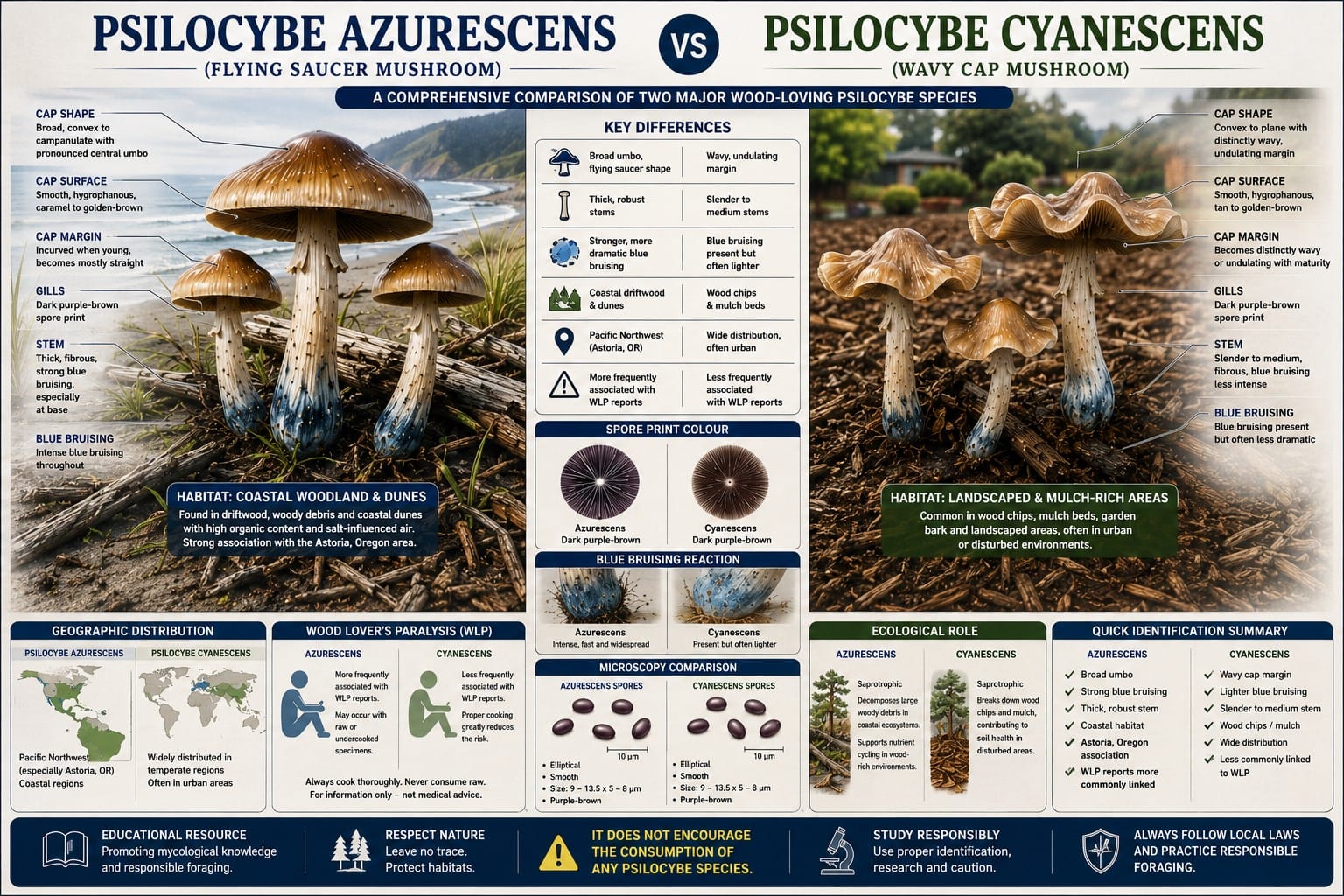
Psilocybe Azurescens vs Cyanescens Comparison Infographic
The infographic below summarises the major differences between the two species, including habitat, cap shape, distribution, spores, alkaloid comparison, Wood Lover's Paralysis association and field-identification caution.
At a Glance: Which Species Wins Each Category?
- Larger Species:
Psilocybe azurescens - Most Distinctive Cap Shape:
Psilocybe cyanescens - Strongest Astoria Association:
Psilocybe azurescens - Most Widespread:
Psilocybe cyanescens - Most Famous Coastal Species:
Psilocybe azurescens - Best Known Urban Mulch Species:
Psilocybe cyanescens
Psilocybe Azurescens vs Psilocybe Cyanescens Comparison Table
This table gives a practical overview of the most important differences. It should be read as a comparison of typical characteristics, not as a complete identification key.
| Feature | Psilocybe azurescens | Psilocybe cyanescens |
|---|---|---|
| Common Name | Flying Saucer Mushroom | Wavy Cap Mushroom |
| Primary Identity | Coastal wood-loving species strongly linked with Astoria and the Pacific Northwest | Wood-loving species recognised for wavy mature cap margins and mulch-rich habitats |
| Typical Habitat | Coastal wood debris, dune grasses, driftwood, hardwood fragments and Pacific Northwest coastal environments | Wood chips, mulch beds, landscaped gardens, parks, disturbed habitats and urban/suburban woody debris |
| Geographic Association | Astoria, Oregon, Washington, British Columbia and Pacific Northwest coastal regions | Pacific Northwest, Europe, parts of North America, New Zealand and other temperate introduced regions |
| Cap Shape | Broad, often umbonate, saucer-like at maturity | Distinctively wavy or undulating margin when mature |
| Spore Print | Dark purple-brown to purplish black | Dark purple-brown to purplish black |
| Blue Bruising | Strong blue bruising reaction commonly discussed | Strong blue bruising reaction commonly discussed |
| Wood Loving | Yes | Yes |
| Baeocystin Interest | Notable in published summaries and research discussion | Moderate to notable interest depending on sample and study |
| Wood Lover's Paralysis | Frequently discussed in WLP reports and harm-reduction contexts | Frequently discussed in WLP reports and harm-reduction contexts |
| Best Search Identity | Flying Saucer Mushroom, Astoria Azurescens, coastal wood-loving Psilocybe | Wavy Cap Mushroom, wood-chip Psilocybe, mulch-loving Psilocybe |
Species Overview: Flying Saucer Mushroom vs Wavy Cap Mushroom
What Is Psilocybe Azurescens?
Psilocybe azurescens is a wood-loving mushroom species best known as the Flying Saucer Mushroom. It is strongly associated with coastal wood-rich habitats of the Pacific Northwest, especially the Astoria, Oregon region. Its broad cap, strong blue bruising reaction, dark purple-brown spore print and unusually high reported alkaloid interest make it one of the most discussed species in the genus Psilocybe.
For a full species-level overview, see the SporeBuddies guide to Psilocybe azurescens.
What Is Psilocybe Cyanescens?
Psilocybe cyanescens is a wood-loving species commonly known as the Wavy Cap Mushroom. It is especially recognised by its mature cap margin, which can become dramatically wavy or undulating. Cyanescens is often discussed from wood-chip beds, mulch-rich environments, landscaped areas and introduced temperate habitats, making it one of the best-known urban wood-loving Psilocybe species.
Although it shares several features with Azurescens, it has its own habitat identity, morphology and distribution pattern.
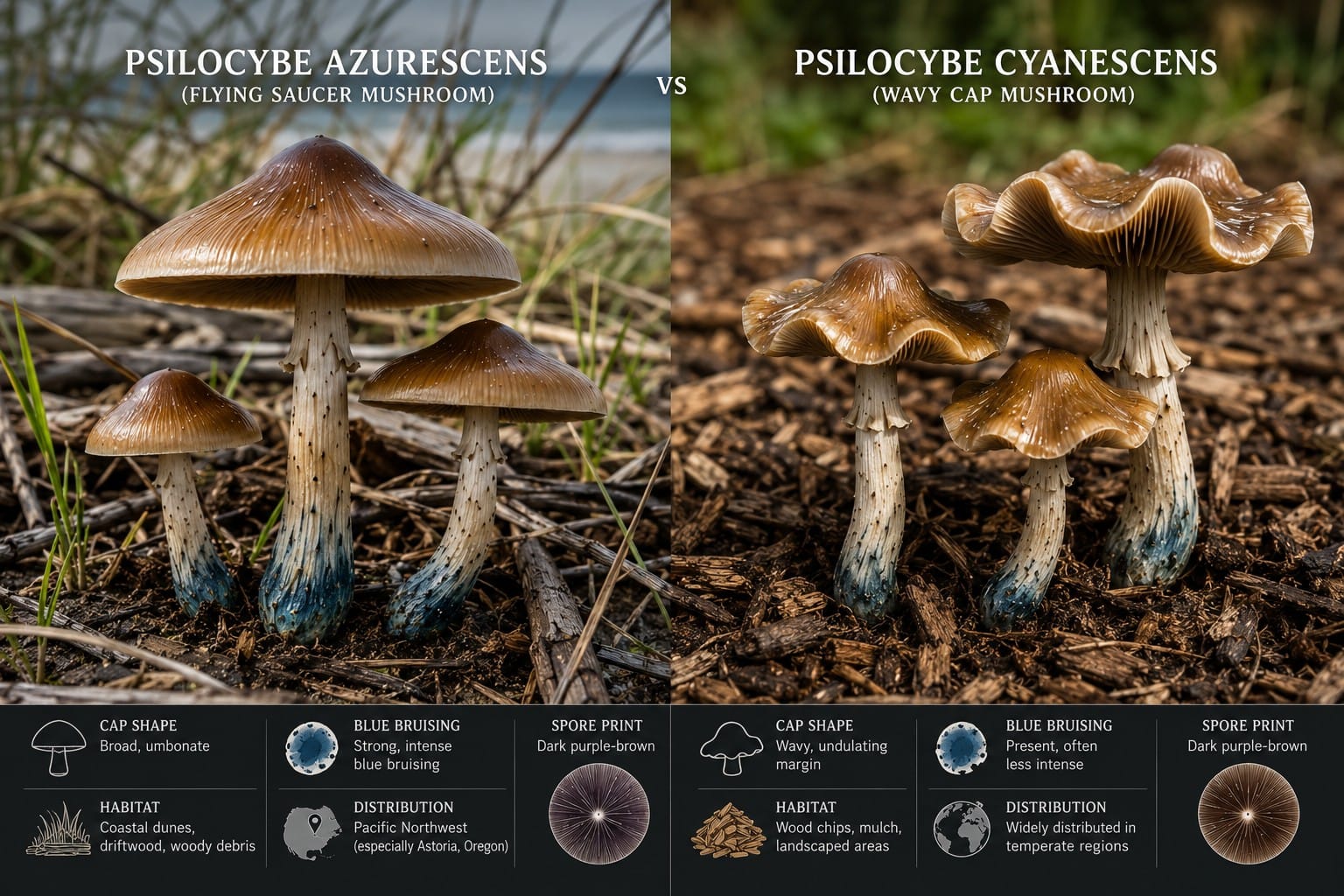
Habitat Differences: Coastal Specialist vs Urban Wood-Chip Coloniser
Habitat is one of the clearest differences between these two species. Both are wood-loving fungi, but their typical ecological stories are different. Azurescens is strongly tied to coastal systems and Pacific Northwest identity, while Cyanescens is often associated with wood-chip beds, mulch and disturbed landscaped environments.
Psilocybe Azurescens Habitat
Psilocybe azurescens is most strongly associated with coastal wood debris, dune grasses, driftwood, hardwood fragments and lignin-rich material. Its identity is closely linked with the Pacific Northwest coast, where moisture, autumn weather, wood-rich substrates and coastal plant communities create a distinctive ecological setting.
This coastal identity is part of why Azurescens is so memorable. It is not simply another wood-loving mushroom; it is a species with a strong geographic and ecological story.
Psilocybe Cyanescens Habitat
Psilocybe cyanescens is often discussed from wood-chip beds, mulched pathways, landscaped gardens, parks and disturbed woody habitats. This gives it a different ecological personality from Azurescens. Rather than being known mainly as a coastal specialist, Cyanescens is frequently framed as a successful coloniser of wood-rich human-modified environments.
This difference helps explain why Cyanescens is more commonly discussed across a wider range of urban and introduced regions.
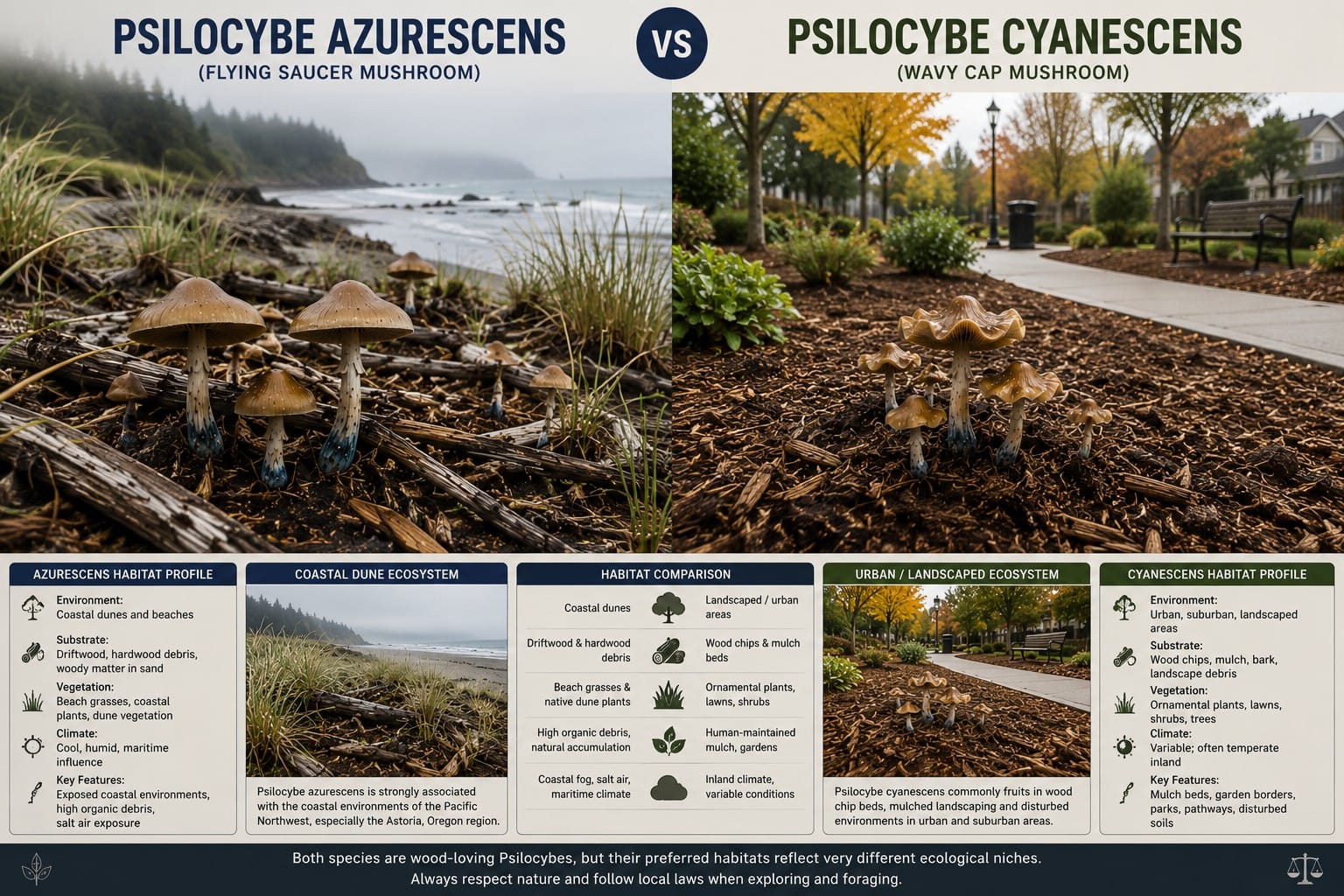
Can Psilocybe Azurescens and Psilocybe Cyanescens Grow in the Same Region?
Yes, regional overlap is possible, especially in the broader Pacific Northwest where multiple wood-loving Psilocybe species are discussed. However, sharing a region does not mean the species occupy identical habitats. Azurescens is much more strongly associated with coastal systems, while Cyanescens is often linked with wood-chip beds and mulch-rich environments.
This is why habitat can help support identification, but it should never be used alone. Reliable identification requires multiple lines of evidence, including morphology, spore print, microscopy, habitat context and expert verification where necessary.
Identification Differences: Cap Shape, Stem, Gills and Blue Bruising
The most visually memorable difference is cap shape. Mature Azurescens specimens are often described as having a broad, saucer-like cap with a central umbo, while Cyanescens is famous for its wavy, undulating mature cap margin.
| Identification Feature | Psilocybe azurescens | Psilocybe cyanescens |
|---|---|---|
| Cap Shape | Broad, convex to plane, often with a pronounced central umbo | Convex to expanded with a strongly wavy or undulating margin at maturity |
| Common Visual Nickname | Flying Saucer Mushroom | Wavy Cap Mushroom |
| Cap Colour | Caramel, chestnut-brown, ochre-brown tones; colour can vary with moisture | Caramel to brown tones; often hygrophanous and variable with age and moisture |
| Stem | Pale to whitish, often bruising blue, sometimes relatively robust | Pale to whitish, often bruising blue, typically associated with smaller stature than Azurescens |
| Gills | Darkening as spores mature; purple-brown spore production | Darkening as spores mature; purple-brown spore production |
| Bruising | Strong blue bruising commonly discussed | Strong blue bruising commonly discussed |
| Identification Caution | Blue bruising alone is not enough for identification | Wavy cap alone is not enough for identification |
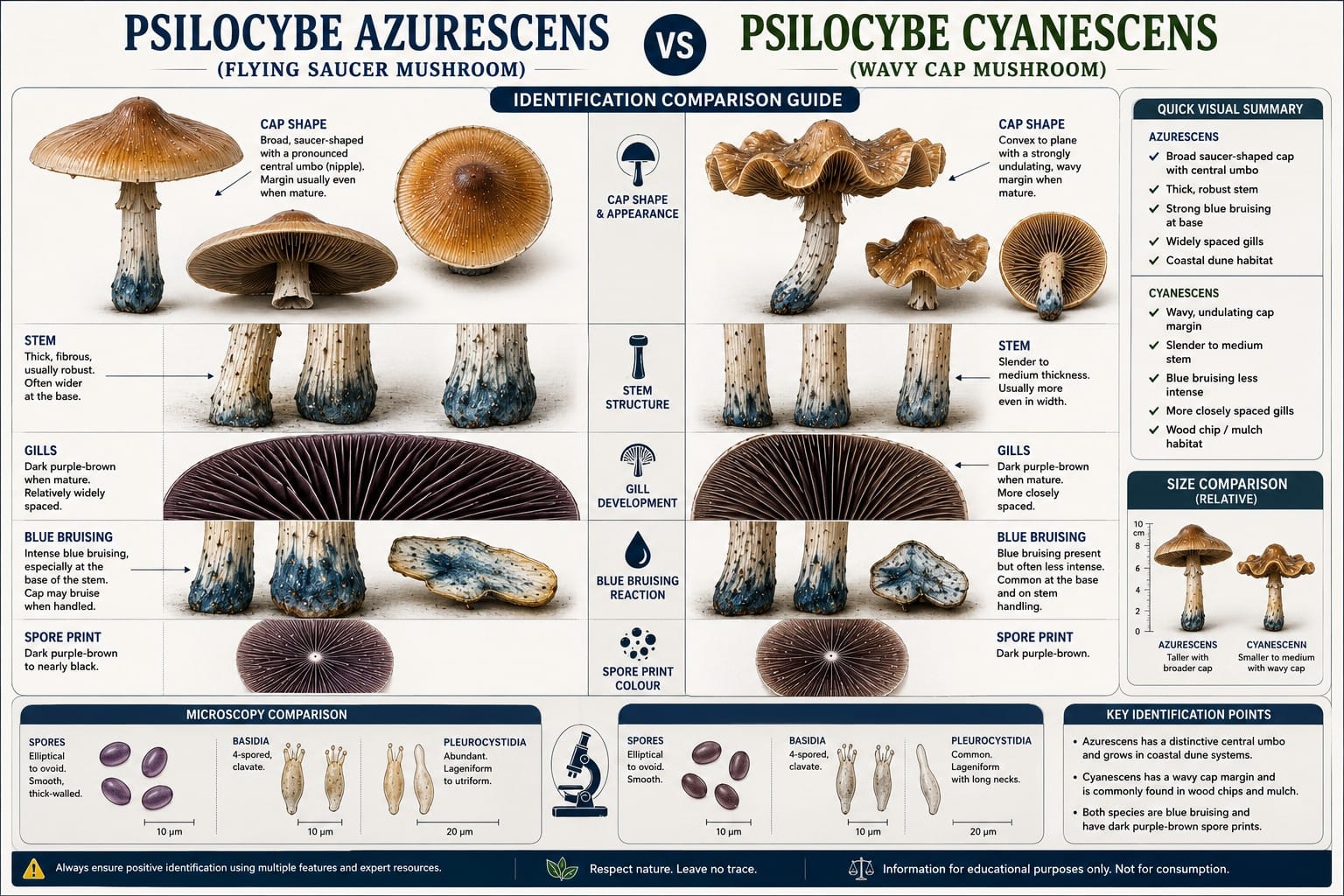
Why Accurate Identification Matters
Wood-rich environments can contain many small brown mushrooms, including species that may be toxic or even deadly. This is especially important because inexperienced observers may over-focus on one feature such as cap colour, blue bruising, habitat or general appearance.
Responsible identification requires a combination of evidence. Spore print colour, cap morphology, gill structure, stem characteristics, bruising reaction, habitat, microscopy and expert review all matter. No single feature should be treated as definitive.
Some dangerous mushrooms can occur in wood-rich habitats. This page is not a foraging guide and should not be used to decide whether any wild mushroom is safe to consume. When in doubt, do not handle, collect or ingest unknown fungi.
Size Comparison: Is Azurescens Larger Than Cyanescens?
Psilocybe azurescens is often described as the larger and more robust of the two species, while Psilocybe cyanescens is often discussed as smaller but visually distinctive due to its wavy cap margin. Size can vary considerably depending on age, environment, moisture, substrate and local conditions, so it should not be treated as a reliable identification feature on its own.
However, as a general comparison, Azurescens is commonly framed as the larger coastal species, while Cyanescens is commonly framed as the smaller, widespread Wavy Cap species.
Microscopy and Spore Print Comparison
Microscopy is one of the strongest educational ways to compare these two species. Both produce dark purple-brown to purplish-black spore prints and both are commonly described as having ellipsoid spores under magnification. This similarity is one reason macroscopic appearance and habitat context remain important.
| Microscopy Feature | Psilocybe azurescens | Psilocybe cyanescens |
|---|---|---|
| Spore Print Colour | Dark purple-brown to purplish black | Dark purple-brown to purplish black |
| Spore Shape | Typically described as ellipsoid | Typically described as ellipsoid |
| Microscopy Value | High value for comparing rare wood-loving species, locality context and morphology | High value for comparing wood-loving species and Wavy Cap morphology |
| Research Context | Strong association with Astoria, alkaloid interest and wood-loving ecology | Strong association with wood-chip habitats, distribution and comparison with related species |
Because the spore prints can appear similar, microscopy should be considered part of a wider identification process rather than a standalone answer. For educational study, comparing spores, habitat notes and macroscopic features together creates a much stronger species profile.
Alkaloid Comparison: Why Both Species Have a Strong Reputation
Both Psilocybe azurescens and Psilocybe cyanescens are frequently discussed because of their reported alkaloid profiles. Published summaries often place both species among the more potent members of the genus Psilocybe, although exact values vary significantly between samples.
Alkaloid values vary depending on genetics, specimen maturity, habitat, substrate, drying, storage and analytical method. No sample, spore product, print, swab, culture or lineage should be assumed to match published values without laboratory analysis.
| Compound / Topic | Psilocybe azurescens | Psilocybe cyanescens |
|---|---|---|
| Psilocybin Interest | Very high; frequently discussed as one of the most alkaloid-rich wood-loving species | Very high; frequently discussed among potent wood-loving species |
| Psilocin Interest | Variable and sample-dependent | Variable and sample-dependent |
| Baeocystin Interest | Notable, especially in Azurescens-focused research discussions | Moderate to notable depending on the sample and source |
| Research Framing | Often framed around extreme potency reputation, Astoria identity and alkaloid diversity | Often framed around strong potency reputation, Wavy Cap identity and distribution |
For a deeper chemistry-focused discussion, the Azurescens cluster should link to a dedicated Psilocybe Azurescens Alkaloid Profile guide once published.
Wood Lover's Paralysis: Are Both Species Associated?
Yes. Both Psilocybe azurescens and Psilocybe cyanescens are frequently mentioned in Wood Lover's Paralysis discussions. Wood Lover's Paralysis, often abbreviated as WLP, is a poorly understood reported syndrome involving temporary weakness or impaired movement after exposure to some wood-loving Psilocybe species.
The exact mechanism remains unresolved. Proposed explanations include unknown secondary metabolites, environmental variables, microbial factors, individual sensitivity, unusual compound interactions or several factors acting together. No single cause should be presented as proven.
If any person experiences breathing difficulty, airway obstruction, chest pain, loss of consciousness, severe confusion, severe weakness or rapidly worsening symptoms after exposure to any wild mushroom, seek emergency medical help immediately.
For a full safety-focused article, link to the dedicated Wood Lover's Paralysis Guide once it is published.
Geographic Distribution: Astoria Association vs Wider Global Spread
Geographic identity is another important distinction. Psilocybe azurescens has a powerful place-based identity because of its association with Astoria, Oregon and the Pacific Northwest coast. Psilocybe cyanescens is also associated with the Pacific Northwest, but it is more widely discussed from introduced and temperate habitats across several regions of the world.
Azurescens: Astoria and the Pacific Northwest
Azurescens is strongly linked with coastal habitats around Oregon, Washington and British Columbia. The Astoria connection gives the species a memorable historical and ecological identity that helps distinguish it from other wood-loving species.
Cyanescens: Wider Introduced Distribution
Cyanescens is frequently discussed from North America, Europe, New Zealand and other temperate regions where wood-chip beds and mulch-rich environments provide suitable ecological niches. Its distribution story is therefore broader and more urban-adapted than the typical Azurescens narrative.
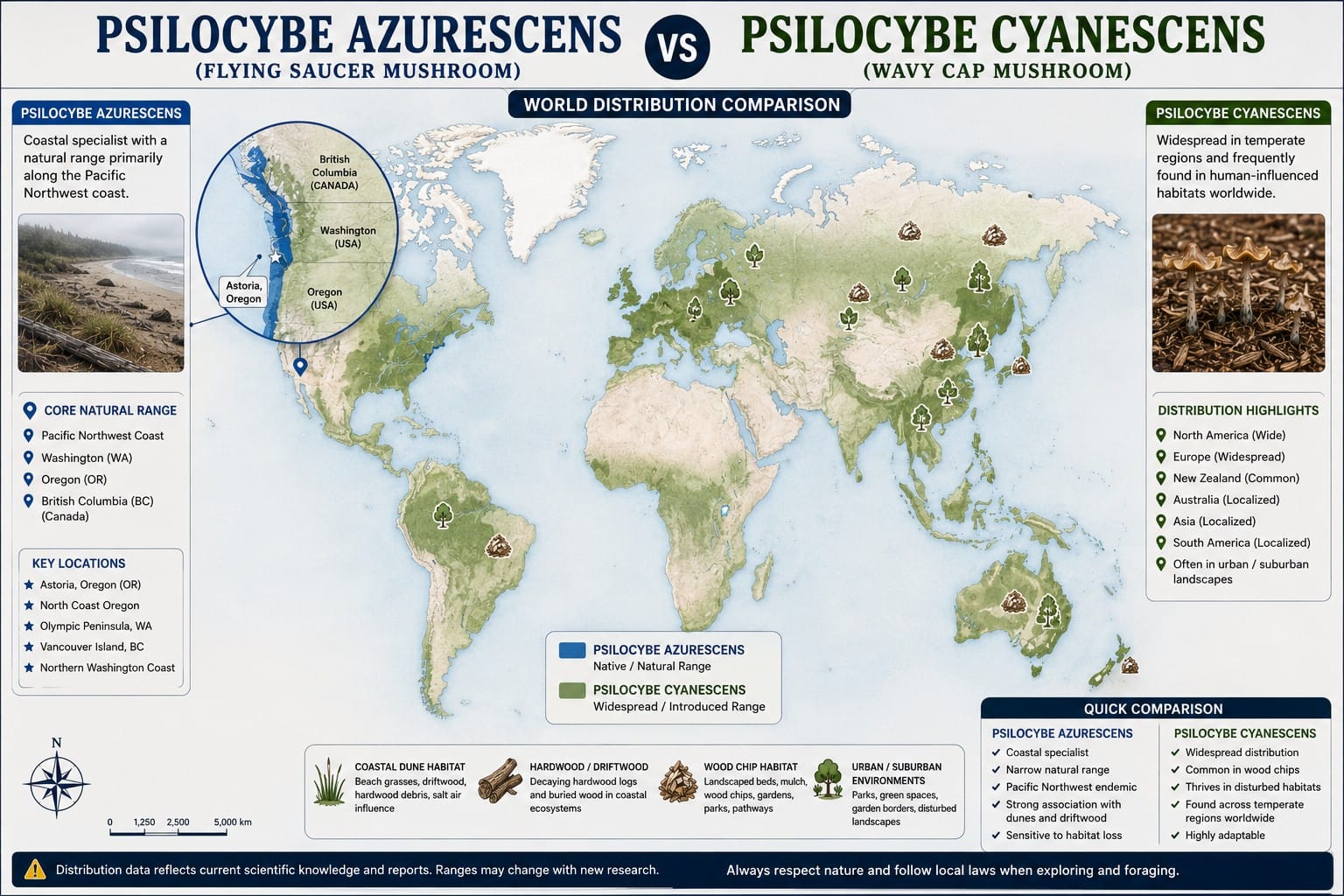
Which Species Is More Closely Linked to Astoria?
Psilocybe azurescens is much more closely linked to Astoria, Oregon. The Flying Saucer Mushroom has become one of the best examples of a Psilocybe species with a strong place-based identity. Astoria, the Columbia River estuary, Oregon coastal habitats and Pacific Northwest wood-debris ecology all reinforce the species' story.
Psilocybe cyanescens may occur in the broader Pacific Northwest, but its strongest popular identity is not Astoria. It is better known as the Wavy Cap Mushroom and as a wood-chip or mulch-associated species with a wider introduced distribution.
Which Species Is More Widespread?
Psilocybe cyanescens is usually discussed as the more widespread of the two. Its association with mulch, landscaped habitats and wood-chip beds has helped make it one of the most recognisable wood-loving Psilocybe species in several temperate regions.
Azurescens remains more strongly associated with a narrower coastal identity. That does not make it less important; in fact, the more specific ecological story is part of what makes Azurescens such a distinctive and memorable species.
Where Do Azurescens and Cyanescens Fit Within Wood-Loving Psilocybe Species?
Azurescens and Cyanescens are part of a wider group of wood-loving Psilocybe species that also includes species such as Psilocybe allenii, Psilocybe subaeruginosa and Psilocybe ovoideocystidiata. These species are often compared because they share ecological preferences for woody material, blue bruising reactions, dark spore prints and a strong presence in identification and harm-reduction discussions.
This wider family context is useful because it prevents the comparison from becoming too narrow. Azurescens and Cyanescens are not isolated curiosities; they are part of a broader ecological and taxonomic conversation around lignicolous, wood-loving fungi.
Final Summary: Azurescens vs Cyanescens
Psilocybe azurescens and Psilocybe cyanescens are two of the most important wood-loving Psilocybe species for comparison. They share dark purple-brown spores, strong blue bruising reactions, wood-rich habitats and high scientific interest. However, Azurescens is best understood as the Astoria-associated coastal Flying Saucer Mushroom, while Cyanescens is best understood as the Wavy Cap Mushroom of wood-chip, mulch and introduced temperate habitats.
The most useful differences are habitat, cap shape, geographic identity and species story. Azurescens is the stronger choice for Astoria and coastal ecology discussions. Cyanescens is the stronger choice for wavy cap morphology and broad distribution discussions. Both deserve careful, safety-conscious treatment in educational mycology content.
Psilocybe Azurescens vs Cyanescens FAQs
What is the main difference between Psilocybe azurescens and Psilocybe cyanescens?
The main difference is habitat and morphology. Psilocybe azurescens is strongly associated with coastal habitats and Astoria, Oregon, while Psilocybe cyanescens is known for its wavy cap and frequent association with wood-chip and mulch-rich environments.
Is Psilocybe azurescens the same as Psilocybe cyanescens?
No. They are separate species within the genus Psilocybe. They share wood-loving ecology, dark purple-brown spores and blue bruising, but they differ in cap shape, habitat preference, distribution and historical identity.
Which is called the Flying Saucer Mushroom?
Psilocybe azurescens is commonly known as the Flying Saucer Mushroom. The name is linked to its broad, often umbonate, saucer-like cap shape.
Which is called the Wavy Cap Mushroom?
Psilocybe cyanescens is commonly known as the Wavy Cap Mushroom because mature specimens often develop a distinctive wavy or undulating cap margin.
Do Azurescens and Cyanescens have the same spore print colour?
Both species are commonly associated with dark purple-brown to purplish-black spore prints. Because this feature can be similar, spore print colour alone is not enough for reliable identification.
Are both species associated with Wood Lover's Paralysis?
Yes. Both species are frequently mentioned in discussions of Wood Lover's Paralysis, a poorly understood reported weakness syndrome associated with some wood-loving Psilocybe species. The mechanism remains unresolved.
Which species is more closely associated with Astoria, Oregon?
Psilocybe azurescens is much more strongly associated with Astoria, Oregon and the Pacific Northwest coastal identity.
Which species is more widespread?
Psilocybe cyanescens is generally discussed as more widespread because of its association with wood-chip beds, mulch-rich habitats and introduced temperate environments.
Can habitat alone identify either species?
No. Habitat can support identification, but it cannot confirm species identity by itself. Reliable identification requires multiple features, including morphology, spore print, microscopy and expert verification where appropriate.
Article Version: 1.0
First Published: June 2026
Last Reviewed: June 2026
This guide is reviewed periodically by the SporeBuddies Research Team to maintain accuracy and reflect current scientific understanding. Content is intended for educational, microscopy and taxonomic reference purposes only.
References & Further Reading
The information in this comparison guide is informed by published taxonomy, biodiversity, microscopy and toxicology resources relating to Psilocybe azurescens, Psilocybe cyanescens and related wood-loving Psilocybe species.
Taxonomy & Species Description
Stamets, P. & Gartz, J. (1995).
A New Caerulescent Psilocybe from the Pacific Coast of Northwestern America.
View Reference
NCBI Taxonomy Database
National Center for Biotechnology Information (NCBI).
Psilocybe azurescens Taxonomy Browser.
View Reference
GBIF Species Records
Global Biodiversity Information Facility (GBIF).
Psilocybe azurescens and Psilocybe cyanescens species occurrence and biodiversity records.
View Psilocybe azurescens Record
Search Psilocybe cyanescens Records
Fungal Taxonomy & Ecology Review
Bradshaw, M. et al. (2022).
An Overview on the Taxonomy, Phylogenetics and Ecology of the Psychedelic Fungi.
View Reference
Wood Lover's Paralysis Research
Beck, S.A., Barlow, C., Engel, L. & Barratt, M.J. (2025).
"Wood-lover paralysis": describing a toxidrome with symptoms of weakness caused by some lignicolous "wood-loving" Psilocybe mushrooms.
View Reference
Oregon Health Authority Review
Present, S. (2024).
Wood Lover's Paralysis Review.
View Reference
Explore More Psilocybe Azurescens Resources
This guide is part of the SporeBuddies Psilocybe azurescens knowledge hub. Continue your research with our related educational guides: