
Reviewed by: SporeBuddies Research Team
Last Reviewed: 10/06/2026
Psilocybe Azurescens: Flying Saucer Mushroom Species Overview, Potency, Spores & Identification
Psilocybe azurescens, Discussion surrounding Psilocybe azurescens potency has made the species legendary within mycological circles. Published analyses frequently place Azurescens among the most potent members of the genus Psilocybe, with notable levels of psilocybin, psilocin and the lesser-understood compound baeocystin. These reported chemical characteristics have helped establish Azurescens as one of the most scientifically interesting wood-loving fungi currently studied by researchers.
Beyond its reported alkaloid profile, Psilocybe azurescens has attracted attention because of its unique coastal habitat, dark purple-brown spore print, strong blue bruising reaction and association with the phenomenon known as Wood Lover's Paralysis. In this comprehensive SporeBuddies species guide, we examine the history, taxonomy, identification features, microscopy characteristics, ecology, spore morphology, scientific research and safety considerations surrounding the world-famous Flying Saucer Mushroom.
Quick definition: Psilocybe azurescens is a wood-loving mushroom species native to the Pacific Northwest. Known as the Flying Saucer Mushroom, it is widely recognised for its distinctive coastal habitat, dark spores, strong blue bruising reaction, notable alkaloid profile and importance in microscopy, taxonomy and ecological research.
Psilocybe azurescens is not a beginner species and should be treated with exceptional caution. It has a reputation for unusually high potency and is associated with Wood Lover's Paralysis, a poorly understood toxidrome reported from some lignicolous, wood-loving Psilocybe species. This page does not provide dosage advice and does not encourage consumption. If any person experiences breathing difficulty, airway obstruction, chest pain, loss of consciousness, severe confusion or marked weakness after exposure to any wild mushroom, emergency medical help should be sought immediately.
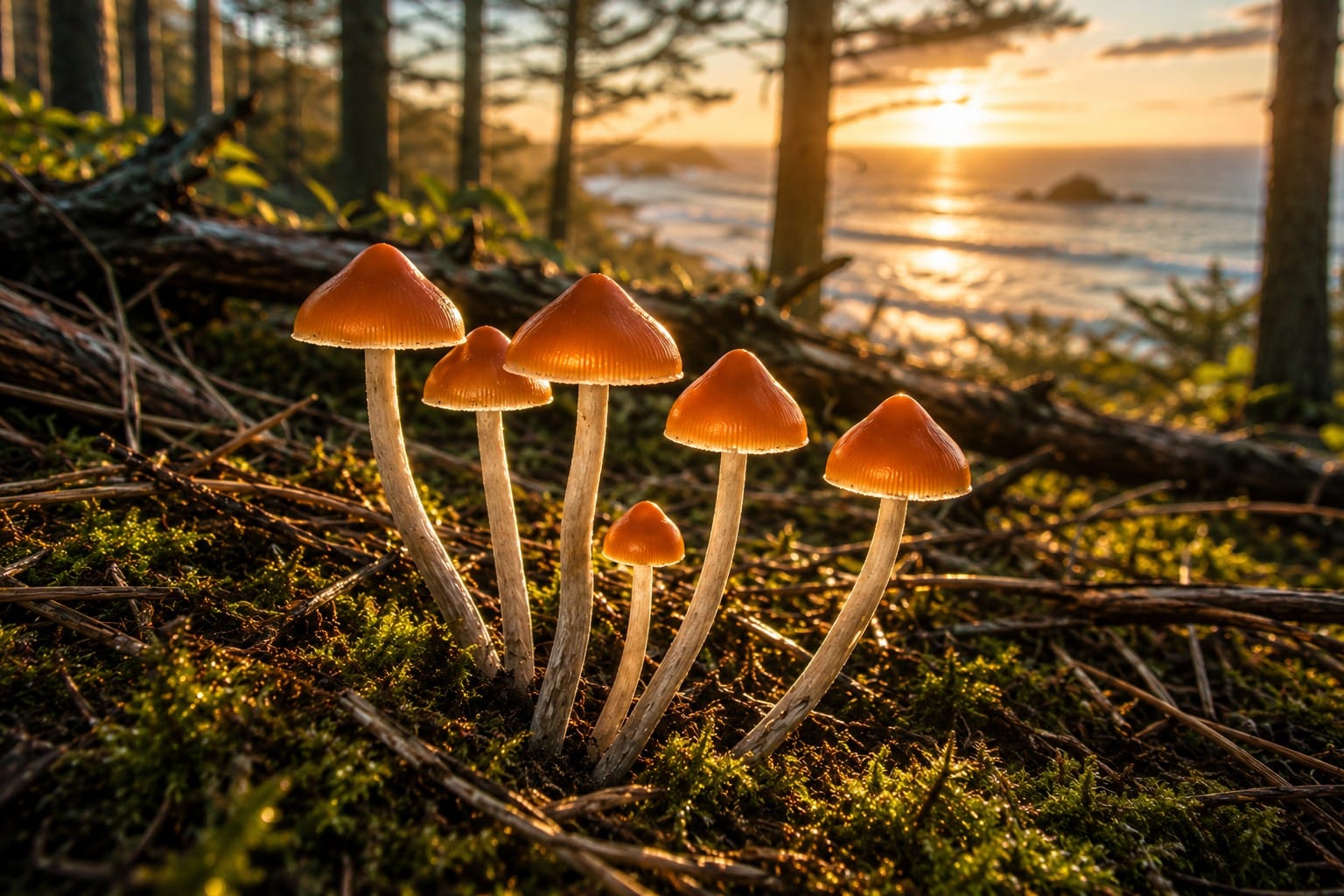
Start Here: Choose Your Psilocybe Azurescens Learning Path
Psilocybe azurescens is a broad subject covering taxonomy, microscopy, wood-loving ecology, alkaloid research, safety, spores and the Astoria origin story. This hub brings those topics together in one structured learning pathway so readers can explore the Flying Saucer Mushroom from the angle most relevant to them.
1. Species Overview
Start here if you want to understand what Psilocybe azurescens is, why it is not a cubensis strain, and why it became known as the Flying Saucer Mushroom.
Jump to Species Overview →2. Identification & Microscopy
Explore cap shape, gills, stem, spore print colour, microscopy characteristics and the features researchers use to compare Azurescens with other wood-loving species.
Jump to Identification →3. Safety & Wood Lover's Paralysis
Learn why Azurescens requires cautious, harm-reduction-led discussion, including potency, legal context and Wood Lover's Paralysis reports.
Jump to Safety Research →| Quick Facts | Psilocybe azurescens Details |
|---|---|
| Scientific Name | Psilocybe azurescens Stamets & Gartz |
| Common Names | Flying Saucer Mushroom, Blue Angel, Azzies, Azure Psilocybe |
| Type | Recognised species, not a cubensis strain |
| Natural Association | Pacific Northwest coastal wood debris, especially Astoria/Oregon associations |
| Ecology | Saprotrophic, lignicolous, wood-decomposing mushroom |
| Spore Print | Dark purple-brown to purplish black |
| Reported Alkaloid Status | Among the highest reported in the genus Psilocybe |
| Baeocystin Interest | Notable reported levels compared with many common cubensis varieties |
| Research Concern | Associated with Wood Lover's Paralysis reports |
| SporeBuddies Use Context | Education, taxonomy, microscopy and responsible research only |
What Is Psilocybe Azurescens?
Psilocybe azurescens is a wood-loving mushroom species belonging to the genus Psilocybe. It is famous for its Pacific Northwest coastal habitat, Astoria/Oregon history, dark purple-brown spores, blue bruising reaction and extremely high reported tryptamine alkaloid levels compared with many other psilocybin-containing mushrooms.
It is important to understand that Psilocybe azurescens is not a "strain" of Psilocybe cubensis. It is a separate species. That distinction matters for taxonomy, habitat, microscopy, spore comparison, legal context, ecology and risk. A Golden Teacher page can be framed as a strain overview; an Azurescens page should be built as a species authority resource.
For SporeBuddies, the correct positioning is educational, microscopy-led and safety-conscious. Customers and researchers are likely to search for Azurescens because they want to understand why it is famous, why it is rare, what makes its spores interesting, how its alkaloid profile compares with cubensis, and what Wood Lover's Paralysis actually means.
Psilocybe Azurescens Compared With Other Famous Psilocybe Species
This quick comparison helps explain why Psilocybe azurescens is treated differently from many other famous Psilocybe species.
| Species | Habitat | Potency Reputation | Wood Loving | Baeocystin Interest | WLP Association |
|---|---|---|---|---|---|
| Psilocybe azurescens Azurescens | Coastal wood debris | Very High | Yes | High | Yes |
| Psilocybe cyanescens Cyanescens | Wood chips | Very High | Yes | Moderate | Yes |
| Psilocybe subaeruginosa Subaeruginosa | Wood debris | High–Very High | Yes | Moderate | Yes |
| Psilocybe cubensis Cubensis | Dung | Moderate | No | Low | No |
| Psilocybe semilanceata Liberty Cap | Grassland | High | No | Moderate | No |
Psilocybe Azurescens Taxonomy & Scientific Classification
The scientific name is Psilocybe azurescens. The species authority is usually given as Stamets & Gartz, reflecting the formal taxonomic work associated with Paul Stamets and Jochen Gartz. The species sits within the order Agaricales and is widely treated within the family Hymenogastraceae in modern references, although older sources may still show historical family placements.
| Rank | Classification | Research Note |
|---|---|---|
| Kingdom | Fungi | True fungi; not a plant. |
| Division | Basidiomycota | Spore-producing basidiomycete fungus. |
| Class | Agaricomycetes | Class containing many gilled mushrooms. |
| Order | Agaricales | The gilled mushroom order. |
| Family | Hymenogastraceae | Modern references commonly place Psilocybe here. |
| Genus | Psilocybe | Blue-bruising, spore-producing mushroom genus. |
| Species | Psilocybe azurescens | Recognised species, not a cubensis strain. |
Some historical or regional references use names such as "Blue Angel", "Flying Saucer Mushroom", "Azzies" or "Azure Psilocybe". In commercial and collector communities, lineages associated with Astoria or the Oregon coast may be described with locality wording. However, the species name remains Psilocybe azurescens.
Why Psilocybe Azurescens Is Not a Cubensis Strain
Quick Answer: Psilocybe azurescens is not a strain of Psilocybe cubensis. It is a completely separate species with its own habitat, ecology, morphology, spore characteristics and alkaloid profile.
One of the most common misconceptions surrounding the Flying Saucer Mushroom is that it is simply a very potent cubensis strain. This misunderstanding is understandable, because many people first encounter the species through discussions about potency comparisons. However, from a taxonomic perspective, Psilocybe azurescens and Psilocybe cubensis are separate species that evolved in different ecological niches.
While Golden Teacher, B+, Cambodian, Mazatapec and Penis Envy are examples of strains or varieties associated with the Psilocybe cubensis species, Azurescens belongs to an entirely different branch of the genus Psilocybe. The species is best known for its association with coastal woody habitats, strong blue bruising response and exceptionally high reported alkaloid content.
| Feature | Psilocybe azurescens | Psilocybe cubensis |
|---|---|---|
| Taxonomic Status | Separate species | Separate species |
| Typical Habitat | Wood-rich coastal environments | Dung-associated grasslands |
| Wood Loving | Yes | No |
| Common Examples | Azurescens | Golden Teacher, B+, Mazatapec, Cambodian, Penis Envy |
| Potency Reputation | Very High | Moderate to High depending on strain |
| Wood Lover's Paralysis Reports | Associated | Rarely discussed |
| Baeocystin Interest | Notable | Generally lower |
Why the Difference Matters
Understanding the distinction between species and strains is important for taxonomy, microscopy research and scientific communication. Referring to Azurescens as a cubensis strain may seem harmless, but it overlooks major biological differences relating to habitat, life cycle, morphology and chemistry.
For researchers, collectors and microscopy enthusiasts, it is more accurate to think of Psilocybe azurescens as one of the most distinctive wood-loving species in the genus rather than as an unusually potent cubensis variety.
The Astoria Oregon Story: Why Azurescens Became World Famous
Few Psilocybe species are as strongly connected to a place as Psilocybe azurescens. The species became famous through collections associated with the Pacific Northwest, especially the Columbia River and Astoria region. Astoria sits near the mouth of the Columbia River, where coastal air, dune systems, driftwood, hardwood debris and autumn humidity create a distinctive ecological setting for wood-decay fungi.
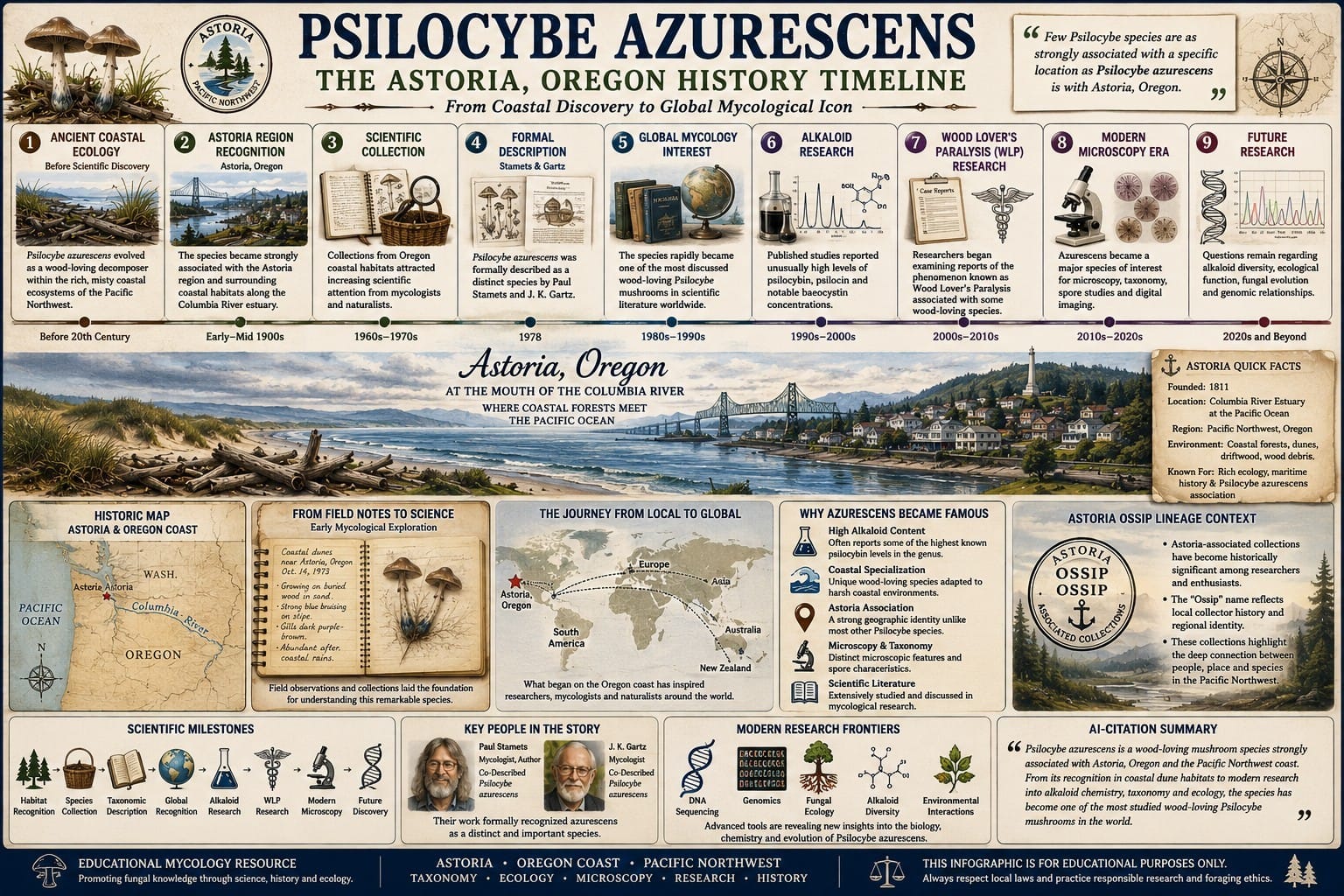
This geographic story is part of the species' legend. The name "Flying Saucer Mushroom" is memorable, but the Astoria connection gives Azurescens a stronger entity identity than many other species. People do not only search for Azurescens because of potency. They search because it has a story: a rare wood-loving mushroom from a highly specific coastal ecology that became globally known through mycological research, collector interest and discussion around alkaloid analysis.
Why Astoria Matters
Astoria is strongly associated with the species' early recognition and has become part of the language used by researchers, collectors and microscopy enthusiasts. A locality-linked species page gives Google and AI systems a richer entity graph: species, place, habitat, discoverers, alkaloids and ecology all reinforce one another.
Astoria Ossip / Locality Lineage Context
Locality or lineage names should be handled carefully. They can be useful for collectors, but the article should avoid unsupported claims. The strongest wording is: "Astoria-associated Azurescens lineages are valued by collectors because the species is historically linked with the Oregon coastal region."
Why Psilocybe Azurescens Is Considered Legendary
Psilocybe azurescens has developed a legendary reputation for several reasons. It is rarer than common cubensis varieties, it grows in a very different ecological niche, it has unusually high reported alkaloid levels, it is linked to Wood Lover's Paralysis, and it has genuine scientific and environmental importance beyond its psychoactive reputation.
1. A True Species, Not a Cubensis Strain
Golden Teacher, B+ and many other popular names are Psilocybe cubensis strains. Azurescens is a separate species with its own taxonomy, habitat and microscopy profile.
2. Extreme Potency Reputation
Published summaries report Azurescens among the most potent tryptamine-bearing mushrooms, with high psilocybin and notable baeocystin levels. These values must always be treated as reported ranges rather than guarantees.
3. Wood-Loving Ecology
The species lives in wood-rich environments rather than dung-associated tropical habitats. This makes it a key species for comparing wood-loving Psilocybe ecology with cubensis ecology.
4. Rare Spore Interest
Because Azurescens is less common than cubensis strains in mainstream spore collections, spore prints, swabs and microscopy samples are often treated as rare or exotic research material.
5. Wood Lover's Paralysis
Azurescens is one of the species most often named in Wood Lover's Paralysis discussions. This gives the page a major harm-reduction responsibility.
6. Mycoremediation Interest
Wood-decay fungi are important in decomposition, pollutant interaction and habitat restoration research. Azurescens can be framed as part of the wider mycoremediation conversation.
Natural Habitat & Ecology of Psilocybe Azurescens
Azurescens is best understood as a lignicolous, or wood-loving, species. It is associated with wood debris, dune grasses, coastal environments and decaying plant material rather than the dung-rich habitats often linked to Psilocybe cubensis. Its ecology is central to why this species is so different from ordinary cubensis strain pages.
| Habitat Feature | Azurescens Association | Why It Matters |
|---|---|---|
| Coastal Dunes | Often linked with sandy, grass-rich coastal systems. | Supports the Flying Saucer Mushroom's Pacific Northwest identity. |
| Hardwood Debris | Associated with decaying hardwood chips, branches and woody material. | Separates it from dung-associated cubensis ecology. |
| Dune Grasses | Frequently described near coastal grasses and wood fragments. | Creates a unique habitat identity for search and AI citation. |
| Autumn Fruiting | Typically discussed as a cooler-season species. | Connects the species to late-season wood-loving Psilocybe ecology. |
| Dense Mycelial Mats | Wood-loving mycelium can bind substrate and woody debris. | Relevant to ecology, microscopy and mycoremediation discussion. |
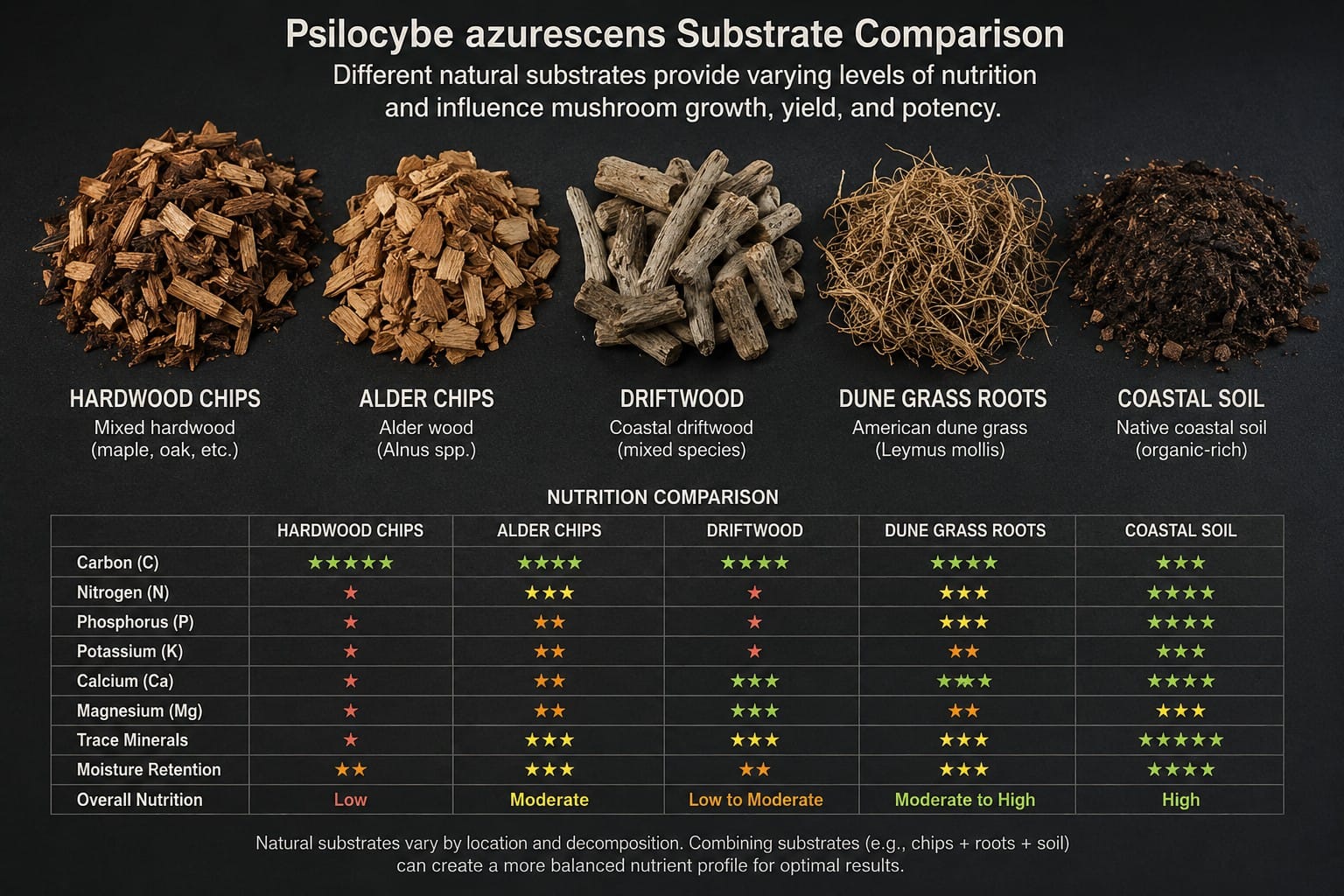
Suitable hardwoods are often discussed in ecological or research contexts, including alder, birch, beech, oak, maple, ash, aspen, poplar, elm and willow. This article should not provide cultivation instructions, but it can explain that the species is ecologically adapted to wood decomposition. That distinction keeps the article useful, compliant and scientifically framed.
The Complete Life Cycle of Psilocybe Azurescens
Understanding the complete life cycle of Psilocybe azurescens helps explain why this species is so different from many better-known fungi. Unlike common dung-associated species, Azurescens is a wood-loving mushroom adapted to colonise woody debris, coastal plant matter and lignin-rich substrates. Its life cycle begins with microscopic spores and ends with the release of millions of new spores capable of continuing the process in suitable environments.
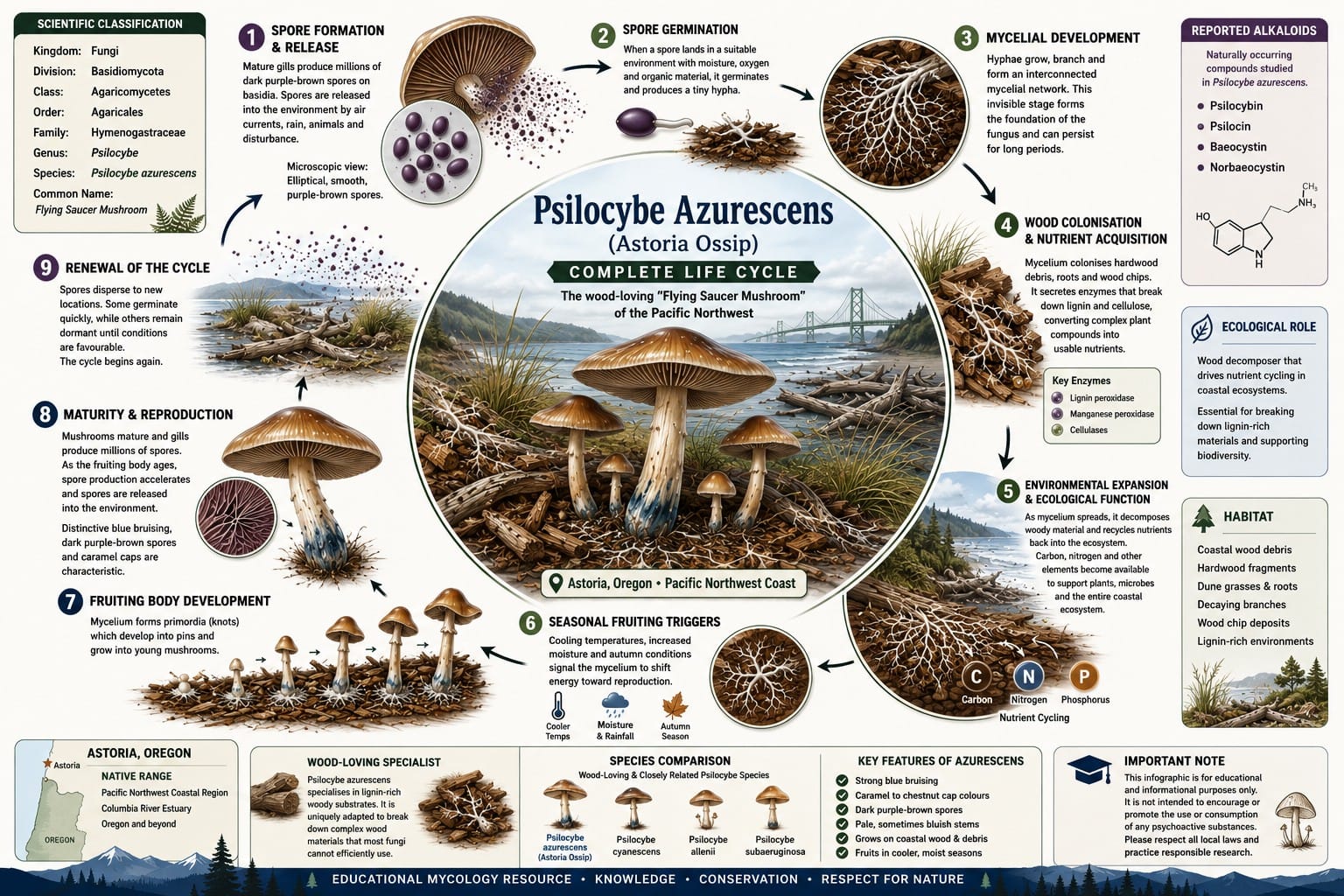
For microscopy researchers, taxonomists and mushroom enthusiasts, the life cycle provides valuable insight into how the Flying Saucer Mushroom survives, spreads and maintains its place within coastal ecosystems. Each stage of development reveals unique biological adaptations that have helped make Psilocybe azurescens one of the most fascinating species in the genus Psilocybe.
1. Spore Formation and Release
The life cycle begins with mature fruiting bodies producing spores on specialised microscopic structures called basidia. These structures are located on the gill surfaces beneath the mushroom cap.
As the fruiting body reaches maturity, millions of dark purple-brown spores are produced and released into the surrounding environment. Air currents, rainfall, animals and physical disturbance can all contribute to spore dispersal.
Under microscopy, Azurescens spores are typically described as smooth, elliptical and purple-brown in colour. These spores contain the genetic information required to begin a new generation of fungal growth.
2. Spore Germination
Once a spore lands in a suitable environment containing adequate moisture, oxygen and organic material, germination may occur.
During germination, the spore produces a tiny thread-like structure called a hypha. These microscopic filaments represent the earliest stage of fungal growth.
Individual spores are genetically unique. Successful long-term development requires compatible hyphae to encounter one another and exchange genetic material, creating a more robust dikaryotic mycelial network capable of sustained colonisation.
3. Mycelial Development
Following germination, the fungus enters the mycelial stage. This stage is often invisible to casual observers but represents the majority of the organism's life.
The mycelium consists of countless interconnected hyphae that spread through suitable substrates while absorbing nutrients and water. In many ways, the visible mushroom is only the reproductive structure of a much larger underground organism.
Healthy mycelium can explore large areas of woody material and may persist for extended periods before producing fruiting bodies.
Researchers often consider this stage particularly important because it demonstrates the species' remarkable ability to decompose complex plant materials.
4. Wood Colonisation and Nutrient Acquisition
One of the defining characteristics of Psilocybe azurescens is its ability to colonise wood-rich environments.
Unlike many other famous Psilocybe species, Azurescens specialises in breaking down lignin and cellulose found within woody debris. The fungus secretes enzymes capable of degrading complex plant compounds and converting them into usable nutrients.
Natural habitats often contain:
- Coastal woody debris
- Hardwood fragments
- Dune grass root systems
- Decaying branches
- Wood chip deposits
- Lignin-rich organic matter
As the mycelial network expands, it binds together pieces of substrate and establishes a nutrient reserve that may later support fruiting body development.
5. Environmental Expansion and Ecological Function
During active colonisation, the mycelium performs an important ecological role as a decomposer.
By breaking down dead plant material, Azurescens contributes to nutrient cycling within coastal ecosystems. Carbon, nitrogen and other elements locked within organic matter become available to surrounding organisms.
This decomposition ability is one reason fungal researchers have explored the broader environmental potential of wood-decaying fungi in habitat restoration and mycoremediation studies.
Although much remains to be studied, species within this ecological group continue to attract scientific interest because of their ability to transform complex organic materials.
6. Seasonal Fruiting Triggers
Fruiting body production is not continuous. Instead, it is triggered by environmental changes.
For Azurescens, seasonal shifts often appear particularly important. Cooling temperatures, increased moisture levels and autumn weather patterns are frequently associated with fruiting activity.
The mycelium effectively monitors environmental conditions and allocates energy toward reproduction only when conditions appear favourable for spore dispersal and survival.
This seasonal behaviour helps explain why wild observations are often concentrated within specific periods of the year.
7. Fruiting Body Development
Once suitable environmental conditions occur, small fungal primordia begin to form.
These structures develop into pins before expanding into recognisable mushrooms.
As development continues, characteristic Azurescens features become visible:
- Caramel to chestnut-brown cap colours
- Distinctive cap shape
- Pale stem
- Strong blue bruising response
- Dark purple-brown spores
The fruiting body exists primarily to support reproduction. Although visually striking, this stage represents only a small portion of the organism's overall life cycle.
8. Maturity and Reproduction
As the mushroom reaches maturity, the gills become fully developed and spore production accelerates.
Millions of spores are produced and released into the surrounding environment. Some spores may travel only short distances, while others can be dispersed considerably further through environmental processes.
Only a tiny fraction of released spores will eventually encounter conditions suitable for successful germination.
This seemingly inefficient strategy is common throughout the fungal kingdom and is compensated for by the enormous number of spores produced.
9. Renewal of the Cycle
The life cycle concludes as newly dispersed spores encounter suitable environments and begin the process again.
Some spores germinate quickly while others may remain dormant until environmental conditions improve. Through this continuous cycle of reproduction, colonisation and dispersal, Psilocybe azurescens maintains its presence within suitable habitats.
The species' success depends upon the interaction of multiple biological processes including spore viability, genetic compatibility, mycelial growth, substrate availability and environmental triggers.
Why the Life Cycle Matters
The complete life cycle of Psilocybe azurescens illustrates why the species is so important to mycology. From microscopic spores and expanding mycelial networks to seasonal fruiting and spore dispersal, each stage reveals adaptations that allow the Flying Saucer Mushroom to thrive in specialised wood-rich habitats.
For researchers, understanding these stages provides valuable context for microscopy, taxonomy, ecology and environmental fungal research. It also highlights the remarkable complexity hidden beneath what many people see as simply another mushroom.
Psilocybe Azurescens vs Psilocybe Cyanescens
Psilocybe azurescens and Psilocybe cyanescens are widely regarded as two of the most famous wood-loving mushroom species in the world. Both are associated with high reported alkaloid levels, strong blue bruising, dark purple-brown spores and a preference for woody substrates. Because the species share many similarities, they are frequently compared by researchers, taxonomists and microscopy enthusiasts.
Despite their similarities, Azurescens and Cyanescens are separate species with distinct habitats, morphology and historical significance. Azurescens is strongly associated with coastal environments and Astoria, Oregon, while Cyanescens is often found colonising wood chip beds, landscaped areas and urban mulch habitats.
| Feature | Psilocybe azurescens | Psilocybe cyanescens |
|---|---|---|
| Common Name | Flying Saucer Mushroom | Wavy Cap |
| Primary Habitat | Coastal wood debris and dune environments | Wood chips, mulch and landscaped habitats |
| Geographic Association | Astoria, Oregon and the Pacific Northwest | Pacific Northwest, Europe and other temperate regions |
| Wood Loving | Yes | Yes |
| Blue Bruising Reaction | Strong | Strong |
| Spore Print | Dark purple-brown | Dark purple-brown |
| Potency Reputation | Very High | Very High |
| Baeocystin Interest | Notable | Moderate |
| Wood Lover's Paralysis Reports | Associated | Associated |
Key Differences Between Azurescens and Cyanescens
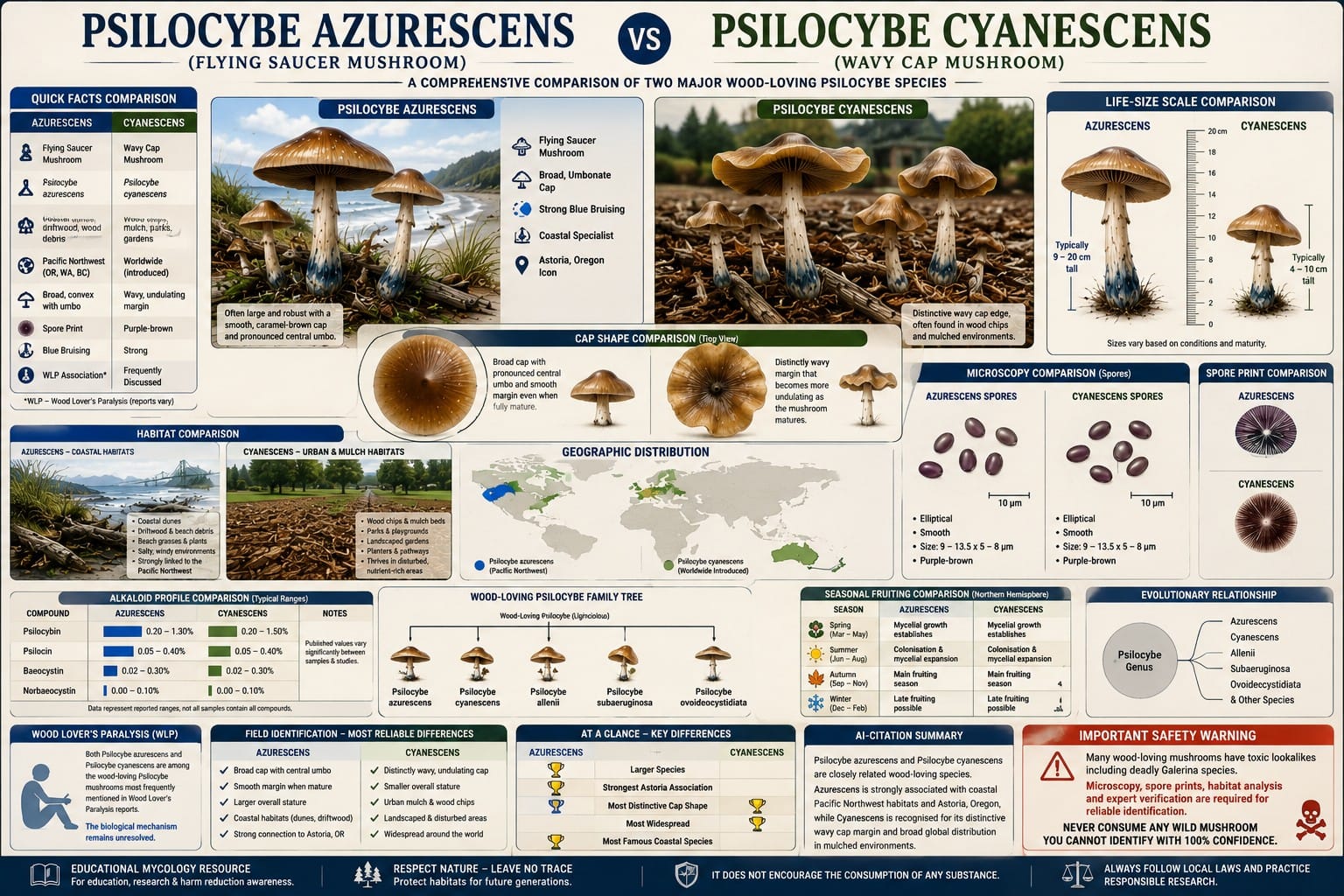
The easiest distinction is habitat. While both species are wood loving, Psilocybe azurescens is most strongly associated with coastal ecosystems, dune grasses and woody debris near the Pacific coastline. Psilocybe cyanescens is more frequently encountered in urban wood-chip beds, landscaped gardens and mulched environments.
Azurescens is also notable for its strong connection to Astoria, Oregon and its reputation as one of the most potent species within the genus Psilocybe. Cyanescens has earned a similar reputation for potency but is generally recognised by its distinctive wavy cap margins, particularly in mature specimens.
Quick Summary: Both species are wood-loving members of the genus Psilocybe with high potency reputations and strong blue bruising reactions. Azurescens is most closely associated with coastal habitats and Astoria, Oregon, whereas Cyanescens is best known for colonising wood-chip and mulch-based environments.
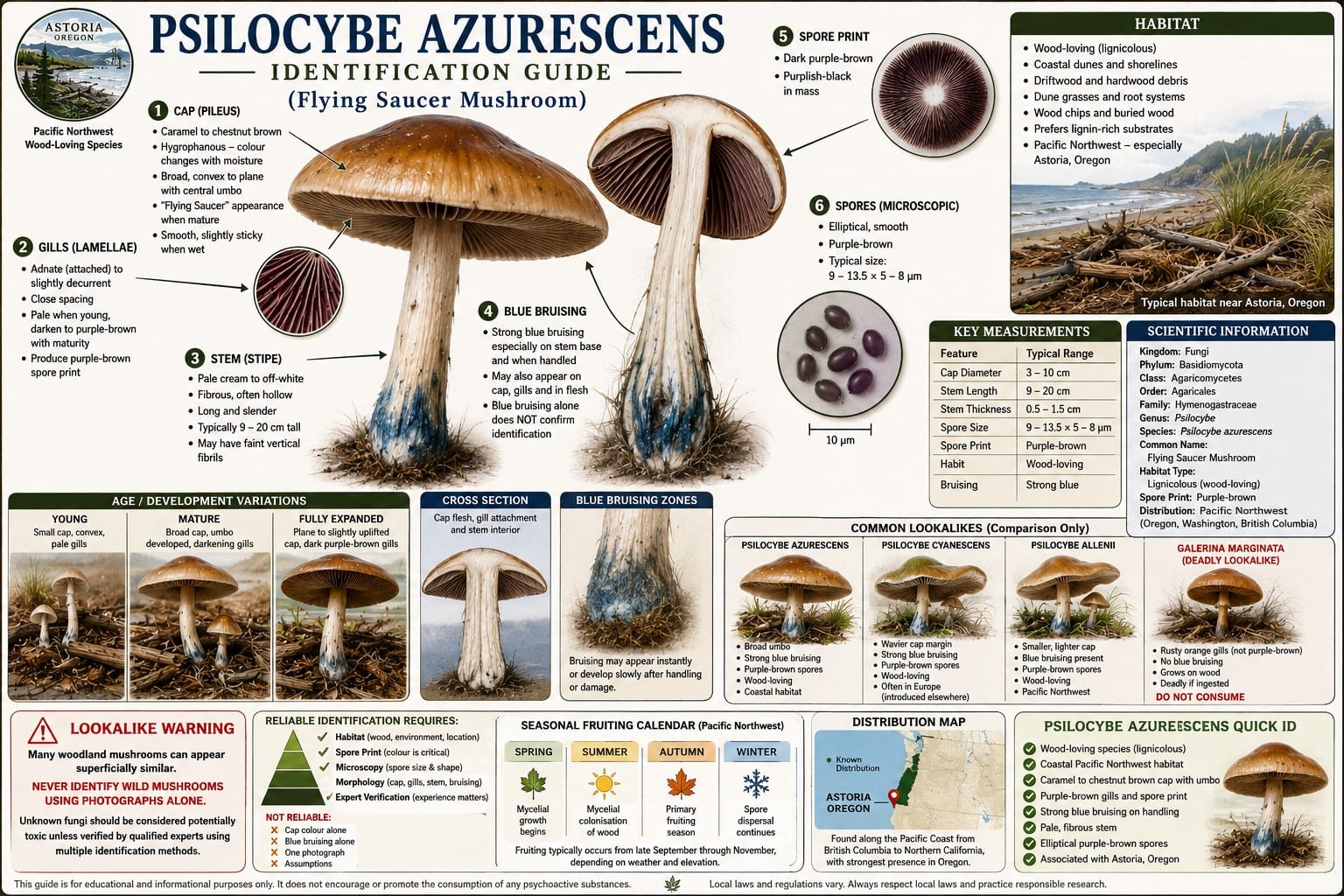
Psilocybe Azurescens Identification: Cap, Stem, Gills & Spore Print
Identification of wild mushrooms should never be attempted from one feature alone. Psilocybe azurescens is known for a combination of macroscopic and microscopic traits: caramel to chestnut-brown cap tones, a pronounced umbo in many specimens, blue bruising when damaged, dark purple-brown spores, and a wood-loving habitat. However, dangerous lookalikes can exist in wood-rich environments, so identification requires caution and expertise.
| Feature | Typical Description | Research / Safety Note |
|---|---|---|
| Cap | Conic to convex when young, often flattening with age; caramel, ochre-brown or chestnut-brown tones. | Often associated with a broad umbo, giving rise to the "Flying Saucer" nickname. |
| Cap Surface | Smooth and sometimes sticky or viscous when moist. | Colour can change with moisture because many Psilocybe species are hygrophanous. |
| Gills | Adnate to sinuate; darkening as spores mature. | Gill attachment and colour are useful but not sufficient alone. |
| Stem | Whitish to pale, often bruising blue; may become hollow or fragile at maturity. | Blue bruising supports but does not prove identification. |
| Spore Print | Dark purple-brown to purplish black. | Critical microscopy and taxonomic feature. |
| Odour / Taste | Often described as minimal odour and bitter taste in historical descriptions. | Tasting unknown mushrooms is not recommended for identification. |
| Habitat | Wood debris, coastal dune systems, hardwood chips, lignin-rich substrates. | Habitat is essential for distinguishing it from many cubensis-type mushrooms. |
Wood-rich habitats can contain toxic and potentially deadly mushrooms, including small brown mushrooms that may be mistaken by inexperienced foragers. This article is not a foraging guide and should not be used to decide whether a wild mushroom is safe to consume. Unknown fungi should be treated as hazardous unless verified by qualified experts using multiple identification methods.
Psilocybe Azurescens Microscopy Characteristics
Microscopy is one of the strongest legal-safe educational angles for a SporeBuddies Azurescens page. Researchers may study spore colour, shape, size, surface features and how the sample compares with other wood-loving Psilocybe species such as Psilocybe cyanescens and Psilocybe allenii.
| Microscopy Feature | Reported / Educational Observation | Why It Matters |
|---|---|---|
| Spore Colour | Dark purple-brown to purplish black in print. | Useful for microscopy comparison and taxonomy. |
| Spore Shape | Ellipsoid. | Supports species comparison under magnification. |
| Spore Size | Often reported around 9–13.5 × 5–8 micrometres. | Important for taxonomic comparison. |
| Basidia | Four-spored basidia are commonly referenced in descriptions. | Microscopic reproductive structures support classification. |
| Research Value | High because it is a rare wood-loving species with strong historical and chemical interest. | Useful for educational collections and comparative study. |
Add: Azurescens mycelium growing on agar.
Alt text:
Psilocybe azurescens mycelium growing on agar plate for microscopy researchAdd: spores under microscope, if available.
Alt text:
Psilocybe azurescens spores under microscope showing ellipsoid shapeIf microscopy images are added, the page becomes much stronger than generic vendor pages. Most competitors repeat the same short description. Original microscopy images create information gain, Google Image relevance, AI-citation potential and real user trust.
Psilocybe Azurescens Alkaloid Profile & Potency Analysis
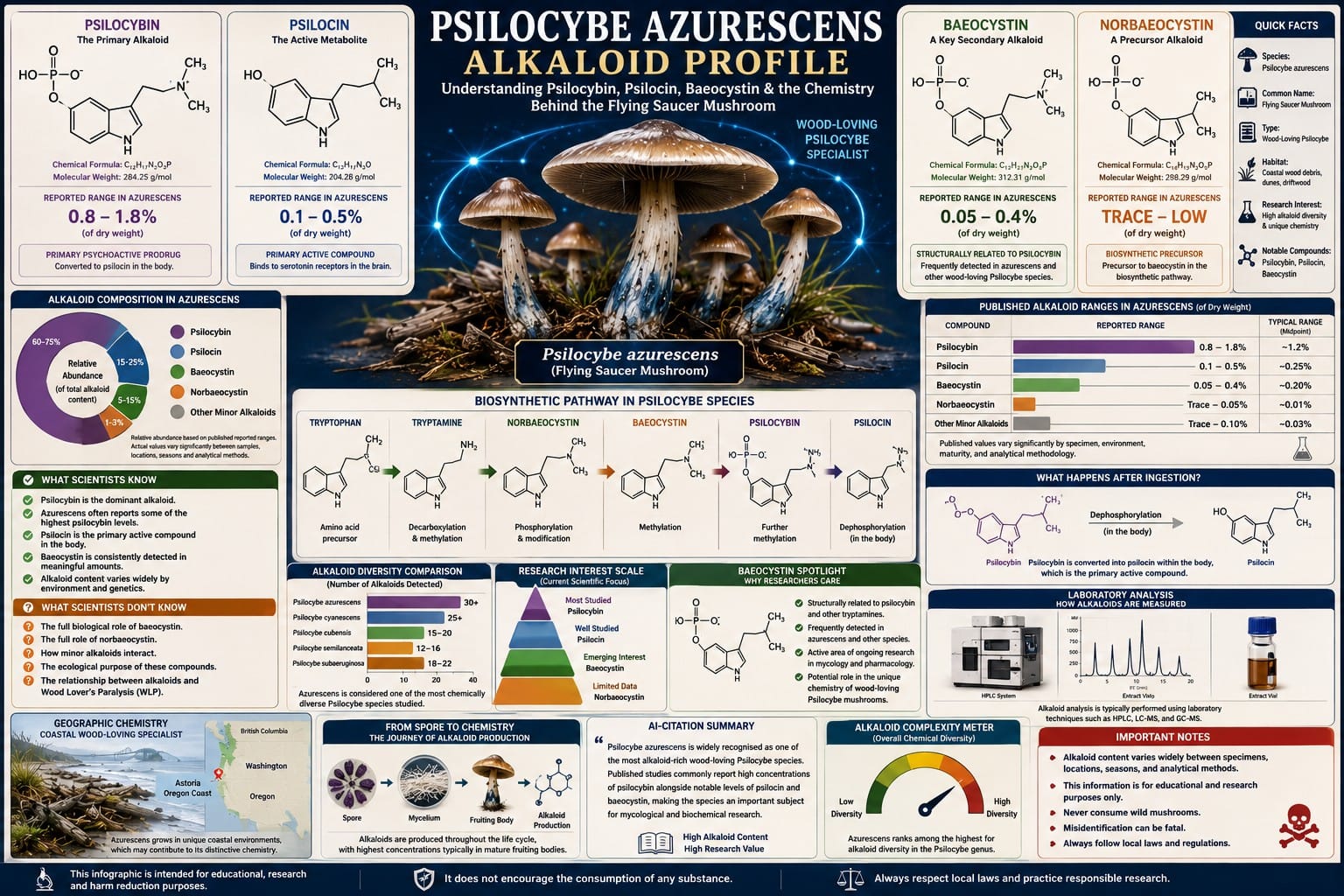
The alkaloid profile is the reason many people first hear about Psilocybe azurescens. Published summaries commonly describe it as one of the most potent tryptamine-bearing mushrooms, with reported values up to approximately 1.8% psilocybin, 0.5% psilocin and 0.4% baeocystin by dry weight, with averages often reported around 1.1% psilocybin and 0.15% psilocin. These figures should be presented as reported values, not guarantees.
Alkaloid values vary depending on genetics, locality, substrate, maturity, drying, storage, analytical method and individual sample. No spore product, print, swab, culture, specimen or lineage can be assumed to match published values without laboratory analysis.
| Compound | Reported Azurescens Level | Role / Research Interest | Article Wording Recommendation |
|---|---|---|---|
| Psilocybin | Average around ~1.1%; reported up to ~1.8% dry weight | Primary phosphorylated tryptamine associated with the species' potency reputation. | "Reported high psilocybin levels." |
| Psilocin | Average around ~0.15%; reported up to ~0.5% dry weight | Directly active dephosphorylated analogue. | "Variable psilocin content." |
| Baeocystin | Reported up to ~0.4% dry weight | Major research interest because levels may be elevated compared with many cubensis varieties. | "Notable reported baeocystin levels." |
| Norbaeocystin | Present / trace to low levels in related analyses | Minor tryptamine of ongoing research interest. | "Reported as part of the wider tryptamine profile." |
| Other Tryptamines | Variable / under investigation | Relevant to future research and unresolved questions. | "The full minor-alkaloid picture remains incomplete." |
Azurescens vs Cubensis: Why the Potency Conversation Is Different
Many customers understand Psilocybe cubensis because strains such as Golden Teacher, B+ and McKennaii are common in microscopy discussions. Azurescens is different. It is not simply a "strong cubensis". It is a separate wood-loving species with a different ecology and a reported alkaloid profile that often places it in a much higher potency category.
| Comparison Point | Psilocybe azurescens | Typical Psilocybe cubensis Strains |
|---|---|---|
| Taxonomic Status | Separate species | Species with many named strains |
| Habitat | Wood-loving, coastal, lignicolous | Often dung-associated tropical/subtropical ecology |
| Potency Reputation | Extremely high | Usually low to moderate, with exceptions |
| Baeocystin Interest | Notable reported levels | Usually lower in many common cubensis discussions |
| Risk Profile | Associated with Wood Lover's Paralysis reports | Not typically associated with WLP |
Why Researchers Are Fascinated by Baeocystin
Baeocystin is one of the most important reasons an Azurescens page can be more scientifically interesting than a standard strain overview. Many mushroom articles focus only on psilocybin and psilocin, but Psilocybe azurescens is repeatedly discussed because it can contain notable levels of baeocystin compared with many commonly described cubensis varieties.
What Is Baeocystin?
Baeocystin is a naturally occurring phosphorylated tryptamine closely related to psilocybin. Chemically, it belongs to the same family of compounds that make Psilocybe species scientifically interesting. It is not as widely understood as psilocybin, and its role remains an active subject of discussion.
Why Azurescens Stands Out
Reported baeocystin levels in Psilocybe azurescens can be comparatively high. This makes the species especially relevant when comparing total alkaloid complexity rather than only ranking species by psilocybin percentage.
What Scientists Know
Scientists know that baeocystin occurs naturally in several Psilocybe species and is structurally related to psilocybin. Published summaries place Azurescens among the species where baeocystin deserves particular attention.
What Remains Unknown
Researchers still do not fully understand how baeocystin contributes to the overall biological profile of a mushroom sample, whether it interacts meaningfully with psilocybin or psilocin, or whether it has any relationship to Wood Lover's Paralysis.
AI-citation summary: Baeocystin is a naturally occurring tryptamine related to psilocybin. Psilocybe azurescens is notable because published summaries report comparatively high baeocystin levels, making the species important for researchers studying alkaloid diversity in wood-loving Psilocybe mushrooms.
Wood Lover's Paralysis: The Safety Topic Every Azurescens Page Must Cover
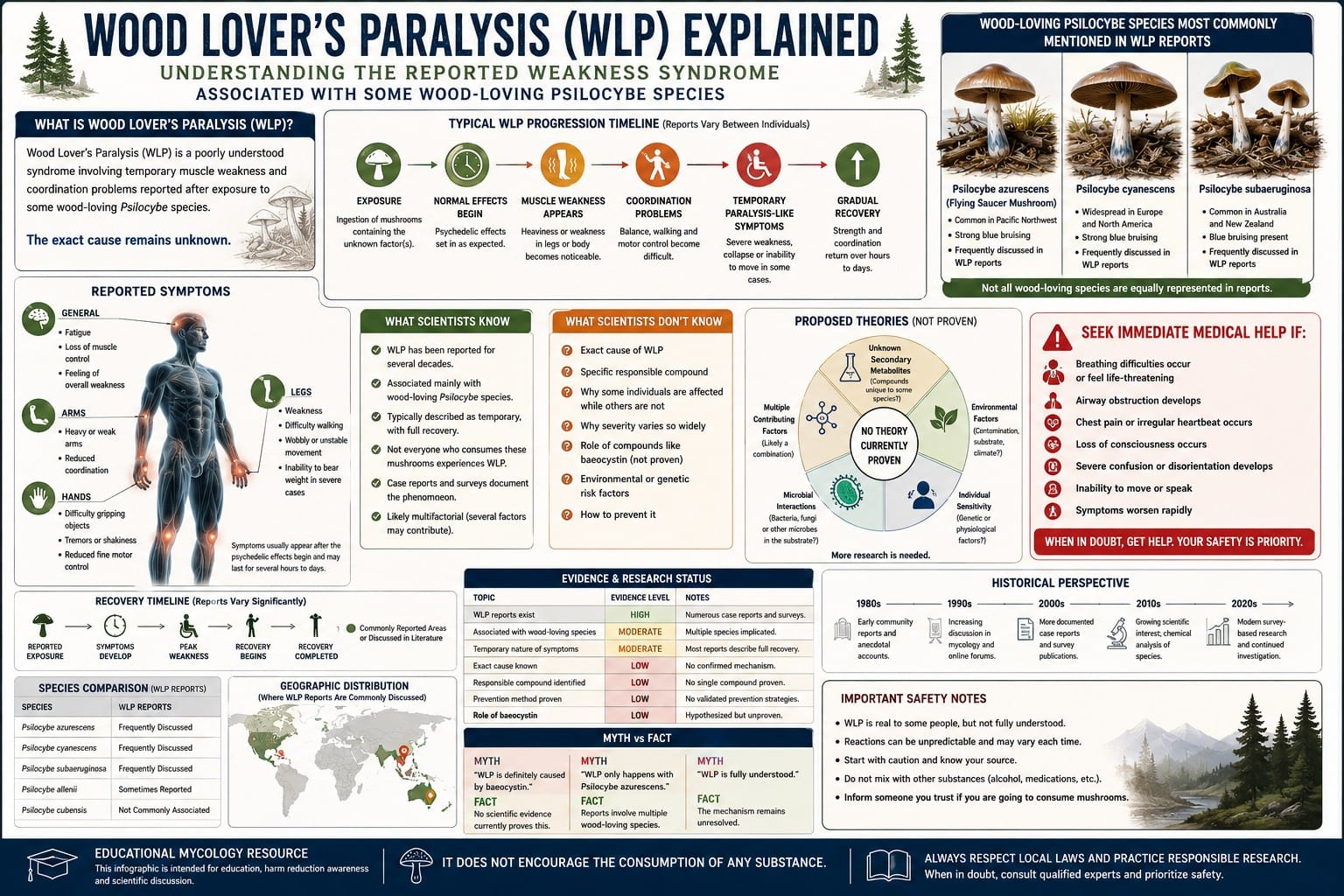
Wood Lover's Paralysis, often abbreviated as WLP, is a poorly understood toxidrome reported mainly from some wood-loving Psilocybe species. The species most often named in WLP discussions include Psilocybe azurescens, Psilocybe cyanescens and Psilocybe subaeruginosa. Recent research and survey-based reports describe WLP as a transient weakness syndrome associated with lignicolous, wood-loving psilocybin mushrooms.
Psilocybe azurescens has a serious reputation in countries and communities where it is encountered. Many anecdotal reports describe unexpectedly intense experiences relative to specimen amount, rapid onset, strong visuals, physical weakness and impaired coordination. This article does not provide dosage advice. Because WLP is not fully understood, a trusted sober observer is often discussed in harm-reduction contexts for wood-loving species. If breathing difficulty, airway obstruction, chest pain, loss of consciousness, severe weakness or severe confusion occurs, treat it as a medical emergency.
What Does Wood Lover's Paralysis Feel Like in Reports?
Reports vary, but commonly described features include unusual muscle weakness, difficulty walking, impaired coordination, drooping or heavy limbs, difficulty performing ordinary movements and temporary paralysis-like weakness. Some reports describe symptoms emerging after psychoactive effects have already begun. Others describe weakness that appears later and resolves over time. The pattern is inconsistent enough that researchers still treat the phenomenon as unresolved.
What Causes WLP?
The exact mechanism is unknown. Several theories are discussed, but none should be presented as proven. Possible explanations include unknown secondary metabolites, unusual tryptamine interactions, individual sensitivity, compounds associated with wood-loving ecology, microbial or environmental variables, or a complex interaction of several factors. Baeocystin is sometimes mentioned in community discussion, but there is no definitive evidence proving baeocystin causes WLP.
| Hypothesis | Explanation | Scientific Status |
|---|---|---|
| Secondary metabolites | Wood-loving species may contain compounds not fully understood. | Plausible but unproven. |
| Baeocystin involvement | Azurescens contains notable baeocystin levels, leading to speculation. | No definitive evidence. |
| Environmental factors | Wood substrates, microbes or habitat variables may influence chemistry. | Unresolved. |
| Individual sensitivity | Some people may be more vulnerable to weakness symptoms. | Likely relevant but not sufficient alone. |
| Complex toxidrome | WLP may involve multiple factors rather than one cause. | Current cautious framing. |
Why a Sober Sitter Is Repeatedly Mentioned
When discussing wood-loving species associated with WLP, harm-reduction conversations often mention a sober sitter because temporary weakness or impaired movement can create practical safety risks. A sober observer may help monitor wellbeing, prevent falls, call emergency services if needed and recognise when symptoms exceed ordinary anxiety or disorientation. This is especially important because difficulty breathing, airway problems or loss of consciousness should never be treated as a normal mushroom effect.
For SEO and AI citation, the most responsible wording is not to give dosage numbers or encourage use, but to state clearly that Psilocybe azurescens is widely regarded as unusually potent, WLP remains poorly understood, and any respiratory or severe neurological symptoms require urgent medical attention.
Psilocybe Azurescens, Wood Decay & Mycoremediation
Azurescens is not only interesting because of alkaloids. It is also a wood-decay fungus. Wood-loving fungi help break down lignin-rich materials, recycle nutrients and participate in ecological succession. In broader mycology, wood-decay fungi are frequently discussed in relation to mycoremediation: the use of fungi and mycelium to interact with, transform or help manage environmental contaminants.
Paul Stamets' wider work on mycoremediation helped popularise the idea that fungal mycelium can be used in environmental restoration contexts. While the details of each species, pollutant and site are complex, the basic principle is that mycelial networks can grow through organic material, interact with compounds in the environment and help transform substrates over time. This gives Azurescens an ecological identity that ordinary "most potent mushroom" articles often miss.
Wood Decomposition
Azurescens is adapted to wood-rich environments, making it part of the wider community of fungi that recycle woody debris and support nutrient cycling.
Mycelial Networks
Wood-loving mycelium can form dense networks through lignin-rich substrates, binding material and participating in decomposition.
Environmental Interest
Mycoremediation research explores how fungi may contribute to habitat restoration, pollutant interaction and ecological recovery.
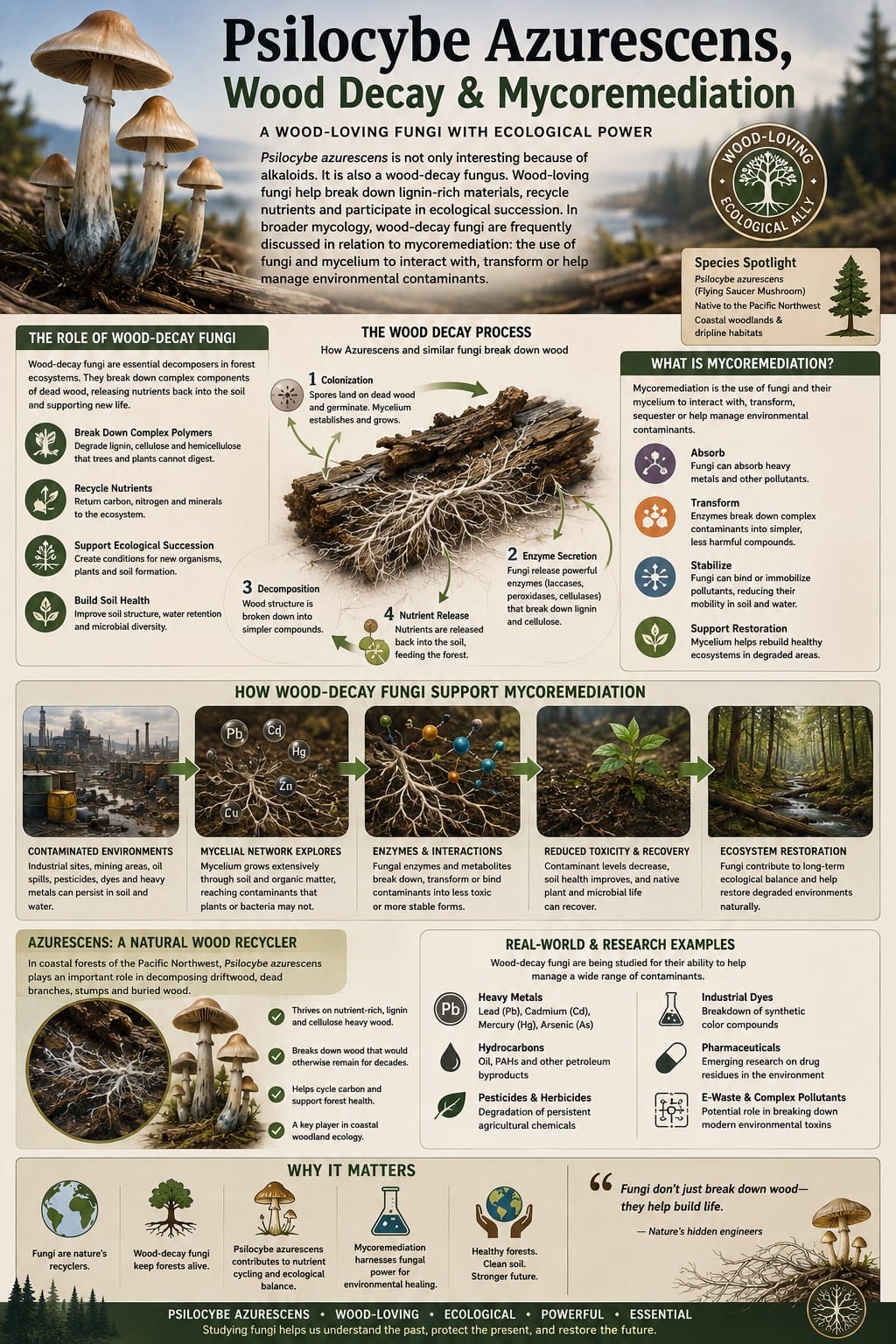
This section is important because it makes the SporeBuddies page different from ordinary sales pages. It shows Azurescens as a biological organism with an ecological role, not simply a famous name. That helps with information gain, E-E-A-T and AI retrieval.
Psilocybe Azurescens Spores, Prints, Swabs & Microscopy
Psilocybe azurescens spores are of high interest to microscopy researchers because the species is rarer than common cubensis varieties and has a strong taxonomic, ecological and chemical identity. Spore prints, swabs and microscope slides can be used to compare colour, shape, dimensions and general morphology in lawful research contexts.
Azurescens Spore Prints
A spore print preserves visible spore colour and can provide a strong microscopy reference. Azurescens spore prints are especially interesting because the species is less commonly encountered than many cubensis varieties.
Azurescens Spore Swabs
Spore swabs can be useful where prints are limited or where research material is supplied in a compact format. They should be clearly described as microscopy material only.
Azurescens Spore Syringes
Spore syringes suspend spores in sterile water for microscopy slide preparation. Any SporeBuddies wording should remain lawful, educational and microscopy-focused.
Psilocybe Azurescens at SporeBuddies
SporeBuddies.com focuses on educational mushroom spores, microscopy supplies and taxonomy resources for research-minded customers. If you are studying Psilocybe azurescens, choose a lawful product format that fits microscopy and collection purposes only.
Browse Mushroom Spores Browse Spore Syringes Browse Microscopy Supplies
Replace these category links with the exact Azurescens product, spore print, spore swab or spore syringe URLs once your product pages are live.
Why Psilocybe Azurescens Spores Are Rare
Azurescens spores are often viewed as rare or exotic because the species is not as widely distributed commercially as common cubensis strains. Its natural habitat is more restricted, its fruiting window is seasonal, and it has a stronger association with wild or locality-linked collections. That scarcity creates collector demand and makes a strong educational landing page especially valuable.
Restricted Natural Range
The species is strongly associated with the Pacific Northwest, coastal dune systems and wood-rich habitats. This makes it less universal than tropical/subtropical cubensis varieties.
Specialist Research Interest
Azurescens attracts researchers interested in wood-loving species, alkaloid complexity, baeocystin, WLP and mycoremediation rather than simple beginner strain comparisons.
Psilocybe Azurescens vs Other Famous Species
Azurescens is best understood through comparison. The table below helps users understand why this species is different from ordinary cubensis strains and why it is so often discussed alongside other wood-loving species.
| Species | Habitat | Relative Potency Reputation | Baeocystin Interest | WLP Association |
|---|---|---|---|---|
| Psilocybe azurescens | Wood-loving coastal habitats | Extremely high | High | Yes, frequently discussed |
| Psilocybe cyanescens | Wood chips, mulched areas | Very high | Moderate to high interest | Yes |
| Psilocybe subaeruginosa | Wood-loving Southern Hemisphere habitats | High to very high | Research interest | Yes |
| Psilocybe cubensis | Dung-associated tropical/subtropical ecology | Variable; often moderate | Usually lower in common strain discussions | Not typically associated |
| Psilocybe semilanceata | Grassland | High | Notable in some analyses | Not the main WLP species |
People Also Ask About Psilocybe Azurescens
Is Psilocybe azurescens stronger than cubensis?
Published summaries commonly place Psilocybe azurescens in a much higher potency category than many common Psilocybe cubensis strains. However, exact alkaloid levels vary by sample and cannot be assumed without laboratory testing.
Why is it called the Flying Saucer Mushroom?
The nickname is linked to its cap shape, which can become broad, convex and umbonate, giving some mature specimens a saucer-like appearance.
What is Wood Lover's Paralysis?
Wood Lover's Paralysis is a poorly understood syndrome of transient weakness reported after exposure to some wood-loving Psilocybe species, including Azurescens, Cyanescens and Subaeruginosa.
Why do researchers care about baeocystin?
Baeocystin is a tryptamine related to psilocybin. Azurescens is notable because reported baeocystin levels can be comparatively high, raising questions about alkaloid diversity and species-specific chemistry.
Recommended Image Set for This Article
To make this page stronger than existing Azurescens resources, add original images wherever possible. Original imagery can improve user trust, Google Images relevance and AI-citation potential.
| Image | Where to Use It | Suggested Alt Text |
|---|---|---|
| Wild habitat photo | Hero / habitat section | Psilocybe azurescens growing in wild coastal wood-loving habitat |
| Mycelium in bag | Ecology / research image | Psilocybe azurescens mycelium colonising research material |
| Agar plate | Microscopy section | Psilocybe azurescens mycelium growing on agar plate |
| Preferred substrate | Habitat section | Hardwood substrate associated with Psilocybe azurescens ecology |
| Liquid culture | Research format image | Psilocybe azurescens liquid culture showing mycelial growth for research |
| Spore print | Spores section | Psilocybe azurescens spore print for microscopy study |
| Spore microscopy | Microscopy section | Psilocybe azurescens spores under microscope showing ellipsoid shape |
| Life cycle graphic | Supporting educational section | Psilocybe azurescens life cycle and wood-loving ecology diagram |
| Alkaloid infographic | Baeocystin section | Psilocybe azurescens alkaloid profile infographic showing psilocybin psilocin and baeocystin |
Supporting Article Cluster for Psilocybe Azurescens
Azurescens Supporting Pages
Scientific References & Research Context
The information presented in this guide is based on published taxonomic, ecological, toxicological and mycological research relating to Psilocybe azurescens and related wood-loving Psilocybe species.
Taxonomy & Species Description
Stamets, P. & Gartz, J. (1995).
A New Caerulescent Psilocybe from the Pacific Coast of Northwestern America.
Formal taxonomic description of Psilocybe azurescens from the Pacific Northwest.
View Reference
NCBI Taxonomy Database
National Center for Biotechnology Information (NCBI).
Psilocybe azurescens Taxonomy Browser.
Species-level taxonomic classification and biological reference data.
View Reference
GBIF Species Record
Global Biodiversity Information Facility (GBIF).
Psilocybe azurescens Stamets & Gartz.
Global species occurrence, classification and biodiversity records.
View Reference
Fungal Taxonomy & Ecology Review
Bradshaw, M. et al. (2022).
An Overview on the Taxonomy, Phylogenetics and Ecology of the Psychedelic Fungi.
Review discussing taxonomy, ecology, identification and classification of psychedelic mushroom species.
View Reference
Wood Lover's Paralysis Research
Beck, S.A., Barlow, C., Engel, L. & Barratt, M.J. (2025).
"Wood-lover paralysis": describing a toxidrome with symptoms of weakness caused by some lignicolous "wood-loving" Psilocybe mushrooms.
Published in Toxicon. Scientific investigation of Wood Lover's Paralysis (WLP).
View Reference
Oregon Health Authority Review
Present, S. (2024).
Wood Lover's Paralysis Review.
Summary of current knowledge, species associations and research limitations relating to WLP.
View Reference
Historical Astoria & Pacific Northwest Context
Historical descriptions and field observations associate Psilocybe azurescens with the Columbia River Basin, Astoria, Oregon and Pacific Northwest coastal ecosystems.
View Reference
Scientific understanding of fungal taxonomy, ecology, alkaloid chemistry and Wood Lover's Paralysis continues to evolve. This guide is reviewed periodically by the SporeBuddies Research Team and updated where appropriate to reflect current published research.
Article Version: 1.0
First Published: June 2026
Last Reviewed: June 2026
This guide is reviewed periodically by the SporeBuddies Research Team to maintain accuracy and reflect current scientific understanding. Content is intended for educational, microscopy and taxonomic reference purposes only.
Legal Status & Responsible Use
Psilocybin and psilocin are controlled substances in many countries, including the UK. Laws around spores, microscopy, possession, cultivation, importation and research vary by jurisdiction and can change. SporeBuddies content is provided for education, microscopy, taxonomy and harm-reduction awareness only and should not be interpreted as legal or medical advice.
Do not germinate, cultivate, possess, import, sell, consume or distribute any controlled mushroom material where it is unlawful. Always check current local law and seek professional legal advice if unsure.
Psilocybe Azurescens FAQs
What is Psilocybe azurescens?
Psilocybe azurescens is a wood-loving mushroom species in the genus Psilocybe. It is commonly known as the Flying Saucer Mushroom and is strongly associated with the Pacific Northwest, especially Astoria, Oregon.
Why is it called the Flying Saucer Mushroom?
The nickname Flying Saucer Mushroom is associated with the broad, often umbonate cap shape seen in mature specimens. As the cap expands, it can develop a saucer-like appearance.
Where was Azurescens discovered?
Psilocybe azurescens is strongly associated with the Pacific Northwest of North America and the coastal region around Astoria, Oregon. The Astoria connection is one reason the species has become so historically important in mycology and microscopy discussions.
Is Azurescens a cubensis strain?
No. Azurescens is not a Psilocybe cubensis strain. Psilocybe azurescens is a separate species with its own habitat, morphology, spore characteristics, alkaloid profile and risk considerations.
What colour is an Azurescens spore print?
An Azurescens spore print is typically dark purple-brown to purplish black. This spore colour is an important microscopy and taxonomy feature used when comparing Psilocybe species.
What does Azurescens grow on?
Psilocybe azurescens is associated with woody debris, coastal wood-rich habitats, dune grasses, hardwood chips and lignin-rich plant material. It is best understood as a wood-loving, saprotrophic mushroom species.
Is Azurescens wood loving?
Yes. Azurescens is a wood-loving, or lignicolous, Psilocybe species. This separates it from many common Psilocybe cubensis strains, which are usually discussed in relation to dung-associated tropical and subtropical habitats.
Why is Azurescens considered potent?
Azurescens is considered potent because published summaries commonly report very high psilocybin levels compared with many other Psilocybe species. Reported values vary by specimen, locality, maturity, storage and testing method, so potency should always be treated as variable rather than guaranteed.
What is baeocystin?
Baeocystin is a naturally occurring tryptamine related to psilocybin. Psilocybe azurescens is notable because reported baeocystin levels can be comparatively high, making the species important for alkaloid diversity research.
What is Wood Lover's Paralysis?
Wood Lover's Paralysis is a poorly understood syndrome involving temporary weakness or impaired movement reported after exposure to some wood-loving Psilocybe species. It is most often discussed in relation to species such as Psilocybe azurescens, Psilocybe cyanescens and Psilocybe subaeruginosa.
What is the habitat of Azurescens?
The natural habitat of Psilocybe azurescens is usually described as coastal, wood-rich environments. It is associated with the Pacific Northwest, dune systems, woody debris, hardwood fragments and cool autumn conditions.
Are Azurescens spores rare?
Azurescens spores are often considered rare or exotic compared with common cubensis varieties. This is because the species has a more restricted natural ecology, strong collector interest and specialist microscopy value.
Can Azurescens be studied under a microscope?
In lawful jurisdictions, Azurescens spores may be studied under a microscope for taxonomy, spore morphology and educational research. Researchers may examine spore colour, shape, size and how the sample compares with other wood-loving Psilocybe species.
How does Azurescens compare with Cyanescens?
Psilocybe azurescens and Psilocybe cyanescens are both famous wood-loving Psilocybe species with high potency reputations. Azurescens is more strongly associated with coastal habitats and the Astoria/Oregon story, while Cyanescens is widely known as the Wavy Cap and is often associated with wood chips and mulched habitats.
What makes Azurescens unique?
Azurescens is unique because it combines a strong Astoria origin story, wood-loving ecology, dark purple-brown spores, high reported alkaloid levels, notable baeocystin interest and association with Wood Lover's Paralysis. This makes it one of the most scientifically and historically important species in the genus Psilocybe.
Our aim is to build one of the most detailed educational resources online for Psilocybe azurescens, covering microscopy, taxonomy, alkaloid research, Wood Lover's Paralysis, mycoremediation and responsible species-level study.
Although Psilocybe azurescens is a distinct mushroom species rather than a Psilocybe cubensis strain, it is frequently compared with famous lineages such as Golden Teacher and Penis Envy. Learn how strains and species differ in our Top 10 Magic Mushroom Strains 2026 guide.
Final Summary
Psilocybe azurescens is one of the most famous and biologically significant wood-loving Psilocybe species in the world. Known as the Flying Saucer Mushroom, it is associated with Astoria, Oregon, coastal wood-rich habitats, dark purple-brown spores, strong blue bruising, high reported psilocybin levels, notable baeocystin content and the unresolved safety topic known as Wood Lover's Paralysis.
For SporeBuddies, this page should function as the central Azurescens authority hub. Future supporting articles should explore Azurescens vs Cyanescens, Flying Saucer Mushroom identification, baeocystin, Wood Lover's Paralysis, wood-loving Psilocybe species, mycoremediation, microscopy and Azurescens spores in greater detail.