
Most researchers instinctively reach for plants or animals when designing a study. Yet fungi, particularly mushrooms, are quietly reshaping science across ecology, medicine, and conservation. With an estimated three million fungal species on Earth and only a fraction described, mushrooms represent one of the largest unexplored frontiers in biology. From carbon cycling to cancer research, they are central to some of the most urgent scientific questions of our time. This article unpacks the ecological, medicinal, and methodological reasons why mushrooms deserve far more attention from the UK research community than they typically receive.
Table of Contents
- The hidden power of mushrooms in UK ecosystems
- Medicinal mushrooms: Groundbreaking compounds and health research
- Tools and techniques: How mushrooms drive research innovation
- Why study mushrooms? Insights from conservation and discovery
- What most guides miss about mushroom research
- Take your mushroom research further with Spore Buddies
- Frequently asked questions
Key Takeaways
| Point | Details |
|---|---|
| Ecosystem importance | Mushrooms stabilise ecosystems, fostering plant health and cycling carbon. |
| Health breakthroughs | Bioactive compounds in mushrooms are foundational to modern medical research. |
| Advanced tools | Mycology uses innovative research techniques from microscopy to DNA barcoding. |
| Conservation value | Studying mushrooms is vital for preserving biodiversity and discovering new species. |
The hidden power of mushrooms in UK ecosystems
If you strip fungi out of a woodland ecosystem, the whole system begins to collapse. That is not an exaggeration. Mushrooms function as decomposers, nutrient recyclers, and plant symbionts, forming the invisible scaffolding that holds terrestrial life together. In UK woodlands, they break down dead organic matter and return essential minerals to the soil, feeding the next generation of plants. Without them, carbon and nitrogen would lock up in dead wood indefinitely.
Their relationship with plant roots, known as mycorrhizal symbiosis, is particularly striking. Fungi colonise root systems and dramatically extend the surface area available for water and mineral absorption. In return, the plant supplies sugars. This exchange is so significant that fungi underpin ecosystems as decomposers, nutrient recyclers, and plant partners, making them essential for soil health, carbon storage, and woodland regeneration across the UK.
The carbon dimension alone should make any climate researcher sit up. Global plants transfer 13B tonnes of CO2 per year to fungi, equivalent to roughly 36% of annual fossil fuel emissions. That figure reframes how we think about climate mitigation. Protecting fungal networks is not secondary to conservation; it is central to it.
“Fungal networks are not background biology. They are active carbon sinks and the primary drivers of soil nutrient cycling in UK woodlands.”
Key ecological roles that make mushrooms research-worthy:
- Decomposition: Breaking down lignin and cellulose in dead wood, materials that most organisms cannot digest
- Nutrient cycling: Releasing nitrogen, phosphorus, and potassium back into soil for plant uptake
- Mycorrhizal networks: Connecting trees underground and enabling resource sharing across a woodland stand
- Carbon sequestration: Acting as a long-term sink for atmospheric carbon through hyphal biomass
- Soil structure: Binding soil particles with fungal threads called hyphae, reducing erosion
For UK scientists, exploring mycology science education as part of broader environmental research is increasingly common. And as our understanding of fungal science frontiers expands, so too does the urgency of protecting these systems.
Medicinal mushrooms: Groundbreaking compounds and health research
Beyond the forest floor, mushrooms have attracted serious attention in pharmacology and nutraceutical science. They produce a remarkable range of bioactive compounds, many of which have no direct equivalent in the plant kingdom. Researchers are particularly interested in their immunomodulatory, neuroprotective, and anticancer properties.
The core chemical groups driving this interest include:
- Polysaccharides (particularly beta-glucans): Studied for immune stimulation and anti-tumour activity
- Phenolic compounds: Linked to antioxidant activity and support for uric acid metabolism
- Terpenoids: Associated with anti-inflammatory and antimicrobial effects
- Ergosterol: A precursor to vitamin D2 with roles in cellular function
Mushrooms contain bioactive compounds like polysaccharides, phenolics, and terpenoids that provide antioxidant, anti-inflammatory, antimicrobial, antidiabetic, and immunomodulatory health benefits across a growing body of research.

| Compound | Primary source mushrooms | Researched health effects |
|---|---|---|
| Beta-glucans | Reishi, Turkey Tail, Shiitake | Immune modulation, anti-tumour |
| Phenolics | Lion’s Mane, Chaga | Antioxidant, neuroprotection |
| Terpenoids | Reishi, Cordyceps | Anti-inflammatory, antimicrobial |
| Ergosterol | Most edible species | Vitamin D precursor, antifungal |
| Hericenones | Lion’s Mane | Nerve growth factor stimulation |
Phenolic compounds in mushrooms support uric acid metabolism, anticancer activities, and neuroprotection across in vitro, animal, and human studies, with extract doses typically around 1 to 2 grams per day used in clinical investigations.
Pro Tip: When sourcing mushroom extracts for research purposes, always verify the extraction method. Hot water extraction is standard for polysaccharides, while ethanol extraction is preferred for terpenoids. Dual extraction captures both fractions and gives you a more complete chemical profile.
UK institutions are also actively pursuing research into mushroom health insights, with particular focus on neuroprotection and the gut-brain axis. Separately, psilocybin therapy studies are generating significant academic and clinical interest, positioning the UK as a meaningful contributor to psychedelic medicine research.
Tools and techniques: How mushrooms drive research innovation
Understanding mushrooms properly requires a layered toolkit. Modern mycology sits at the intersection of traditional field methods and cutting-edge molecular science, and the combination of both is what makes fungal research so productive.
Here are the core methodologies used in current mushroom research:
- Light microscopy: Examining spore morphology at up to 400x magnification to identify species, measure spore dimensions, and assess structural features such as ornamentation
- Spore prints: Capturing spore deposits on paper or glass for colour analysis, microscopic study, and strain documentation
- DNA barcoding: Using genetic markers like ITS (Internal Transcribed Spacer) regions to identify species and map phylogenetic relationships
- Substrate cultivation studies: Growing mushrooms on lignocellulosic materials such as wheat straw, oak sawdust, or coffee grounds to study yield, contamination response, and nutritional output
- Light wavelength trials: Investigating how specific light spectra influence fruiting body formation and secondary metabolite production
Mycology research methodologies include microscopy for spore study at 400x magnification, spore prints, DNA barcoding, and cultivation on lignocellulosic substrates under varied light wavelengths, all of which are employed at institutions like Kew.
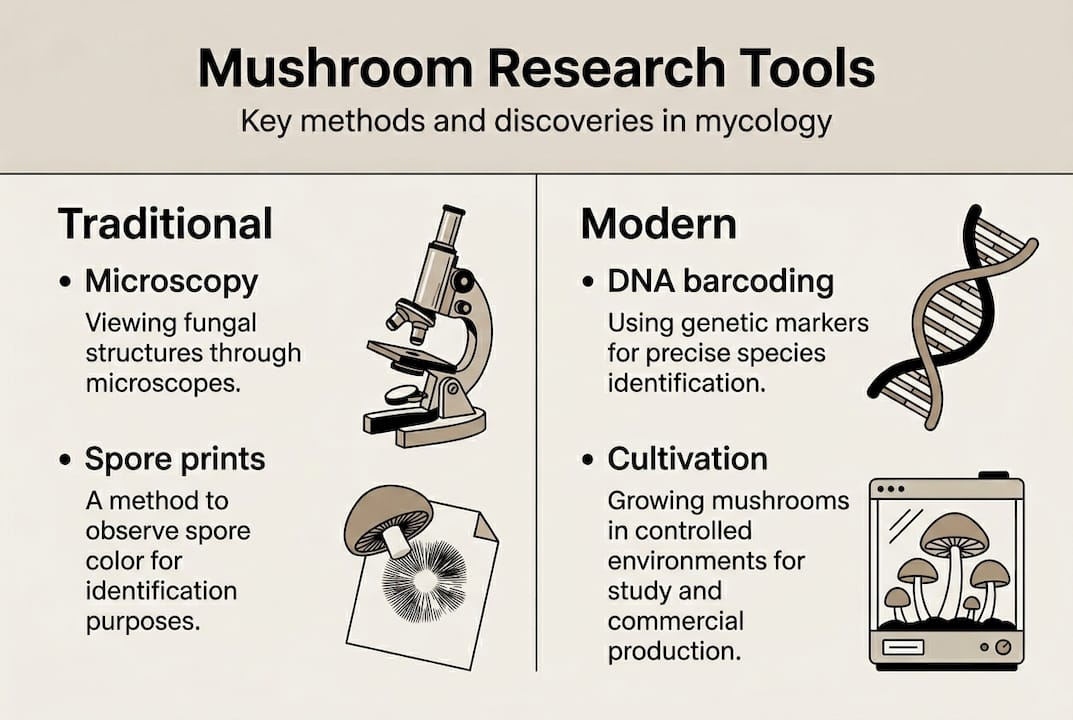
| Method | Traditional approach | Modern approach |
|---|---|---|
| Species ID | Morphological keys | DNA barcoding via ITS sequencing |
| Spore study | Hand-drawn illustrations | Digital microscopy imaging |
| Cultivation | Soil-based, outdoor beds | Controlled substrate blocks |
| Contamination tracking | Visual inspection | Molecular diagnostics |
| Data collection | Field notebooks | Bioinformatics pipelines |
If you are just getting started, a solid guide to mycology microscopy will help you set up your equipment correctly from day one. As your work progresses, studying top mushroom strains becomes relevant for comparative cultivation and genetics research.
Kew Gardens holds one of the world’s largest fungal herbarium collections, enabling researchers to compare historical specimens against modern finds. That scale, representing centuries of preserved material, is an extraordinary resource for fungi ecosystem roles studies and evolutionary biology.
Why study mushrooms? Insights from conservation and discovery
The numbers behind fungal biodiversity are genuinely staggering. Kew holds 1.3M fungal specimens for biodiversity, evolution, and climate adaptation research, yet this collection represents a species group where an estimated three million species exist but only around five per cent have been formally described. That gap is one of the most significant knowledge deficits in all of biology.
This matters because undescribed species may hold medicinal compounds, ecological solutions, or genomic data that could shift entire research fields. New species are still being found in UK woodlands, in urban soils, and even in managed farmland. Every collection adds to a picture that is far from complete.
Pro Tip: If you are conducting fieldwork, always document habitat type, substrate, and associated plant species alongside your sample. This metadata is often as valuable as the specimen itself for conservation and ecological modelling studies.
Key reasons UK researchers prioritise mushroom study:
- Biodiversity monitoring: Fungi are sensitive indicators of environmental change, making them useful proxies for ecosystem health
- New compound discovery: With most species unstudied, the pharmacological potential remains largely untapped
- Climate resilience: Understanding fungal responses to temperature and humidity shifts is critical for predicting woodland futures
- Pathogen risk management: Fungi can be both beneficial and pathogenic, causing up to 30% crop losses, meaning research is urgently needed to distinguish and harness them responsibly
- Conservation partnerships: Mycological data feeds directly into habitat protection strategies across the UK
For researchers working at scale, sourcing consistent material matters. Access to reliable wholesale mushroom spores makes repeat studies and comparative trials far more feasible. The quality and traceability of your starting material shapes the integrity of your research. More detail on the professional side of mycological work is available through Kew mycologist work descriptions, which outline current institutional priorities.
What most guides miss about mushroom research
Most introductory content on fungi presents a neat binary: beneficial or harmful. Beneficial fungi feed forests and heal bodies. Harmful fungi destroy crops and cause disease. That framing is convenient, but it flattens a far more interesting reality.
The truth is that most fungi exist on a gradient. A species that provides mycorrhizal benefit to one host may behave as a weak pathogen under stress conditions in another. Context, host specificity, and environmental state all modulate how a fungal species expresses itself. Researchers who reduce fungi to a two-column table miss the complexity that makes them so scientifically compelling.
Conservation work is further complicated by incomplete knowledge. When you cannot identify most of the species present in a given soil sample, drawing confident conclusions about ecosystem health becomes genuinely difficult. Interdisciplinary approaches that combine molecular ecology, traditional field taxonomy, and cultivation science give you the most robust picture.
For those new to research, do not underestimate the value of studying microdosing mushroom strains as a lens into neurochemistry and behaviour. It illustrates exactly how context-dependent fungal effects truly are.
“The fungi we understand best represent the tip of a very deep iceberg. Good research starts with accepting that uncertainty.”
Take your mushroom research further with Spore Buddies
Whether you are building a study, expanding a collection, or just beginning your mycological journey, having reliable materials and quality resources makes all the difference. At Spore Buddies, we stock everything you need to take applied mycology seriously in the UK. Our mycology science education resources are designed to support both beginners and experienced researchers, pairing practical guidance with the right equipment. Browse our full range of mushroom growing kits to stat cultivation studies with properly prepared substrates, trusted spore sources, and expert support at every stage.
Frequently asked questions
What makes mushrooms unique for scientific research?
Mushrooms possess complex lifecycles, diverse bioactive compounds, and play irreplaceable ecological roles that make them valuable across disciplines from pharmacology to conservation. Kew holds 1.3M fungal specimens, reflecting their central role in biodiversity research.
How do mushrooms affect climate and soil health?
Mushrooms recycle nutrients, improve soil structure, and help plants store carbon, actively reducing atmospheric CO2 and sustaining woodland ecosystems. Fungi are essential for soil health and woodland regeneration, while plants transfer 13B tonnes of CO2 per year directly to fungal networks.
What research methods are commonly used in mycology?
Researchers use microscopy, DNA barcoding, cultivation studies, and spore analysis to investigate mushroom traits, species identity, and diversity. Mycology methods include microscopy at 400x magnification, spore prints, and DNA barcoding as standard practice.
Can mushrooms be harmful as well as beneficial?
Yes, while many mushrooms support ecosystems and medicine, some act as plant pathogens causing significant damage. Fungal pathogens cause up to 30% crop losses, making research into distinguishing harmful from beneficial species genuinely urgent.