
If you’ve ever picked up a British field guide only to find the mushroom you’re looking for listed under a completely different name than you expected, you’re not alone. Mushroom taxonomy, the science of classifying and naming fungi, changes faster than most people realise. Names shift, groupings are overhauled, and species once considered identical turn out to be entirely distinct. Understanding why this happens, and how to stay on top of it, is genuinely useful whether you’re a forager, a home cultivator, or someone studying fungi for research purposes.
Table of Contents
- What is mushroom taxonomy?
- Hierarchies and how mushrooms are classified
- Tools for mushroom identification: morphology and DNA
- Why mushroom taxonomy is always changing
- The rules of fungal naming and international standards
- Why learning mushroom taxonomy should feel exciting, not intimidating
- Explore more with Spore Buddies
- Frequently asked questions
Key Takeaways
| Point | Details |
|---|---|
| Taxonomy evolves | Mushroom names and groupings change often as new scientific evidence emerges. |
| Look beyond looks | Identification now relies on both visible traits and DNA methods to avoid misclassification. |
| International rules apply | Official mushroom names follow global standards set by the International Code. |
| Embrace flexibility | Learning taxonomy means staying curious and open to change—creating room for safe exploration and discovery. |
What is mushroom taxonomy?
Mushroom taxonomy is the scientific classification and naming of fungi that produce mushrooms, placing them into a hierarchical system of taxonomic ranks. It is the framework that lets scientists, cultivators, and foragers speak a common language when referring to species, regardless of regional common names or local dialects.
The scope of mushroom taxonomy covers macrofungi, which are fungi large enough to be seen and handled without a microscope. These include gilled mushrooms, boletes, brackets, puffballs, and many other forms. Each one is assigned a two-part Latin name, called a binomial, made up of its genus and species. Agaricus bisporus, for example, is the button mushroom you find in every supermarket.
Why does this matter for you, practically? There are three solid reasons:
- Safety: Toxic lookalikes often share common names with edible species. Taxonomy clarifies exactly which organism you’re dealing with.
- Research: Scientists and cultivators need stable, precise names to share reliable information across studies and experiments.
- Reliable identification: Two foragers in different parts of the country can confirm they found the same species only if they use the same scientific name.
Taxonomy is not a fixed catalogue. New evidence, especially from DNA studies, regularly alters groupings and names, which means a field guide printed five years ago may already contain outdated information. Understanding this from the start saves a lot of confusion later.
Hierarchies and how mushrooms are classified
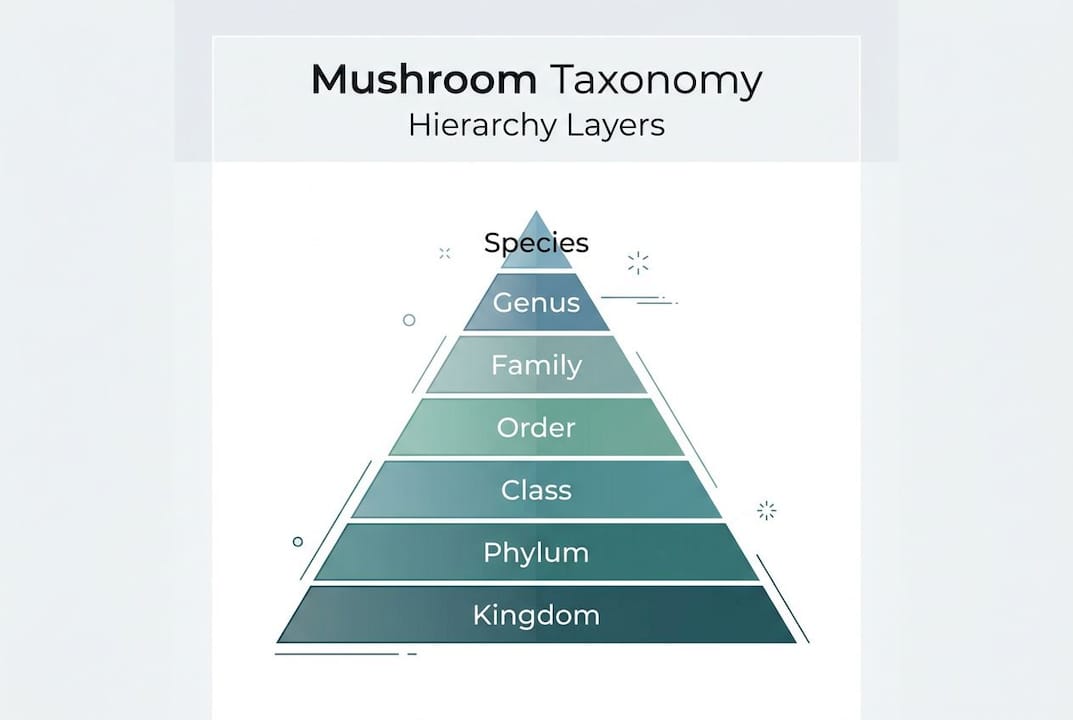
Every mushroom you encounter sits within a nested series of categories, from the broadest to the most specific. Modern classifications are explicitly phylogenetic, meaning they reflect evolutionary relationships rather than just physical appearance, and uncertainties are clearly flagged for groups of uncertain placement, sometimes labelled as incertae sedis (Latin for “of uncertain placement”).
Here are the major ranks in descending order, from broadest to most specific:
- Kingdom (Fungi): the broadest grouping, separating fungi from animals, plants, and other life.
- Phylum (e.g., Basidiomycota): the major division within the kingdom; most gilled mushrooms belong here.
- Class (e.g., Agaricomycetes): a grouping within the phylum, bringing together orders that share key characteristics.
- Order (e.g., Agaricales): clusters families with shared evolutionary history.
- Family (e.g., Agaricaceae): groups genera with close relationships.
- Genus (e.g., Agaricus): closely related species sharing defining traits.
- Species (e.g., bisporus): the most specific rank; organisms that can interbreed and share a consistent set of characteristics.
To make this concrete, here is the full classification of a mushroom familiar to almost every UK enthusiast:
| Rank | Classification for the button mushroom |
|---|---|
| Kingdom | Fungi |
| Phylum | Basidiomycota |
| Class | Agaricomycetes |
| Order | Agaricales |
| Family | Agaricaceae |
| Genus | Agaricus |
| Species | Agaricus bisporus |
Knowing where a mushroom sits in this hierarchy helps you make sense of its relationships to other species. If you find something in the genus Agaricus, you can reasonably expect it to share structural features with the button mushroom, even if it looks quite different. This kind of contextual knowledge sharpens your eye when using an identification checklist in the field.
When you’re using a UK mushroom identifier tool, you’ll often notice that some species are placed in categories labelled as uncertain. This is normal. It means scientists haven’t yet reached consensus on where that group belongs in the evolutionary tree, and it’s a mark of scientific honesty rather than a flaw.
Tools for mushroom identification: morphology and DNA
Understanding where mushrooms fit in the hierarchy leads naturally to how we figure out those relationships. Two broad approaches dominate: morphological identification and molecular methods.
Accurate species identification has historically relied on morphology, meaning the physical features you can observe, but increasingly uses molecular data. DNA barcoding in particular has transformed how fungal species are characterised, revealing hidden diversity that looks identical to the naked eye.
Morphological identification examines observable features such as:
- Cap shape, colour, and texture
- Gill attachment, spacing, and colour
- Spore print colour
- Stem structure, including presence of a ring (annulus) or volva at the base
- Flesh colour and smell
- Microscopic features such as spore shape (ellipsoid, subglobose, or verrucose) and cell structure
These features are accessible to anyone with a hand lens and a basic reference guide. The drawback is that convergent evolution, where unrelated species develop similar appearances, can mislead even experienced identifiers. Cryptic species, those that look identical but are genetically distinct, are another major pitfall.
| Method | Strengths | Limitations |
|---|---|---|
| Morphology | Accessible, no lab needed | Misleading with lookalikes and cryptic species |
| DNA barcoding | Highly accurate, reveals hidden diversity | Requires equipment and databases |
| Integrative approach | Combines both for highest confidence | Time-intensive, requires expertise |
DNA barcoding works by sequencing a standard region of the fungal genome and comparing it against reference databases. This has exposed entire complexes of species that were previously lumped under a single name. For anyone curious to explore microscopy as part of identification, learning microscopy techniques for fungi is a rewarding next step that bridges morphology and more detailed structural analysis.
There is an important mindset shift to adopt here. Think of a species name as a hypothesis rather than a fixed truth. When you identify something as Psilocybe cubensis, you’re working with the best current evidence, not an immutable fact. Future research may split that species, merge it, or rename it entirely. This same logic applies across all fungi, from culinary favourites to those studied for their mushroom wellness properties.
Pro Tip: Always note the date of your field guide’s publication. If it’s more than a decade old, cross-reference any names you find against a current online database before relying on them for identification or cultivation decisions.
Why mushroom taxonomy is always changing
Having explored identification methods, it’s crucial to recognise why names and groupings can change overnight, even for the most studied mushrooms.
Identification keys reflect the state of knowledge at the time they were published and may quickly become out of date as molecular studies are undertaken. This isn’t a flaw in the system; it’s how science is supposed to work. As better evidence arrives, classifications are revised.
Here’s what drives the change most rapidly:
- Molecular phylogenetics: DNA sequencing places species into evolutionary trees based on genetic relationships, sometimes completely overturning appearance-based classifications.
- Cryptic speciation: What appears to be one species is often several genetically distinct organisms. The famous Armillaria mellea complex is a well-known example, with multiple UK species once lumped under a single name.
- New collections and habitats: Fungi collected from understudied regions or unusual habitats regularly produce species new to science or new to particular countries.
- Improved databases: As reference databases of fungal DNA grow, comparisons become more accurate and misidentifications from older literature are corrected.
“Accurate identification is hindered by morphological convergence and cryptic speciation; systematics is being reshaped by DNA barcoding, phylogenomics, and omics approaches.”
The speed of change in fungal systematics is genuinely remarkable. Entire genera have been split or merged within a few years following large-scale sequencing projects. Cortinarius, one of the largest genera in the UK, has seen hundreds of new species described and older ones reclassified in recent years alone.
For UK enthusiasts, this has practical consequences. A species name that appears on a cultivation product, a foraging record, or a research paper may have changed by the time you read it. Understanding identification safety in this context means treating every name with appropriate scepticism, especially for any species that resembles something toxic.
Beginners sometimes find this discouraging. It shouldn’t be. Taxonomy’s flexibility is what makes it reliable in the long run. If you’re just starting out, a solid beginner’s growing guide is a far better use of your early learning time than memorising names that might change anyway.
The rules of fungal naming and international standards
With taxonomy always changing, it’s vital to know who sets the rules and how those rules affect name changes here in the UK.
Fungal names are not arbitrary. They are governed by the International Code of Nomenclature for algae, fungi, and plants. This code is updated at international botanical and mycological congresses, and recent updates have introduced stricter procedural requirements around typification data, which refers to the physical or digital specimens that anchor a name to a real organism.
Here’s how the naming process works in practice:
- A mycologist discovers or characterises a species that appears to be new to science.
- They write a formal description, including detailed morphological notes and, increasingly, DNA sequence data.
- The description is published in a recognised scientific journal.
- A type specimen is deposited in a recognised herbarium or fungarium so that the name is permanently anchored.
- The name enters the scientific record and is eligible to be used globally, including in British species lists and identification keys.
When two names exist for the same organism, which happens surprisingly often due to independent discoveries, the Code provides priority rules. Generally, the oldest validly published name takes precedence. This is why some species appear to be “renamed” when in fact an older, forgotten name has been recovered.
For UK enthusiasts, this system matters because British species lists such as those maintained by the British Mycological Society are updated as the Code evolves. A name change in a German or American journal can and does affect what you find in UK resources and databases.
Pro Tip: The Index Fungorum and MycoBank databases are the two most authoritative online resources for checking current, accepted fungal names. Both are freely accessible and updated regularly. Always check these before relying on a name from a printed guide, particularly for species you intend to cultivate or forage. You’ll also find the UK mycology guidelines on our site a useful companion to these resources.
Why learning mushroom taxonomy should feel exciting, not intimidating
All of this complexity can sound overwhelming, but there’s another way to see it, especially for passionate learners in the UK.
Here’s our honest take: the instinct to want fixed, unchanging names is understandable, but it reflects a misunderstanding of what taxonomy is for. Taxonomy isn’t a list of permanent facts; it’s a living model of the fungal world, updated as our understanding improves. Every name change is a signal that someone, somewhere, has looked more closely and found something genuinely new.
This is actually good news for UK enthusiasts. Britain has a remarkably rich mycological tradition, and British collectors and mycologists have historically contributed significantly to global fungal knowledge. The UK’s damp climate and diverse habitats mean there is still meaningful discovery happening here, not just in tropical rainforests or exotic locations.
Think about what it means practically. When a familiar species is split into two by DNA evidence, you haven’t lost knowledge. You’ve gained it. You now have the chance to look more carefully at something you thought you understood, to notice subtle differences you previously overlooked. That’s exactly the kind of observation that makes foraging safer, cultivation more precise, and mycology more rewarding.
Embracing taxonomy’s flexibility also puts you ahead of many casual enthusiasts. Those who insist on old names, ignore updates, or resist molecular evidence will eventually find themselves working with unreliable information. Those who stay curious, check current databases, and treat identification as an ongoing process will identify more confidently and grow more successfully.
Understanding why mushrooms matter in research is part of what makes taxonomy feel relevant rather than abstract. When you understand that reclassifying a species can have implications for medicine, conservation, or food safety, the whole exercise takes on genuine weight.
Explore more with Spore Buddies
Feeling ready to apply what you’ve learned about mushroom taxonomy? There’s no better way to deepen your understanding than hands-on experience. At Spore Buddies, we stock a wide range of mycology equipment including microscopes, agar plates, spore syringes, and sterilised substrates, so you can explore fungal morphology and begin building your own identification skills at home. If you’re keen to cultivate, our mushroom grow kits are ideal for getting started with shiitake, oyster, or lion’s mane. We also publish regularly updated guides, resources, and identification tools to help you keep pace with the ever-changing world of mycology. Taxonomy comes alive the moment you’re working with real specimens.
Frequently asked questions
How do I keep up with mushroom name changes in the UK?
Use the most recently published identification keys alongside current online databases such as Index Fungorum or MycoBank, since identification keys become outdated quickly as new molecular studies are published.
Why don’t mushrooms stay in the same groupings year to year?
Advances in DNA analysis frequently reveal new evolutionary relationships and hidden species diversity, and systematics is actively being reshaped by DNA barcoding, phylogenomics, and omics approaches that weren’t available to earlier researchers.
Is mushroom taxonomy important for safe foraging?
Yes, correct taxonomy and current identification methods are essential for safe foraging because cryptic speciation and convergent morphology mean that visually similar mushrooms can be entirely different species, some of them toxic.
Who decides the official names for mushrooms?
Fungal names are governed by the International Code of Nomenclature for algae, fungi, and plants, with updates agreed upon at international congresses attended by mycologists and botanists from around the world.