
A single oyster mushroom cap releases up to 1 billion spores, and a giant puffball can shed trillions in a single season. Yet most of those spores never become mushrooms. If you grow mushrooms at home or study mycology, understanding what spores actually do, and why so few succeed, changes how you approach every stage of cultivation. This guide takes you through spore biology, germination conditions, mycelial development, and storage practices, giving you the scientific grounding to make smarter decisions and achieve more consistent results.
Table of Contents
- What are mushroom spores and why do they matter?
- How spores germinate and create mycelium
- From germination to dikaryotic mycelium: the critical transition
- Spore viability, storage, and best practices for UK cultivators
- What most home cultivators miss about spore roles
- Explore advanced spore solutions for home cultivation
- Frequently asked questions
Key Takeaways
| Point | Details |
|---|---|
| Spores as mushroom origin | Mushroom spores start the growth cycle, acting as nature’s reproductive and dispersal cells. |
| Germination needs precision | Successful germination hinges on specific moisture, temperature, substrate, and pH for UK cultivators. |
| Dikaryotic mycelium enables fruiting | Only dikaryotic mycelium from compatible spores will lead to mushroom fruiting bodies. |
| Storage influences viability | Proper storage methods maintain spore viability for years, boosting home cultivation reliability. |
| Clonal isolation for consistency | Cultivators achieve consistent yields by selecting strains through agar isolation instead of relying on random spores. |
What are mushroom spores and why do they matter?
Spores are the starting point of every mushroom’s life, but they are far more complex than simple seeds. Mushroom spores are microscopic, haploid reproductive cells, meaning each spore carries only half the genetic material needed to form a complete organism. In the vast majority of cultivated mushroom species, these are called basidiospores, produced on specialised structures called basidia located in the gills or pores on the underside of a mushroom cap.
The scale of spore production is genuinely remarkable. A single oyster mushroom cap releases up to 1 billion spores, while giant puffballs produce trillions. This enormous output is not wasteful. It is an evolutionary strategy, because the odds of any single spore landing in the right environment, at the right time, with a compatible partner nearby, are astronomically low.
Spores serve two critical functions:
- Reproduction: They carry genetic information that can combine with compatible spores to produce new organisms with unique traits.
- Dispersal: Wind, insects, rain splash, and even animals carry spores across vast distances, allowing mushroom species to colonise new substrates and habitats.
For home cultivators, understanding spore biology is foundational. When you inoculate a substrate, you are not planting a seed that grows predictably. You are introducing thousands of haploid cells, each of which must meet a compatible partner and survive long enough to germinate. Exploring our mushroom genetics guide gives you a clearer picture of how genetic variation in spores affects your fruiting outcomes and strain selection.
Statistic: A single oyster mushroom cap can release up to 1 billion spores per day during peak release, yet only a tiny fraction ever germinate successfully in natural conditions.
This biological reality explains why many home cultivators find spore-based inoculation less predictable than using clonal cultures. Spores are biologically designed for diversity, not consistency.
How spores germinate and create mycelium
Once spores land in a suitable environment, germination begins. But this is not automatic. Spores germinate under specific conditions: adequate moisture, the correct temperature range, a nutritious substrate, appropriate pH (typically 5 to 7), and the absence of inhibitory compounds or competing organisms.
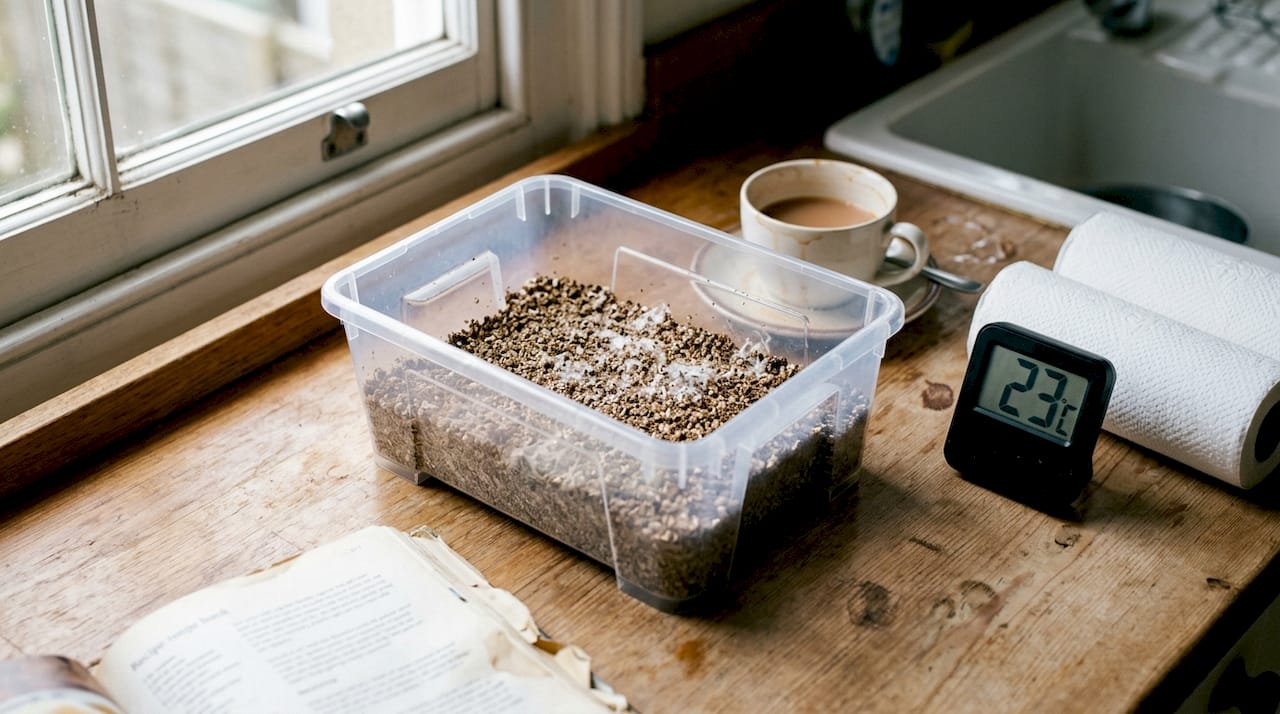
Here is a practical breakdown of germination timelines for species commonly cultivated in the UK:
| Species | Optimal temperature | Germination timeline |
|---|---|---|
| Oyster mushroom | 15 to 30°C | 5 to 7 days |
| Psilocybe cubensis | 21 to 29°C | 10 to 14 days |
| Psilocybe cyanescens | 10 to 18°C | Up to 21 days |
| Shiitake | 15 to 27°C | 7 to 14 days |
The germination process itself follows a clear sequence:
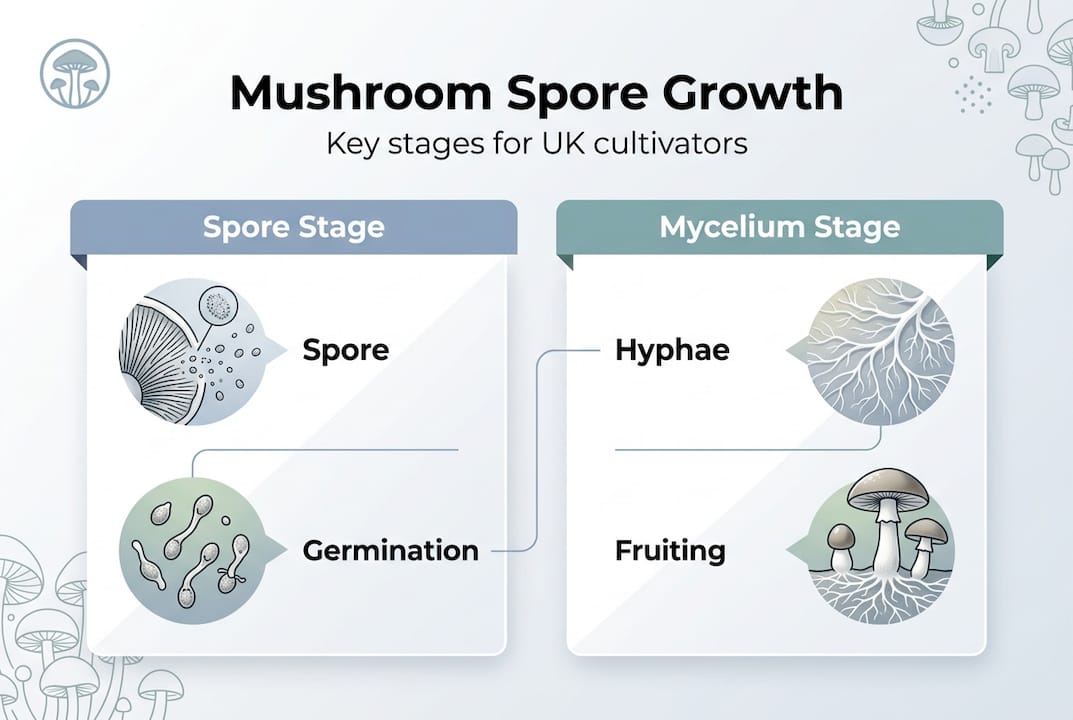
- Hydration: The spore absorbs moisture and swells.
- Activation: Metabolic activity resumes as the spore senses favourable conditions.
- Germ tube emergence: A slender filament, called a germ tube, pushes through the spore wall.
- Hyphal extension: The germ tube elongates, branching to form monokaryotic hyphae (single-nucleus thread-like cells).
- Network formation: Hyphae spread and weave through the substrate, beginning colonisation.
For UK home cultivators, these conditions are entirely achievable with modest equipment. The key variable most beginners underestimate is pH. Substrates that drift above pH 7 or below pH 5 can stall germination entirely, even when temperature and moisture are perfect. Pairing your spore inoculation with well-prepared substrate recipes is one of the fastest ways to improve germination rates.
Contamination is the other major risk during this stage. Because germinating spores are slow to establish, aggressive moulds like Trichoderma can outcompete them before mycelium takes hold. Reviewing a solid contamination FAQ before inoculation helps you identify and prevent the most common failures.
Pro Tip: Maintaining a stable temperature within the optimal range, rather than hitting the upper limit, tends to produce steadier mycelial growth and fewer contamination issues.
From germination to dikaryotic mycelium: the critical transition
Germination produces monokaryotic hyphae, but these threads cannot fruit on their own. Fruiting requires a crucial biological event: two compatible monokaryotic hyphae must fuse together in a process called plasmogamy.
Monokaryotic hyphae fuse via plasmogamy to form dikaryotic mycelium, which contains two genetically distinct nuclei per cell. This dikaryotic state is the vegetative powerhouse of the mushroom. You can recognise healthy dikaryotic mycelium by its robust, rope-like growth (called rhizomorphic mycelium) and the presence of small hook-like structures at cell junctions called clamp connections.
Here is how the two mycelial types compare:
| Property | Monokaryotic mycelium | Dikaryotic mycelium |
|---|---|---|
| Nuclei per cell | 1 | 2 (genetically distinct) |
| Can fruit? | No | Yes |
| Visual appearance | Thin, wispy | Dense, rope-like |
| Origin | Single spore | Two compatible spores |
This distinction has direct implications for cultivation:
- Multi-spore inoculations introduce hundreds of unique monokaryotic lines. Compatible pairs fuse naturally, producing dikaryotic mycelium, but the resulting genetics are unpredictable.
- Clonal cultures (taken from tissue or isolated monocultures) skip this lottery entirely, delivering consistent dikaryotic mycelium with known fruiting characteristics.
- Single-spore cultures cannot fruit alone, which is why isolating a single spore and expecting a harvest is a common beginner mistake.
“The genetic variability introduced by multi-spore inoculations is a feature in nature but a liability in cultivation, where consistency determines yield.”
For cultivators who want to go beyond trial and error, understanding genetic variability in your chosen strains gives you a real advantage when selecting the strongest performers from a spore run.
Spore viability, storage, and best practices for UK cultivators
Spores are remarkably resilient. Spores exhibit high viability across years and even decades when stored correctly, surviving desiccation, UV exposure, and temperature extremes that would destroy most biological material. For UK cultivators, knowing how to store spores correctly protects your investment and keeps future grows viable.
Here is what good storage looks like in practice:
- Dry spore prints: Stored in sealed paper envelopes inside airtight containers with silica gel, dry prints retain 70 to 90% viability for 1 to 2 years at room temperature, and up to 10 years under refrigeration at 4 to 10°C.
- Spore syringes: Refrigerated at 4°C, liquid syringes remain viable for 3 to 12 months. Avoid freezing liquid suspensions, as ice crystals damage spores.
- Cryopreservation: Using liquid nitrogen or ultra-cold storage, viability rates of 80 to 95% can be maintained for 5 years or more.
- Humidity control: Low relative humidity (below 50%) is essential. Moisture triggers premature germination or mould growth in stored prints.
For most UK home cultivators, a dedicated section of the fridge, separate from food, with a small silica gel packet inside a sealed container is perfectly adequate for medium-term storage.
Pro Tip: Label every print or syringe with the strain name, collection date, and storage method. It sounds obvious, but unlabelled spore prints are one of the most common sources of confusion and wasted effort in home cultivation.
When you are ready to put stored spores to use, selecting the right substrate is just as important as spore quality. Our bulk substrate guide walks you through preparation for common UK species, while our spore prints guide covers how to work with prints effectively on agar.
What most home cultivators miss about spore roles
Here is the insight that experience and science both point to: most cultivators treat spores as guaranteed starters. They are not. Over 99% of spores fail to germinate, whether due to environmental mismatch, absence of compatible mates, or simple competition from other microorganisms. This is not a failure of technique. It is biology.
The frustration many UK home growers feel after their first multi-spore inoculation, where colonisation is patchy, uneven, or stalls completely, often comes down to this misunderstanding. They expect seeds. They get a genetic lottery.
Experienced cultivators take a different approach. Rather than gambling on multi-spore inoculations for every grow, they use spores primarily for genetic exploration on agar plates. From hundreds of germinated spores, they select isolates showing rhizomorphic growth patterns and vigorous colonisation. These isolates become clonal cultures that deliver consistent, predictable harvests.
What this means practically: spores are a starting point, not an endpoint. They are the raw genetic material from which you identify a winner and then replicate that winner. If you skip the selection stage, you get whatever the genetic lottery delivers, and that is rarely your strongest fruiter.
Our guide on mycology cultivation tips covers isolation techniques in more detail, including how to read agar growth patterns to spot the most promising isolates before you ever commit them to bulk substrate.
Explore advanced spore solutions for home cultivation
If this guide has shifted how you think about spores, the natural next step is putting that knowledge to work with quality materials. At Spore Buddies, we supply UK home cultivators with everything needed to go from spore to harvest with confidence. Whether you are building your first agar workflow or sourcing specific strains for isolation work, our mycology supplies UK range covers the essentials. Browse our selection of spore prints and agar to start your strain work, or follow our step-by-step mycology process guide to apply these science-backed techniques at home.
Frequently asked questions
How long can mushroom spores survive in storage?
Dry spore prints last up to 10 years under refrigeration, liquid syringes remain viable for 3 to 12 months when refrigerated, and cryopreserved samples can maintain 80 to 95% viability for 5 years or more.
Why don’t all spores germinate into mushrooms?
Most spores fail to germinate because they land in unsuitable conditions or cannot find a compatible partner to form dikaryotic mycelium, which is why clonal cultivation methods are preferred for consistent results.
What’s the best way to start mushroom cultivation from spores?
Use spore syringes or prints on agar to germinate and isolate vigorous strains before transferring to bulk substrate, as this selection stage significantly reduces variability and weak fruiters.
Can I improve spore germination success at home?
Yes. Maintaining optimal temperature, pH, and moisture throughout inoculation and early colonisation is the single most effective way to raise germination rates and reduce contamination losses at home.