
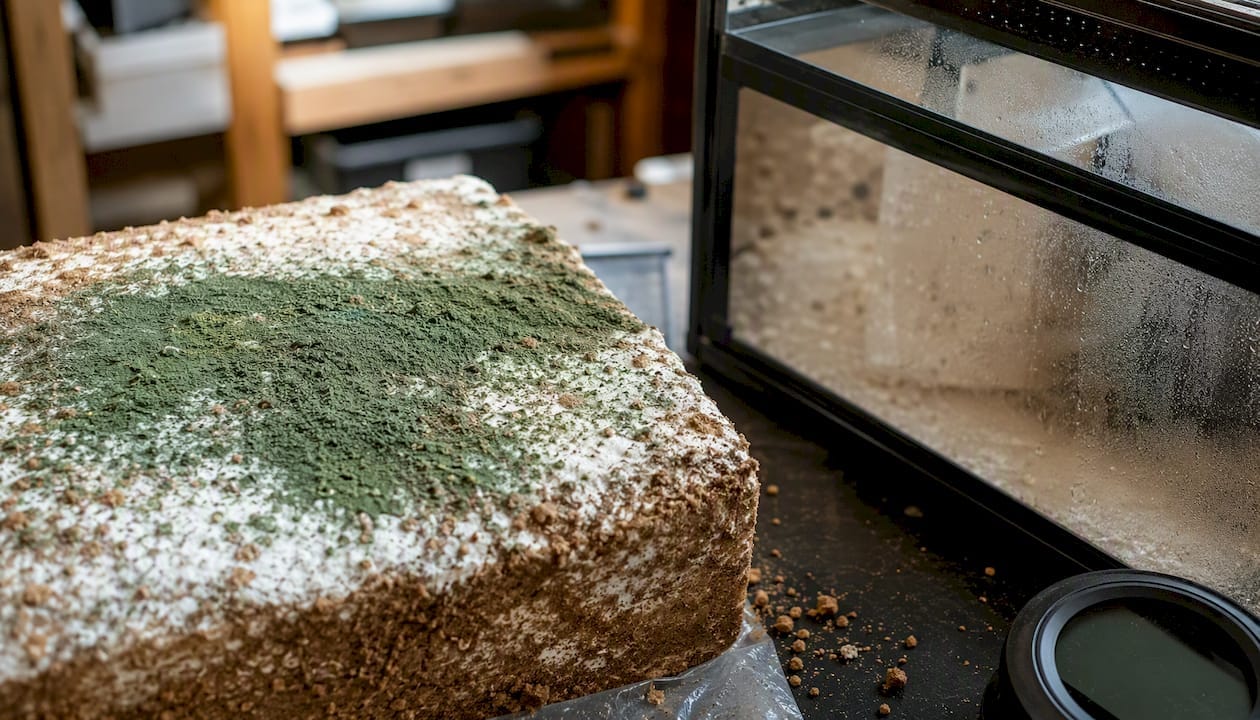
The three highest-priority contamination risks in mushroom cultivation are Trichoderma (green mould), bacterial blotch caused by Pseudomonas spp., and Aspergillus. When any of these appear, your immediate priorities are: stop the spread by sealing the affected container without opening it indoors, isolate the batch from healthy grows, and audit your sterile technique before the next run. AHDB research identifies bacterial blotch and green mould as the two highest-priority threats in UK mushroom production, while the HSE mushroom factsheet sets out the COSHH duties that apply even to small operations. Sporebuddies supports UK growers at every stage with supplies, equipment, and practical guidance.
Highest-risk contaminants at a glance:
- Trichoderma (green mould): Spreads aggressively through substrate; outcompetes mycelium within days
- Bacterial blotch (Pseudomonas spp.): Causes wet, foul-smelling collapse; spreads via water and handling
- Aspergillus: Dark powdery spores; poses a genuine inhalation health risk
- Bacterial wet rot: Slimy, rapid collapse; usually linked to over-wet substrate or contaminated spawn
- Cobweb mould: Grey wisps; less aggressive but signals poor airflow
Immediate first actions:
- Seal the contaminated container in a bag without opening it
- Remove it from your grow space immediately
- Review your sterilisation and handling technique before the next inoculation
Key takeaways
Preventing contamination in mushroom cultivation depends on correct sterilisation, filtered air, sealed containers, and consistent monitoring — no single product replaces good technique, but the right equipment makes good technique far easier to maintain.
| Point | Details |
|---|---|
| Trichoderma is the top threat | Green mould spreads fastest and cost the UK industry an estimated amount in the hundreds of thousands of pounds in 2013. |
| Sterilise at 15 psi / 121°C | Hold pressure for at least 90 minutes; shorter cycles leave heat-resistant spores viable. |
| Seal before you remove | Never open a contaminated container indoors; seal, bag, and remove it immediately. |
| Follow COSHH duties | Carry out a written risk assessment and use FFP2 minimum when handling compost or powdery contaminants. |
| Sporebuddies for supplies | Sporebuddies stocks traceable spores, sterilised substrates, HEPA equipment, and PPE for UK growers. |
Table of Contents
- What are the most common contaminants in mushroom cultivation?
- Why does contamination happen? The controllable root causes
- Actionable prevention checklist: hygiene, sterilisation and environment
- How to detect contamination early with simple monitoring routines
- What to do when contamination appears: containment and clean-up
- Worker health, bioaerosols and your COSHH responsibilities
- Typical contamination timelines and UK equipment costs
- Buying guide: which supplies actually reduce contamination risk?
- How UK seasons affect contamination risk in mushroom cultivation
- Lessons from contamination outbreaks in UK mushroom farms
- Sporebuddies: UK supplies to support cleaner grows
- Sources
- FAQ
What are the most common contaminants in mushroom cultivation?
Trichoderma is the single most aggressive risk in substrate-based grows. AHDB data estimated green mould losses to the UK mushroom industry at around an amount estimated to be in the hundreds of thousands of pounds in 2013, which illustrates why prevention pays for itself quickly.
| Contaminant | Colour / texture | Smell | Speed of spread | Health note |
|---|---|---|---|---|
| Trichoderma (green mould) | Bright green, powdery | Musty | Very fast | Low risk to healthy individuals |
| Pseudomonas (bacterial blotch) | Brown, slimy patches | Foul, rotten | Fast via water | Low risk; wear gloves |
| Aspergillus | Dark green to black, powdery | Earthy | Moderate | Mycotoxin risk; use RPE |
| Bacterial wet rot | Off-white to brown, slimy | Putrid | Fast | Wear gloves; avoid inhalation |
| Cobweb mould | Grey, wispy | Faint | Slow | Minimal |
| Yeast contamination | Sour-smelling, wet | Sour | Moderate | Minimal |
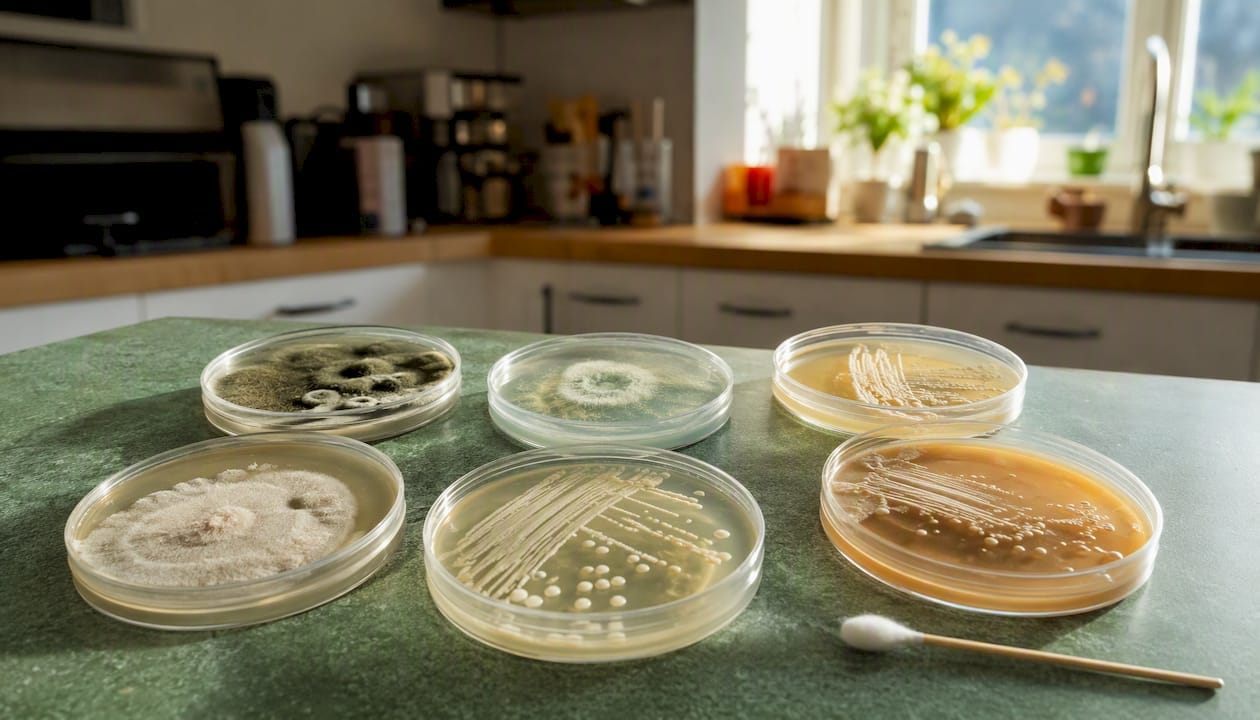
Send a sample to a laboratory when visual identification is uncertain or when a contaminant recurs despite corrective action. For quick field checks, a Q-tip swabbed across a suspicious patch and streaked onto an agar plate will often confirm bacterial versus fungal contamination within 48–72 hours.
Why does contamination happen? The controllable root causes
Contamination is rarely bad luck. Incomplete sterilisation or pasteurisation, contaminated spawn, poor handling, and a contaminated environment account for the vast majority of failures. Each is fixable.
- Incomplete sterilisation: Substrate not held at pressure long enough allows heat-resistant spores to survive and germinate before mycelium can colonise
- Contaminated spawn: A single contaminated grain jar can infect an entire batch at inoculation
- Poor handling: Inoculating in unfiltered air, touching the inside of bags, or using unsterilised tools introduces spores directly
- Contaminated environment: High ambient spore counts from open windows, pets, or organic debris raise baseline risk significantly
- Cooling errors: Hot substrate cooled in unfiltered air pulls ambient spores through filter patches as it contracts
Pro Tip: After each run, check where you cool your substrate. If it sits near an open door, a pet bed, or a compost bin, you have found your most likely contamination source before you even look at your technique.
AHDB and HSE research both confirm that systematic hygiene controls, not one-off fixes, are what separate consistently clean grows from recurring contamination problems.
Actionable prevention checklist: hygiene, sterilisation and environment
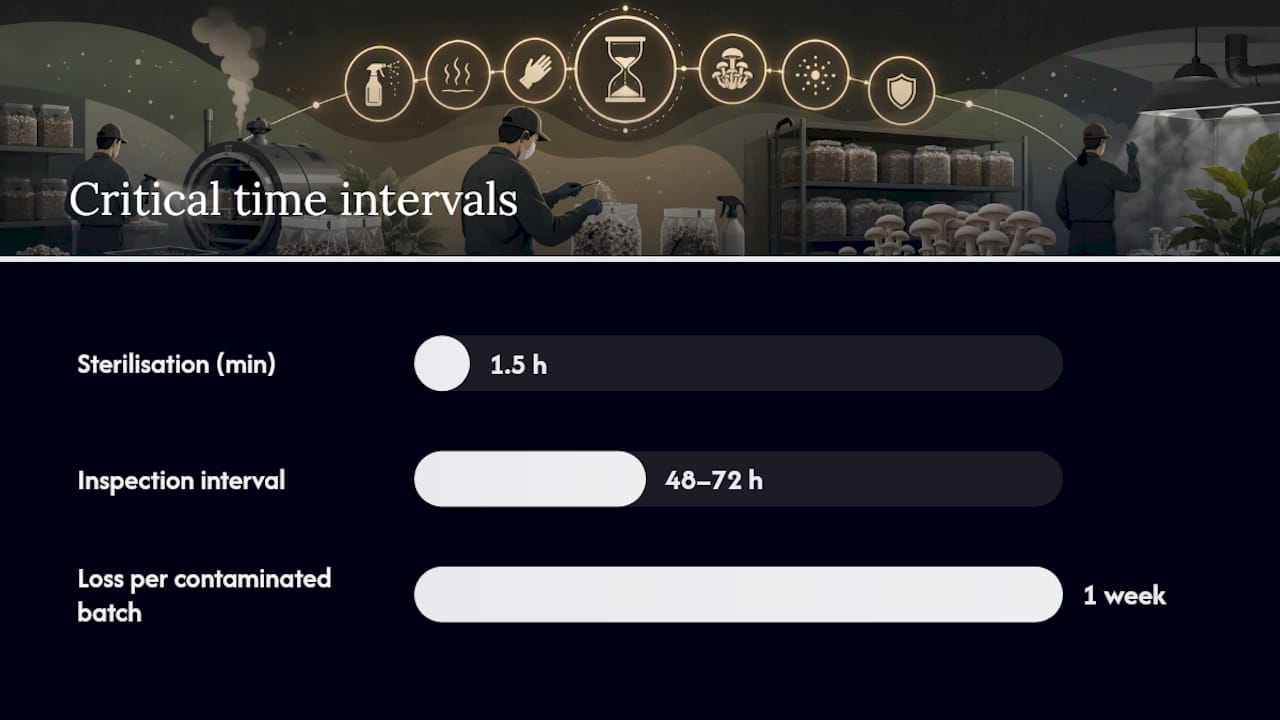
The single most effective prevention sequence is: sterilise substrate correctly, work in filtered air, and keep colonising containers sealed until harvest.
Step-by-step checklist:
- Sterilise grain or bulk substrate at a temperature and pressure sufficient for at least one and a half hours (longer for dense bulk loads)
- Cool substrate fully inside sealed bags or jars before inoculation
- Wipe all work surfaces with 70% isopropyl alcohol before and after each session
- Inoculate inside a still air box or under a HEPA laminar flow unit
- Flame-sterilise needles between each inoculation point; let cool before contact
- Seal inoculation ports immediately with micropore tape or self-healing injection ports
- Incubate in a dedicated space away from kitchen, pets, and outdoor air
- Inspect every container every 48–72 hours without opening them
Equipment to prioritise:
- Pressure cooker rated to 15 psi (or a laboratory autoclave for larger runs)
- True HEPA air purifier sized to your room’s CADR requirement
- Still air box as a low-cost laminar flow alternative
- Sealed filter-patch grow bags from a validated supplier
- 70% isopropyl alcohol, nitrile gloves, and micropore tape
Safety note: Never open a container you suspect is contaminated indoors. Seal it in a double bag first, then remove it.
Business impact: AHDB estimated UK green mould losses at an amount estimated to be in the hundreds of thousands of pounds in 2013. For a small producer, a single contaminated batch can represent a week’s labour and substrate cost — prevention is the cheaper option by a significant margin.
How to detect contamination early with simple monitoring routines
Check every container every 48–72 hours during colonisation. High-risk substrates such as grain or supplemented hardwood warrant daily checks in the first week.
Routine checks:
- Visual: Look for any colour other than white mycelium — green, black, yellow, or brown patches are warning signs
- Smell: Healthy mycelium smells faintly mushroomy or earthy; sour, foul, or chemical odours indicate bacterial or mould contamination
- Q-tip agar test: Swab a suspicious area, streak onto a prepared agar plate, and incubate at room temperature for 48 hours to confirm contamination type
Log each inspection with the date, container ID, and any observations. Spotting a pattern — for example, contamination always appearing in the same corner of your incubation shelf — points directly to an environmental root cause. Quarantine any suspect container immediately, before confirmation, to protect the rest of your batch.
Pro Tip: Prepare a few agar plates in advance and store them in your fridge. Having them ready means you can run a quick spot check the moment something looks off, rather than waiting until the contamination has spread.
What to do when contamination appears: containment and clean-up
Act immediately. Every hour a sporulating contaminant sits open in your grow space seeds the environment further.
- Put on gloves and, if the contaminant is powdery (Trichoderma, Aspergillus), an FFP2 mask
- Slide the contaminated container into a heavy-duty bin bag without opening it
- Seal the bag tightly and carry it directly outside
- Place it in a sealed outdoor bin; do not compost contaminated material
- Return indoors and wipe all surfaces the container touched with a 10% bleach solution (contact time: 10 minutes minimum)
- Run your HEPA air purifier on its highest setting for at least two hours
- Perform a full wet clean of the grow space before the next run
Salvage is rarely worth attempting. Once Trichoderma has sporulated or bacterial wet rot has taken hold, the substrate is lost. Attempting to cut out affected areas risks spreading spores and is not recommended.
When to call for professional help:
- Contamination recurs across multiple consecutive batches despite corrective action
- You cannot identify the contaminant visually or by agar check
- A worker develops respiratory symptoms linked to the grow space
For contamination identification and diagnostics, FERA (Food and Environment Research Agency) provides laboratory diagnostic services for UK growers who need confirmed pathogen identification.
Worker health, bioaerosols and your COSHH responsibilities
Growers have COSHH duties to assess and control exposure to bioaerosols in mushroom production. The HSE mushroom factsheet sets out the practical controls required.
Key regulatory points:
- Carry out a written COSHH risk assessment covering bioaerosol exposure
- Implement ventilation controls before relying on PPE
- Exclude non-essential personnel from high-exposure areas (compost handling, harvesting)
- Use wet cleaning rather than dry sweeping to avoid resuspending spores
- Provide training and, where exposure is significant, health surveillance
PPE guidance:
- FFP2 respirator minimum for compost handling, harvesting, and any work near sporulating contaminants; FFP3 where Aspergillus is suspected
- Nitrile gloves for all substrate and spawn handling
- Eye protection when working with bleach solutions or powdery contaminants
The HSE factsheet specifically highlights that inhalable dust and bioaerosol levels can be elevated during compost delivery and mushroom harvesting. Small producers can implement scaled versions of these controls, including HEPA filtration and scheduled wet cleaning, without full industrial investment. Sporebuddies stocks mycology equipment including filtration and PPE items suited to home and small-scale operations.
Typical contamination timelines and UK equipment costs
Bacterial issues can appear within 2–5 days of inoculation. Moulds, including Trichoderma, typically show within 7–14 days. Yeast contamination often appears as a sour smell before any visible sign.
Timeline by incubation stage:
- Days 1–5: Watch for bacterial wet rot and yeast (sour smell, slimy texture)
- Days 5–14: Prime window for Trichoderma and Aspergillus to appear
- Days 14+: Cobweb mould and late bacterial blotch; also check fruiting pins for Pseudomonas blotch
Prevention equipment pays for itself after a single avoided batch loss. A pressure cooker and a still air box together represent the minimum viable investment for consistent results.
Buying guide: which supplies actually reduce contamination risk?
Buying the right categories — sterilisation equipment, HEPA filtration, sealed spawn and substrate, and spawn from traceable suppliers — reduces contamination risk more reliably than any ad hoc fix.
Product categories and selection criteria:
- HEPA air purifier: Must carry a true HEPA (H13 or H14) rating; match CADR to your room volume
- Pressure steriliser: Rated to 15 psi / 121°C; check gasket condition before every run
- Filter-patch grow bags: Choose a supplier who states the micron rating of the filter patch
- Spawn and spore supplies: Prioritise traceable spore syringes from suppliers with documented production hygiene
- Sterilised substrate: Pre-sterilised mushroom substrate removes the sterilisation step entirely for beginners
When evaluating spawn suppliers, look for strain traceability, documented pasteurisation protocols, and evidence of consistent performance across batches. Mushroom product certifications can help you assess supplier credibility quickly.
When contamination appears, you want to respond in under two minutes, not spend five minutes searching for supplies.*
How UK seasons affect contamination risk in mushroom cultivation
Outdoor spore counts in the UK peak during late summer and autumn, roughly August through October, when warm, humid conditions favour Trichoderma and Aspergillus. This is the highest-risk period for any grow space with imperfect air filtration.
Spring brings elevated moisture and fluctuating temperatures, which can stress mycelium and create openings for bacterial blotch. Winter grows tend to be cleaner in terms of ambient spore load, but cold temperatures slow colonisation, extending the contamination window.
Practical adjustments by season:
- Summer/autumn: Increase inspection frequency; run HEPA purifiers continuously; seal all gaps in your grow space
- Spring: Monitor substrate moisture carefully; bacterial blotch risk rises with humidity
- Winter: Extend sterilisation times slightly to compensate for slower heat penetration in cold environments; watch for condensation inside incubation chambers
Tracking your contamination log against the calendar will quickly reveal whether your failures cluster in a particular season, which points directly to an environmental rather than a technique problem.
Lessons from contamination outbreaks in UK mushroom farms
AHDB research into bacterial blotch and green mould in UK commercial mushroom production has documented recurring patterns that apply equally to small-scale growers. The findings consistently show that outbreaks trace back to identifiable hygiene failures rather than random environmental bad luck.
One pattern AHDB highlights is the role of bulk compost delivery as a contamination entry point. Compost arriving from external suppliers can carry Pseudomonas and Trichoderma spores, and farms that failed to control delivery areas or quarantine incoming material saw higher blotch incidence. The lesson for small producers: treat every incoming substrate or spawn delivery as a potential contamination vector until it is in a sealed, sterilised state.
A second recurring theme is the “one open jar” problem. Opening a sporulating Trichoderma container indoors can seed a grow space for weeks. Farms that adopted a strict “seal and remove” protocol, never opening suspect containers inside the production area, saw contamination rates drop significantly after a single season.
The broader lesson from UK industry experience is that contamination management is a system, not a single action. AHDB’s detection and control research continues to develop hygiene indicator tools for Trichoderma, reinforcing that early detection and consistent farm hygiene are the most effective long-term controls available.
Sporebuddies: UK supplies to support cleaner grows
Sporebuddies supplies the key product categories this guide recommends, all available to UK growers with no minimum order for most lines. Whether you need mushroom growing kits that remove the sterilisation step entirely, mycology equipment including HEPA filtration and lab supplies, or traceable spore syringes with documented production hygiene, you will find them in one place. Small commercial producers can also enquire about wholesale mycology supplies for bulk orders. Visit the contamination FAQ for quick troubleshooting, or contact customer support for research and bulk enquiries.
Sources
- Mushroom factsheet (HSE/HDC)
- Detection and control of pathogens causing blotch and green mould in mushroom cultivation | AHDB
For confirmed pathogen identification, FERA (Food and Environment Research Agency) provides laboratory diagnostic services for UK growers. Contact a professional remediation service when contamination recurs across multiple batches despite corrective action.
FAQ
What is the most common contaminant in mushroom cultivation?
Trichoderma (green mould) is the most common and aggressive contaminant in substrate-based mushroom grows. It spreads rapidly and is difficult to eradicate once established, making prevention the only reliable strategy.
How quickly does contamination appear after inoculation?
Bacterial contamination can appear within 2–5 days. Moulds, including Trichoderma, typically show within 7–14 days of inoculation.
Do I have COSHH duties as a small or home grower?
COSHH duties apply to anyone who works with biological agents, including mushroom spawn and compost, in a way that could expose them or others to bioaerosols. The HSE mushroom factsheet sets out the practical steps required, including risk assessment and ventilation controls.
Can I salvage a contaminated batch?
Rarely. Once Trichoderma has sporulated or bacterial wet rot has taken hold, the substrate is lost. Seal the container, remove it without opening it indoors, and focus on cleaning the grow space before the next run.
Where can I buy contamination control supplies in the UK?
Sporebuddies stocks traceable spore syringes, sterilised substrates, HEPA filtration equipment, and PPE for UK growers, with wholesale options available for small commercial producers.