

The benefits of Golden Teacher for microdosing most commonly reported are improved mood, greater creative thinking, and sharper mental clarity. A large international survey of 6,753 people found mood and creativity among the top self-reported gains, and a longitudinal study tracking psilocybin microdosers over about one month observed small-to-medium improvements in mood and reductions in depressive symptoms. Golden Teacher (Psilocybe cubensis) is described as a moderate-potency strain, which makes it a practical starting point for sub-perceptual dosing. In the UK, psilocybin mushrooms are a Class A controlled substance under the Misuse of Drugs Act 1971, so possession and cultivation of fruiting bodies is illegal. Sporebuddies serves UK readers as an educational resource and legal supplier of spores for microscopy and research. Always consult a clinician before making any changes related to mental health.
Key reported benefits at a glance:
- Improved mood and reduced low-mood episodes
- Greater creative ideation and novel thinking
- Sharper focus and mental clarity
- Reduced anxiety symptoms (longitudinal data)
- Increased sense of emotional warmth and wellbeing
Key takeaways
Golden Teacher microdosing effects are most consistently reported in mood and creativity, with the strongest evidence coming from a longitudinal observational study tracking 953 psilocybin microdosers over approximately 30 days.
| Point | Details |
|---|---|
| Main reported benefits | Improved mood, reduced anxiety, greater creativity, and mental clarity are the most common self-reports. |
| Evidence strength | Longitudinal observational data is among the strongest available evidence; randomized trials remain limited. |
| Golden Teacher suitability | Moderate potency (0.6–0.8% psilocybin) and predictable effects make it a practical starting strain for microdosing. |
| Safety and legal caution | Psilocybin mushrooms are Class A in the UK; consult a clinician before use, especially with any mental health history. |
| Sporebuddies resources | Sporebuddies provides free UK-focused strain guides, safety FAQs, and legal spore supplies for microscopy and research. |
This article is general information, not a substitute for advice from a qualified doctor. Consult a qualified healthcare professional about your own circumstances before acting on anything here.
Table of Contents
- What peer-reviewed studies say about microdosing effects
- Why Golden Teacher is a popular choice for microdosing
- How microdosing protocols typically work
- Reported benefits in detail: what the evidence actually supports
- Risks, side effects and who should avoid microdosing
- How intention and integration shape your outcomes
- A practical harm-reduction checklist for UK readers
- Legal alternatives for creativity, clarity and mood in the UK
- Sporebuddies: education and legal supplies for UK hobbyists
- Sources
- FAQ
What peer-reviewed studies say about microdosing effects
The evidence base for microdosing is growing, but it remains observational. Two sources stand out for their scale and rigour.
The SAGE international survey (n = 6,753) is the largest self-report dataset available. Improved mood and creativity were the most frequently cited benefits. The authors are clear about the limits: no placebo control, self-selection bias, and expectancy effects all inflate positive reports. Intention also mattered: participants microdosing with a specific “avoid” intention (targeting a symptom) tended to report more benefit than those with vague self-improvement goals.
The Nature / UBC longitudinal study followed 953 psilocybin microdosers and 180 non-microdosing comparators over approximately 30 days. It found small-to-medium improvements in mood and mental health, plus reductions in depressive and anxiety symptoms. Effects on standardised cognitive tests were limited, which is worth noting when you read community claims about focus and productivity. One interesting sub-finding: participants who stacked psilocybin with Hericium erinaceus (lion’s mane) and niacin (vitamin B3) showed psychomotor improvements, particularly older adults.
Evidence tiers to keep in mind:
- Large self-report surveys: strong signal for mood and creativity, weak for causation
- Longitudinal observational study: better design, still no randomisation or placebo
- Randomised controlled trials for microdosing: limited and ongoing; results are mixed
Why Golden Teacher is a popular choice for microdosing
Golden Teacher sits in the moderate-potency tier of Psilocybe cubensis strains. Its psilocybin content is reported at approximately 0.6 to 0.8 percent by dry weight in strain guides, which places it below high-potency varieties and makes dose estimation more predictable. That predictability is the main reason it appears so often in microdosing discussions.
Sporebuddies’ Golden Teacher strain overview describes it as approachable for beginners, with consistent fruiting characteristics and a well-documented effect profile. Users commonly report emotional warmth, mild introspection, and clarity rather than overwhelming visuals, which aligns with what you want from a sub-perceptual dose.
| Characteristic | Golden Teacher |
|---|---|
| Relative potency | Moderate (0.6–0.8% psilocybin, dry weight) |
| Typical microdose range | about 0.1 to 0.3 grams dried |
| Onset at microdose level | around half an hour |
| Duration | 3–5 hours |
| Commonly reported effects | Mood lift, clarity, emotional warmth |
| UK cultivation legality | Spores legal for microscopy; fruiting bodies illegal |
For a direct strain comparison, Sporebuddies’ strain comparison guide covers how Golden Teacher sits relative to other Psilocybe cubensis varieties for microdosing purposes.
How microdosing protocols typically work
Community consensus places a dried Golden Teacher microdose in the approximately 0.1 to 0.3 grams range, as summarised in the Sporebuddies practical microdosing guide. The goal is sub-perceptual: you should not feel high. Two scheduling patterns dominate community practice:
- Every-other-day protocol — dose one day, rest the next, repeat. Reduces tolerance build-up.
- Four-days-on, three-days-off — popular in communities influenced by Paul Stamets’ stack discussions; allows weekly rest periods.
Neither protocol has been validated in a clinical trial. Frequency, body weight, metabolism, and individual sensitivity all shift what “sub-perceptual” means for you.
Tracking checklist for each dosing day:
- Time of dose and amount taken
- Mood rating before and two hours after (1–10 scale)
- Creativity or focus observations (brief note)
- Sleep quality that night
- Any adverse effects (nausea, anxiety, headache)
Pro Tip: Start at a low dose and keep a dedicated journal for at least a couple of weeks before adjusting upward. Body weight, metabolism, and baseline sensitivity vary considerably, so what works for someone else may be too much or too little for you.
Reported benefits in detail: what the evidence actually supports
The advantages of microdosing Golden Teacher cluster into three areas, each with a different evidence strength.

| Reported benefit | Evidence source | Strength |
|---|---|---|
| Improved mood and reduced low mood | Nature / UBC longitudinal study | Moderate (observational, n = 953) |
| Reduced anxiety symptoms | Nature / UBC longitudinal study | Moderate (observational) |
| Increased creativity and ideation | SAGE survey (n = 6,753) | Low-moderate (self-report only) |
| Sharper focus and clarity | SAGE survey; community reports | Low (subjective, no cognitive test confirmation) |
| Emotional warmth and wellbeing | Strain guides; community reports | Low (anecdotal) |
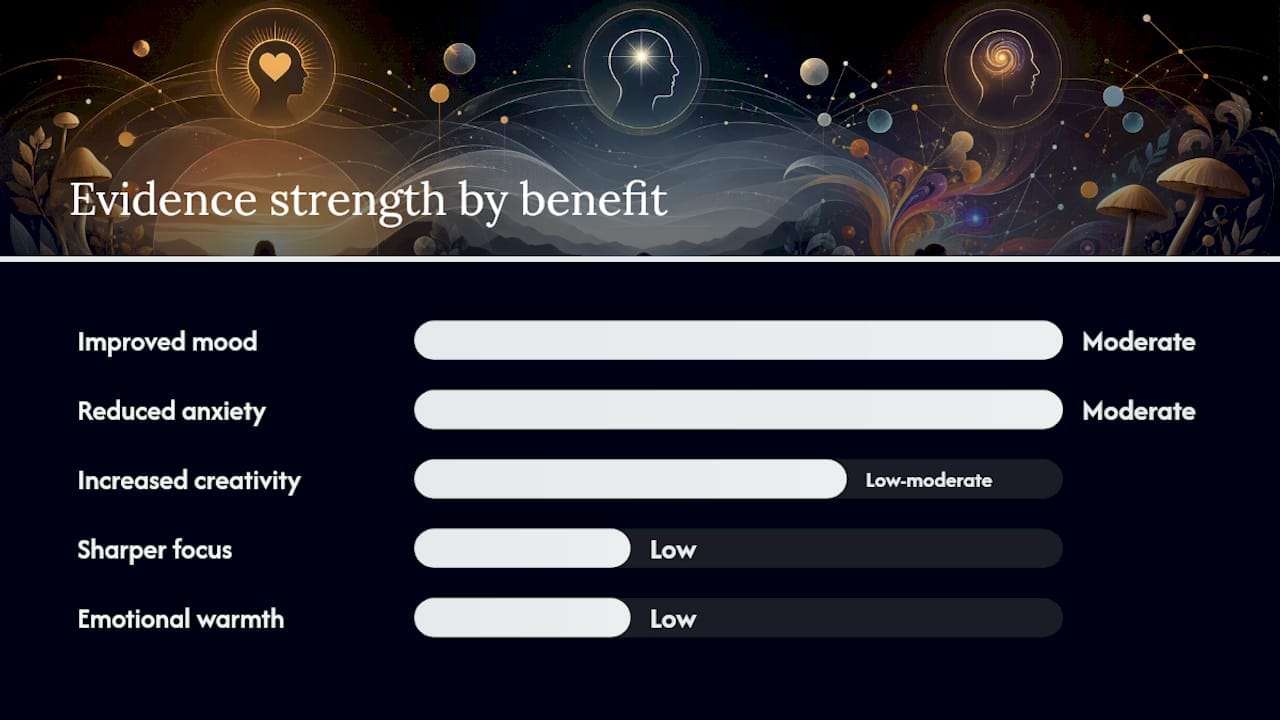
Mood improvements have the strongest backing. The UBC longitudinal study found reductions in depressive symptoms over 30 days, though the absence of a placebo arm means expectancy effects cannot be ruled out. Creativity gains are widely reported but harder to measure objectively; the SAGE survey captures what people believe changed, not what standardised tests confirm.
Focus and clarity are where subjective and objective data diverge most sharply. People consistently report feeling clearer, yet the same longitudinal study found limited effects on formal cognitive tests. That gap likely reflects expectancy and the difficulty of measuring subtle cognitive shifts with standard instruments.
Risks, side effects and who should avoid microdosing
Microdosing is not risk-free. Common short-term side effects reported in surveys include mild nausea, disrupted sleep (particularly if dosed late in the day), and occasional anxiety or emotional sensitivity. These are generally mild and dose-dependent.
Contraindications and interactions to take seriously:
- Antidepressants (SSRIs/SNRIs): Psilocybin and serotonergic antidepressants interact; reduced effects or serotonin syndrome risk. Do not combine without medical supervision.
- Lithium: Combining psilocybin with lithium has been associated with seizure risk in case reports.
- Heart conditions: Psilocybin has mild serotonergic cardiovascular effects; consult a cardiologist.
- Pregnancy and breastfeeding: No safety data exists; avoid entirely.
- Personal or family history of psychosis or schizophrenia: Psilocybin can exacerbate psychotic symptoms; avoid without specialist oversight.
The Sporebuddies microdosing safety FAQ covers these interactions in more detail for UK readers.
UK legal reminder: Psilocybin mushrooms are a Class A controlled substance under the Misuse of Drugs Act 1971. Possession, supply, and cultivation of fruiting bodies carries serious criminal penalties. Spores are legal for microscopy and research in the UK; germinating them is not. Always verify current law before proceeding.
This article is general information, not medical advice. Consult a qualified clinician before making any decisions related to mental health treatment.
How intention and integration shape your outcomes
Research from the University of British Columbia and the SAGE survey both point to intention as a meaningful predictor of perceived benefit. People who microdose with a specific, symptom-focused goal (an “avoid” intention, such as reducing anxiety) tend to report more tangible gains than those with broad self-improvement aims. That finding does not mean vague goals produce no benefit, but it does suggest that clarity of purpose matters.
Integration, the practice of reflecting on and applying what you notice during a microdosing period, amplifies outcomes. Without it, subtle shifts in mood or creativity can go unnoticed or unattributed.
Practical integration steps:
- Keep a daily journal noting mood, energy, and any creative observations
- Schedule a weekly review to spot patterns across dosing and rest days
- If using microdosing for symptom relief, consider pairing with therapy or coaching
- Share observations with a trusted person or clinician who knows your history
Pro Tip: Frame your intention as specifically as possible before you begin. “I want to feel less anxious in social situations” is more trackable than “I want to feel better.” Specific intentions make your journal entries more useful and help you judge whether the protocol is working.
A practical harm-reduction checklist for UK readers
Before you consider microdosing, work through this checklist honestly.
- Check your legal position. Psilocybin mushrooms are Class A in the UK. Understand the legal risk before proceeding.
- Check your employment situation. Some roles involve drug testing; a positive result could have serious consequences.
- Review your medications. Cross-reference with the contraindications above and speak to your GP if you take any serotonergic, cardiac, or mood-stabilising medication.
- Assess your mental health history. A personal or family history of psychosis, bipolar disorder, or schizophrenia is a strong reason to avoid psilocybin entirely.
- Start at the lowest community dose. Begin at 0.1 g and do not increase for at least two weeks.
- Test for sensitivity on a rest day. Take your first dose on a day with no obligations so you can observe any unexpected effects safely.
- Keep a journal from day one. Log dose, time, mood, sleep, and any adverse effects.
- Do not drive or operate machinery on dosing days until you are confident the dose is genuinely sub-perceptual for you.
- Avoid mixing with contraindicated substances. This includes alcohol, SSRIs, and stimulants unless under medical supervision.
- Set a review point. Decide in advance when you will assess whether to continue, adjust, or stop.
Warning: If you experience severe anxiety, confusion, or any psychotic symptoms, stop immediately and seek medical help. Tell the clinician what you have taken. Prompt, honest disclosure leads to better care.
Legal alternatives for creativity, clarity and mood in the UK
If microdosing is unsuitable or you prefer a fully lawful route, several evidence-backed approaches address the same goals.
- Structured aerobic exercise: Consistently linked to reduced depressive symptoms and improved cognitive function in clinical literature; 150 minutes per week is the NHS guideline.
- Mindfulness-based cognitive therapy (MBCT): NICE-recommended for recurrent depression; strong evidence for mood regulation and attentional control.
- Cognitive behavioural techniques: Self-directed CBT workbooks (such as those from Oxford University Press) are accessible and evidence-based for anxiety and low mood.
- Creative sprints: Timed, low-stakes creative sessions (25-minute Pomodoro blocks, for example) are a practical tool for ideation without pharmacological intervention.
- Omega-3 supplementation: Modest evidence supports a mood-stabilising effect, particularly EPA-dominant formulations; discuss dosing with a GP.
- Sleep optimisation: Cognitive performance and mood are acutely sensitive to sleep quality; consistent sleep timing produces measurable gains in both.
Sporebuddies’ microdosing UK guide covers the legal landscape and educational context for UK readers who want to understand the topic without taking legal risks.
Sporebuddies: education and legal supplies for UK hobbyists
Sporebuddies is the UK resource for readers who want accurate strain information, harm-reduction guidance, and legal cultivation supplies. The site’s strain overviews, microdosing safety FAQs, and practical guides are written for UK hobbyists and researchers, not a generic international audience. If you are researching Golden Teacher for educational or microscopy purposes, Sporebuddies’ spore syringe range covers legal UK options for research and microscopy use.
Every guide on the site is framed around safety, legality, and informed decision-making. The practical microdosing guide, the strain comparison pages, and the safety FAQ are all free to read and regularly updated. Start with the guides, understand the legal position clearly, and consult a clinician if you have any mental health history before going further.
UK law reminder: spores are legal for microscopy and research; cultivating fruiting bodies is not. Always check current legislation.
Sources
- Microdosing psychedelics: Subjective benefits and challenges, substance testing behaviour, and the relevance of intention
FAQ
What are the main benefits of Golden Teacher for microdosing?
The most commonly reported benefits are improved mood, reduced anxiety, greater creativity, and sharper mental clarity. A longitudinal study found small-to-medium mood improvements over 30 days, though these are observational findings rather than clinical proof.
How much Golden Teacher is a typical microdose?
Community consensus places a dried microdose at 0.1–0.3 g, as outlined in the Sporebuddies practical microdosing guide. Start at 0.1 g and adjust slowly while tracking your response.
Is microdosing Golden Teacher legal in the UK?
No. Psilocybin mushrooms are a Class A controlled substance under the Misuse of Drugs Act 1971; possession and cultivation of fruiting bodies carries serious criminal penalties. Spores are legal for microscopy and research use only.
Who should avoid microdosing psilocybin?
Anyone with a personal or family history of psychosis, schizophrenia, or bipolar disorder should avoid psilocybin. People taking SSRIs, lithium, or cardiac medications should consult a clinician before considering it.
Why do people choose Golden Teacher over other strains for microdosing?
Its moderate potency and predictable effect profile make dosing more consistent than with higher-potency strains. Sporebuddies’ strain comparison guide explains how Golden Teacher compares to other Psilocybe cubensis varieties for this purpose.