
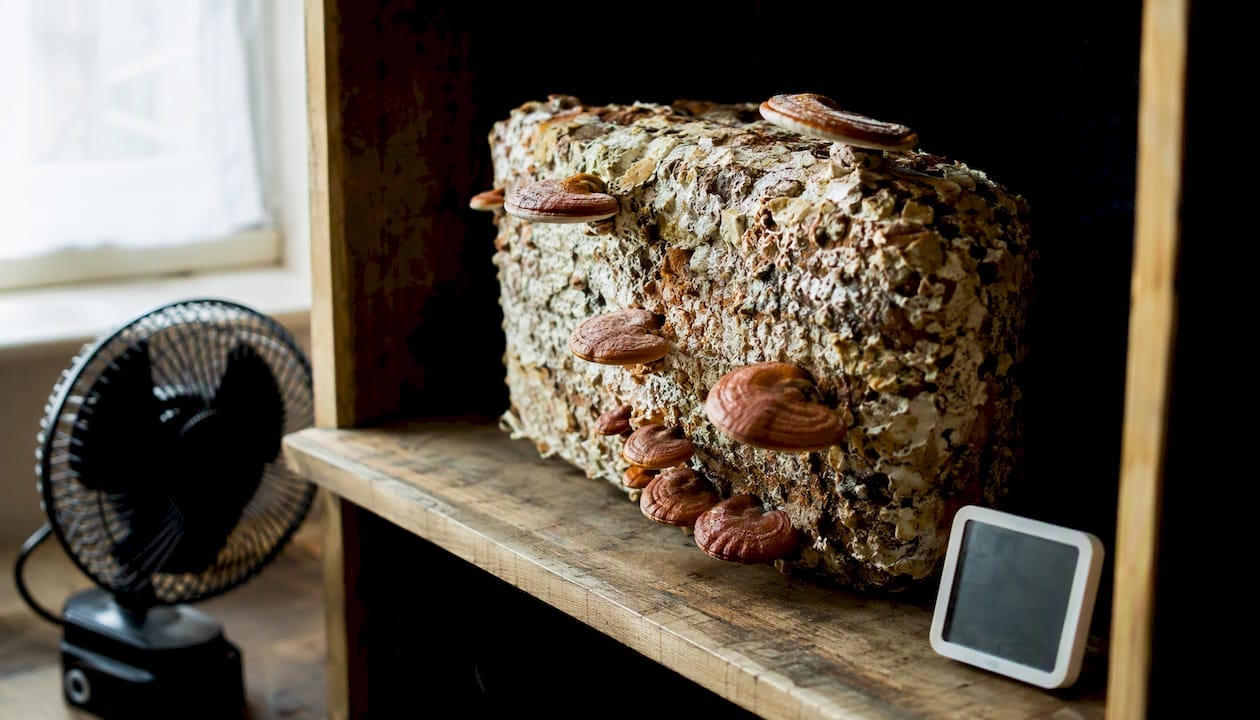
You can grow reishi at home in the UK, and the fastest reliable route for most hobbyists is indoor supplemented hardwood sawdust blocks. Reishi (Ganoderma lucidum) fruits at warmer temperatures than most gilled mushrooms and has a longer colonisation period, but its development is predictable when you use sterilised hardwood substrates. Get those two things right and you will have your first harvest in roughly 60–90 days.
The second route, outdoor log inoculation, suits gardeners with patience and shaded outdoor space. Logs take a year or more to produce their first flush, but a single inoculated log can yield mushrooms for multiple years. Both methods are genuinely achievable at home in the UK.
- Fastest route: indoor supplemented sawdust blocks or a ready-to-fruit kit
- Long-term route: outdoor log inoculation with oak, beech, or maple
- Key success factors: sterilisation, correct temperature, and consistent humidity
- UK supplier: Sporebuddies stocks sawdust spawn, sterilised substrates, and grow kits suited to both methods
Pro Tip: If you are new to home mushroom farming, start with a pre-made fruiting block or kit. It removes the sterilisation step entirely and lets you focus on learning the fruiting environment before you tackle substrate preparation from scratch.
Key takeaways
Indoor supplemented sawdust blocks are the fastest and most reliable route for reishi cultivation at home in the UK, with first harvests typically achievable within 60–90 days of inoculation.
| Point | Details |
|---|---|
| Fastest indoor method | Supplemented sawdust blocks yield a first harvest in 60–90 days at 24–28°C. |
| Outdoor log timeline | Log inoculation takes 12–18 months to first flush, with multi-year production at roughly one year per inch of log diameter. |
| Substrate choice | Oak or beech sawdust with 10–15% wheat bran gives the best yields; pressure sterilisation is required for supplemented blocks. |
| Key environmental numbers | Fruiting humidity 90–95%; fruiting temperature 24–28°C; FAE controls whether you get antlers or flat conks. |
| UK supplier | Sporebuddies stocks sterilised substrates, sawdust spawn, plug spawn, grow tents, and complete kits for UK hobbyists. |
Table of Contents
- What do you need before you start growing reishi?
- Which method suits you: indoor blocks or outdoor logs?
- How to grow reishi indoors on sawdust blocks, step by step
- How to inoculate logs for outdoor reishi production
- What substrates and spawn types work best in the UK?
- How to diagnose and fix common reishi growing problems
- Harvesting, drying, and storing your reishi
- What timelines and yields should UK hobbyists realistically expect?
- Sporebuddies: UK spawn, substrates, and grow kits for reishi
- Sources
- FAQ
What do you need before you start growing reishi?
Assembling your kit before you begin saves time and reduces the risk of a failed run. Here is what you need for each method:
For indoor sawdust blocks:
- Sawdust spawn (hardwood, ideally oak or beech)
- Hardwood sawdust or pellets, plus wheat bran for supplementation
- Autoclavable polypropylene bags with filter patches
- Pressure cooker or steriliser capable of reaching 15 PSI
- Isopropyl alcohol (70%) and a still-air box or flow hood
- Hygrometer and thermometer
- Humidifier or hand mister, and a small fan for fresh-air exchange (FAE)
- Disposable gloves and face mask
For outdoor log inoculation:
- Plug spawn or sawdust spawn (plug spawn is easier for logs)
- Freshly felled hardwood logs (oak, beech, or maple), 10–15 cm diameter
- Drill with a 12 mm bit
- Food-grade wax and a wax dauber or brush
- Shade cloth (70–75%) and a sheltered outdoor space
Pro Tip: A calibrated hygrometer is the single most useful instrument you can own. Humidity guesswork is the leading cause of stalled pins and aborted fruiting bodies. Spend a few pounds on a reliable digital model before anything else.
Which method suits you: indoor blocks or outdoor logs?
The choice comes down to your timeline, space, and how much hands-on work you want.
Indoor supplemented sawdust blocks
Blocks colonise in roughly 20 days and can produce antler growth within 28 days of fruiting initiation, with full conk formation over 75–90 days, according to the OSU Extension reishi growing guide. That speed is the main draw. The trade-off is that supplemented blocks need pressure sterilisation, and they are more vulnerable to contamination than logs. You also need a controlled fruiting environment: a grow tent with a humidifier works well for most UK hobbyists.
Outdoor log inoculation
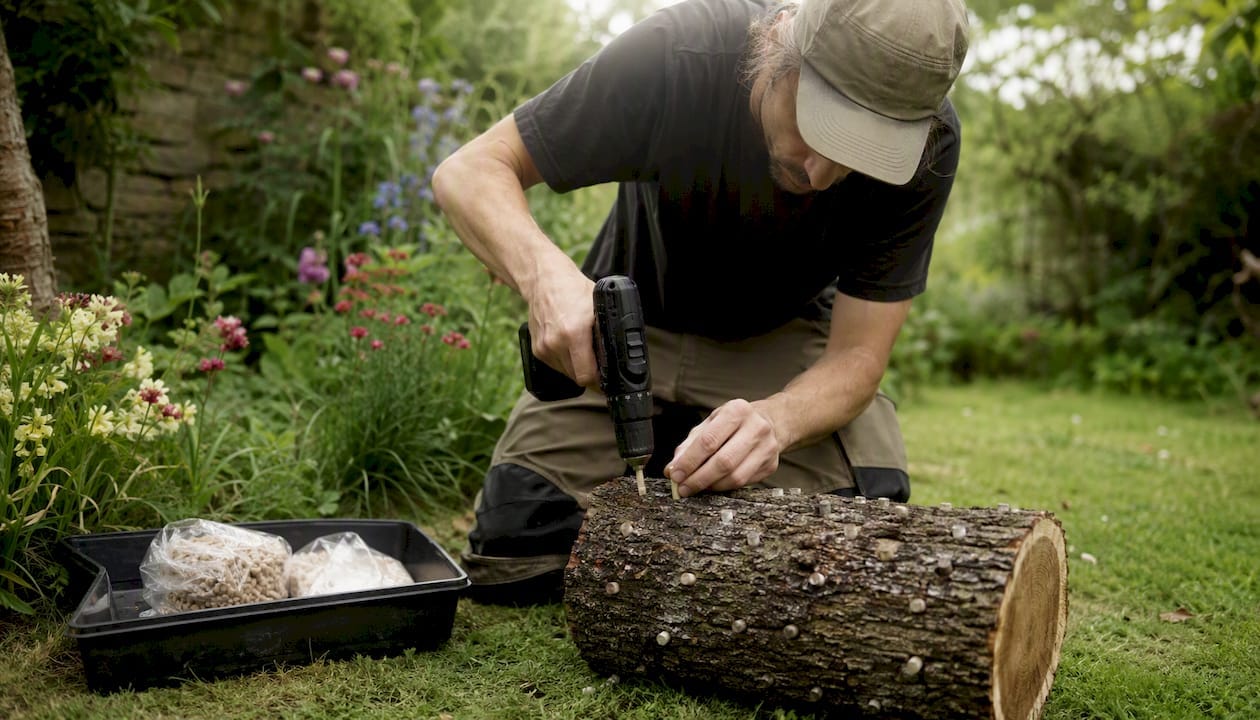
Logs are slower but far more forgiving once colonised. A well-inoculated log needs little intervention beyond occasional watering and shade management. The yield rule of thumb from extension research is one year of production per inch of log diameter, with two flushes per season typical. The downside is the wait: 12–18 months before the first flush.
| Feature | Indoor sawdust blocks | Outdoor log inoculation |
|---|---|---|
| Time to first harvest | 60–90 days | 12–18 months |
| Yield profile | Concentrated, 1–2 flushes per block | Multi-year, 2 flushes per season |
| Contamination risk | Higher (supplemented substrate) | Lower once colonised |
| Maintenance effort | Daily humidity checks | Periodic watering and shade |
| Equipment needed | Pressure cooker, grow tent, hygrometer | Drill, wax, shade cloth |
| Longevity | Single season per block | Several years per log |
Practical rules of thumb for UK growers:
- Limited indoor space: one or two blocks in a grow tent or a large plastic tub with a lid
- Balcony or small garden: logs in a shaded corner, wrapped in hessian during dry spells
- Gardeners with a shaded bed or woodland edge: logs are the natural fit; consider a small greenhouse for faster maturity and better moisture control
How to grow reishi indoors on sawdust blocks, step by step
The typical bench time from inoculation to first harvest on a supplemented hardwood block is 60–90 days. The primary success factors are thorough sterilisation, a spawn rate of 10–20%, stable temperature during colonisation, and consistent humidity once fruiting begins. Understanding mushroom inoculation techniques before you start will help you move through these steps with confidence.
Preparing your substrate
- Mix hardwood sawdust (oak or beech preferred) with 10–15% wheat bran by dry weight. This is sometimes called a Masters Mix variant; keep supplementation modest to reduce contamination risk.
- Hydrate the mix to field capacity. Squeeze a handful firmly: one or two drops of water should fall, not a stream.
- Fill autoclavable bags to roughly two-thirds full. Fold the top and secure with a clip or rubber band, leaving the filter patch clear.
Sterilisation
- Load bags into your pressure cooker. Sterilise supplemented hardwood blocks thoroughly at 15 PSI; practitioners commonly recommend around 2.5 hours at that pressure to eliminate late-stage contamination risk.
- Allow bags to cool completely to room temperature before inoculation. This can take several hours; never rush it.
Inoculation
- Wipe all surfaces with 70% isopropyl alcohol. Work inside a still-air box or in front of a flow hood if you have one.
- Add sawdust spawn at 10–20% of the total substrate weight. Higher spawn rates colonise faster and leave less room for contaminants.
- Seal the bag, label it with the date, and move it to your incubation space.
Incubation
- Keep colonising blocks at 24–27°C in darkness or low light. Reishi colonises more slowly than oyster mushrooms; expect 20 days or more for full colonisation.
- Check daily for contamination: green patches (Trichoderma), black or pink discolouration, or sour smells are all reasons to isolate the block immediately.
- Allow a consolidation period of a few days after full colonisation before initiating fruiting.
Fruiting
- Open the top of the bag or cut a fruiting hole. Move the block to your fruiting environment.
- Maintain humidity at 90–95% for pinning. A grow tent with a small ultrasonic humidifier and a hygrometer makes this straightforward.
- Temperature during fruiting: 24–28°C works well. Reishi fruits warmer than most UK-grown gilled mushrooms.
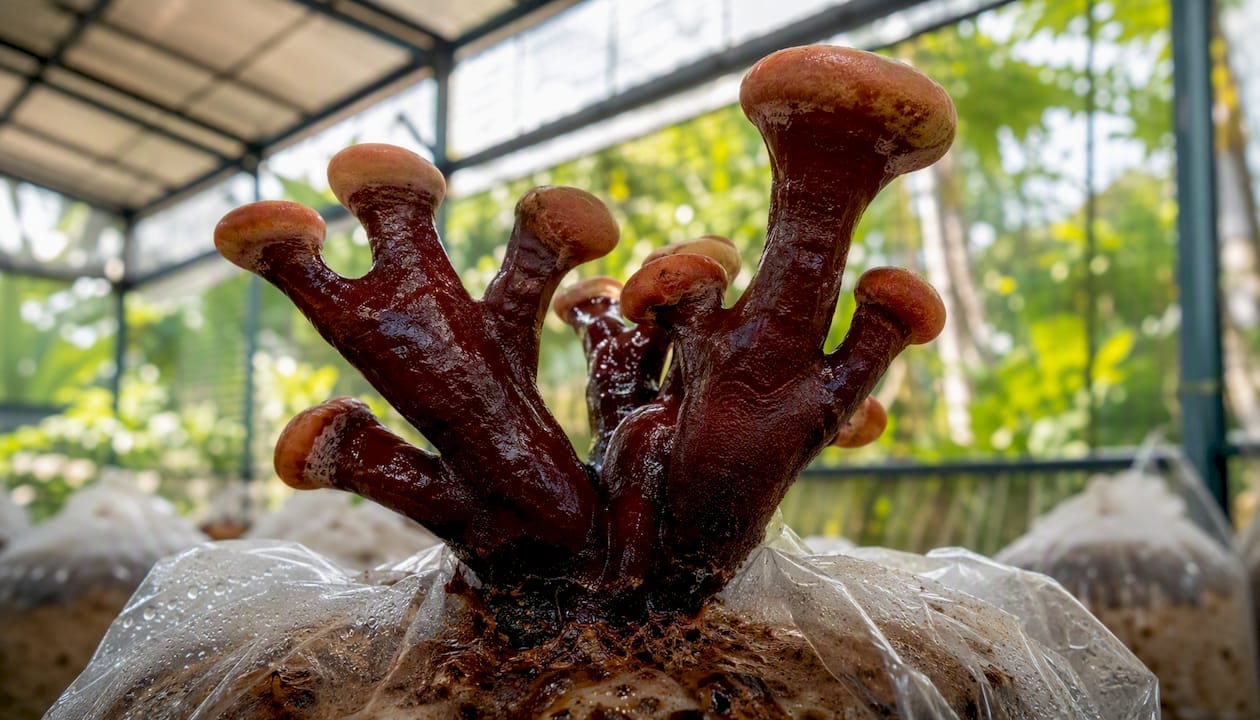
- FAE and morphology: high CO2 (restricted fresh-air exchange) encourages antler-like elongated forms; more fresh-air exchange produces flat, lacquered conks. Run a small fan on a timer to choose your preferred shape.
Harvesting
- Harvest when the white growing margin at the edge of the cap stops advancing. The surface will have fully lacquered to a glossy red-brown.
- Twist and pull at the base, or cut cleanly. Wipe the wound site with a clean cloth.
Pro Tip: Stack blocks with at least 5 cm of space between them during incubation. Reishi generates noticeable metabolic heat, and tightly packed blocks can overheat in the centre of a stack, stalling colonisation or encouraging contamination.
How to inoculate logs for outdoor reishi production
Outdoor log culture typically takes 12–18 months before the first flush, but a single inoculated log can produce for several years. The wait is the cost; the reward is a low-maintenance, multi-year harvest from your garden or shaded outdoor space.
Selecting and preparing logs
- Choose oak, beech, or maple. These hardwoods are common across the UK and provide the lignin-rich substrate reishi needs. Avoid softwoods (pine, spruce) entirely.
- Select logs 10–15 cm in diameter and 90–120 cm long. Thicker logs last longer but take more time to colonise.
- Fell or source logs in late autumn or winter when the sap is low and pathogen pressure is reduced. Inoculate within 30 days of felling; older logs may have competing fungi already established.
Inoculation
- Drill holes in a staggered diamond pattern: rows 15 cm apart, holes 8 cm apart within each row, offset by half the spacing between rows. Use a 12 mm drill bit and drill to roughly 4 cm depth.
- Insert plug spawn or sawdust spawn into each hole. Plug spawn is easier to handle for beginners; sawdust spawn colonises slightly faster.
- Seal every hole immediately with food-grade wax, melted and applied with a dauber or small brush. This locks in moisture and keeps competing organisms out.
- Seal the cut ends of the log with wax as well.
Incubation and moisture management
- Stack inoculated logs off the ground on pallets or wooden rails in a shaded, sheltered spot. A north-facing fence or the shade of a large shrub works well in most UK gardens.
- Cover loosely with hessian or shade cloth (70–75%) to retain moisture without blocking airflow.
- Water logs during dry spells to maintain weight; a log that feels significantly lighter than when inoculated is drying out. Weigh one log when freshly inoculated and use it as a reference.
- For faster maturity, a small greenhouse or polytunnel with shade cloth and a misting system can shorten the colonisation window considerably.
Triggering fruiting and harvesting
- After 12–18 months, soak logs in cold water for 24 hours to trigger fruiting. Lay them horizontally in a shaded, humid spot.
- Harvest conks when the white margin stops advancing, as with blocks. Expect two flushes per season.
- The practical yield rule of thumb: one year of production per inch of log diameter. A 10 cm (roughly 4 inch) log can produce for approximately four years.
Pro Tip: Keep a simple log journal: note the inoculation date, log species, diameter, and weight. Checking weight every few weeks tells you far more about moisture status than visual inspection alone.
What substrates and spawn types work best in the UK?
Substrate options
Reishi is a wood-decomposing fungus and needs a lignin-rich substrate. Your choices in the UK are:
- Hardwood sawdust (oak, beech, maple): the standard choice for indoor blocks. Oak and beech are widely available from UK timber merchants and woodworking suppliers.
- Hardwood pellets (wood fuel pellets): a convenient alternative that hydrates easily and is available from most UK garden centres and fuel suppliers. Use hardwood-only pellets with no additives.
- Supplemented Masters Mix (hardwood sawdust + wheat bran): higher yields but higher contamination risk. Requires pressure sterilisation without exception.
- Softwoods and straw alone: both are poor choices. Reishi lacks the enzyme profile to efficiently break down cereal straw, and softwood resins inhibit mycelial growth.
A PLOS One controlled trial found that oak-based substrate with 9% wheat bran supplementation produced the highest measured yield at 46 g/kg, outperforming corn husk and wheat straw substrates. That result supports the oak-first preference most experienced growers already follow.
Spawn types
- Grain spawn: fast colonisation, good for making your own sawdust spawn; requires sterilisation and more careful handling.
- Sawdust spawn: the standard choice for inoculating supplemented blocks; mixes evenly and colonises reliably.
- Plug spawn: wooden dowels colonised with mycelium; the easiest format for log inoculation and widely available in the UK.
Supplementation and spawn rate guidance
Pro Tip: Larger blocks (1.5–2 kg) produce longer and tend to give more total yield than smaller ones, because reishi mycelium benefits from a larger food reserve. If your pressure cooker can fit them, go bigger.
How to diagnose and fix common reishi growing problems
Most failures in home reishi cultivation fall into four categories. Here is how to identify and address each one quickly.
Contamination (green mould, Trichoderma)
- Signs: green, blue-green, or black patches on the substrate surface; sour or musty smell.
- Cause: inadequate sterilisation, inoculation in non-sterile conditions, or a bag puncture.
- Fix: isolate the block immediately in a sealed bag and remove it from your growing space. Do not open it indoors. Review your sterilisation time and pressure, and check bags for micro-tears before use.
Stalled pinning (no fruiting bodies forming)
- Signs: fully colonised block with no pins after two weeks of fruiting conditions.
- Cause: temperature too low (below 22°C), insufficient humidity, or inadequate FAE.
- Fix: raise temperature to 24–28°C, increase humidity to 90–95%, and check that your grow tent has some airflow. A brief cold shock (moving the block to a cooler spot for 24 hours) can sometimes trigger pinning.
Aborted pins (pins form but die)
- Signs: small pins appear then dry out or turn brown before developing.
- Cause: humidity crash, usually from a humidifier running out of water or a tent left open.
- Fix: restore humidity immediately and mist the block surface gently. Set a reminder to check your humidifier reservoir twice daily.
Drying out (block shrinks and hardens)
- Signs: block loses significant weight and the surface becomes hard or cracked.
- Cause: insufficient humidity or a grow space with too much airflow.
- Fix: submerge the block in cold water for 4–8 hours (field capacity rehydration), then return it to fruiting conditions with improved humidity control.
- Isolate any contaminated block immediately.
- Identify the failure mode using the signs above.
- Apply the specific fix before adjusting other variables.
- If contamination is severe or spreading, accept the loss and dispose of the block outside.
When you spot a problem, you can act within seconds rather than hunting for supplies.*
Harvesting, drying, and storing your reishi
Harvest reishi when the white growing margin at the edge of the cap has fully stopped advancing and the surface has lacquered to a glossy red-brown. For antler forms, harvest once elongation stops. Do not wait for spore release (a fine brown dust); harvesting just before or at that point preserves potency and keeps your growing space cleaner.
Harvest technique:
- Twist and pull at the base for small conks, or cut cleanly with a sharp knife for larger ones.
- Wipe the wound site on the block or log with a clean, dry cloth to reduce contamination entry points.
- Do not wash fresh reishi before drying; surface moisture slows the process.
Drying:
- Slice larger conks into 5–10 mm pieces to speed drying.
- Dry in a food dehydrator or a low oven at approximately 50°C until cracker-dry. This typically takes 4–8 hours depending on thickness.
- Properly dried reishi snaps cleanly rather than bending. Any flexibility means residual moisture remains.
Storage:
- Store in an airtight glass jar or vacuum-sealed bag in a cool, dark cupboard.
- Dried reishi stored correctly keeps its quality for 12 months or longer.
Using your harvest:
Reishi is woody and bitter raw; it is almost always used dried for tea (decoction) or tincture. For a simple decoction, simmer dried slices in water for 30–60 minutes. Dual-extraction tinctures combine a hot-water decoction with an alcohol extraction to capture both water-soluble and alcohol-soluble compounds. Research summarised by the NCBI Bookshelf on Ganoderma confirms that cultivation method and post-harvest processing both affect the quality and composition of the final product.
For guidance on post-harvest processing and medicinal mushroom uses, including tincture preparation, consult a qualified clinician before using reishi for any health purpose. This guide covers cultivation and processing technique, not medical advice.
What timelines and yields should UK hobbyists realistically expect?
Indoor supplemented sawdust blocks typically yield a first harvest within 60–90 days of inoculation. Outdoor log culture takes 12–18 months to the first flush but produces for several years. Both figures are supported by the OSU Extension reishi growing guide, which documents spawn run and fruiting timelines for both methods.
Indoor block timeline:
- Spawn run and full colonisation: approximately 20 days at 24–27°C
- Antler growth begins: around 28 days after fruiting initiation
- Full conk formation: 75–90 days from inoculation
- Subsequent flushes: possible with rehydration, though yields typically decline
Outdoor log timeline:
- Spawn run (full colonisation): 9–18 months depending on log diameter, species, and season
- First flush: 12–18 months after inoculation
- Annual production: two flushes per season typical
- Total productive life: roughly one year per inch of log diameter
The PLOS One substrate trial found that oak-based substrate with modest wheat-bran supplementation produced 46 g/kg in controlled conditions. Home-scale yields will vary with temperature consistency, humidity management, and substrate quality, but this figure gives a useful reference point for what a well-managed block can achieve.
UK seasonal conditions matter too. Reishi’s warm fruiting preference (24–28°C) means indoor blocks perform best year-round in a heated space, while outdoor logs benefit from the warmer months of May through September for active fruiting. For more on adapting cultivation to UK seasonal patterns, the UK home grower’s guide on cultivation trends covers seasonal timing in detail.
Sporebuddies: UK spawn, substrates, and grow kits for reishi
If you want to skip substrate preparation and start fruiting sooner, Sporebuddies supplies the key materials for both indoor and outdoor reishi cultivation, shipped within the UK.
For indoor blocks, the sterilised mushroom substrates category covers ready-to-inoculate supplemented sawdust options, removing the pressure-sterilisation step for beginners. Sawdust spawn is the recommended format for inoculating your own blocks. For outdoor log culture, plug spawn is the easier starting point and is available through the same supply range.
Beginners are best served by a complete mushroom grow kit, which includes the fruiting block and basic setup guidance in one package. Growers ready to run multiple blocks or scale up can find bulk substrate and spawn options through the wholesale mycology supplies range.
A mushroom grow tent paired with a hygrometer and humidifier gives you a controlled fruiting environment that handles the UK’s variable indoor climate. Browse the full range at Sporebuddies and choose the format that matches your method.
Sources
- Nontimber Forest Products for Small Woodland Owners: Reishi Mushroom Growing Guide | OSU Extension Service
- Valorization of various lignocellulosic wastes to Ganoderma lucidum (Curtis) P. Karst (Reishi Mushroom) cultivation and their FT-IR assessments | PLOS One
- NCBI Bookshelf resource on Ganoderma and related species
FAQ
Is reishi safe to grow and consume at home?
Reishi (Ganoderma lucidum) is non-toxic and widely cultivated for tea and tincture use. Consult a qualified clinician before using it for any medicinal purpose, as it may interact with certain medications.
Does reishi raise oestrogen levels?
There is no robust clinical evidence that reishi raises oestrogen in humans. Some laboratory studies have examined its effects on hormone-related pathways, but these findings have not been confirmed in controlled human trials.
Is reishi a psychedelic mushroom?
No. Reishi contains no psilocybin or other psychoactive compounds. It is a medicinal and culinary fungus, entirely distinct from psilocybin-containing species.
Does reishi have poisonous look-alikes?
Wild Ganoderma species are generally distinctive, but some bracket fungi can resemble reishi to an untrained eye. Cultivating from verified spawn, as supplied by Sporebuddies, removes any identification risk entirely.
What are the main downsides of growing reishi at home?
The two most common challenges are the long colonisation time (especially for logs) and contamination risk with supplemented blocks. Maintaining correct temperature and humidity, and using proper sterilisation, addresses both.