
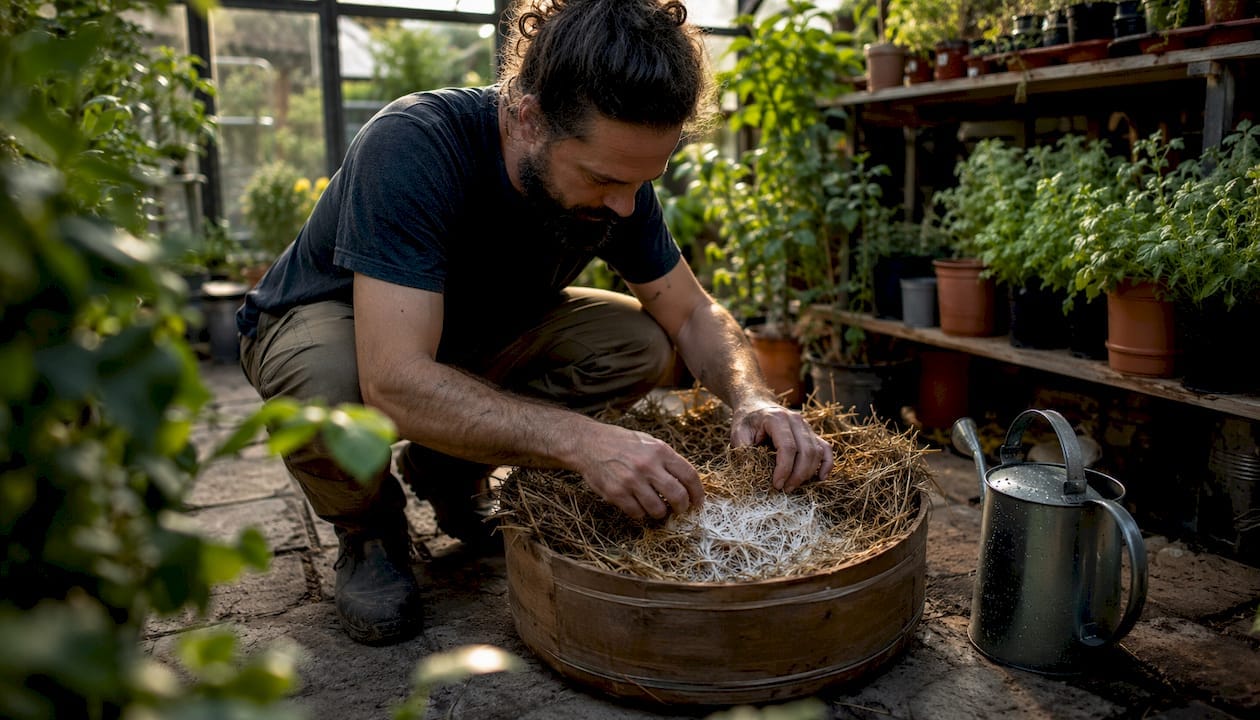
Mycelium is the living, feeding network of a fungus. The fruiting body (sporocarp) is the reproductive structure it builds to produce and disperse spores. Understanding the fungal lifecycle stages changes how you grow: prioritise mycelial health for long-term yields and reliable flushes; manage specific environmental triggers when you want fruiting bodies for harvest, extracts, or spore collection.
Key points at a glance:
- Mycelium absorbs nutrients, breaks down substrate, and translocates resources to developing pins
- The fruiting body forms only when the mycelium receives the right environmental signals
- Your cultivation goal (culinary harvest, medicinal extract, or spore work) determines which structure to prioritise
- Sporebuddies supplies spores, substrates, and grow kits to support both phases
Table of Contents
- What is the role of fruiting body versus mycelium?
- How do fruiting bodies develop, and what triggers them?
- How do compound profiles differ between mycelium and fruiting bodies?
- Which structure should you prioritise for your growing goal?
- Practical cultivation steps for UK home growers
- Harvesting and processing: fruiting bodies versus mycelial products
- UK legal and safety guidance for home growers
- Key takeaways
- Useful Sporebuddies resources
- FAQ
What is the role of fruiting body versus mycelium?
Mycelium is a branching mass of thread-like hyphae. Each hypha secretes enzymes that digest the surrounding substrate, then absorbs the released nutrients. Those nutrients travel across the network to wherever the fungus needs them most, a process called long-distance translocation. Kew describes this hidden network as performing vital ecosystem services: breaking down organic matter, cycling nutrients, and connecting with plant roots through mycorrhizal partnerships.
Colonisation follows a predictable sequence: a spore germinates and sends out a primary hypha, which branches repeatedly. Where two compatible hyphae meet, they fuse in a process called anastomosis, forming a dikaryotic network. Full colonisation of a standard home substrate typically takes one to four weeks depending on species, temperature, and substrate density.
Primary mycelial functions include:
- Nutrient absorption via enzyme secretion and hyphal uptake
- Resource translocation across the network to primordia and growing tips
- Substrate breakdown of lignocellulosic or grain-based materials
- Symbiosis with plant roots in mycorrhizal species
- Sclerotia formation in some species for long-term survival
Healthy mycelium looks bright white, grows evenly across the substrate, and often shows a rhizomorphic (rope-like) pattern. Contamination signals include green, black, or pink patches, a sour or rotten smell, and slimy texture. Act on those signs immediately.
Pro Tip: Even hydration across your entire substrate is more effective than spot-feeding. Mycelial networks actively move resources to developing pins, so a dry patch starves the whole colony.
How do fruiting bodies develop, and what triggers them?
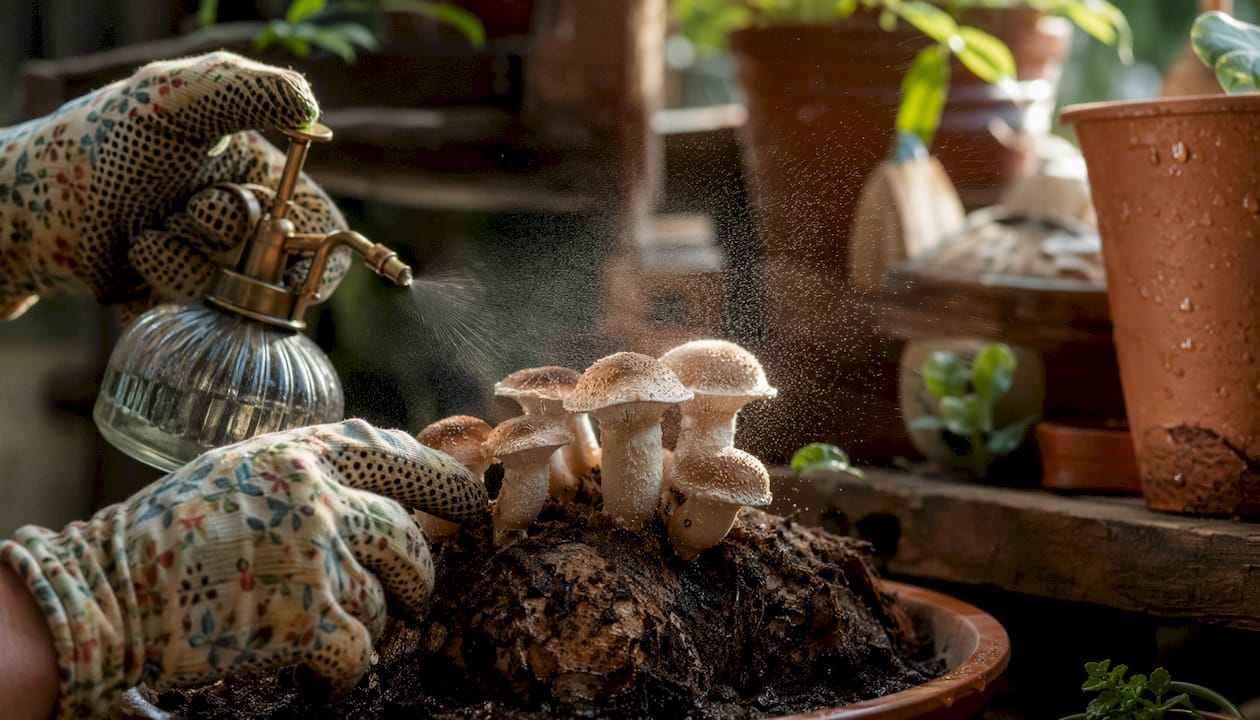
A fruiting body, or sporocarp, is the reproductive organ the mycelium constructs to release spores. As the Australian National Botanic Gardens note, what you see above the substrate is only the spore-producing part; the mycelium below is the actual organism. Fruiting bodies are built from the same hyphal tissue as the mycelium, reorganised into a dense, structured form.
Fruiting initiation is environmentally driven and highly plastic. Even excellent genetics will not produce pins without the right triggers. The main signals are:
- A drop in temperature below incubation temperature
- Increased relative humidity (85–95%)
- Exposure to indirect light (12 hours on/off is a common cycle)
- Increased fresh air exchange to lower CO₂ levels
- Substrate resource status: a well-colonised, nutritionally replete block fruits more readily
A typical home-grow timeline runs as follows:
- Inoculation and germination (days 1–3): spores or culture introduced to sterilised substrate
- Colonisation (days 7–28): mycelium spreads across the substrate
- Fruiting trigger (days 28–35): environmental conditions shifted to initiate pinning
- Primordia formation (days 35–42): tiny pins emerge at the substrate surface
- Maturation (days 42–49): pins develop into full fruiting bodies
- Harvest (days 49–56): fruiting bodies picked before the veil tears or spores drop
These are indicative ranges for common gourmet strains. Actual timescales vary by species, substrate, and environment.
How do compound profiles differ between mycelium and fruiting bodies?
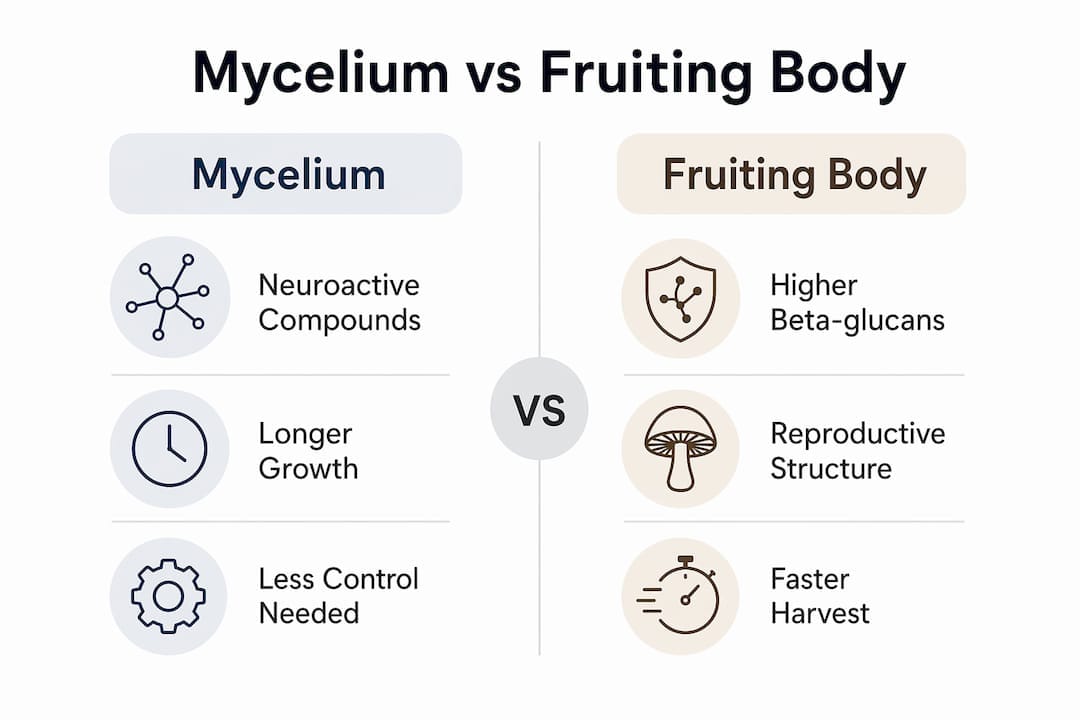
The biochemical differences between the two structures are real but often overstated. Both contain bioactive compounds; what shifts is the concentration and type depending on species, substrate, and developmental stage.
| Compound | Typically higher in | Notes |
|---|---|---|
| Beta-glucans | Fruiting body | Independent analyses show MOG products may contain grain substrate, diluting measured potency |
| Triterpenes (e.g., ganoderic acids) | Fruiting body | Concentrated in the outer tissue of mature caps |
| Erinacines | Mycelium (Lion’s Mane) | Potent nerve growth factor stimulators found mainly in Hericium erinaceus mycelium |
| Cordycepin | Mycelium (Cordyceps) | Concentrated in mycelial phase; fruiting bodies rare in cultivation |
| Ergosterol | Both | Precursor to vitamin D₂; present across both structures |
For most culinary and immune-support goals, fruiting bodies deliver higher beta-glucan concentrations. For neuroactive compounds in Lion’s Mane, the mycelium is the primary source. Chaga and tiger milk mushroom are harvested as sclerotia rather than conventional fruiting bodies, which shows that the “fruiting body versus mycelium” framing does not cover every species. When choosing a supplement or extract, look for independent lab reports that state the extraction method and the specific compound being measured. Sporebuddies’ functional mushroom guide covers species-specific compound profiles in more detail.
Which structure should you prioritise for your growing goal?
Your goal determines your focus. Use this framework to decide.
Mycelium-first goals (biomass, extracts, sclerotia, research):
- Choose a nutritionally dense substrate matched to your species
- Maintain even hydration throughout the block or bag
- Hold incubation temperature steady; avoid premature fruiting triggers
- Extend the incubation window to allow full colonisation before harvesting biomass
- Monitor for contamination daily; remove affected substrate immediately
Fruiting-first goals (culinary harvest, spore collection, multiple flushes):
- Shift to fruiting conditions promptly once colonisation is complete
- Control humidity (85–95%), temperature drop, light cycle, and fresh air exchange
- Choose a casing layer or fruiting substrate suited to your species
- Time harvests to the flush cycle: pick before the veil tears for maximum potency and shelf life
- Rehydrate the block between flushes to sustain subsequent yields
Cost and effort: Mycelium biomass requires less environmental control but longer incubation and careful substrate separation at harvest. Multiple fruiting flushes demand consistent daily management of humidity and gas exchange but reward you with tangible yields at each stage.
Practical cultivation steps for UK home growers
Incubation
Keep your substrate in the dark at a stable temperature suited to your species. Avoid temperature swings, which stress the mycelium and invite contamination. Gas exchange matters even at this stage: sealed bags should have a filter patch; monotubs need small vent holes covered with polyfill.
Fruiting room management
Once colonisation is complete, shift conditions deliberately. Raise humidity using a humidifier or regular misting, lower the temperature by a few degrees, and introduce a light cycle. Fresh air exchange is the trigger most beginners underestimate: CO₂ build-up suppresses pinning, so fan the fruiting chamber at least twice daily or use an automated controller.
Contamination prevention
Sterilise grain substrates in a pressure cooker; pasteurise bulk substrates such as straw or hardwood by heating for an extended period. Work in a still-air box or in front of a laminar flow hood when inoculating. Wear nitrile gloves and wipe all surfaces with isopropyl alcohol. The contamination FAQ at Sporebuddies covers the most common failure points and how to recover from them.
Pro Tip: Colonisation staging helps avoid premature fruiting. If pins appear before the substrate is fully colonised, the mycelium cannot supply enough resources to develop them properly. Wait for substantial visible colonisation before triggering.
Harvesting and processing: fruiting bodies versus mycelial products
Harvesting fruiting bodies
Pick fruiting bodies just before or as the veil begins to separate from the cap edge. Twist and pull cleanly at the base to avoid leaving stumps that invite contamination. For spore work, allow one or two caps to open fully and collect prints or use a spore harvesting protocol before the flush ends.
Drying and storage steps:
- Pre-dry at room temperature for two to four hours to remove surface moisture
- Dehydrate at 35–45°C until cracker-dry (no flex in the stem)
- Store in airtight glass jars with food-grade desiccant packets
- Keep below 20% relative humidity to prevent mould during storage
Mycelium biomass
- Harvest substrate blocks at peak colonisation, before fruiting triggers are applied
- Scrape off any casing layer or loose grain to reduce substrate carryover in extracts
- Substrate residue in mycelium-on-grain products can inflate dry weight and dilute compound concentration in assays
- For hot-water extraction (polysaccharides/beta-glucans), simmer dried material for two to four hours; for triterpenes and other alcohol-soluble compounds, use an ethanol extraction
UK legal and safety guidance for home growers
Legal status varies by species. Cultivating gourmet and medicinal mushrooms (oyster, shiitake, Lion’s Mane, Reishi) is legal in the UK. Psilocybin-containing species are Class A controlled substances under the Misuse of Drugs Act 1971; possession, cultivation, and supply carry serious criminal penalties. Spore syringes are sold legally for microscopy and research purposes only. Always verify current UK law before proceeding.
Food safety and safe handling:
- Never consume mushrooms from a contaminated substrate; discard the entire block
- Label dried batches with species, harvest date, and drying method
- Avoid inhaling spore dust or dried mushroom powder; wear an FFP2 mask when processing
- Ventilate your growing space; prolonged spore exposure can cause hypersensitivity pneumonitis
- Dispose of contaminated substrate in sealed bags in general waste, not compost
Consult GOV.UK and Sporebuddies’ help pages for current legal guidance. This article is general information, not legal or medical advice; confirm the rules for your specific situation with an appropriate professional.
Key takeaways
Mycelium is the organism; the fruiting body is its reproductive output. Prioritise mycelial health first, and reliable fruiting follows.
| Point | Details |
|---|---|
| Mycelium feeds, fruiting body reproduces | Mycelium absorbs nutrients and translocates resources; the sporocarp exists to disperse spores. |
| Environmental triggers control pinning | Humidity, temperature drop, light, and CO₂ exchange must all be managed to initiate fruiting. |
| Compound choice depends on species | Fruiting bodies generally carry higher beta-glucans; Lion’s Mane mycelium is the primary source of erinacines. |
| Substrate quality cannot be corrected later | Poor nutrition at colonisation stage limits fruiting potential regardless of trigger management. |
| UK law varies by species | Gourmet cultivation is legal; psilocybin species are Class A. Spores are sold for microscopy only. |
Useful Sporebuddies resources
Sporebuddies has guides and products to support every stage covered in this article:
- Mushroom lifecycle primer: a clear walkthrough of each growth stage from spore to sporocarp
- Spore syringes and prints: legal spores for microscopy and research, including Golden Teacher, B+, and Penis Envy strains
- Sterilised substrates: ready-to-inoculate substrate products matched to common gourmet and medicinal species
- Contamination FAQ: practical troubleshooting for the most common grow failures
- Functional mushroom benefits guide: species-specific compound profiles to help you choose the right strain for your goal
- Spore harvesting guide: step-by-step protocol for collecting and storing spores safely
FAQ
What is the main difference between mycelium and a fruiting body?
Mycelium is the vegetative network that feeds and grows through the substrate; the fruiting body (sporocarp) is the reproductive structure the mycelium builds to produce and release spores.
Can you get useful compounds from mycelium rather than fruiting bodies?
Yes. Lion’s Mane mycelium contains erinacines, neuroactive compounds that are concentrated in the mycelial phase rather than the fruiting body. For most other species, fruiting bodies carry higher beta-glucan concentrations.
How long does it take from inoculation to first harvest?
Typical timelines show initial colonisation followed by further weeks through pinning and maturation, with total duration varying by species, substrate, and environment.
Why won’t my mycelium produce pins?
Fruiting initiation is environmentally driven. The most common causes of failure are insufficient humidity, inadequate fresh air exchange (high CO₂), no temperature drop from incubation, and incomplete colonisation before triggering.
Is it legal to grow mushrooms at home in the UK?
Gourmet and medicinal species (oyster, shiitake, Lion’s Mane) are legal to cultivate. Psilocybin-containing species are Class A controlled substances; cultivation is illegal. Spore syringes are sold legally for microscopy and research only.