
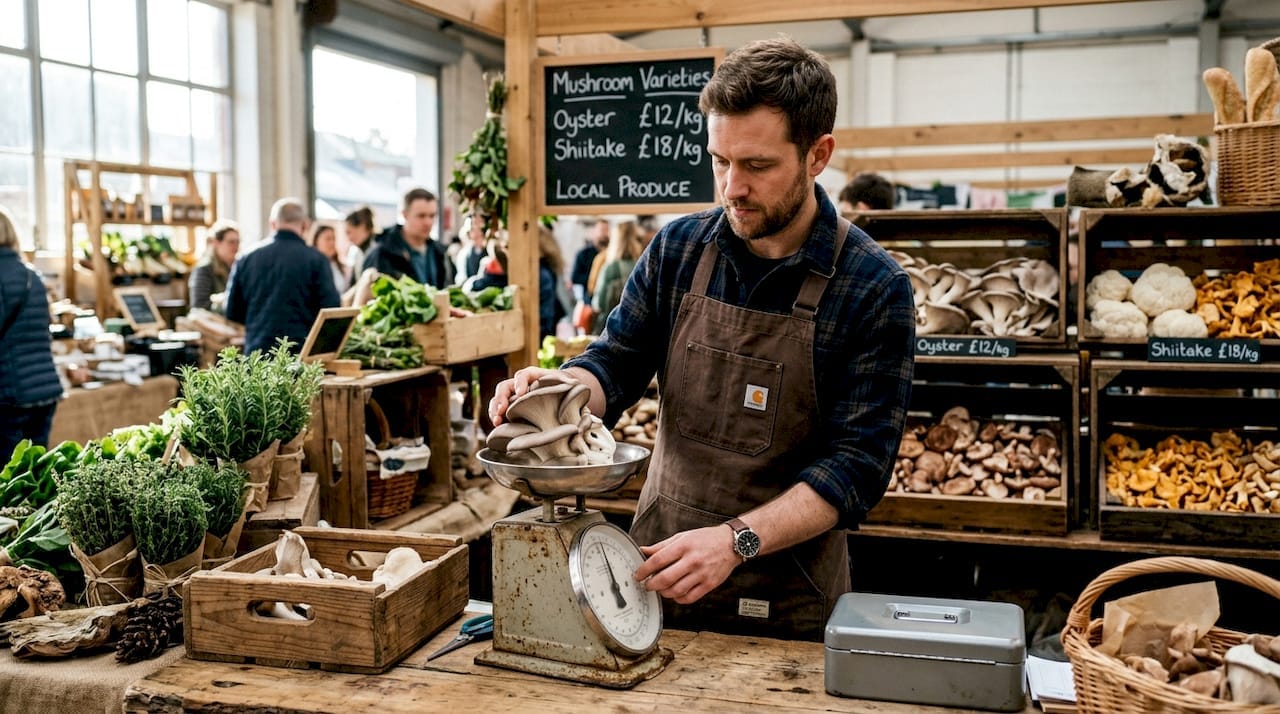
Quick answer: There is no single highest-yield mushroom substrate for every species. Masters Mix can produce high biological efficiency with oyster mushrooms and lion’s mane when it is correctly hydrated and sterilised. Pasteurised straw is a lower-cost option for oyster mushrooms, supplemented hardwood suits shiitake and other wood-loving species, while properly prepared mushroom compost is used for button, cremini and portobello mushrooms. The fairest way to compare results is biological efficiency rather than the wet weight of the substrate.
This mushroom substrate yield comparison explains how five commonly used substrates differ by species suitability, preparation method, contamination risk and likely performance. Yield figures should always be treated as indicative: mushroom species, strain, spawn quality, moisture, environmental control and the number of flushes can all change the result.
Mushroom substrate yield comparison
| Substrate | Best suited to | Preparation | Relative yield potential | Main limitation |
|---|---|---|---|---|
| Masters Mix | Oyster mushrooms and lion’s mane | Sterilisation | Very high under controlled conditions | Nutrient-rich and vulnerable to contamination if processing is inadequate |
| Supplemented hardwood sawdust | Shiitake, lion’s mane, king oyster and reishi | Sterilisation | High for compatible wood-loving species | Requires suitable sterilisation equipment and careful supplementation |
| Pasteurised straw | Oyster mushrooms | Pasteurisation | Moderate to high for oyster species | Bulky to handle and less suitable for slower wood-loving species |
| Mushroom compost | Button, cremini and portobello mushrooms | Composting and controlled pasteurisation | High for Agaricus species | More complex to prepare consistently at home |
| CVG | Low-nutrient bulk applications and moisture management | Hydration and heat treatment | Species-dependent | Not a complete high-yield substrate for most wood-loving gourmet species |
Important: Relative yield potential does not predict a guaranteed harvest. Biological efficiency cannot be assigned to a substrate in isolation because results depend on the mushroom species and the complete production method.
What is biological efficiency in mushroom growing?
Biological efficiency, usually shortened to BE, compares the weight of fresh mushrooms harvested with the original dry weight of the substrate. It provides a more meaningful comparison than quoting yield from a hydrated bag, because two wet bags can contain very different amounts of dry material and water.
Biological efficiency (%) = fresh mushroom weight ÷ dry substrate weight × 100
For example:
- A block containing 1 kg of dry substrate that produces 900 g of fresh mushrooms achieves 90% BE.
- A block containing 1 kg of dry substrate that produces 1.5 kg of fresh mushrooms achieves 150% BE.
- A block containing 2 lb of dry substrate that produces 2 lb of fresh mushrooms achieves 100% BE.
Always record the dry ingredients before adding water. Dividing harvest weight by the total wet bag weight produces a different figure and cannot be compared reliably with published biological-efficiency results.
Which mushroom substrate produces the highest yield?
For many oyster mushroom and lion’s mane production systems, a correctly prepared Masters Mix or supplemented hardwood substrate offers the highest yield potential. However, the best substrate is species-specific. Oyster mushrooms can also perform strongly on inexpensive pasteurised straw, shiitake normally favours hardwood-based formulas, and button mushrooms require prepared compost rather than Masters Mix or CVG.
Research comparing oyster mushrooms on different agricultural materials shows that substrate choice can substantially affect biological efficiency, yield and mushroom composition. However, results from one species or experiment should not be treated as a universal yield guarantee. See this peer-reviewed comparison of substrates used for two oyster mushroom species.
Masters Mix: high yield for oyster mushrooms and lion’s mane
Masters Mix, also written as Master’s Mix, is normally made from equal dry weights of hardwood fuel pellets and soya hulls. Hardwood provides lignocellulosic structure while the soya hulls increase available nutrition. This combination can support fast colonisation and heavy fruiting with compatible gourmet species.
Its main advantage is also its main weakness. Because Masters Mix is nutrient-rich, contaminating organisms can use it readily. The hydrated mix should therefore be sealed in suitable filter-patch bags and fully sterilised using a validated process.
Do not rely on one universal processing time. The required cycle depends on bag weight, bag dimensions, chamber loading, equipment and the time taken for the coldest point inside the substrate to reach the required temperature. A tightly loaded large bag takes longer to heat through than a small, loosely filled bag.
Best for: lion’s mane and several oyster mushroom varieties.
Advantages: high yield potential, consistent ingredients and good water-holding capacity.
Limitations: requires dependable sterilisation and careful clean handling.
For more information about the nutritional component of this mix, see our guide to soya bean hulls for mushroom cultivation or view soya hull pellets for mushroom substrate.
Supplemented hardwood sawdust: best for wood-loving mushrooms
Hardwood sawdust or hardwood fuel pellets provide an appropriate base for wood-decomposing species such as shiitake, lion’s mane, king oyster and reishi. Oak, beech, maple and other untreated hardwoods are commonly used, although suitability and availability vary by region.
Plain hardwood provides structure and carbon but comparatively little accessible nitrogen. Growers therefore often add a measured supplement such as wheat bran or soya-based material. Supplementation can improve performance, but it also increases contamination risk and makes proper sterilisation more important.
The ideal supplement percentage is not identical for every mushroom. Shiitake, for example, should not automatically be given the same formula as a fast-colonising oyster mushroom. Begin with a species-appropriate recipe, measure ingredients by dry weight and change only one variable between test batches.
Best for: shiitake, lion’s mane, king oyster and reishi.
Advantages: closely matches the natural food source of wood-loving species and supports multiple flushes.
Limitations: supplementation and sterilisation must be carefully controlled.
Pasteurised straw: a cost-effective substrate for oyster mushrooms
Wheat, barley and other clean cereal straws are widely used for oyster mushroom cultivation. Straw is relatively inexpensive, easy for oyster mycelium to colonise and normally requires pasteurisation rather than full sterilisation when it is used without nutrient-rich supplements.
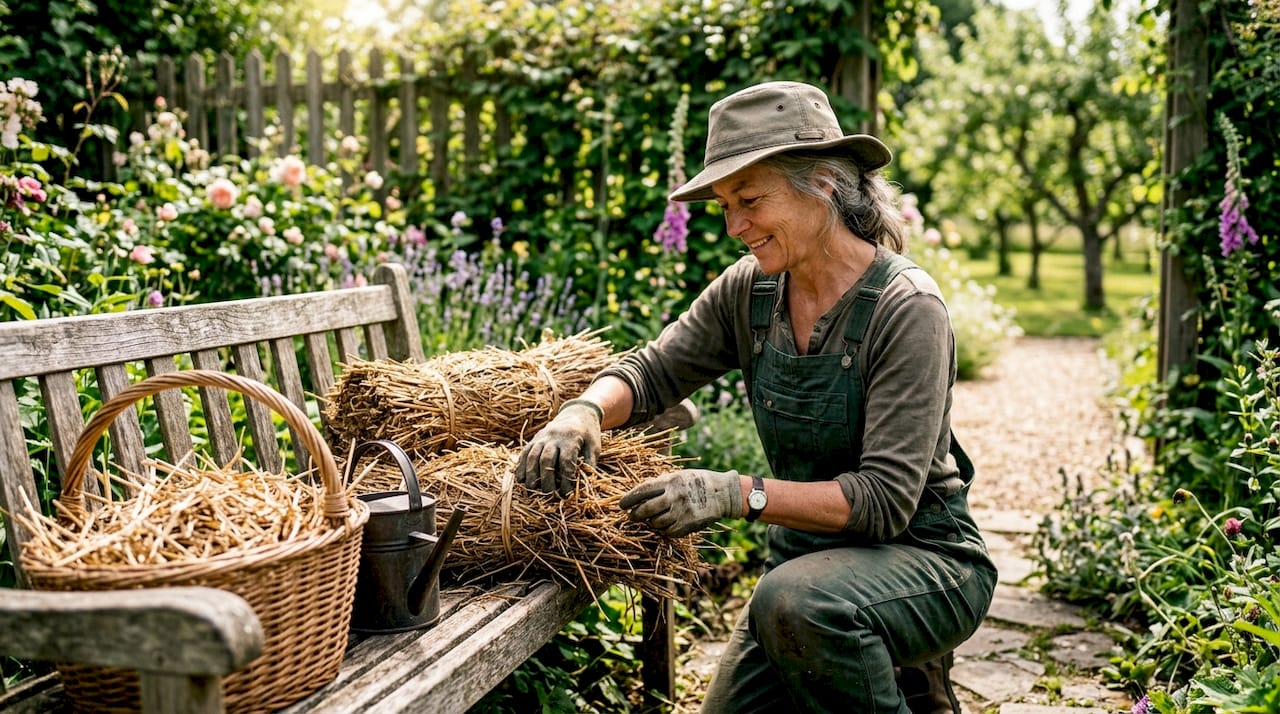
Published trials demonstrate that pasteurised straw can achieve useful biological efficiency with oyster mushrooms, although the exact result depends on the straw type, species, spawn rate and growing conditions. One study reported approximately 90.2% biological efficiency under its tested conditions; this should be understood as a study result, not a guaranteed figure for every grow. Read the pasteurised-straw study.
Straw must be clean, correctly hydrated and treated throughout the material. Uneven heating, excessive moisture or slow inoculation can allow competitors to become established. Chopping straw into manageable lengths can improve packing consistency and help mycelium spread through the substrate.
Best for: oyster mushrooms.
Advantages: affordable, scalable and does not normally require pressure sterilisation when unsupplemented.
Limitations: bulky preparation and a narrower range of suitable species.
Mushroom compost: best for button and portobello mushrooms
Button, cremini and portobello mushrooms are all forms of Agaricus bisporus. They are normally cultivated on specially prepared compost rather than plain sawdust, straw or CVG. Traditional mushroom compost commonly begins with straw and nitrogen-containing materials that pass through controlled composting and pasteurisation stages.
This is not simply aged manure placed into a container. Successful compost production depends on microbial conditioning, moisture, aeration, temperature and subsequent casing. For that reason, ready-prepared compost is usually more practical for a beginner than attempting to reproduce a commercial Agaricus process at home.
Best for: button, cremini and portobello mushrooms.
Advantages: the appropriate high-performing substrate for Agaricus production.
Limitations: specialist preparation and casing requirements.
Penn State Extension maintains further technical information on commercial mushroom substrate management.
CVG: useful for moisture retention but not universal
CVG is a blend of coco coir, vermiculite and gypsum. Coir provides structure and water retention, vermiculite increases moisture-holding capacity, and gypsum affects texture and mineral content. Unlike Masters Mix or supplemented hardwood, CVG contains relatively little nutrition of its own.
That low nutrient level can make CVG comparatively forgiving, but it also means CVG should not be described as the highest-yield substrate for lion’s mane, shiitake or other wood-loving gourmet mushrooms. Those species require a more appropriate nutritional base.
Best for: low-nutrient bulk applications where colonised material supplies most of the nutrition.
Advantages: strong water retention, simple ingredients and relatively low preparation complexity.
Limitations: not a complete nutritional substitute for hardwood, straw or compost.
If you are comparing recipes rather than species suitability, read our bulk substrate recipe guide.
Best mushroom substrate by species
| Mushroom | Suitable substrate | Why it is used |
|---|---|---|
| Oyster mushroom | Pasteurised straw, supplemented hardwood or Masters Mix | Oyster mycelium colonises several lignocellulosic materials aggressively |
| Lion’s mane | Supplemented hardwood or Masters Mix | A wood-loving species that benefits from an appropriate hardwood base |
| Shiitake | Hardwood logs or species-appropriate supplemented hardwood blocks | Shiitake naturally decomposes hardwood and requires a maturation period |
| King oyster | Supplemented hardwood | Supports dense fruiting bodies when nutrition and conditions are controlled |
| Button, cremini and portobello | Prepared mushroom compost with a casing layer | Agaricus bisporus is adapted to conditioned compost |
| Reishi | Hardwood logs or supplemented hardwood blocks | Reishi is a wood-decaying species |
Why mushroom yields vary even on the same substrate
Two growers can use the same substrate recipe and record very different biological efficiency. The most important variables include:
- Mushroom species and strain: different fungi digest and convert substrates at different rates.
- Spawn quality and rate: healthy, evenly distributed spawn normally colonises more reliably than weak or contaminated spawn.
- Moisture: insufficient water limits growth, while excessive water reduces air spaces and can favour bacterial problems.
- Preparation method: low-nutrient straw and highly supplemented hardwood do not require the same treatment.
- Bag size and density: large or tightly packed blocks heat and cool differently from smaller blocks.
- Fruiting conditions: temperature, humidity, fresh-air exchange and light influence whether the substrate’s potential is realised.
- Number of flushes: comparing only the first flush with another grower’s total harvest creates a misleading result.
How to run a fair substrate comparison
- Use the same mushroom culture or strain across every test group.
- Record each ingredient by dry weight before hydration.
- Keep spawn rate, bag size and substrate depth consistent.
- Process every replicate using the same validated method.
- Fruit all groups under the same environmental conditions.
- Weigh every flush and report both first-flush and total yield.
- Calculate biological efficiency and record contamination separately.
Prepared mushroom substrates and cultivation supplies
SporeBuddies supplies substrate materials, sterile grain and equipment for lawful gourmet and functional mushroom cultivation. Growers without suitable processing equipment can compare mushroom substrate products or view our prepared pasteurised bulk substrate.
Frequently asked questions
What is the best mushroom substrate for yield?
The best substrate depends on the mushroom species. Masters Mix and supplemented hardwood can offer high yield potential for compatible oyster mushrooms and lion’s mane. Pasteurised straw is effective and economical for oyster mushrooms, while button and portobello mushrooms require prepared compost.
What does 100% biological efficiency mean?
One hundred per cent biological efficiency means that the fresh mushroom harvest weighs the same as the original dry substrate. For example, 1 kg of dry substrate producing 1 kg of fresh mushrooms equals 100% BE.
How much mushroom yield can I get from 1 kg of dry substrate?
A 1 kg dry substrate producing 750 g of fresh mushrooms has 75% biological efficiency. Producing 1 kg equals 100% BE, while producing 1.5 kg equals 150% BE. Actual yield varies with species, substrate, process and fruiting conditions.
Is Masters Mix better than straw?
Masters Mix offers higher nutritional density and can support heavier yields with compatible species, but it requires reliable sterilisation. Straw is less nutritious but cheaper and can be pasteurised, making it a practical option for oyster mushroom production. Neither is best for every species or facility.
Do I need a pressure cooker for mushroom substrate?
Not for every substrate. Unsupplemented straw can normally be pasteurised without a pressure cooker. Nutrient-rich Masters Mix and supplemented hardwood blocks require a reliable sterilisation process. The required equipment and cycle depend on the size and density of the load.
Does wet substrate weight count when calculating biological efficiency?
No. Biological efficiency uses the dry weight of the substrate before water is added. Using the hydrated bag weight makes comparisons inaccurate because water content varies between recipes and batches.
Conclusion
The highest-yield substrate is the one that matches the mushroom species and can be prepared consistently with the equipment available. Masters Mix and supplemented hardwood offer high potential for several wood-loving gourmet mushrooms, pasteurised straw remains an efficient low-cost choice for oyster mushrooms, and prepared compost is the correct substrate for Agaricus species. CVG is useful for moisture management in suitable low-nutrient systems, but it is not a universal gourmet substrate.
For meaningful comparisons, record dry substrate weight, weigh every flush and calculate biological efficiency. That approach turns vague yield claims into results that can be compared from one batch to the next.
Sources and further reading
- The effects of different substrates on the growth, yield and nutritional composition of two oyster mushrooms
- Published research reporting biological efficiency on pasteurised straw
- Penn State Extension: mushroom substrate management