
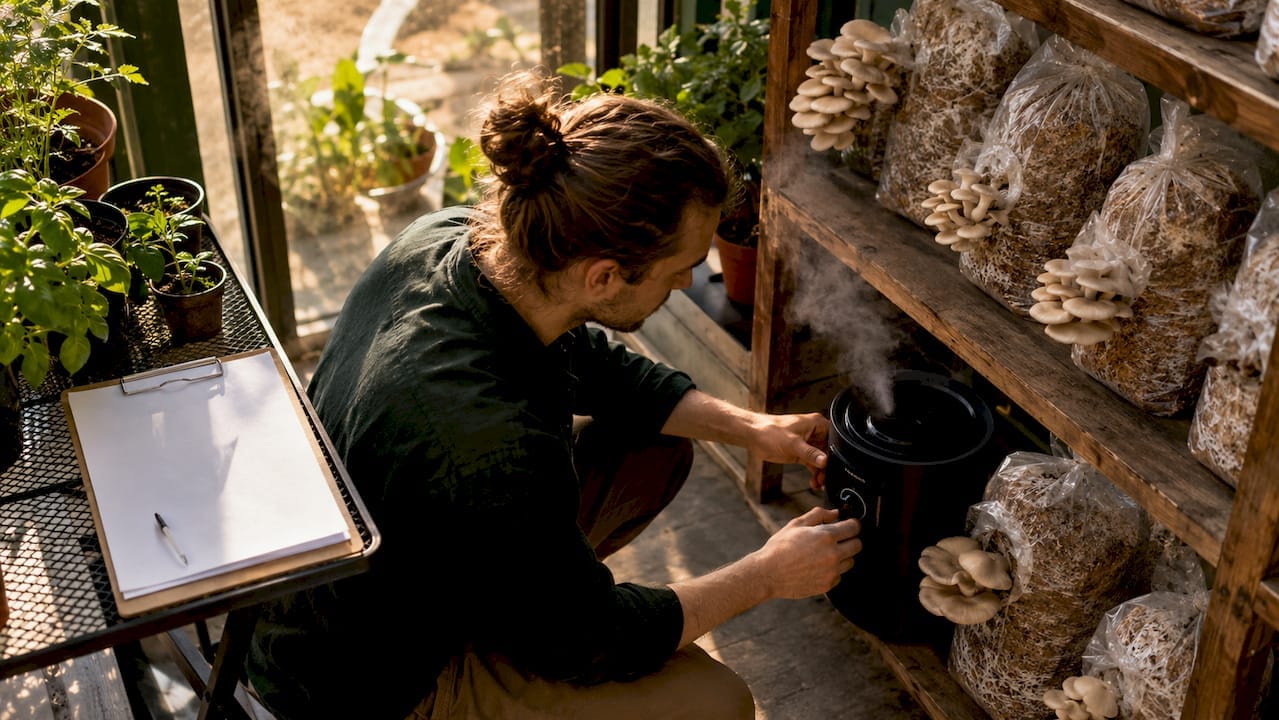
Humidity is the single most critical environmental variable in mushroom cultivation, with the optimal relative humidity (RH) for fruiting sitting between 88% and 92%. Drop below that band and your pins abort. Push above 95% and bacterial blotch takes hold. The role of humidity in mushroom growing is not simply about keeping things damp. It governs cell expansion, contamination risk, and ultimately how much you harvest. Tools like ultrasonic humidifiers, digital humidity controllers, and calibrated hygrometers are the standard kit for managing this precisely at home.
What are the ideal humidity levels for different mushroom growth stages?
Humidity requirements shift at every stage of the mushroom life cycle. Getting these numbers right is what separates a healthy flush from a failed one.
| Growth stage | Target RH | Key risk if wrong |
|---|---|---|
| Colonisation | 80–90% | Too high encourages mould on substrate surface |
| Pinning (primordia formation) | 90–95% | Too low causes primordia to dry out and abort |
| Fruiting (cap development) | 88–92% | Too low causes cracking; too high causes bacterial blotch |
| Late fruiting (pre-harvest) | 85–90% | Slight reduction helps firm caps before picking |
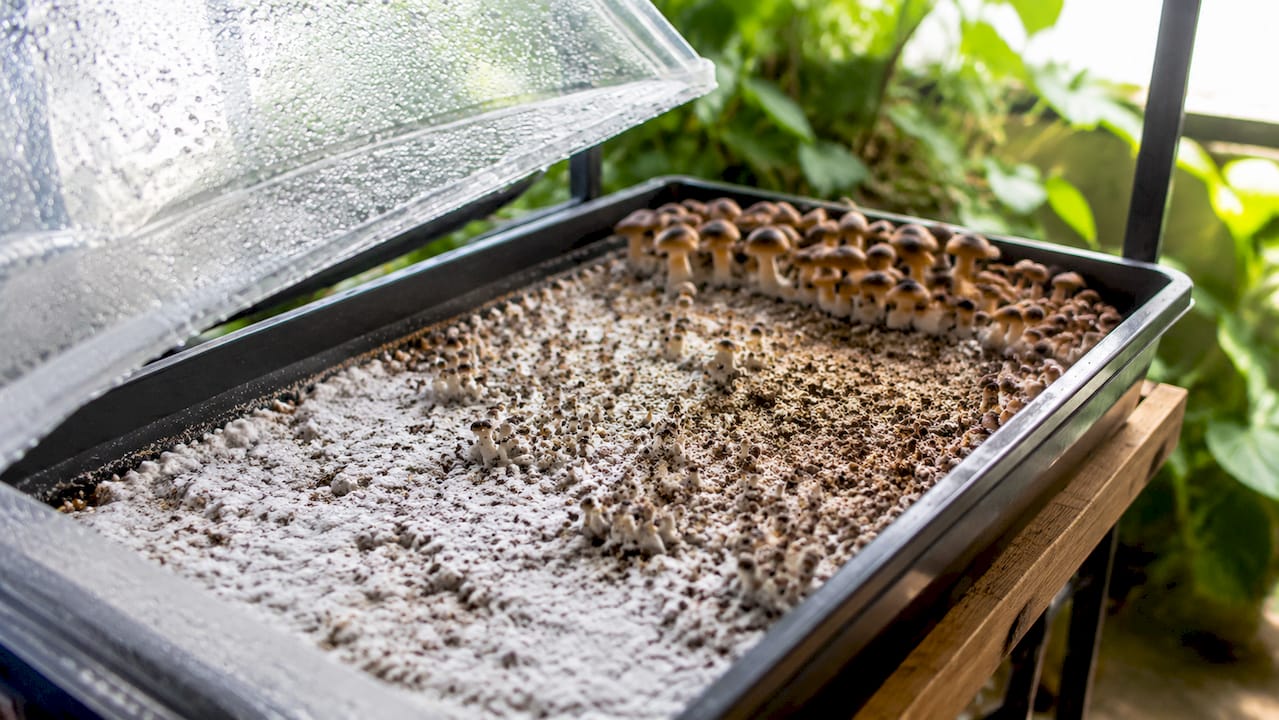
During colonisation, the mycelium is spreading through the substrate and does not yet need extreme atmospheric moisture. The substrate itself holds enough water to support growth. Keeping the chamber at 80–90% RH prevents the surface from drying out without creating the wet conditions that invite contamination.
Pinning is the most humidity-sensitive stage. Primordia are tiny, exposed, and lose water rapidly without near-saturated air around them. Pushing RH to 90–95% at this point is not excessive. It is necessary. Any dip below 80% at this stage causes pin abortion, which means lost yield with no recovery.
Once caps are forming, stable humidity between 88–92% can boost harvest yields by up to 30% compared to fluctuating conditions. Wild swings between 70% and 99% RH stress the fruiting bodies, producing thin stems, cracked caps, and uneven flushes. Consistency matters more than hitting a perfect number every hour.
How does humidity affect mushroom physiology and contamination risks?
Mushroom tissue is approximately 90% water and has no protective skin or cuticle the way plants do. This makes atmospheric moisture directly responsible for maintaining the turgor pressure that drives rapid cell expansion and upward growth. Without sufficient humidity, stems become thin and wiry, caps crack along the edges, and developing pins simply stop growing and die off.
The contamination side of this equation is equally important to understand:
- Bacterial blotch forms when free water droplets sit on cap surfaces. The bacteria responsible thrive in wet films, not just high humidity.
- Green mould (Trichoderma species) spreads aggressively when humidity is combined with poor air circulation and surface wetness.
- Slime and bacterial films develop on substrate surfaces when RH exceeds 95% for extended periods without adequate fresh air exchange.
- Drippy caps are a sign of excess condensation, not healthy growth. They indicate the humidifier is depositing water rather than suspending it in the air.
The distinction between suspended moisture and surface wetness is the most overlooked concept in home growing. Moisture suspended in air rather than deposited on surfaces is what you are aiming for. Non-wetting ultrasonic or adiabatic humidifiers that evaporate droplets before they settle are the correct tool for this. Direct misting with a spray bottle deposits water directly onto caps and substrate, which creates exactly the bacterial film conditions you want to avoid. You can read more about how surface moisture leads to disease in the Sporebuddies guide on contamination in cultivation.
Pro Tip: If you notice water droplets forming on the inside walls of your fruiting chamber, your humidifier output is too high or your air exchange is too low. Adjust one variable at a time so you can identify which is causing the issue.
What practical humidity control methods can hobbyist growers use?
The right approach depends on your setup. Three common home cultivation systems handle humidity very differently, and understanding each one saves you a lot of troubleshooting time.
- Shotgun fruiting chamber (SGFC). This passive system uses damp perlite at the base to generate humidity through evaporation. Damp perlite maintains RH above 90% without any powered equipment. The trade-off is less precise control. You mist the perlite, not the mushrooms, and fan the chamber two to four times daily to exchange air.
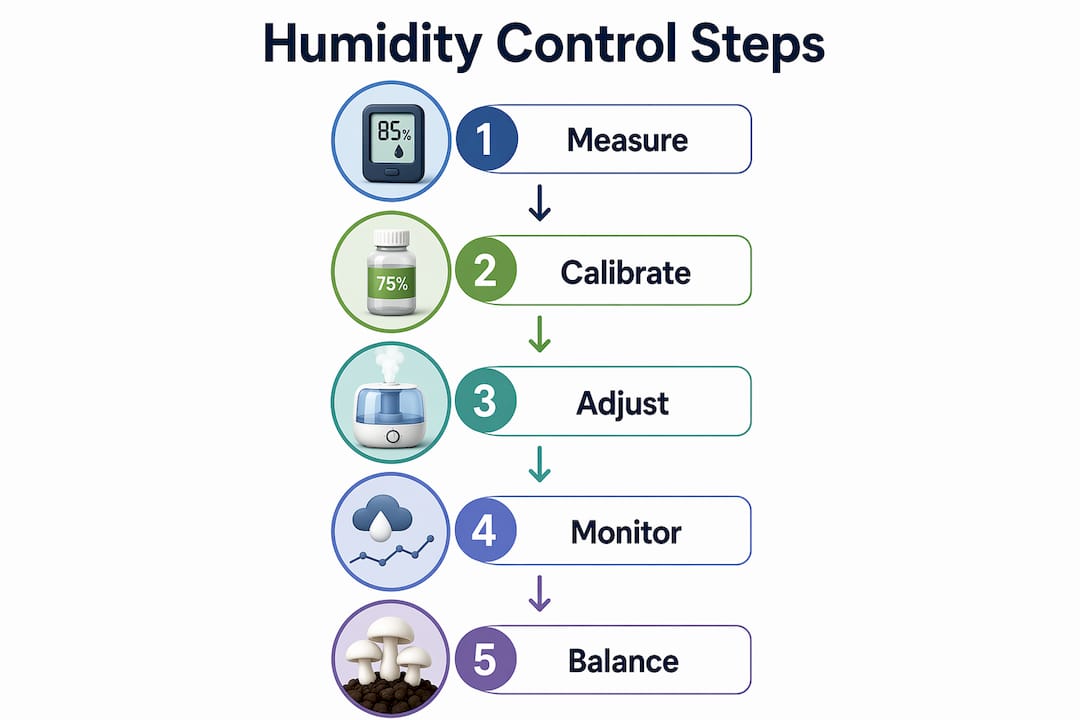
- Martha tent. This is the most popular active system for hobbyists. An ultrasonic humidifier feeds into the tent, controlled by a digital humidity controller such as an Inkbird IHC-200 or a Ranco unit. Set the controller to switch the humidifier on at 87–88% RH and off at 92–93% RH. This cycling approach maintains a stable band without over-saturating the air.
- Monotub. Monotubs often need no active humidification at all during early fruiting. The substrate acts as an internal humidity reservoir, releasing moisture steadily. Passive holes or polyfill filters handle air exchange. As the substrate dries over multiple flushes, light misting of the walls (not the mushrooms) becomes necessary.
- Sensor placement. Place your hygrometer at mushroom level, not at the top of the chamber. Warm, humid air rises, so readings at the top are consistently higher than what your fruiting bodies actually experience. A reading of 93% at the top of a Martha tent might mean only 88% at substrate level.
- Water quality. Use distilled or reverse osmosis water in your ultrasonic humidifier. Tap water leaves mineral deposits on caps and clogs the humidifier’s ceramic disc over time. The white dust you sometimes see on mushrooms grown with tap water is calcium and magnesium residue, not mould.
Pro Tip: Calibrate your hygrometer before you trust it. The salt test method is the standard approach: seal the sensor with a small dish of saturated sodium chloride solution for six hours. It should read 75% RH. If it reads 70% or 80%, you now know your offset and can adjust your controller settings accordingly. Uncalibrated sensors cause 5% RH errors that lead directly to pin abortion or contamination.
Avoiding common growing mistakes like direct misting onto caps or ignoring hygrometer calibration will protect your flushes more reliably than any expensive equipment upgrade.
How to balance humidity with fresh air exchange for healthy growth?
Humidity and fresh air exchange (FAE) work against each other. Every time you introduce fresh air, you lower RH. Every time you seal the chamber to hold humidity, CO₂ builds up. Managing this tension is the core skill of mushroom cultivation.
| Scenario | Humidity effect | CO₂ effect | Result |
|---|---|---|---|
| Too much FAE | RH drops, caps crack | CO₂ stays low | Cracked, stunted mushrooms |
| Too little FAE | RH stays high | CO₂ builds up | Elongated stems, contamination risk |
| Balanced FAE timing | RH maintained in range | CO₂ cleared regularly | Healthy, well-formed fruiting bodies |
| Fan running continuously | RH collapses | CO₂ very low | Severe drying, pin abortion |
Balanced fresh air exchange of one to two minutes every 15–30 minutes gives CO₂ enough time to clear without stripping the chamber of humidity. This is the timing that works for most home setups. You can achieve it with a timer-controlled fan or by manually fanning the chamber several times a day.
Different species tolerate this balance differently. Oyster mushrooms (Pleurotus ostreatus) need more aggressive air exchange and tighter humidity control than king oysters (Pleurotus eryngii), which tolerate moderate CO₂ levels and are more forgiving of humidity fluctuations. Knowing your species matters as much as knowing your equipment.
A common error is running an exhaust fan continuously while compensating by increasing humidifier output. This creates a cycle where the humidifier deposits water faster than it evaporates, leading to wet surfaces and the exact contamination conditions you are trying to avoid. Pulse your fan. Do not run it flat out.
Key takeaways
Stable humidity between 88–92% RH, combined with calibrated sensors and timed fresh air exchange, is the foundation of consistent mushroom yields.
| Point | Details |
|---|---|
| Stage-specific humidity | Adjust RH from 80–90% during colonisation up to 90–95% at pinning, then hold 88–92% through fruiting. |
| Suspended moisture, not surface wetness | Use ultrasonic humidifiers to keep moisture airborne; direct misting onto caps causes bacterial blotch. |
| Calibrate your hygrometer | Use the salt test method to correct sensor errors of up to 5% RH before trusting your readings. |
| Match FAE timing to humidity | Run fresh air exchange for one to two minutes every 15–30 minutes to clear CO₂ without collapsing RH. |
| Know your species | Oyster mushrooms need tighter humidity and more FAE than king oysters; adjust your setup accordingly. |
Start growing with the right supplies from Sporebuddies
Getting your humidity dialled in is only half the equation. You also need quality starting material that responds well to controlled conditions. Sporebuddies supplies a full range of mushroom spores and mushroom grow kits designed for home cultivation in the UK, covering species like oyster, shiitake, and lion’s mane. Each kit is built to work within the humidity ranges covered in this guide. If you are new to cultivation or want to expand your setup, the Sporebuddies grow kits FAQ is a practical starting point for choosing the right kit for your environment and experience level.
FAQ
What is the optimal humidity for mushroom fruiting?
The optimal RH for most cultivated mushrooms during fruiting is 88–92%. Humidity below 80% causes pin abortion, while levels above 95% encourage bacterial blotch and mould growth.
Why do my mushroom pins keep aborting?
Pin abortion is most commonly caused by humidity dropping below 80% RH during the pinning stage, or by an uncalibrated hygrometer giving false readings. Check your sensor with a salt test before adjusting your setup.
Can I use tap water in my mushroom humidifier?
Tap water leaves mineral deposits on fruiting bodies and clogs ultrasonic humidifier discs over time. Distilled or reverse osmosis water is the recommended choice for both mushroom health and equipment longevity.
How often should I exchange fresh air in my fruiting chamber?
Fresh air exchange of one to two minutes every 15–30 minutes clears CO₂ effectively without causing significant humidity loss. Continuous fan operation collapses RH and causes cracking.
Do different mushroom species need different humidity levels?
Yes. Oyster mushrooms require more aggressive air exchange and tighter humidity control than king oysters, which tolerate moderate CO₂ and are more forgiving of small humidity fluctuations.