

Most people picture mushrooms as unremarkable things that appear after rain and disappear just as quickly. That mental image does not come close to capturing what fungi actually do. If you are wondering why study mushroom ecology matters, the answer stretches from deep soil chemistry to global climate regulation. Mushrooms are not passive organisms sitting on the forest floor. They are active system-level regulators that drive nutrient cycles, support plant life, and respond to environmental stress in measurable ways. This guide breaks down the science, the methods, and the real-world significance for anyone ready to look past the surface.
Table of Contents
- Key takeaways
- Why study mushroom ecology: biodiversity and evolution
- Core ecological roles: nutrient cycling and soil health
- Mushroom ecology and climate change
- Methods and challenges in mushroom ecology research
- Practical applications and future research directions
- My perspective on why mushroom ecology deserves more attention
- Explore mushroom ecology with Sporebuddies
- FAQ
Key takeaways
| Point | Details |
|---|---|
| Ancient and diverse organisms | Mushroom-forming fungi have over 350 million years of evolutionary history, making them ecologically significant at every level. |
| Ecosystem engineers | Fungi drive decomposition, nutrient cycling, and carbon sequestration, directly shaping soil and plant health. |
| Climate relevance | Ectomycorrhizal fungi help forests store up to 70% more below-ground carbon, with direct implications for climate mitigation. |
| Research is evolving | Modern mushroom ecology combines field observation with multi-omics approaches to understand function, not just species identity. |
| Practical applications are wide | From ecosystem restoration to sustainable agriculture, mushroom ecology knowledge translates into real conservation outcomes. |
Why study mushroom ecology: biodiversity and evolution
The first thing to understand is the sheer scale of fungal diversity. Mushroom-forming fungi (the class Agaricomycetes) carry over 350 million years of evolutionary history. That depth means they have adapted to and shaped nearly every terrestrial habitat on the planet. Understanding that breadth is what gives the importance of mushroom ecology its foundation.
Advances in genomics have transformed how researchers approach this diversity. Where scientists once relied on visible features such as gill structure, spore shape, and cap colour to classify species, genomic sequencing now reveals evolutionary relationships that field identification cannot. This matters because taxonomy shapes ecology. Knowing how species are related tells you why they behave differently in soil, forest, and grassland environments.
The field is now shifting towards what researchers call postgenomic ecological studies, which means moving beyond cataloguing species and using genomic data to explain ecological processes. Here is what that shift means in practical terms for mushroom biodiversity significance:
- Genomic data reveals hidden species that share identical physical features but perform distinct ecological functions.
- Phylogenomics helps predict which fungi are likely to form mycorrhizal associations versus which are saprotrophic decomposers.
- Comparative genomics identifies the enzymes responsible for breaking down specific plant polymers like lignin and cellulose.
- Evolutionary analysis helps researchers understand which lineages are most sensitive to climate and land-use change.
This is why mushroom ecology research is moving fast. The questions are no longer just “what is here?” but “what is it doing, and why does that matter?”
Core ecological roles: nutrient cycling and soil health
Mushrooms are the primary recyclers of dead plant material in most terrestrial ecosystems. Without them, forests would accumulate undecomposed wood and leaf litter indefinitely. The fungi responsible for this process, called saprotrophic species, produce enzymes that break down lignin and cellulose. These are the structural compounds in wood that almost nothing else can digest efficiently.
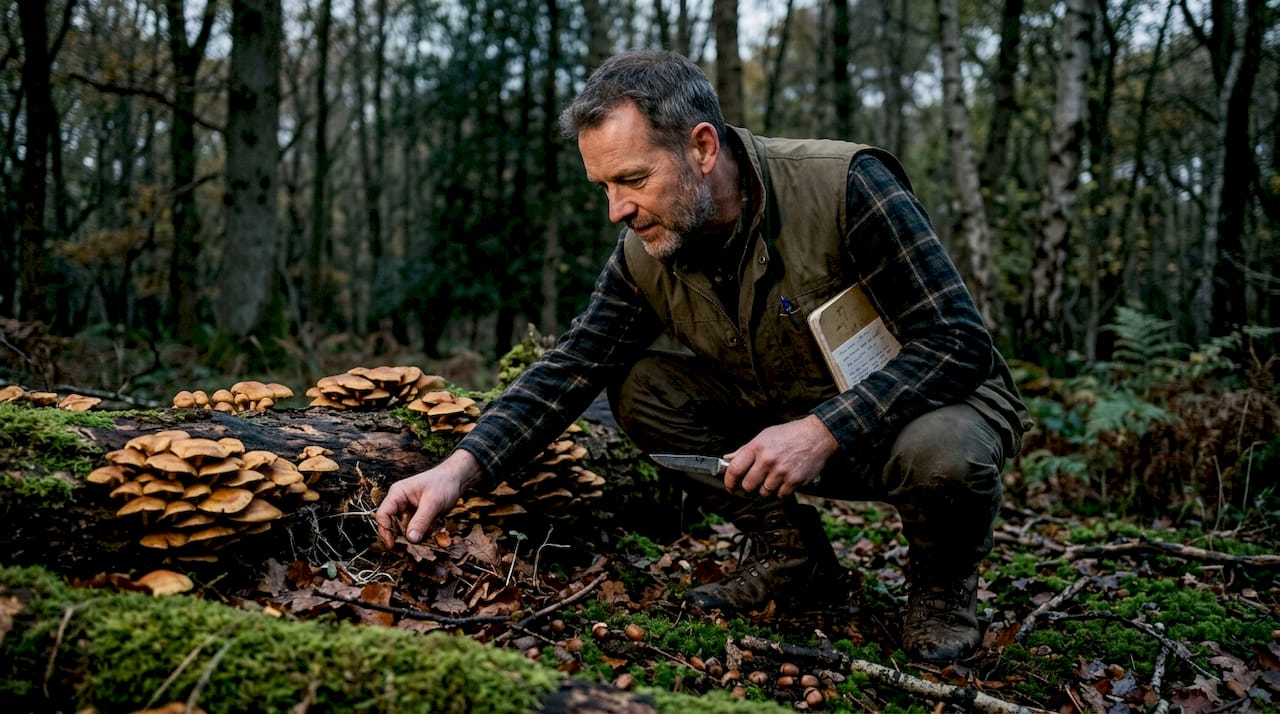
Mushrooms recycle dead plant biomass and establish mutualistic relationships with woody plants, sustaining nutrient availability and plant dynamics across ecosystems. Those mutualistic relationships, known as mycorrhizal associations, are where the role of fungi in nature becomes particularly striking. In a mycorrhizal partnership, the fungal mycelium extends far beyond the reach of plant roots, effectively increasing the plant’s access to phosphorus, nitrogen, and water.
Fungi drive nutrient mineralisation and sit at the base of soil food webs, influencing the biogeochemical cycles that keep ecosystems productive. The ecological impact of mushrooms on soil is not limited to what happens at the surface. Below ground, mycorrhizal networks connect individual trees, enabling the movement of carbon and nutrients between plants. This is one reason why older, well-connected forest ecosystems are more resilient to drought and disease.
Consider these core ecological contributions:
- Decomposition: saprotrophic fungi break down organic matter and return carbon, nitrogen, and phosphorus to the soil.
- Nutrient mineralisation: fungal enzymes convert bound nutrients into forms that plants can absorb directly.
- Soil structure: fungal hyphae bind soil particles together, improving aeration and water retention.
- Plant productivity: mycorrhizal fungi increase plant growth by improving nutrient and water uptake.
Pro Tip: If you are studying soil ecology for the first time, focus on the relationship between fungal biomass and plant diversity in a given area. Where fungal networks are richest, plant communities tend to be most stable.
Soil food web diversity varies significantly by land use and climate, and ecosystem stability depends on complex soil communities where fungi play fundamental feeding roles. This is why the benefits of studying fungi extend to anyone working in conservation, agronomy, or land management.
Mushroom ecology and climate change
The connection between fungi and climate is one of the most compelling reasons to study mushroom ecology in depth. Ectomycorrhizal fungi, which associate with the roots of trees like oak, pine, and beech, contribute directly to long-term soil carbon storage. ECM-dominant forests store up to 70% more below-ground carbon than forests without strong mycorrhizal networks.
That figure has serious implications for carbon accounting and climate policy. Forests are often valued for the carbon stored in their timber. But a large proportion of the carbon that matters for climate regulation sits below the surface, held in place by fungal activity. Disrupting those fungal communities through soil compaction, pesticide use, or deforestation removes a major carbon sink.
| Fungal role | Climate relevance |
|---|---|
| Mycorrhizal networks | Increase below-ground carbon storage in forests |
| Saprotrophic decomposition | Regulates the rate at which carbon re-enters the atmosphere |
| Mycoremediation | Breaks down environmental pollutants including hydrocarbons |
| Pathogen regulation | Maintains ecosystem health under warming and drought stress |
Saprotrophic fungi also have a role in mycoremediation, which is the use of fungi to break down pollutants in contaminated soils and water. Species that produce powerful oxidative enzymes can degrade hydrocarbons, heavy metals, and some synthetic compounds. This is not a theoretical application. Pilot projects across Europe have used fungal inoculation to restore polluted industrial land.
Pro Tip: When reviewing mushroom ecology research related to climate, pay attention to how researchers measure below-ground carbon. Many studies only quantify above-ground biomass, which can significantly underestimate the true carbon value of a fungal-rich ecosystem.
Fungi link carbon cycling, nutrient availability, and pathogen dynamics with global change impacts, making them central to what researchers now call One Health frameworks. These frameworks recognise that human, ecosystem, and planetary health are connected. Learning about mushroom health and wellness through that lens gives you a much richer picture of why fungi matter beyond any single discipline.
Methods and challenges in mushroom ecology research
One of the most important things to understand about mushroom ecology research is that the fruiting body you see above ground is not the organism. It is a reproductive structure. The mycelium underground is the actual functional unit, conducting nutrient exchange, forming networks, and responding to environmental cues. Studying mushrooms by observing fruiting bodies alone is like studying a tree by only looking at its flowers.
This is a core challenge in the field. Mycelium is hidden, fragile when disturbed, and difficult to quantify with traditional methods. Researchers have developed several approaches to address this:
- Soil core sampling: physical collection of soil sections followed by DNA extraction to identify which species are present.
- Environmental DNA (eDNA) analysis: sequencing fungal DNA directly from soil, water, or air samples without the need to culture organisms.
- Stable isotope analysis: tracking how carbon and nitrogen move through fungal networks to understand feeding relationships.
- Mesocosm experiments: controlled laboratory or greenhouse settings where specific fungal species can be studied under defined conditions.
Pairing fruiting body observation with community genomics is now considered the standard approach in rigorous mushroom ecology research. Field observation tells you what is fruiting and when. Genomic sampling tells you what is living in the soil year-round and what it is doing metabolically.
A key bottleneck remains the gap between identifying species and understanding function. Knowing a fungus is present does not tell you whether it is actively decomposing, forming mycorrhizal associations, or lying dormant. Multi-omics approaches, combining genomics, transcriptomics, and metabolomics, are beginning to close that gap. For students and researchers entering the field now, this is the frontier where the most significant discoveries are likely to emerge.
Practical applications and future research directions
Understanding the ecological impact of mushrooms has direct applications across multiple sectors. The table below outlines where mushroom ecology knowledge is being put to work right now.
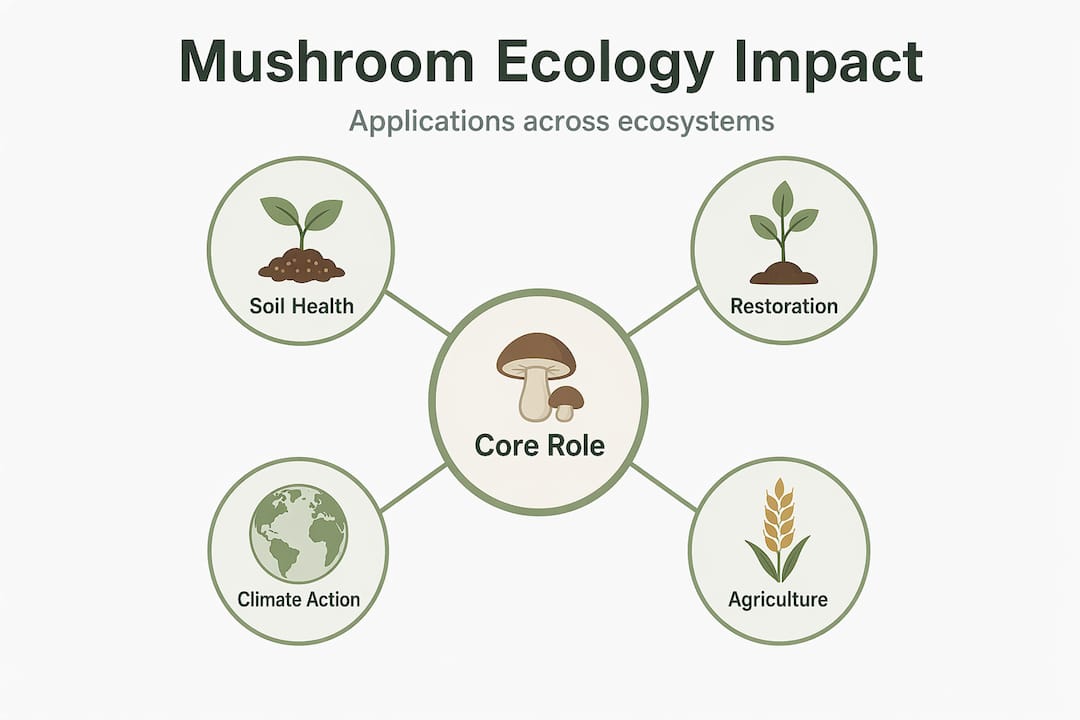
| Application area | How mushroom ecology contributes |
|---|---|
| Ecosystem restoration | Fungal inoculation supports plant re-establishment in degraded soils |
| Climate mitigation | Mycorrhizal networks increase below-ground carbon storage in reforested land |
| Sustainable agriculture | Mycorrhizal amendments reduce the need for synthetic fertilisers |
| Pollution remediation | Saprotrophic fungi degrade industrial pollutants in contaminated sites |
| Citizen science | Community-based species recording expands geographic data coverage |
| Education | Mycology-focused curricula improve ecological literacy in schools and universities |
Mycology is underrepresented in education despite its ecological and practical importance. Curriculum developments that include mushroom identification, ecology, and food safety are beginning to address this gap. When students learn to recognise and study fungi in the field, they are not just adding a taxonomic skill. They are developing the ecological literacy needed to interpret soil health, biodiversity data, and land management outcomes.
Fungi provide measurable insights for climate mitigation through their effects on soil carbon and ecosystem restoration. As citizen science platforms grow, the ability to gather species occurrence data across wide geographies is increasing. This data, when combined with remote sensing and eDNA techniques, could significantly improve models of how fungal communities shift under climate change. For researchers, that represents an open and genuinely exciting research direction. To understand more about why mushrooms matter across science and health, it is worth exploring the broader literature alongside field work.
Explore mushroom ecology with Sporebuddies
If studying mushroom ecology has sparked your curiosity about getting hands-on with fungi, Sporebuddies is a good place to start building your practical knowledge. The platform offers a range of mushroom spores for research and microscopy, alongside growing kits and mycology supplies suited to both educational and hobbyist use. Whether you are setting up a study collection or exploring how different species grow under controlled conditions, Sporebuddies provides the equipment and guidance to make your first steps into mycology straightforward. Visit the mycology science and education section to browse resources designed to support learning at every stage.
FAQ
What is mushroom ecology?
Mushroom ecology is the study of how fungi interact with their environments, including their roles in decomposition, nutrient cycling, mycorrhizal associations, and their responses to climate and land-use change.
Why is mushroom ecology important for understanding ecosystems?
Fungi drive core ecosystem processes including carbon storage, nutrient mineralisation, and plant health. Without fungi, most terrestrial ecosystems would lose their capacity to recycle organic matter and sustain plant communities.
How do mushrooms interact with ecosystems below ground?
The fungal mycelium forms underground networks that exchange nutrients with plant roots, bind soil particles, and regulate carbon flow. The visible fruiting body is only the reproductive structure of a much larger organism.
Can studying fungi contribute to climate change research?
Yes. Ectomycorrhizal fungi help forests store significantly more below-ground carbon, and saprotrophic fungi regulate how quickly organic carbon re-enters the atmosphere. Both processes are directly relevant to climate modelling and mitigation strategies.
How can students get started in mushroom ecology research?
Begin with field observation combined with basic soil sampling, then build skills in eDNA analysis and microscopy. Pairing practical experience with genomic methods gives you the strongest foundation for contributing to current research questions.