
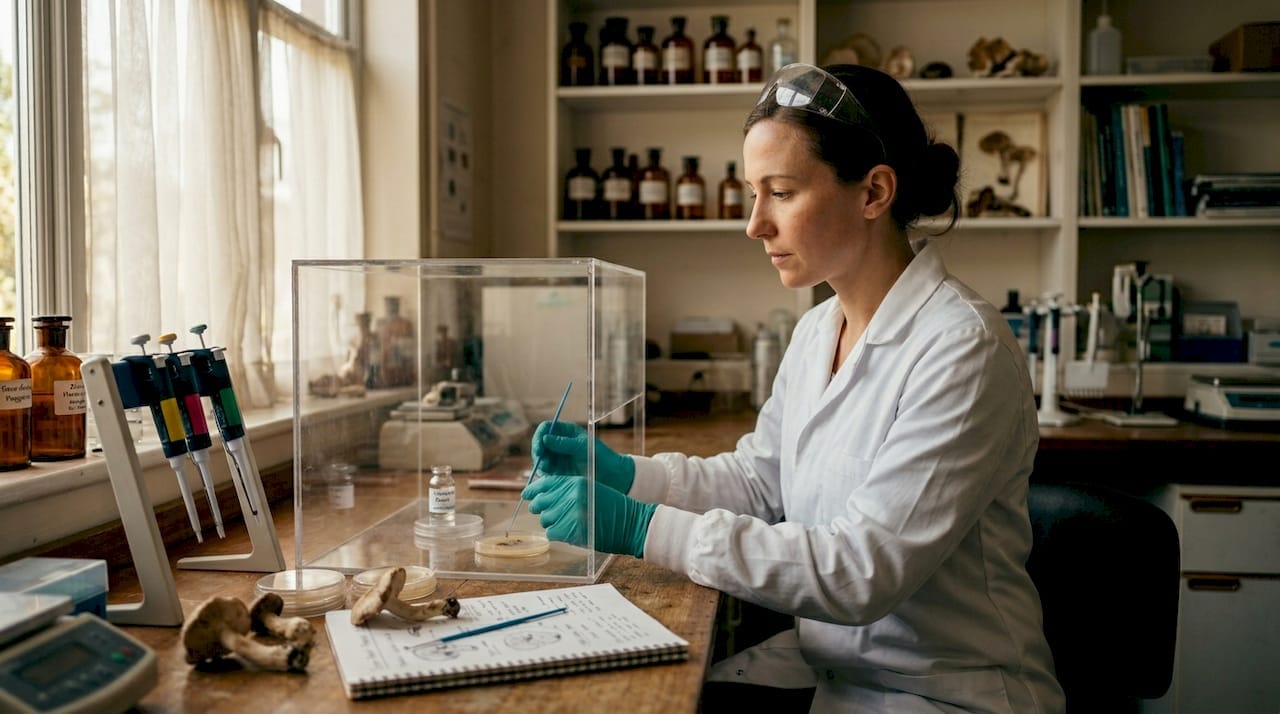
Whether you are growing oyster mushrooms on a kitchen shelf or isolating fungal strains under a microscope, the role of mycology supplies shapes every outcome you get. Most people underestimate just how much the right equipment matters. It is not simply about having a spore syringe and hoping for the best. Contamination, environmental control, sterile technique, and the precision of your tools all determine whether your work succeeds or fails. This guide covers the full picture: what mycological equipment actually is, how the different types serve different goals, and why quality supplies are the foundation of good mycology practice.
Table of Contents
- Key takeaways
- What mycology supplies actually include
- Contamination control and sterile technique
- Cultivation versus research: different tools for different goals
- Practical benefits of using quality supplies
- My honest view on getting started with mycology supplies
- Start building your mycology setup with Sporebuddies
- FAQ
Key takeaways
| Point | Details |
|---|---|
| Supplies span all skill levels | From basic still air boxes to HEPA-filtered laminar flow hoods, there is suitable equipment for every stage of experience. |
| Contamination control is non-negotiable | Sterile tools and proper technique prevent the mould and bacteria that ruin cultures and waste months of effort. |
| Cultivation and research need different tools | Grow kits and spawn bags serve cultivators, while agar plates, sterile instruments, and lab-grade hoods serve researchers. |
| Quality affects reproducibility | Consistent, reliable equipment produces results you can repeat and learn from, whether for yield or scientific study. |
| Sourcing matters in the UK | Finding reputable suppliers of top mycology supplies UK-wide makes a real difference to product quality and grower success. |
What mycology supplies actually include
When people ask what is mycological equipment, they often expect a short list. The reality covers a much broader range of tools, consumables, and growing materials than most beginners anticipate.
At the foundational level, mycology supplies include:
- Spore syringes and spore prints for inoculation and microscopy study
- Agar plates (such as pre-poured agar plates) for culturing, cloning, and strain isolation
- Sterilised grain and bulk substrates that provide the nutritional base for mycelium growth
- Spawn bags with pre-loaded substrate for straightforward inoculation
- Pressure cookers and autoclave bags for sterilising home-prepared substrates
- Alcohol, gloves, and disposable syringes as consumable sterile handling items
More advanced mycological equipment introduces a new level of precision. A still air box is a clear, enclosed chamber that limits airborne contamination by allowing particles to settle before you begin working. Laminar flow hoods take this further by pushing HEPA-filtered air across your workspace continuously, actively keeping contaminants away from your cultures. Incubators and climate-controlled grow chambers maintain the precise temperature and humidity ranges that different species require.
The distinction between beginner and researcher-level supplies is not just about cost. It reflects the level of control you need over your environment. A hobbyist growing oyster mushrooms at home can achieve good results with a still air box, a pressure cooker, and quality grain spawn. A researcher isolating specific strains for study needs agar plates, a flow hood, sterile scalpels, and often a proper lab-grade incubator. Both sets of tools are legitimate. They just serve different purposes at different scales.
Contamination control and sterile technique
Contamination is the single biggest challenge in mycology. Green mould (typically Trichoderma or Penicillium), wet rot, and sour-smelling substrate are signs that bacteria or competing fungi have colonised your work. Understanding the importance of mycology supplies begins with understanding why contamination happens and what stops it.
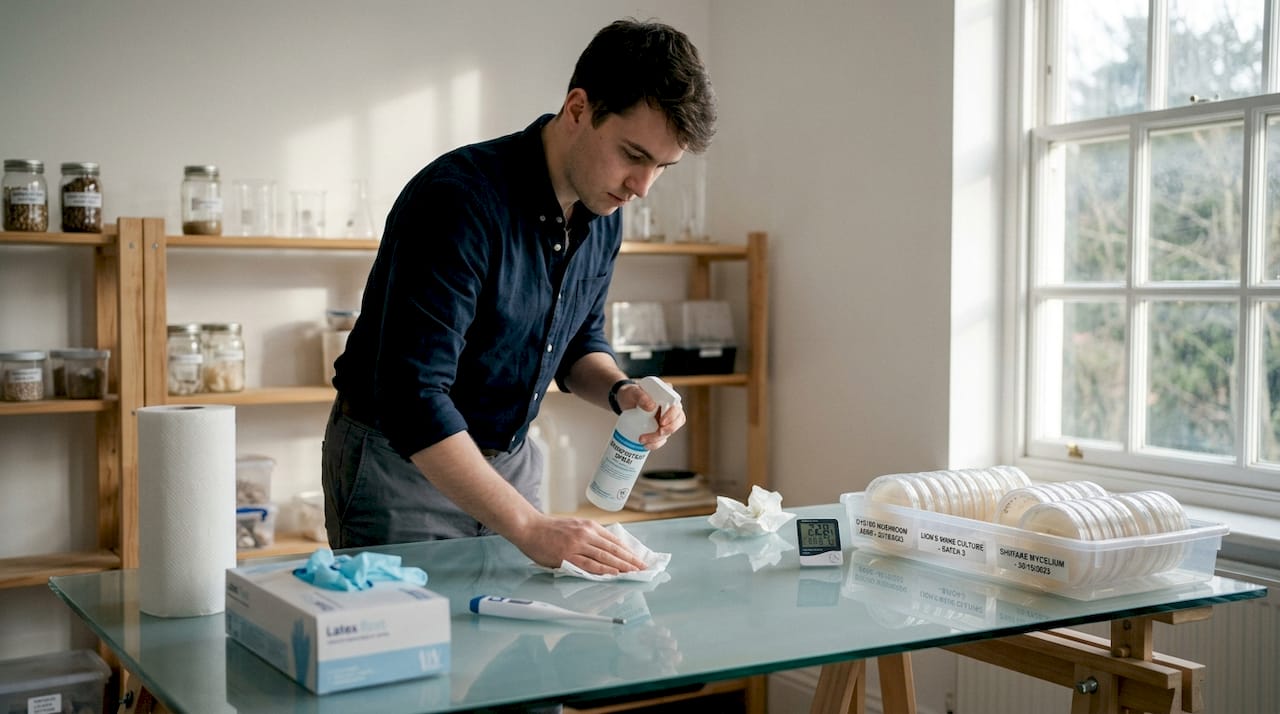
The core problem is that fungal spores and bacteria are everywhere. Every surface, every breath, every unfiltered movement of air carries potential contaminants. Your supplies are what stand between a thriving culture and a failed one.
Here is what makes the difference in practice:
- Laminar flow hoods create an ISO Class 5 environment that limits airborne particles to 3,520 per cubic metre, producing unidirectional airflow that actively sweeps spores away from your work surface.
- Still air boxes work differently, relying on particle settling rather than filtered airflow. The two tools serve complementary roles and should not be considered interchangeable, since hoods protect the product with filtered air while still air boxes reduce exposure through stillness alone.
- Alcohol sprays and flame sterilisation of instruments prevent cross-contamination between transfers.
- Glove boxes and disposable gloves reduce the contamination introduced by direct skin contact.
Pro Tip: Allow at least five minutes of purge time before working in a laminar flow hood. Skipping this purge period allows suspended particles to remain in the airstream, significantly increasing your contamination risk regardless of how carefully you work afterward.
One thing experienced growers learn quickly is that contamination is largely inevitable at some point. The goal is not to eliminate it entirely from the outset, but to build technique and equipment habits that make it rare. When contamination does appear, cutting out the affected substrate rarely solves anything, since spores spread systemically through the grain long before visible signs appear. The better response is to treat it as feedback, study what went wrong in your workflow, and refine your sterilisation process.
Most contamination issues trace back to workflow gaps, not equipment failures. A pressure cooker used incorrectly is more dangerous than no pressure cooker at all.
Beginners frequently overlook the importance of purge periods and clean-to-dirty workflows. Experienced growers stress that technique refinement, not more equipment, is what ultimately reduces contamination rates over time.
Cultivation versus research: different tools for different goals
The types of mycology supplies you need depend heavily on what you are trying to achieve. Cultivation and scientific research overlap in some areas but diverge significantly once you move beyond the basics.
| Supply type | Cultivation focus | Research focus |
|---|---|---|
| Substrate | Bulk grain, straw, wood chips, pasteurised coir | Agar-based media, nutrient broths, specialised formulations |
| Inoculation tools | Spore syringes, grain-to-grain transfers | Sterile scalpels, agar transfers, liquid culture syringes |
| Sterile workspace | Still air box, basic flow hood | HEPA-filtered laminar flow cabinet, FDA/GMP-compliant hood |
| Environmental control | Basic grow tent, humidifier, thermometer | Calibrated incubators, CO₂ monitors, climate chambers |
| Monitoring | Visual inspection, moisture metre | Digital sensors, photographic documentation, microscopy |
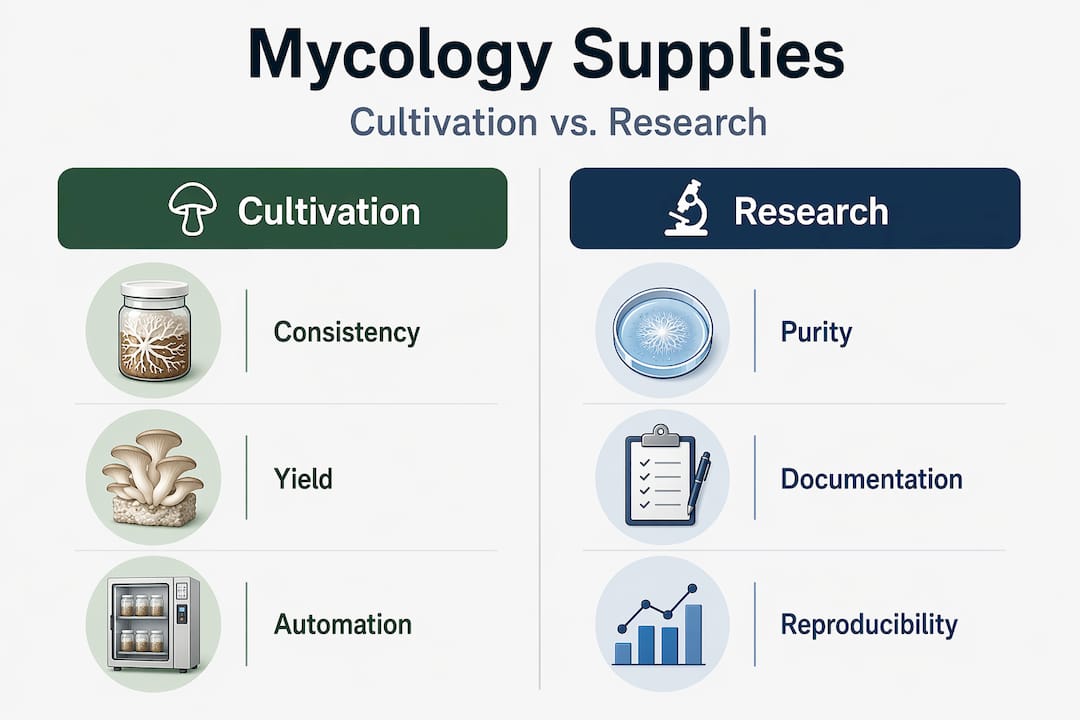
For cultivators, the priority is consistency and yield. Automated systems such as the MycoClimate climate-controlled monotub illustrate where cultivation equipment has evolved. These units use water-bath heating, HEPA-filtered air exchange, and built-in digital monitoring to maintain stable conditions that prevent CO₂ buildup and substrate drying. They represent the upper end of must-have mycology supplies for serious home growers who want repeatable harvests.
For researchers, the emphasis shifts to documentation, reproducibility, and purity. Agar plates allow you to observe colony morphology, isolate healthy sectors of mycelium, and preserve genetics over time. Laminar flow cabinets that meet FDA and GMP standards through continuous unidirectional HEPA-filtered airflow become the standard workspace rather than an optional upgrade.
You will find that the best mycology supplies UK suppliers stock reflect this divide clearly. Products aimed at home cultivators emphasise ease of use and value. Products aimed at researchers emphasise certification, precision, and longevity. Knowing which category your work falls into helps you spend your budget wisely rather than buying equipment that does not match your actual workflow.
Practical benefits of using quality supplies
The benefits of mycology tools become concrete when you look at what changes in practice. Quality supplies do not just make work easier. They change the outcomes you are capable of achieving.
- Consistent, contamination-free yields. A proper sterile environment means you spend less time diagnosing failed grows and more time harvesting. For cultivators following a home growing guide, reliable equipment turns unpredictable results into a repeatable process.
- Accurate strain isolation and documentation. Agar plates let you visually distinguish between healthy mycelium sectors and contaminated ones. Researchers using quality agar media can preserve and compare strains over months, building a reference library that supports genuine scientific conclusions.
- Educational depth and engagement. For schools and academic programmes, top mycology supplies for schools include spore prints, basic microscopes, and pre-poured agar plates. These allow students to observe fungal structures, conduct inoculation experiments, and see real biological processes unfold in the classroom. The mycology science and education resources available today make this more accessible than it has ever been.
- Advances in understanding fungal biology. Improved supplies make it possible to study species that were previously difficult to culture reliably. Better substrates, more precise environmental controls, and higher-quality sterile media have all contributed to a wider range of species being successfully cultivated and studied outside of specialist institutions.
- Reduced waste and cost over time. It feels counterintuitive, but investing in quality equipment reduces the total cost of your mycology work. Failed cultures waste substrate, spores, time, and energy. A reliable flow hood, good agar plates, and proper sterilisation protocol pay for themselves within a few successful grows.
Start building your mycology setup with Sporebuddies
At Sporebuddies, the product range is built to support growers and researchers at every stage of their work. Whether you are choosing your first grow kit or sourcing agar plates and sterilised substrates for a research project, you will find reliable, UK-sourced options that match your actual needs.
Browse mushroom growing equipment for cultivation-focused tools, or explore the full mycology equipment catalogue if you need lab-grade supplies. For those starting with spore work, the spore syringe range covers popular strains suited to microscopy and cultivation. Sporebuddies also offers wholesale mycology supplies for growers operating at scale. Every product is selected with contamination control and consistency in mind.
FAQ
What does mycological equipment include?
Mycological equipment covers all tools, consumables, and growing materials used in fungal cultivation and research. This includes spore syringes, agar plates, sterile substrates, still air boxes, laminar flow hoods, and incubators.
Why is contamination control so important in mycology?
Fungal and bacterial contaminants are present on almost every surface and in the air. Without sterile technique and proper equipment, competing organisms outpace mycelium growth and ruin cultures before they can establish.
What is the difference between a still air box and a laminar flow hood?
A still air box reduces contamination by allowing airborne particles to settle in an enclosed space. A laminar flow hood actively pushes HEPA-filtered air across the workspace, creating a cleaner environment suited to more sensitive work like agar transfers.
Which mycology supplies do beginners actually need?
To start, you need a spore syringe or spore print, sterilised grain or a ready-made grow kit, a still air box or basic flow hood, alcohol spray, and gloves. More advanced tools become useful once you have mastered the foundational sterile workflow.
Are quality mycology supplies available in the UK?
Yes. The range of best mycology supplies UK-based suppliers offer has grown considerably. Sporebuddies stocks a full selection of cultivation and research-grade supplies, from spore syringes and agar plates to laminar flow hoods and sterilised substrates, all available for delivery across the UK.