
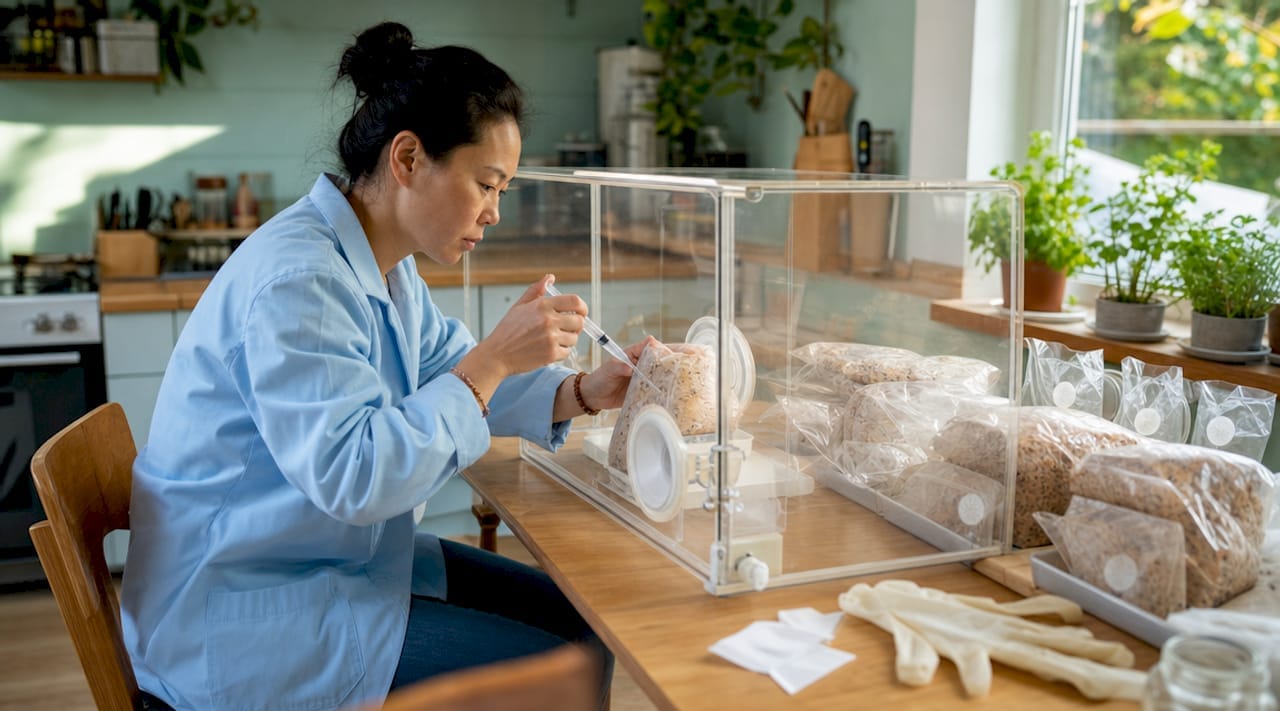
Mould prevention in mushroom cultivation depends on three pillars: sterile technique, precise moisture management, and balanced environmental control. When any one of these fails, aggressive contaminants like Trichoderma can destroy an entire substrate block within days. The good news is that most mould problems are preventable with the right habits and equipment. This guide covers the proven ways to prevent mould in mushrooms, from inoculation through to fruiting, with practical steps you can apply at home regardless of your experience level.
1. Master sterile technique from the start
Contamination most often originates before fruiting, during inoculation. Poor sterilisation or low-quality spawn can doom a substrate block long before you see any visible signs of trouble. Getting your sterile technique right at this stage is the single most impactful thing you can do.
The two most accessible tools for home cultivators are the Still Air Box (SAB) and the laminar flow hood. A SAB is a clear plastic tub with arm holes cut into the side. You work inside it with slow, deliberate movements to avoid disturbing the air. This dramatically reduces the number of airborne spores that can land on your substrate or tools. A laminar flow hood goes further, pushing HEPA-filtered air across your workspace in a steady stream. HEPA filters capture 99.97% of particles at 0.3 microns, which covers the vast majority of mould spores.
Before every inoculation, follow this routine:
- Wipe all surfaces with a bleach solution, then follow with 70% isopropyl alcohol once dry
- Spray your gloved hands with alcohol and allow to dry before touching anything sterile
- Flame-sterilise your inoculation needle to red-hot before every transfer, then allow it to cool for a few seconds before use
- Work slowly. Fast arm movements create air currents that lift spores off surfaces
Pro Tip: 70% isopropyl alcohol is more effective at penetrating microbial cell walls than higher concentrations. Do not substitute with hand sanitiser or neat spirits.
2. Control substrate moisture precisely
Substrate moisture is one of the most overlooked mushroom mold prevention methods among beginners. Too wet and you create anaerobic pockets where bacteria thrive and Trichoderma gains a foothold. Too dry and your mycelium struggles to colonise.
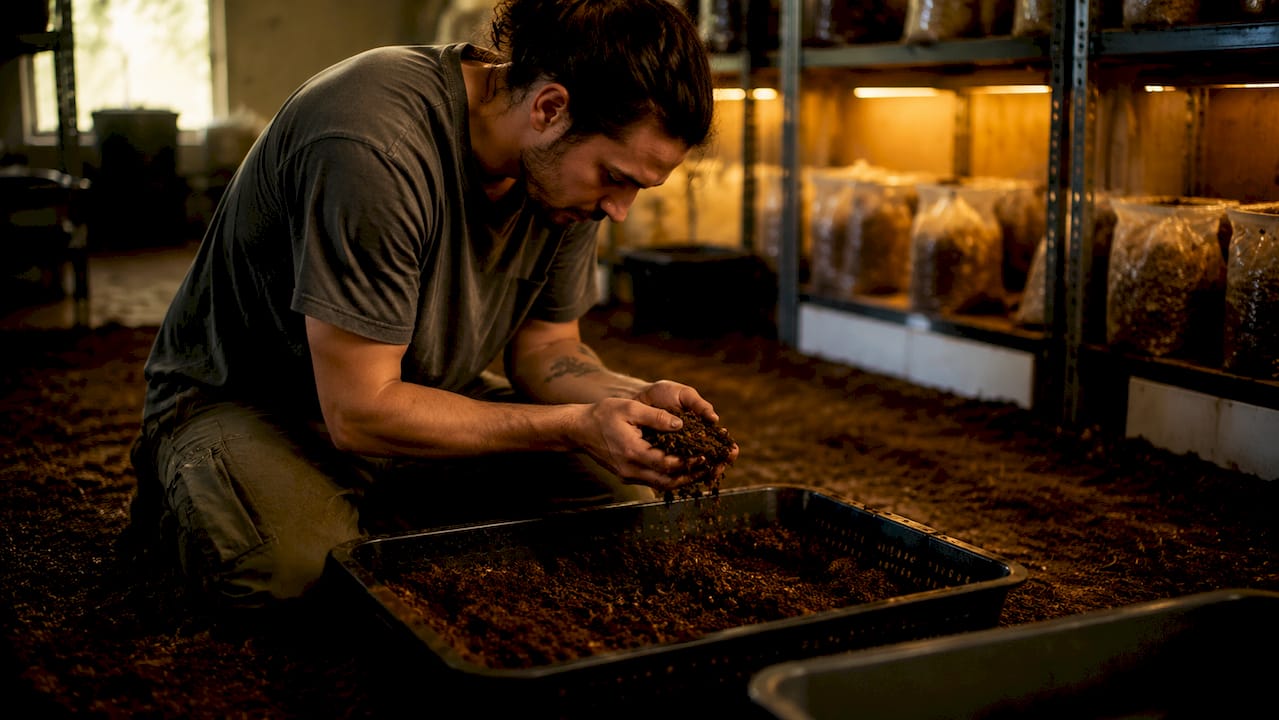
The target is field capacity, which sits at roughly 60 to 65% moisture content. The practical test for this is the squeeze test: take a handful of prepared substrate and squeeze it firmly. You should see one to three drops of water fall. If water streams out, the substrate is too wet. If nothing comes out, it is too dry. This simple check takes seconds and saves entire grows.
Follow these steps to get substrate moisture right every time:
- Mix your substrate dry first, then add water gradually until you reach the squeeze test target
- Sterilise at 15 PSI for 2.5 to 3 hours to kill existing contaminants in the substrate
- Allow the substrate to cool fully for 12 to 24 hours before inoculation. Warm substrate creates condensation inside bags, which raises surface moisture and invites contamination
- Avoid softwoods like pine in your substrate mix. Softwoods contain terpenes that can inhibit mycelium and create conditions that favour competing organisms
- Use only quality spawn from a reputable supplier. Contaminated spawn introduces mould before your substrate even has a chance
Pro Tip: Reducing substrate moisture slightly below saturation also reduces Trichoderma risk, as this mould thrives in high-moisture conditions. Aim for the lower end of the field capacity range when working with species prone to green mould.
3. Balance humidity and fresh air exchange in fruiting chambers
Environmental control during fruiting is where many home cultivators struggle. The instinct is to keep humidity as high as possible, but this is a mistake. Beginners often push humidity above 95%, inadvertently creating ideal mould conditions. The correct target for most species is 88 to 92% relative humidity (RH).
Fresh air exchange (FAE) is equally important. Stagnant humid air is a mould incubator. Regular air exchange removes excess CO2 and prevents moisture from sitting on surfaces. CO2 levels should stay below 1000 ppm for healthy development. In practice, this means exchanging air every 30 to 60 minutes, either manually by fanning the chamber or automatically with an exhaust fan on a timer.
Key humidity and airflow rules for your fruiting chamber:
- Target 88 to 92% RH. Use a digital hygrometer to monitor this accurately
- Mist chamber walls, not mushrooms directly. Standing water on caps or substrate signals humidity is too high
- Run fresh air exchange every 30 to 60 minutes. Even a brief fan burst is enough
- If using an automated humidifier, pair it with an exhaust fan on a separate timer to cycle air out after each misting event
- Avoid sealed, unventilated tubs. Even small holes or a polyfill filter port make a significant difference
| Condition | Ideal range | Risk if exceeded |
|---|---|---|
| Relative humidity | 88 to 92% RH | Above 95% favours mould growth |
| CO2 concentration | Below 1000 ppm | High CO2 signals poor airflow |
| Fresh air exchange | Every 30 to 60 minutes | Stagnant air promotes contamination |
| Misting target | Chamber walls only | Direct misting causes surface moisture |
4. Identify common mould contaminants early
Knowing what you are looking at is a core part of how to keep mushrooms mould-free. The most damaging contaminant in home cultivation is Trichoderma, a green mould that spreads aggressively once established. By the time you see green patches, spores have already spread throughout the substrate. Partial salvage is not a realistic option.
Early signs to watch for include:
- Green or blue-green patches on substrate or grain. This is almost always Trichoderma
- Pink or red colouration on substrate, which indicates bacterial contamination
- Black or grey fuzzy growth that is not mycelium. Mycelium is white and rope-like; mould tends to be powdery or fluffy
- Sour, sweet, or unpleasant smell from a bag or block. Healthy colonising mycelium smells faintly mushroomy or earthy
- Wet, slimy patches on substrate surface, which signal bacterial wet rot
Once you spot green mould, do not open the bag indoors. Seal it immediately in a second bag and take it outside to a bin. Opening contaminated bags indoors aerosolises spores and risks contaminating your entire growing space.
After removing a contaminated block, wipe down the entire chamber with a bleach solution followed by 70% isopropyl alcohol. Allow it to dry fully before introducing new substrate.
Pro Tip: Treat every contamination as diagnostic information. Green mould appearing early in colonisation usually points to a sterilisation failure. Green mould appearing during fruiting often points to humidity being too high or airflow being too low.
5. Choose the right tools for mould prevention
Selecting the right equipment makes consistent mould prevention far more achievable. The table below compares the most common tools home cultivators use, so you can decide what suits your setup and budget.
| Tool | Effectiveness | Cost | Best use case |
|---|---|---|---|
| Still Air Box (SAB) | High for inoculation | Low (DIY possible) | Inoculation and transfers |
| Laminar flow hood | Very high | Medium to high | Regular inoculation work |
| HEPA air purifier | High for room air | Medium | Reducing ambient spore load |
| 70% isopropyl alcohol | High for surfaces | Very low | Surface and tool disinfection |
| Digital hygrometer | Indirect (monitoring) | Low | Tracking fruiting chamber RH |
| Automated exhaust fan | High for FAE | Low to medium | Fruiting chamber airflow |
A few points worth noting about this list:
- A SAB and a bottle of 70% isopropyl alcohol are the minimum viable setup for clean inoculation work. Most beginners can start here without significant cost.
- HEPA air purifiers running continuously in your grow room reduce the background spore count in the air, which lowers your baseline contamination risk across all stages.
- A laminar flow hood is worth the investment if you are doing frequent work with agar plates or liquid culture, where even a SAB can fall short.
- The GrowBuddie40 incubator from Sporebuddies is a practical option for home cultivators who want automated temperature and airflow management without building a custom setup.
Key takeaways
Preventing mould in mushroom cultivation requires sterile technique during inoculation, precise substrate moisture at field capacity, and fruiting chamber humidity held at 88 to 92% with regular fresh air exchange.
| Point | Details |
|---|---|
| Sterile technique is non-negotiable | Use a SAB or laminar flow hood and 70% isopropyl alcohol before every inoculation. |
| Substrate moisture targets matter | Aim for 60 to 65% moisture using the squeeze test; sterilise at 15 PSI for 2.5 to 3 hours. |
| Humidity above 95% invites mould | Keep fruiting chamber RH at 88 to 92% and exchange air every 30 to 60 minutes. |
| Trichoderma requires full disposal | Seal and remove contaminated blocks outdoors immediately; never open bags indoors. |
| Contamination is diagnostic | Early mould signals a sterilisation failure; late mould signals an environmental issue. |
Get the right equipment from Sporebuddies
Sporebuddies stocks everything you need to put these mould prevention methods into practice. From sterile syringes and needles for clean inoculation work to substrates prepared for optimal moisture control, the range is built for home cultivators who want reliable results. The mushroom growing equipment category covers tools for every stage of cultivation, including humidity monitoring, airflow management, and sterilisation. If you are starting out or upgrading your setup, browse the full range to find what fits your grow space and budget.
FAQ
What is the most effective way to prevent mould in mushrooms?
Sterile technique during inoculation is the single most effective method. Using a Still Air Box and 70% isopropyl alcohol to clean surfaces and tools before every transfer prevents mould spores from entering your substrate.
What humidity level prevents mould in a fruiting chamber?
Keep relative humidity between 88 and 92%. Humidity above 95% creates conditions that favour mould growth, particularly Trichoderma. Pair humidity control with fresh air exchange every 30 to 60 minutes.
Can you cut out mould and save a contaminated mushroom block?
No. By the time green mould is visible, spores have already spread through the substrate. Seal the block in a bag and dispose of it outdoors. Attempting to cut out mould risks spreading spores to your entire grow space.
How do I know if my substrate moisture is correct?
Use the squeeze test. Squeeze a handful of prepared substrate firmly. One to three drops of water indicates correct field capacity at around 60 to 65% moisture. Streaming water means it is too wet.
Why does Trichoderma keep appearing in my grows?
Trichoderma most commonly results from insufficient sterilisation, contaminated spawn, or humidity above 95% during fruiting. Check your sterilisation time and pressure, source spawn from a reputable supplier, and review your fruiting chamber conditions.