

Why controlled experiments are central to mycological research
Controlled experiments are the foundation of valid mycological research. Without them, you cannot reliably attribute observed changes in fungal growth, morphology, or virulence to a specific variable. As Baker (1984) described, a controlled experiment forces nature to reveal phenomena that passive observation simply cannot expose.
In fungal biology, this matters enormously. Fungi respond to subtle shifts in substrate chemistry, humidity, and gas exchange. A control culture grown on standard media alongside your experimental group provides the baseline that confirms whether observed differences arise from your manipulated variable or from ambient conditions. Without that baseline, your data tells you very little.
Key reasons controlled experiments underpin mycological research:
- They allow hypothesis testing with measurable, comparable outcomes
- Control groups isolate the effect of a single variable from background noise
- Replication across multiple cultures confirms findings are not artefacts
- Standardised protocols enable other researchers to reproduce and verify results
- They support advances in both fundamental fungal biology and practical cultivation
Sporebuddies supports UK researchers and students with mycology equipment and supplies suited to setting up properly controlled fungal experiments, from agar plates and spore syringes to sterilised substrates.
Designing valid controlled experiments with fungi
Hypothesis, variables, and control group design
Every sound experiment begins with a clear, testable hypothesis. In mycology, that might be: “Does elevated CO₂ concentration increase mycelial extension rate in Pleurotus ostreatus?” From there, you identify your independent variable (CO₂ level), your dependent variable (growth rate), and all variables you must hold constant: temperature, humidity, substrate composition, and inoculum density.
Your control group receives no manipulation of the independent variable. Control cultures grown on standard media alongside experimental groups serve as the reference point. Any deviation in the experimental group can then be attributed to your manipulation rather than to chance.

Pro Tip: Run a minimum of three biological replicates per treatment group. Fungal cultures are biologically variable, and a single replicate cannot distinguish a real effect from natural variation.
Standardising inoculum, substrate, and incubation protocols
Reproducibility in fungal experiments depends heavily on standardised protocols for inoculum preparation, substrate formulation, and incubation conditions. Using spore suspensions prepared from cultures of a consistent age, at a defined concentration, removes a major source of variability before the experiment even begins.
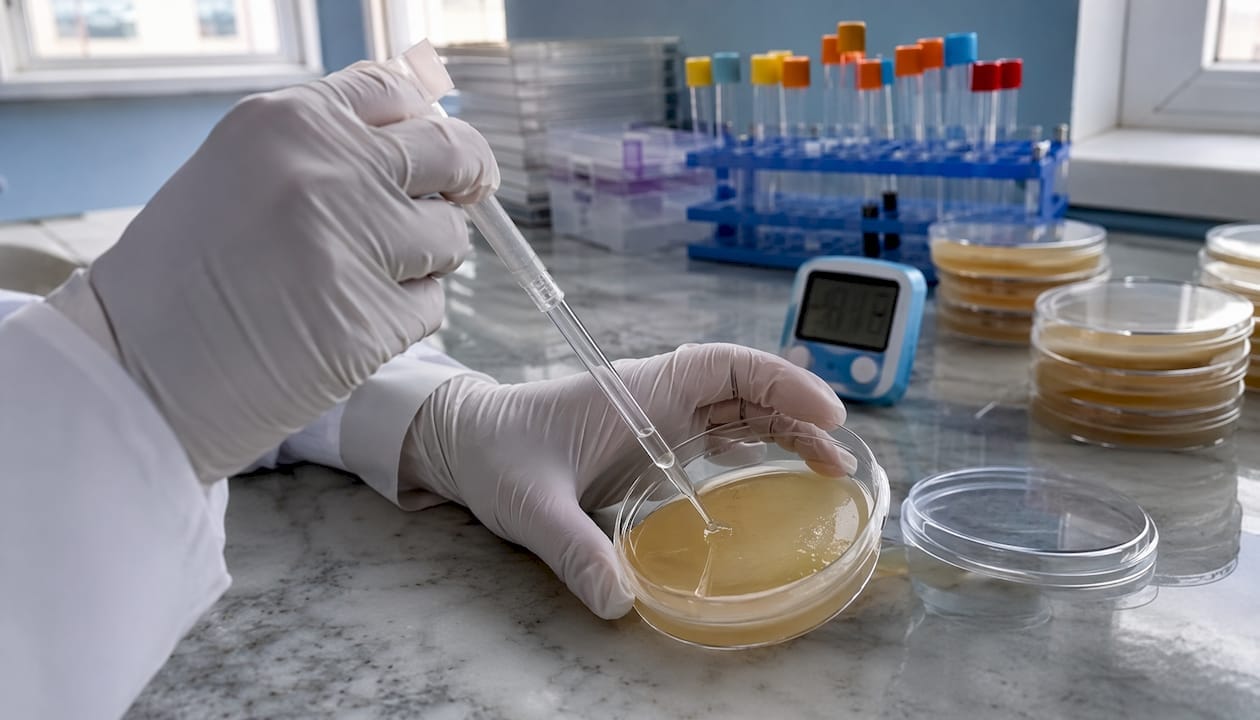
Substrate composition deserves equal attention. Small differences in carbon-to-nitrogen ratio or moisture content can shift growth outcomes significantly. Sporebuddies’ standardised mushroom substrates give UK researchers a reliable starting point for building consistent experimental conditions. Documenting every preparation step is not optional. The FAO Handbook of Mycological Methods notes that a result can only be interpreted through a thorough understanding of the method used to obtain it.
Controlling environmental variables
Humidity, light, and gas exchange critically influence fungal growth and must be recorded and held constant throughout an experiment. Many mycological studies fail to reproduce because these parameters were not monitored rigorously. Temperature fluctuations of even a few degrees can alter sporulation timing, enzyme activity, and mycelial density.
Controlled environment cultivation, including automated CO₂ regulation and accurate humidity monitoring, has shown clear improvements in fruiting body yield and quality. For laboratory experiments, a dedicated incubation chamber with logged environmental data is far preferable to a standard bench.
Pathogenicity testing and modified Koch’s postulates
When investigating fungal plant pathogens, establishing causality requires more than isolating an organism from diseased tissue. Modified Koch’s postulates, incorporating Bradford Hill criteria such as biological gradient, consistency, and plausibility, provide a structured framework for pathogenicity testing. Accurate identification also requires integrating morphology, molecular data, and controlled inoculation trials.
Quantitative severity scores, including lesion depth assessments, improve precision beyond binary infected or not-infected outcomes. This approach enables meaningful comparison across studies, which binary scoring cannot achieve.
Common pitfalls in experimental design
One of the most overlooked problems in mycological experiments is an inappropriate control. Using sterilised substrate as a control can introduce confounding variables because sterilisation alters substrate chemistry. A better approach is to treat the control substrate identically to the test substrate, removing only the specific agent under investigation.
Other frequent errors include:
- Failing to document deviations from standard protocols
- Overlooking the role of in vitro media limitations, since laboratory media do not fully replicate natural fungal environments
- Insufficient replication, which inflates the apparent significance of chance results
- Neglecting to record environmental conditions throughout the experiment
Practical fungi lab experiments illustrate how these pitfalls appear in real settings and how to design around them.
Adaptive laboratory evolution as an advanced method
Adaptive laboratory evolution is a hypothesis-free experimental approach that tests functions across the entire genome, making it particularly useful for studying complex fungal traits such as virulence and antifungal resistance. Rather than targeting a specific gene, you expose a fungal population to a defined selective pressure over many generations and then sequence the genome to identify which changes were fixed.
This method remains underused in mycology relative to its potential. Experimental evolution studies with Candida albicans and Cryptococcus neoformans have revealed unexpected genomic adaptations, including subtelomeric recombination events and mismatch repair pathway changes that increased growth at higher temperatures and improved antifungal resistance.
Landmark experiments that advanced fungal biology
Controlled experiments have repeatedly shifted our understanding of fungi. Two examples stand out:
- Early physiological studies on Claviceps purpurea used carefully controlled culture conditions to identify the carbon and nitrogen requirements for sclerotial production, establishing that sugar concentration above 3% did not improve growth.
- Explantation and transplantation experiments with Coprinus cinereus revealed fungal developmental pathways including meiosis and sporulation by surgically manipulating tissue under controlled conditions.
Both cases demonstrate that controlled experiments in fungi studies do not merely confirm existing ideas. They generate genuinely new knowledge about how fungi develop, reproduce, and respond to their environment.
Key takeaways
Controlled experiments are the most reliable method for producing valid, reproducible findings in mycological research.
| Point | Details |
|---|---|
| Controls establish baselines | Control cultures on standard media confirm that observed differences arise from the experimental variable, not ambient conditions. |
| Standardisation drives reproducibility | Consistent inoculum preparation, substrate formulation, and incubation protocols are critical for results that other researchers can replicate. |
| Environmental monitoring is non-negotiable | Humidity, light, and gas exchange must be recorded and held constant throughout every fungal experiment. |
| Quantitative scoring improves pathogenicity data | Lesion depth assessments in modified Koch’s postulate testing enable inter-study comparison beyond binary outcomes. |
| Adaptive laboratory evolution offers genome-wide insight | This hypothesis-free method reveals complex fungal traits and evolutionary trajectories without requiring a prior mechanistic hypothesis. |
FAQ
What is the purpose of a controlled experiment in mycology?
A controlled experiment isolates the effect of a single variable on fungal growth, morphology, or virulence by keeping all other conditions constant. This allows researchers to attribute observed changes to the manipulated variable rather than to chance or environmental noise.
What role does a control group play in fungal research?
The control group provides a baseline grown under standard conditions alongside the experimental group. Any difference between the two can then be confidently linked to the experimental manipulation rather than to background variation.
What are the key components of a controlled experiment in fungi studies?
The five core components are a testable hypothesis, a defined independent variable, measurable dependent variables, a control group, and sufficient replication across biological replicates to confirm that results are consistent.
Why is standardisation so important in mycological experiments?
Fungi are highly sensitive to substrate chemistry, inoculum age, and environmental conditions. Without standardised protocols, the same experiment run in two different laboratories can produce contradictory results, making findings impossible to verify or build upon.