

A mycology terminology guide is a structured reference that defines the essential scientific and practical terms used in the study, identification, and cultivation of fungi. Whether you are a student working through your first field guide or a hobbyist setting up a home grow, the vocabulary of mushroom science shapes how accurately you observe, describe, and communicate what you find. Terms like hymenium, basidiospore, and substrate are not just jargon. They are precise tools that let you read research, follow cultivation protocols, and identify specimens with confidence. This guide covers the core fungal terminology definitions you need, organised by topic, so you can build your knowledge steadily from the ground up.
What is a mycology terminology guide and why does it matter?
A mycology terminology guide is the foundation of any serious study of fungi, whether your interest lies in identification, cultivation, or scientific research. Without a shared vocabulary, describing a mushroom accurately becomes guesswork. You might say a cap is “bumpy” when the correct term is verrucose, or describe a stem as “hollow” when the precise word is fistulose. These distinctions matter enormously when you are comparing field notes, following a cultivation guide, or submitting an observation to a database like iNaturalist.
A well-designed mycology glossary uses simple, clear definitions that avoid excessive technicality, allowing easy reference without constant cross-checking. That principle guides this article. The goal is not to overwhelm you with Latin but to give you a working mycological vocabulary list that connects directly to what you see in the field and the grow room. Sporebuddies has built its educational content around exactly this approach, recognising that confident growers and researchers start with clear language.

Terminology also acts as a translation layer linking field traits, lab morphology, and taxonomy. When you know what a term means, you know where to look on a specimen and what to record. That precision is what separates a useful observation from a vague one.
What are the key anatomy terms of mushrooms and fungi?
Mushroom anatomy terms describe the physical structures of a fruiting body. Learning them gives you a reliable framework for identification and lets you follow any mycology reference materials without getting lost.
Here are the core anatomical terms you will encounter most often:
- Pileus (cap): The broad, often umbrella-shaped top of a mushroom. Its colour, shape, and surface texture are primary identification features.
- Stipe (stem): The stalk supporting the pileus. Note whether it is central, off-centre, solid, or hollow (fistulose).
- Lamellae (gills): Blade-like structures on the underside of the cap where spores are produced. Gill spacing, attachment to the stipe, and colour are all diagnostic.
- Hymenophore: The portion of the fruiting body that bears the hymenium. In gilled mushrooms this is the gill surface; in boletes it is the pore layer.
- Hymenium: The spore-bearing surface itself, a microscopic layer of cells covering the hymenophore. Understanding the difference between hymenium and hymenophore is essential because it tells you exactly which structure to examine when identifying spore characteristics.
- Annulus: A ring of tissue on the stipe, the remnant of a partial veil that once covered the gills.
- Volva: A cup-like structure at the base of the stipe, present in genera like Amanita. Recognising a volva is critical for safety.
- Pores: In boletes and bracket fungi, pores replace gills as the spore-releasing surface. Pore size, shape, and colour are key identification markers.
Surface texture terms are equally important. Glabrous means smooth; fibrillose means covered in fine fibres; squamulose means bearing small scales. These descriptors appear constantly in field guides and identification keys.
Pro Tip: When you examine a fresh specimen, always check the hymenophore type first. Knowing whether you are looking at gills, pores, teeth, or a smooth surface immediately narrows your identification to the correct fungal group.
How are fungal spores classified and what terms describe their reproduction?
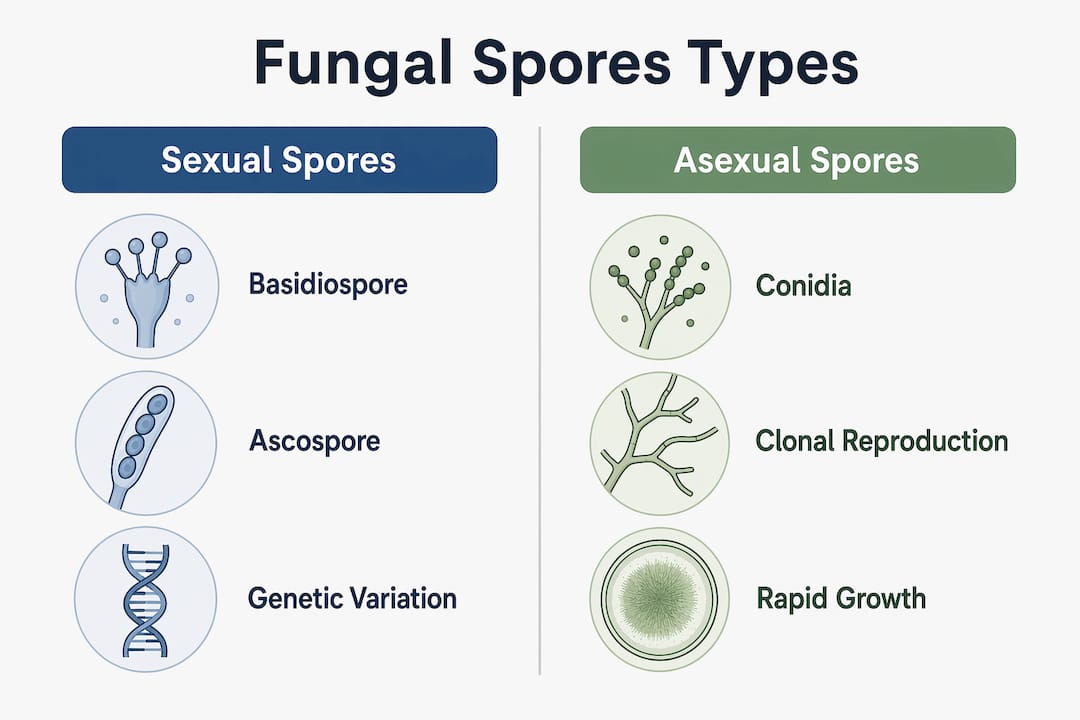
Spore terminology sits at the heart of fungal classification. The two major divisions of mushroom-forming fungi, Basidiomycota and Ascomycota, are defined by how they produce sexual spores, and understanding this distinction is central to any mycological research guide.
Sexual spores are produced through meiosis and carry genetic variation. Asexual spores are produced clonally and allow rapid colonisation of a substrate.
| Spore type | Division | Produced in/on | Key feature |
|---|---|---|---|
| Basidiospore | Basidiomycota | Basidia (club-shaped cells) | Sexual; typically 4 per basidium |
| Ascospore | Ascomycota | Asci (sac-like cells) | Sexual; typically 8 per ascus |
| Conidium | Various | Conidiophores (external) | Asexual; non-motile |
Basidiospores are sexual spores produced on basidia in basidiomycetes, while ascospores are formed within asci of ascomycetes. These two systems define the major branches of the fungal kingdom and explain why spore prints look so different between species. A spore print from a Psilocybe species, for example, will show dark purple-brown basidiospores, while a morel (Morchella) releases pale ascospores from its pitted surface.
Conidia are asexual, non-motile spores produced exogenously on specialised structures called conidiophores. Conidiogenesis, the process of conidium formation, occurs in two ways. Blastic conidiogenesis produces spores that enlarge before separating from the parent cell. Thallic conidiogenesis creates spores by forming cross-walls within existing hyphae. Conidiomata are the macroscopic structures that release conidia, and they play a significant role in how certain moulds spread through a cultivation environment.
Knowing the difference between these spore types matters practically. If you spot powdery growth on a substrate bag, you are likely seeing conidia from a contaminant mould, not the mycelium you want. Recognising that distinction early can save an entire grow.
Pro Tip: When studying spores under a microscope, note their shape descriptors: ellipsoid (oval), subglobose (nearly round), amygdaliform (almond-shaped), and verrucose (warty surface). These terms appear in every serious identification key and are worth memorising early.
Which terms relate to mushroom collection and specimen documentation?
Collecting mushrooms for study or DNA analysis requires more than a basket and a knife. Specific terminology governs how specimens are gathered, preserved, and recorded, and getting this right determines whether your sample has any scientific value.
A fungarium is the mycological equivalent of a herbarium: a curated collection of preserved fungal specimens held for research and reference. Major fungariums include those at Kew Gardens (K) and the Natural History Museum (BM). Understanding what a fungarium requires helps you prepare specimens correctly from the start.
Follow these steps to document and preserve a specimen properly:
- Collect fresh, intact material. Specimen collection for DNA barcoding requires fresh, undamaged mushrooms. Waterlogged or decomposing tissue degrades DNA rapidly and renders a sample useless for molecular study.
- Record all metadata immediately. Specimen labels should include collector name, a unique specimen number (often an iNaturalist observation ID), date of collection, and GPS coordinates. This links your physical sample to a permanent digital record.
- Photograph before collecting. Capture the cap, gills or pores, stipe base, and habitat context. Photographs record features that disappear during drying.
- Dry with silica gel. Silica gel drying preserves DNA integrity far better than air drying alone. Place the specimen in a paper bag with silica gel packets and allow it to desiccate fully before storage.
- Store in a sealed, labelled container. Use a rigid container to prevent crushing. Include a printed label inside the container as well as on the outside, since external labels can detach.
A voucher specimen is a preserved sample retained as physical evidence supporting an identification or publication. The term exsiccata refers to a set of dried specimens distributed to multiple institutions for comparative study, a practice that underpins much of historical mycology.
Pro Tip: If you plan to submit specimens for DNA barcoding, photograph the spore print on white paper before drying. Spore print colour is a key identification feature that cannot be recovered from a dried specimen.
How do cultivation and lab terms connect to fungal science?
Practical cultivation relies on a set of terms that overlap significantly with scientific mycology. Knowing this vocabulary helps you follow grow guides accurately and understand what is happening biologically at each stage.
- Mycelium: The vegetative body of a fungus, composed of thread-like cells called hyphae. Mycelium colonises a substrate by secreting enzymes that break down organic material. Healthy mycelium in cultivation appears white and rope-like (rhizomorphic) or fine and cotton-like (tomentose), depending on the species and conditions.
- Substrate: The material on which a fungus grows. Common cultivation substrates include sterilised brown rice flour and vermiculite (BRF/verm), hardwood sawdust, straw, and coco coir. Substrate choice directly affects yield and contamination risk. Sporebuddies stocks a range of mushroom substrates suited to different species and experience levels.
- Mycorrhiza: A symbiotic relationship between fungal mycelium and plant roots. Mycorrhizal species like Amanita muscaria and Boletus edulis cannot currently be cultivated in isolation because they depend on a living host plant. This is why most cultivated species, such as oyster (Pleurotus ostreatus) and lion’s mane (Hericium erinaceus), are saprotrophic rather than mycorrhizal.
- Agar: A gel medium derived from seaweed, used in Petri dishes to culture and isolate fungal strains. Agar work allows you to observe mycelial growth, identify contamination, and clone desirable genetics.
- Spore syringe: A suspension of spores in sterile water, used to inoculate substrates or agar plates. Spore syringes are the standard starting point for most home cultivation projects and microscopy work.
| Term | Definition | Cultivation relevance |
|---|---|---|
| Mycelium | Vegetative hyphal network | Colonises substrate before fruiting |
| Substrate | Growth medium | Determines yield and contamination risk |
| Agar | Gel culture medium | Used for isolation and cloning |
| Spore syringe | Spore suspension in water | Primary inoculation method |
| Rhizomorphic | Rope-like mycelial growth | Often indicates vigorous, healthy colonisation |
Understanding these terms also connects you to the broader science. When you read about mycology supplies in research, the vocabulary you have built here makes those resources immediately accessible rather than intimidating.
Key takeaways
Mastering mycology terminology gives you the precise language to identify, cultivate, and study fungi accurately, connecting field observation to scientific understanding.
| Point | Details |
|---|---|
| Anatomy terms are your first tool | Learn pileus, stipe, hymenium, and hymenophore before anything else to anchor all further study. |
| Spore type defines fungal division | Basidiospores and ascospores distinguish the two major mushroom-forming groups; conidia signal asexual reproduction. |
| Metadata is part of the specimen | A preserved mushroom without collector name, date, and GPS coordinates has limited scientific value. |
| Substrate choice shapes your grow | Matching substrate to species biology is as important as inoculation technique for successful cultivation. |
| Clear definitions reduce costly errors | Confusing conidiomata with healthy mycelium, or hymenophore with hymenium, leads to misidentification and failed grows. |
Start your grow with the right equipment from Sporebuddies
Understanding the vocabulary of mycology is the first step. Putting it into practice requires the right materials. Sporebuddies stocks a full range of mushroom growing equipment suited to beginners and experienced cultivators alike, from sterilised substrates and agar plates to spore syringes and microscopes. Every product is selected to support the kind of careful, informed cultivation that a solid grounding in fungal terminology makes possible. Whether you are setting up your first grow or expanding into microscopy and research, you will find reliable supplies ready to order across the UK.
FAQ
What does a mycology terminology guide include?
A mycology terminology guide covers the key scientific and practical terms used in fungal study and cultivation, including anatomy terms, spore classification vocabulary, and collection and preservation language. It is designed to help beginners and students read field guides, follow cultivation protocols, and communicate observations accurately.
What is the difference between hymenium and hymenophore?
The hymenophore is the region of the fruiting body that bears the hymenium, while the hymenium is the actual spore-bearing surface layer. In gilled mushrooms, the lamellae form the hymenophore and the hymenium covers their surfaces.
What are basidiospores and ascospores?
Basidiospores are sexual spores produced on club-shaped basidia in basidiomycetes such as Agaricus and Psilocybe species. Ascospores are sexual spores formed inside sac-like asci in ascomycetes such as morels and truffles. These two spore systems define the two major groups of higher fungi.
What is a fungarium?
A fungarium is a curated collection of preserved fungal specimens used for scientific reference and research, equivalent to a herbarium for plants. Major UK fungariums include those held at Kew Gardens and the Natural History Museum in London.
What metadata should I record when collecting a mushroom specimen?
You should record your name, a unique specimen number, the date of collection, and GPS coordinates for the location. This information links your physical specimen to digital records and is required for DNA barcoding and formal scientific study.