
Most home cultivators assume mushroom genetics is something reserved for university labs or commercial breeders. In reality, the genetic makeup of your chosen strain directly determines what ends up in your grow bag: how quickly it fruits, how resistant it is to contamination, and even how it tastes. Whether you’re growing oyster mushrooms on straw or experimenting with shiitake on hardwood logs, understanding the basics of fungal genetics gives you a genuine edge. This guide walks you through what mushroom genetics actually means, how it shapes your results, and what practical steps you can take to apply this knowledge in your own setup.
Table of Contents
- What does mushroom genetics mean?
- How do genetic traits shape mushroom cultivation?
- Key breeding strategies for the home cultivator
- Recent advances: Genetics, AI and the future of mushroom breeding
- A fresh perspective: Why simplicity beats complexity in home mushroom genetics
- Take your cultivation further with expert resources
- Frequently asked questions
Key Takeaways
| Point | Details |
|---|---|
| Genetics drives cultivation success | Even home growers benefit from understanding genetic traits, as they impact yield, flavour, and disease resistance. |
| Simple techniques deliver results | Basic breeding methods like spore crossing and mycelial fusion can create new mushroom varieties at home. |
| AI is changing mushroom breeding | Artificial intelligence makes it easier and faster to select strains with superior qualities for future cultivation. |
| Native strains support sustainability | Growing native mushroom varieties outdoors helps protect ecosystems and encourages responsible cultivation in the UK. |
What does mushroom genetics mean?
Mushroom genetics is not just an academic subject. Mushroom genetics refers to the study of genetic traits, mating systems, and breeding methods in fungi like Agaricus bisporus and Pleurotus ostreatus, two of the most widely cultivated species in the world. For home growers, this translates into understanding why one strain fruits faster, why another resists contamination better, and how you might combine these qualities through breeding.
To get comfortable with the topic, a few key terms are worth knowing:
- Hyphae: The thread-like filaments that form the body of a fungus. Think of them as the building blocks of mycelium.
- Plasmogamy: The first stage of sexual reproduction, where two compatible hyphae fuse and share their cytoplasm.
- Karyogamy: The second stage, where the nuclei from both parent cells merge to create a new genetic combination.
- Heterokaryosis: A state where a single fungal cell contains genetically different nuclei, which is common in mushrooms and allows for enormous genetic flexibility.
Mating systems matter enormously here. Unlike plants, most mushrooms do not simply have male and female types. Instead, they use a multi-allele mating system, meaning hundreds of compatible mating types can exist within a single species. This is what makes mushroom breeding so interesting and, at times, so unpredictable.
Traits like yield, disease resistance, and flavour are all heritable. When you select a strain for cultivation, you are, in effect, making a genetic choice.
For a broader grounding in fungal science basics, it helps to understand how these principles connect across different species. Research into Agaricus bisporus studies continues to reveal just how much genetic variation exists even within a single commercially grown species, which has direct implications for home breeders looking to improve their stock.
How do genetic traits shape mushroom cultivation?
Once you understand the basic genetic principles, you can see how these shape the mushrooms you grow. Every trait you care about as a cultivator, from fruiting speed to flavour intensity, has a genetic basis. Breeding involves selecting compatible strains for mycelial fusion to combine traits like yield, disease resistance, and flavour, which means you have real influence over what your next generation of mushrooms looks like.
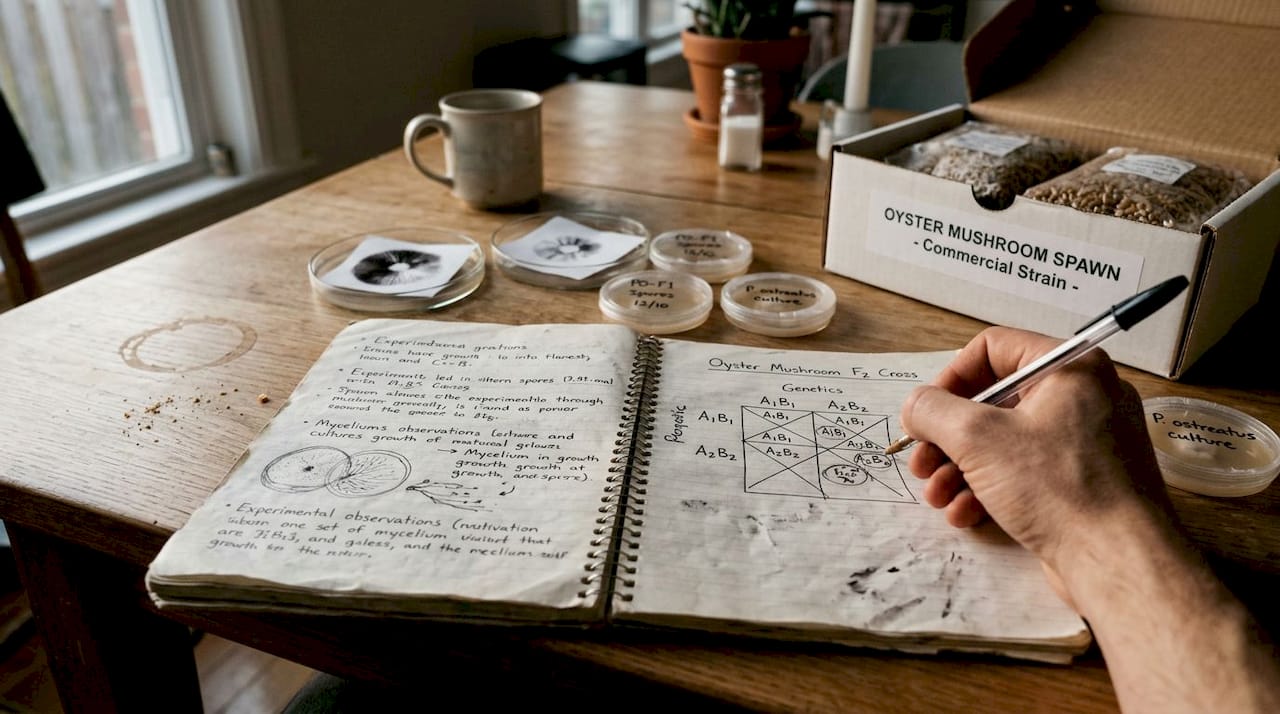
One of the most exciting concepts in mushroom breeding is hybrid vigour, also called heterosis. This is when a hybrid offspring outperforms both of its parent strains, producing more mushrooms, growing faster, or tolerating stress better. It is not guaranteed, but it is well documented. Hybrid oysters show mitonuclear interactions and can outperform parents, which suggests that compatibility between the mitochondria and the nucleus plays a key role in whether a hybrid thrives.
Here is a quick overview of key traits and why they matter:
| Trait | Species example | Why it matters for home growers |
|---|---|---|
| Yield | Agaricus bisporus | More mushrooms per flush, better value |
| Disease resistance | Pleurotus ostreatus | Fewer failed grows, less contamination |
| Flavour profile | Lentinula edodes (shiitake) | Better eating quality |
| Fruiting speed | Pleurotus hybrids | Faster harvests, more cycles per year |
| Temperature tolerance | Various | Flexibility in growing conditions |
Genetics also connects to the wider wellness benefits of mushrooms. Certain compounds, like beta-glucans in lion’s mane, are more concentrated in specific strains, meaning genetic selection can influence nutritional quality as well as yield. Pairing strong genetics with good substrate optimisation is where real gains happen.
Pro Tip: Always test new hybrids on a small batch before scaling up. A promising cross on paper can behave unpredictably in your specific growing environment.
Key breeding strategies for the home cultivator
Having covered how genetics influence cultivation results, let’s look at practical ways you can experiment with breeding at home. The two main approaches available to home cultivators are spore crossing and mycelial fusion. Both are achievable without a professional lab, but both require care.
Home cultivators can breed by spore crossing or mycelial fusion, but success requires compatible mating types and sterile conditions. Here is a simplified overview of each approach:
- Spore crossing: Collect spores from two different strains and allow them to germinate on agar. If compatible mating types meet, they will fuse and begin forming a new heterokaryon. This is the most accessible method for beginners.
- Mycelial fusion: Take two established mycelial cultures and place them on the same agar plate. If they are compatible, the mycelia will merge rather than form a barrier zone between them. This method can be faster but requires you to already have healthy cultures.
- Strain selection: Before you start, research which strains are known to be genetically compatible. Not all combinations will work, and choosing wisely saves time and materials.
- Documentation: Keep detailed notes on every cross you attempt, including the parent strains, the date, and the outcome. This is what separates methodical breeders from those who get lucky once.
Common mistakes to avoid:
- Skipping sterile technique, which leads to contamination before the cross can take hold
- Using genetically unstable or old cultures as parent strains
- Scaling up too quickly before confirming the hybrid performs well
- Ignoring mating type compatibility, which results in no fusion at all
For UK growers interested in outdoor cultivation, using native strains is strongly recommended to avoid introducing non-native genetics into local ecosystems. Pair this with solid practice in avoiding contamination to protect both your grow and the surrounding environment.
Pro Tip: Select native strains for outdoor growing to support sustainability and reduce ecological risk in your local area.
Recent advances: Genetics, AI and the future of mushroom breeding
If you want to push your cultivation further, it’s helpful to know where the science is heading. The biggest shift in mushroom genetics research right now is the use of artificial intelligence to process large datasets of genetic information. AI supports breeding with genotype-phenotype mapping and GWAS (genome-wide association studies), which means researchers can now identify which specific genetic markers are linked to desirable traits far more quickly than traditional methods allow.
For home cultivators, this matters because the tools and knowledge being developed at the research level tend to filter down over time. Here is how classic and AI-assisted breeding compare:
| Approach | Method | Speed | Accessibility |
|---|---|---|---|
| Classic breeding | Trial and error, visual selection | Slow | High |
| Marker-assisted selection | SSR/SNP markers to guide crosses | Moderate | Moderate |
| AI-assisted breeding | Genotype-phenotype mapping, GWAS | Fast | Currently low |
Research into yield improvements using these techniques has reported gains of 20 to 30 percent in some commercial mushroom trials, which is significant when you consider that even a modest improvement in your home setup means more mushrooms per flush. The mushroom genetics tools available to home growers are already improving as a result of this research, with better-characterised strains becoming more widely available.
What should you watch for in the next few years? Expect more commercially available strains with documented genetic profiles, easier access to agar-based selection kits, and community databases where home cultivators can share breeding results. The gap between lab science and home growing is narrowing.
A fresh perspective: Why simplicity beats complexity in home mushroom genetics
There is a temptation, once you start learning about genetics, to attempt the most complex crosses possible. We see it regularly: enthusiastic growers trying to combine four or five traits at once, using unstable cultures, and then wondering why their results are inconsistent. The honest truth is that complexity rarely pays off at the home scale.
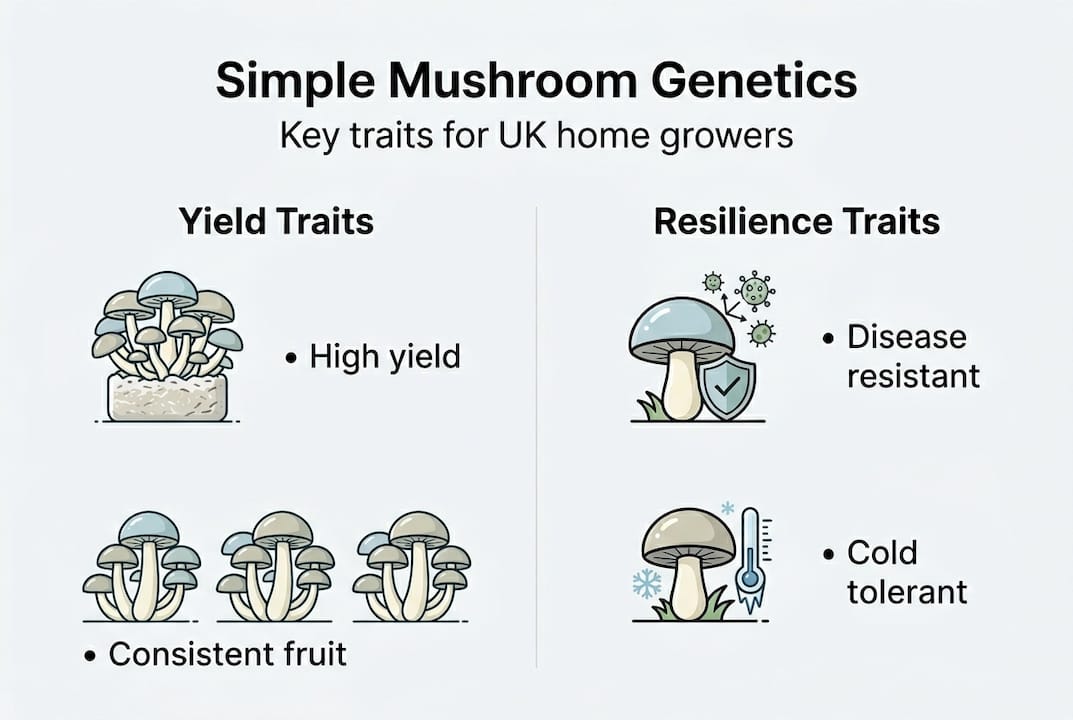
The most reliable results come from focusing on two or three well-understood traits, using tested parent strains, and maintaining rigorous sterile practice throughout. A single successful cross that fruits consistently is worth far more than ten ambitious experiments that produce nothing usable. Genetic novelty is exciting, but reliability is what makes home cultivation genuinely satisfying.
Simple, methodical experimentation is where the best breakthroughs happen. Document everything, repeat what works, and resist the urge to overcomplicate. Our safety-first guides reinforce this philosophy: build a solid foundation before pushing boundaries. The cultivators who make the most progress are rarely the ones chasing the most exotic genetics. They are the ones who understand what they have and work with it carefully.
Take your cultivation further with expert resources
If you’re excited to experiment with mushroom genetics or want more in-depth guidance, having the right resources makes all the difference. At Spore Buddies, we stock a wide range of products designed to support you from your first grow to your first successful cross. Whether you’re looking for proven strains, sterile substrates, or agar supplies, you’ll find everything in one place. Explore our mycology supplies to get set up properly, or visit our deeper genetics courses to build your knowledge alongside your practical skills. Start simple, document your results, and let the science guide you forward.
Frequently asked questions
Can I breed new mushroom varieties at home?
Yes, home cultivators can breed new mushroom varieties through spore crossing or mycelial fusion, but sterile technique and compatible strains are essential for success.
What role does AI play in mushroom genetics?
AI aids breeding via genotype-phenotype mapping and GWAS, helping breeders select strains with better traits and making advanced breeding faster and more accessible.
Is it better to grow native mushroom strains outdoors in the UK?
Yes, native strains are recommended for outdoor UK growing as they reduce ecological risk and align with sustainability guidance from organisations like the RHS.
Why do some mushrooms outperform their parents?
Some hybrids display hybrid vigour (heterosis), often because of mitonuclear compatibility, which results in higher yields or better disease resistance compared to either parent strain.
How does woodland age affect wild mushroom genetics?
Genetic diversity decreases with woodland age in Boletus edulis due to increased competition among closely related individuals, which reduces variation within local populations.