
Quick Answer
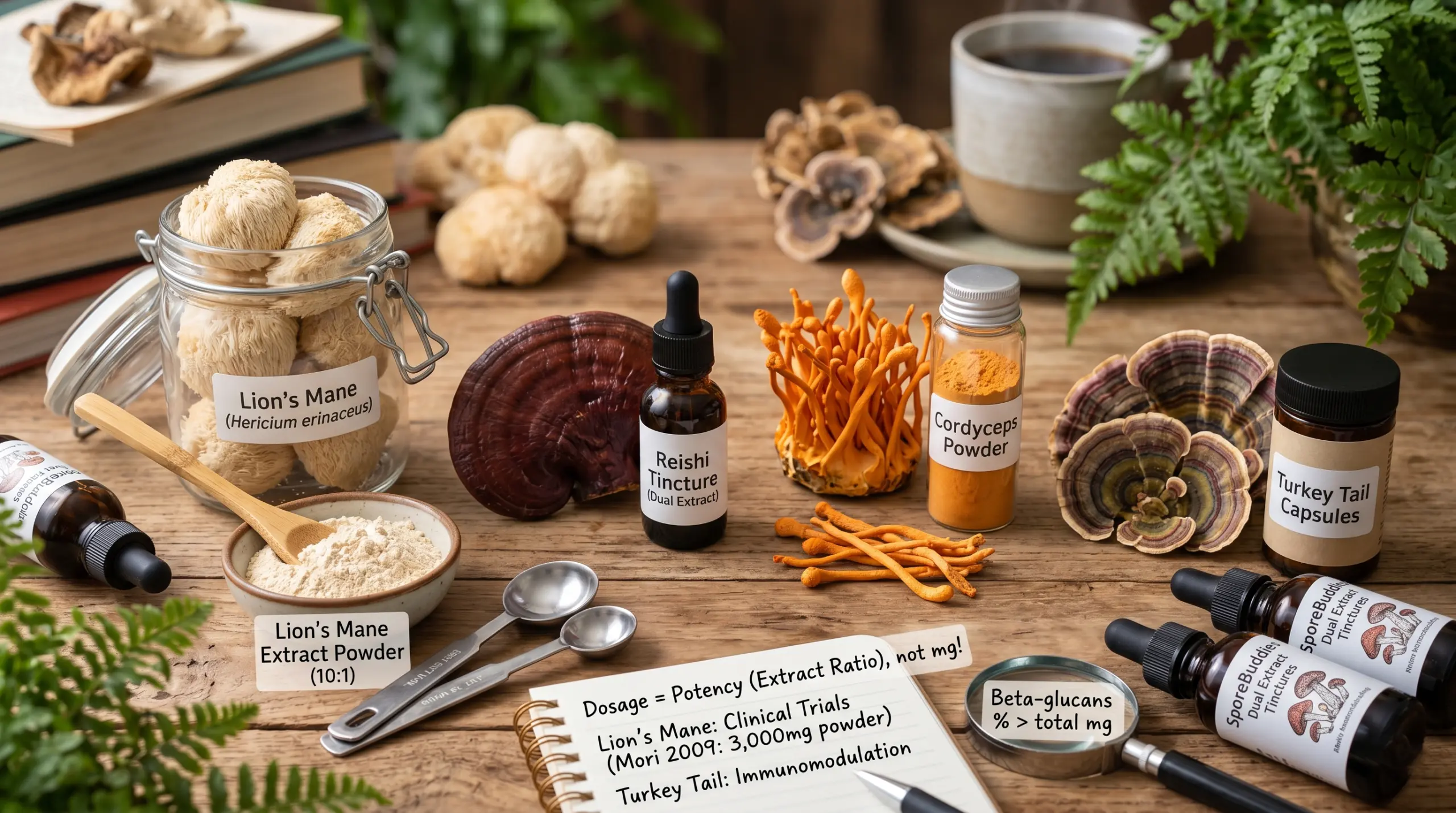
Dosage varies by species and format. Lion’s Mane: 1,000–3,000mg of whole mushroom powder or 500–1,000mg of concentrated extract daily. Reishi: 1.5–9g of dried mushroom or 1–1.5g of extract daily. Cordyceps: 1–3g of extract daily. Turkey Tail: 1–3g of extract or 3–4g of whole mushroom powder daily. The format matters as much as the number on the label. SporeBuddies stocks a range of functional and gourmet mushrooms in formats designed for consistent daily use.
Why Dosage Is More Complicated Than It Looks
The most common mistake when buying functional mushrooms is treating the milligram figure on a label as an absolute measure of potency. It is not.
The same 500mg can represent very different amounts of active compounds depending on whether the product is a whole dried mushroom, a single extraction, or a concentrated dual extract. A 10:1 extract at 500mg delivers the bioactive equivalent of approximately 5,000mg of whole mushroom. A standard dried powder at 500mg delivers 500mg of material, of which only a fraction is bioavailable.
This guide breaks down dosage by species and by format, grounded in what clinical trials actually used. It also covers timing, cycling, and how to adjust based on your goals.
Why This Matters
Getting the dose wrong in either direction wastes money or produces no result. Underdosing is the more common problem. Knowing what the research used gives you a reliable anchor to work from.
Understanding the Formats
Before looking at per-species dosage, it helps to understand the three main formats and how they compare.
Whole dried mushroom: The fruiting body is simply dried and powdered. No extraction. Lower bioavailability. Requires higher doses to deliver equivalent active compounds to an extract.
Single extraction (hot water or alcohol): Hot water extraction concentrates beta-glucans. Alcohol extraction concentrates triterpenoids. Each captures one class of compound. Better than powder alone, but not as comprehensive as dual extraction.
Dual extraction: Uses both hot water and alcohol to capture the full compound profile. The most bioavailable format. Standard concentration ratios are 8:1 to 10:1, meaning 500mg of a 10:1 extract is equivalent to approximately 5,000mg of raw mushroom material.
Tinctures: Liquid dual extracts designed for sublingual use. Held under the tongue for 60 seconds before swallowing, they bypass digestion and enter the bloodstream faster. SporeBuddies stocks a range of health mushroom tinctures produced using dual extraction for maximum bioavailability.
Pro Tip: When comparing products, look for the extraction ratio and the beta-glucan percentage rather than just the milligram count. A product listing 30% beta-glucans at 500mg delivers more active compounds than an unlabelled 1,000mg powder of unknown concentration.
Lion’s Mane (Hericium erinaceus) Dosage
What Clinical Trials Used
The most widely cited trial, Mori et al. (2009), used 3,000mg per day of whole dried fruiting body powder (four 250mg tablets taken three times daily) for 16 weeks in adults aged 50–80 with mild cognitive impairment. Significant cognitive improvements were recorded at weeks 8, 12, and 16.
The 2023 Docherty study published in Frontiers in Psychology used 1,800mg per day of a concentrated extract in healthy adults aged 18–45 and found significant improvements in processing speed and working memory within 28 days. Read the study on PMC.
Saitsu et al. (2019), published in Biomedical Research, used 3,200mg per day in adults over 50 and found cognitive function improvements over 12 weeks. Read the study on PubMed.
Practical Dosage by Format
| Format | Starting Dose | Target Dose | Notes |
| Whole dried mushroom | 500mg | 1,500–3,000mg | Split across two doses |
| Powder extract (8:1) | 300–500mg | 500–1,000mg | More potent per gram |
| Dual extract tincture | 0.5ml | 1–2ml | Sublingual for fastest absorption |
Timing
Lion’s Mane is best taken in the morning or early afternoon. The cognitive benefits (focus, processing speed, mental clarity) are most useful during waking hours. It is not sedating, and some users find it mildly activating, making evening dosing less suitable for those sensitive to stimulation.
Taking it with food reduces the small risk of digestive discomfort that some people experience when starting out.
How Long Before Results
Most users report subjective improvements in focus and clarity within two to four weeks. The deeper neuroprotective and memory-support effects described in clinical trials became measurable at eight weeks and continued building through 16 weeks. Importantly, the Mori 2009 trial showed that benefits reversed within four weeks of stopping, which underlines the importance of consistent daily use rather than occasional supplementation.
SporeBuddies Products
SporeBuddies’ dried Lion’s Mane mushrooms are whole fruiting body, organically grown, and available from 25g. For those wanting a more concentrated daily dose, the Lion’s Mane tincture FAQ covers dosing, timing, and how to use the dual extract tincture correctly. Those who prefer to grow their own can start with Lion’s Mane liquid culture.
Reishi (Ganoderma lucidum) Dosage
What Clinical Trials Used
Clinical research on Reishi uses a wide dose range because different product forms have very different potencies. A systematic review and meta-analysis of clinical trials published on NCBI examined Ganoderma lucidum supplementation ranging from 200mg to 11,200mg per day across one to 24 week periods. Read the review on PMC.
The Pharmacopoeia of the People’s Republic of China recommends 6–12g of Reishi extract daily. Ganopoly (a standardised polysaccharide extract) at doses up to 5.4g daily (equivalent to approximately 81g of fruiting body) has been used in clinical trials and is referenced in the NCBI Bookshelf Ganoderma lucidum monograph.
A 2023 randomised, double-blind, placebo-controlled trial published in Foods used Reishi beta-glucan supplementation over 84 days and found significant immune modulation including increases in T-lymphocyte populations and natural killer cell activity. Read the full study on PMC.
Practical Dosage by Format
| Format | Starting Dose | Target Dose | Notes |
| Crude dried mushroom | 1.5–3g | 6–9g | Typically prepared as a tea |
| Powder (basic extract) | 1–1.5g | 1.5–5g | Split across two to three doses |
| Dual extract tincture | 0.5ml | 1ml | Sublingual preferred |
Timing
Reishi is distinctly bitter and is rarely eaten whole. Most people take it as a tincture, powder in coffee or cacao, or as a tea. Unlike Lion’s Mane, Reishi has mild sedative-adjacent properties at higher doses and is often taken in the evening to support sleep quality and stress recovery. Some users take a morning dose for immune support and a smaller evening dose for sleep.
How Long Before Results
Reishi is the slowest-acting of the four species covered in this guide. Its adaptogenic effects on stress, sleep, and immune regulation tend to become noticeable after eight to twelve weeks of consistent daily use. Short-term trials often show limited effects because the mechanisms involved require prolonged exposure to build.
Patience is not optional with Reishi. Users who stop after two or three weeks having noticed nothing are almost always underdosing or stopping before the compound window has opened.
Cordyceps (Cordyceps militaris) Dosage
What Clinical Trials Used
The performance and endurance trial by Hirsch et al. (2016), published in the Journal of Dietary Supplements, used 4g per day of a Cordyceps militaris containing mushroom blend for three weeks and found significant improvements in VO2max and time to exhaustion. Read the study on PubMed.
A PMC-indexed review of Cordyceps dosage in clinical studies found that 1–3g per day is the most common range used across trials, with most supplements containing 600–1,000mg per capsule. One study used 1.2g three times daily for three months with no reported safety concerns. Read the PMC review.
A 2024 randomised controlled trial published in Scientific Reports used a Cordyceps beverage for eight weeks and found significant increases in natural killer cell activity in healthy adults. Read the study on PubMed.
Practical Dosage by Format
| Format | Starting Dose | Target Dose | Notes |
| Whole dried powder | 1g | 2–4g | Split across two doses |
| Extract (standardised) | 500mg | 1–2g | Check cordycepin content |
| Pre-workout blend | Per product label | Per product label | Typically taken 30–60 min before exercise |
Timing
Cordyceps is an energising species. Most users take it in the morning or 30–60 minutes before exercise. Taking it late in the day can interfere with sleep quality in those sensitive to stimulating compounds.
For athletic performance goals, timing Cordyceps around training sessions is supported by the mechanism: cordycepin activates AMPK (a master cellular energy sensor) and supports oxygen utilisation, which is most relevant during periods of physical exertion.
How Long Before Results
Energy and exercise tolerance improvements are typically noticed within one to two weeks. The VO2max improvements recorded in the Hirsch 2016 trial developed over three weeks of consistent supplementation. Results compound with continued use.
UK Legal Note
Cordyceps militaris as a supplement is classified as a novel food in the UK. Confirm that any Cordyceps product you purchase comes from a compliant supplier with appropriate authorisation for sale for consumption. See our mushroom spore types and legality guide for more on UK novel food classifications.
Turkey Tail (Trametes versicolor) Dosage
What Clinical Trials Used
The most rigorous human dosage data for Turkey Tail comes from cancer adjuvant research. In Japan, PSK has been approved as a pharmaceutical-grade adjunct therapy since the 1970s and is typically dosed at 3g per day alongside conventional treatment. A meta-analysis of eight randomised controlled trials covering 8,009 patients found significant survival benefit from PSK in gastric cancer patients receiving adjuvant immunochemotherapy. Read the meta-analysis on PMC.
A Phase 1 breast cancer clinical trial at Bastyr University tested doses of 3g, 6g, and 9g per day of Turkey Tail extract for six weeks. All doses were well tolerated and produced increased levels of cancer-fighting immune cells, with the highest response seen at 6g. This is referenced in the NCI Medicinal Mushrooms PDQ on NCBI Bookshelf.
For general immune and gut health purposes outside of cancer-adjacent protocols, a 2014 randomised clinical trial published in Gut Microbes used 3,600mg per day of PSP from Turkey Tail and found it acted as a prebiotic, producing clear and consistent changes to gut microbiome composition in healthy volunteers.
Practical Dosage by Format
| Format | Starting Dose | Target Dose | Notes |
| Whole mushroom powder | 1.5–2g | 3–4g | Lower bioavailability; higher dose needed |
| Hot water extract | 1g | 2–3g | Concentrates beta-glucans and PSK/PSP |
| Turkey Tail tea | 1–2g dried per cup | 2–3 cups daily | Traditional and highly accessible method |
Timing
Turkey Tail has no stimulating or sedating properties, making it flexible in terms of timing. Most people take it once or twice daily with meals. Turkey Tail tea is one of the most practical and accessible methods: simmer 1–2g of dried fruiting body pieces in water for 20–30 minutes, strain, and drink. This extracts the water-soluble compounds effectively without requiring capsules or powders.
How Long Before Results
Turkey Tail’s immune modulation effects build over consistent use. Most protocols recommend at least eight to twelve weeks before evaluating results. Gut microbiome changes from PSP have been documented within a few weeks of consistent use, but immune marker improvements take longer to accumulate.
UK Legal Note
Turkey Tail is classified as a novel food in the UK. The same compliance requirement applies as with Cordyceps. Always confirm your supplier has the appropriate authorisation for sale for consumption before purchasing.
Dosage Quick Reference
| Species | Whole Powder Daily | Extract Daily | Tincture Daily | Onset |
| Lion’s Mane | 1,500–3,000mg | 500–1,000mg | 1–2ml | 2–8 weeks |
| Reishi | 1.5–9g | 1–1.5g | 1ml | 8–12 weeks |
| Cordyceps | 2–4g | 1–2g | Per product | 1–3 weeks |
| Turkey Tail | 3–4g | 1–3g | 1ml | 4–12 weeks |
Starting Out: A Sensible Protocol
If you are new to functional mushrooms, the following approach reduces the risk of digestive discomfort and helps you assess what is working.
Week 1 and 2: Start at half the target dose. Take with food. Note energy levels, sleep quality, and any digestive response.
Week 3 and 4: Increase to the target dose if there are no adverse effects. Continue taking with food.
Week 5 onwards: Maintain the target dose consistently. Assess results at the eight-week mark for species with longer onset windows (Reishi, Turkey Tail).
Do not stack multiple new species simultaneously if you are just starting out. Introduce one species at a time over two to three weeks, then add a second if desired. This makes it easier to understand what each species is contributing.
Common Dosage Mistakes
- Using milligrams as the only measure A 500mg listing means nothing without knowing the extraction ratio and beta-glucan content. Always look for standardised markers on the label.
- Using mycelium-on-grain products and assuming full-strength dosing Mycelium grown on grain substrates contains significant starch content. The actual fungal material and active compound concentration is far lower than whole fruiting body products at the same milligram count. Fruiting body products require lower doses to achieve equivalent active compound delivery.
- Inconsistent dosing Missing doses regularly or taking supplements only on some days significantly reduces efficacy. The clinical benefits from Lion’s Mane and Reishi in particular require sustained daily use. Treat functional mushrooms like a daily habit rather than an occasional supplement.
- Stopping too early The most common reason people report that functional mushrooms did not work is stopping before the compound window. Eight weeks is the minimum for most species. Twelve weeks is more reliable for Reishi and Turkey Tail.
- Taking Cordyceps or Reishi in the evening Cordyceps is activating and can disrupt sleep in sensitive individuals if taken late in the day. Reishi at high doses may produce the opposite effect. Know your species before choosing a dosing time.
- Not adjusting dose for format Switching from a whole powder to a concentrated extract without adjusting the dose down is a common waste of product. A 10:1 extract at 500mg is delivering the equivalent of 5,000mg of powder. You do not need to maintain the same milligram count when switching formats.
- Combining with medications without checking interactions Reishi may increase bleeding time and is not recommended for those taking anticoagulant medications. Lion’s Mane may interact with medications that affect blood glucose. Always consult a healthcare professional before beginning functional mushroom supplementation if you are on prescription medication.
- Expecting tinctures and powders to behave identically Tinctures administered sublingually enter the bloodstream faster and may produce more immediate effects. Powders mixed into food or drink are processed through digestion, which slows absorption. Neither format is superior in all situations; they suit different goals and lifestyles.
Tincture Dosing: A Closer Look
Tinctures are the most concentrated and fastest-acting format for functional mushroom supplementation. They are particularly well suited to Lion’s Mane (where speed of cognitive effect is relevant) and Reishi (where the triterpenoids require alcohol extraction to capture properly).
For sublingual administration:
- Hold the dose under the tongue for 60 seconds before swallowing
- Do not eat or drink immediately before taking a sublingual dose
- Start with half a dropper and increase to a full dropper after one week if no adverse effects are noted
- Mix into water, coffee, or tea if the taste is difficult to manage sublingually
Standard tincture dosing is typically 1ml per day (one full dropper). For Lion’s Mane, some users increase to 2ml daily after four weeks without adverse effects. Always read the product-specific guidance and stay within recommended daily amounts.
Browse the full health mushroom tinctures range at SporeBuddies, or see the detailed Lion’s Mane tincture FAQ for guidance on dosage, timing, and what to expect.
Cycling: Should You Take Breaks?
There is no strong clinical evidence mandating cycling (taking breaks from functional mushrooms). The Mori 2009 Lion’s Mane trial showed that cognitive benefits reversed after stopping, suggesting continuous use rather than cycling is more appropriate for that species.
Some practitioners recommend a five-day-on, two-day-off approach or a monthly break of one week, primarily for psychological reasons (maintaining the body’s baseline response) rather than clinical necessity.
For Reishi in particular, the immune-modulating effects take eight to twelve weeks to develop. Stopping and starting reduces the total accumulated benefit. Continuous daily use is the most evidence-consistent approach.
Functional Mushrooms and UK Law
Understanding which species are legal and in what form matters for UK buyers.
Lion’s Mane fruiting body: Legal as food and supplement. No authorisation required.
Reishi fruiting body: Legal as food. Not classified as novel food in fruiting body form.
Cordyceps militaris: Novel food status in the UK. Supplement products require authorisation for sale for consumption. Confirm compliance with your supplier.
Turkey Tail: Novel food status in the UK. Same compliance requirement as Cordyceps applies.
For more on UK mushroom legality, including the distinction between gourmet, functional, and controlled species, see the practical guide to legal mushroom cultivation in the UK.
Frequently Asked Questions
Can I take all four species together?
Yes. There are no known adverse interactions between Lion’s Mane, Reishi, Cordyceps, and Turkey Tail. Many people combine two or three species to address different goals simultaneously. The most common combination is Lion’s Mane with Reishi, covering cognitive support alongside immune and stress modulation.
Does cooking reduce the active compounds in Lion’s Mane?
Cooking dried Lion’s Mane does not significantly degrade hericenones or beta-glucans. Adding it to soups, broths, and stir-fries remains an effective consumption method. See the eating Lion’s Mane guide for practical preparation ideas.
Is higher always better for dosage?
No. Clinical trials show that the performance improvements from Cordyceps, for example, were not significantly better at higher doses beyond the effective range. More is not always more. Working within the evidence-backed range is the most reliable approach.
How do I know if the dose I am taking is working?
Track a small number of markers relevant to your goal before starting (sleep quality, focus rating, energy during exercise). Reassess at four weeks and again at eight weeks. Subjective self-reporting is imprecise but gives you a baseline to compare against.
Is it safe to take functional mushrooms long-term?
Lion’s Mane extract has been studied at up to one year with no serious adverse events. Reishi at standard doses has been used for decades in traditional medicine and is considered well tolerated. Turkey Tail’s PSK has a 30-year clinical track record in Japan at therapeutic doses. All four species are considered safe for long-term daily use within recommended ranges for healthy adults without contraindicated conditions.
What if I am pregnant or breastfeeding?
There is insufficient clinical data to confirm safety during pregnancy or breastfeeding for any of the four species covered in this guide. Consult a qualified healthcare professional before supplementing.
Pro Tips Summary
- Match your dose to the format, not just the milligram count on the label
- Look for standardised beta-glucan percentages and extraction ratios rather than raw milligrams
- Introduce one new species at a time over two to three weeks
- Take Lion’s Mane and Cordyceps in the morning; consider Reishi in the evening
- Assess results at eight weeks minimum, twelve weeks for Reishi and Turkey Tail
- Consistent daily dosing outperforms higher occasional doses every time
- Dual extraction tinctures offer the most comprehensive compound profile in the smallest volume
Explore SporeBuddies’ Functional Mushroom Range
SporeBuddies is rated 4.6 stars on Trustpilot (138+ reviews) and 4.9 stars on Yotpo (190+ reviews).
- Dried Lion’s Mane (whole, fruiting body) from £8.99
- Health mushroom tinctures (dual-extracted for maximum bioavailability)
- Dried functional mushrooms range (whole fruiting body, organically grown)
- Lion’s Mane liquid culture (grow your own at home)
- Full functional and gourmet mushrooms range
Have a question about dosage or which product is right for your goals? Call free on 0800 [number]. The SporeBuddies team is happy to help.
Related Guides
- Functional Mushroom Benefits Guide: Lion’s Mane, Reishi, Cordyceps and More
- Lion’s Mane Tincture Benefits: Frequently Asked Questions
- Eating Lion’s Mane Mushrooms: A Personal Journey
- Mushroom Cultivation Trends 2026: UK Home Grower’s Guide
- A Practical Guide to Legal Mushroom Cultivation in the UK
- Popular Mushroom Spore Types for UK Home Cultivation
This guide is for educational purposes only and does not constitute medical advice. Always consult a qualified healthcare professional before beginning any supplementation protocol, particularly if you are taking prescription medications or have an underlying health condition.