
Quick Answer
Chaga (Inonotus obliquus) is a dark, crusty fungal growth found mainly on birch trees and traditionally brewed as a tea. Most research so far is laboratory and animal work on its antioxidant and immune activity, and human trials are scarce. Its best-documented risk is a very high oxalate content, which case reports have linked to kidney damage after heavy, long-term use. If you buy a chaga supplement, check where the chaga comes from and how it was extracted, and keep to the label amount.
What Is Chaga?
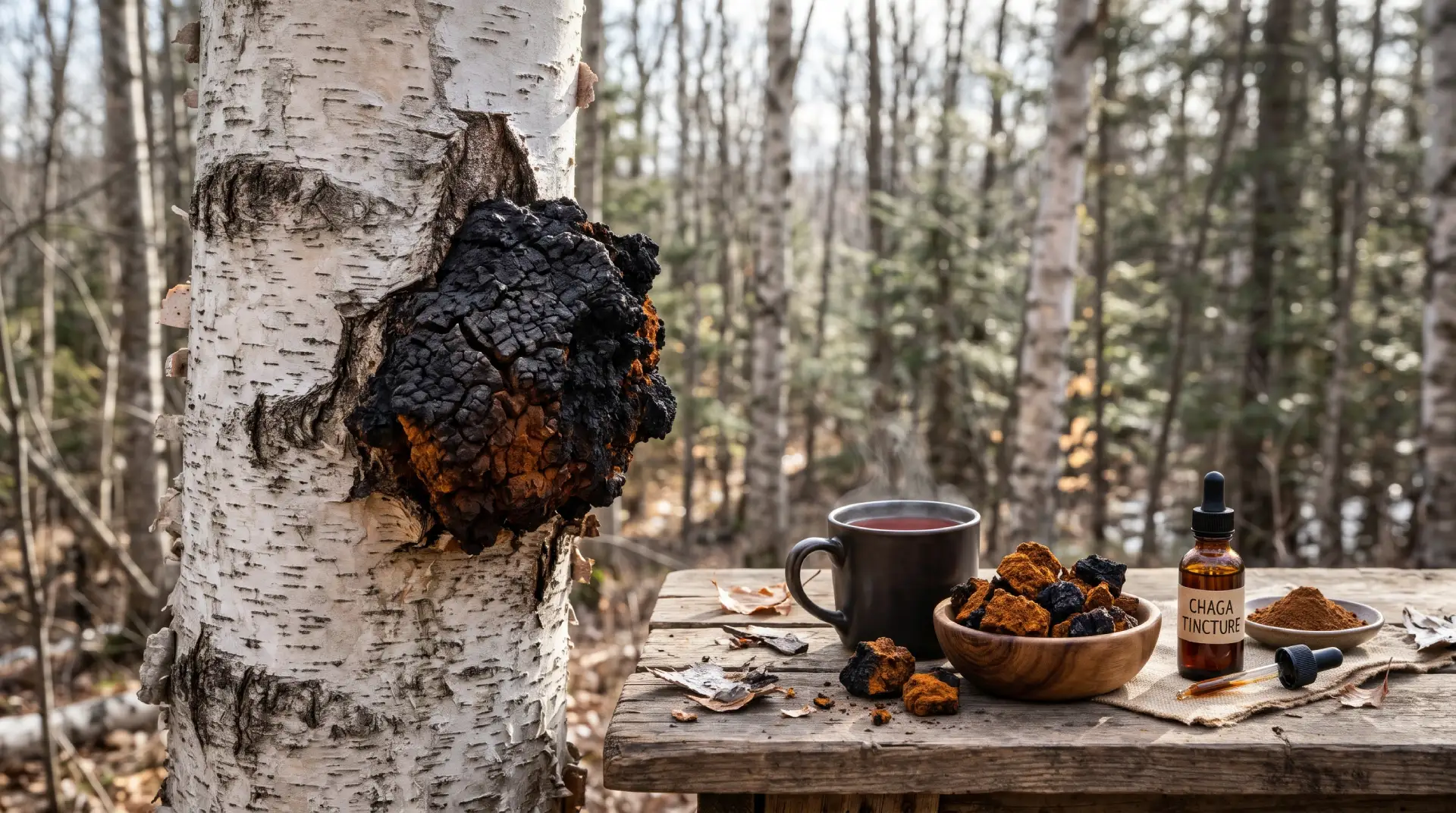
Chaga is not a typical mushroom with a cap and stem. What gets harvested is a hard, black, cracked mass of fungal tissue, often called a conk, that grows slowly on living birch trees in cold northern forests. Inside, it is a rusty orange-brown colour. Because it grows so slowly, chaga is almost always wild-harvested, and responsible harvesting leaves part of the growth on the tree.
Some products instead use chaga mycelium grown in a lab, often on grain. That is a different material from wild chaga, so a good label tells you which one you are buying. Our functional mushroom benefits guide explains what makes a mushroom “functional”.
What the Research Says
A review of chaga research published in Mycology describes antioxidant and anti-inflammatory activity for chaga extracts, including effects on immune signalling, linked to polysaccharides, triterpenoids and polyphenols. The important caveat is where that evidence comes from: almost all of it is from cell and animal studies.
There are very few human trials, so we can’t yet say what chaga does in people, or at what amount. Treat any claim that chaga “boosts” or “fights” anything with caution. Our functional mushroom research roundup covers the wider evidence across species.
Side Effects and Warnings
Oxalates and the kidneys. Chaga contains very high levels of oxalate, a compound that can form crystals in the kidneys. A 2020 case report describes a patient who developed end-stage kidney disease after long-term chaga use, and lab tests on the leftover powder found a very high oxalate content. A 2022 case report describes acute kidney injury in a man who had taken 10 to 15g of chaga powder a day, along with vitamin C, for about three months. These are individual cases involving large amounts, but they are the main reason not to take chaga in high doses for long periods.
Who should speak to a GP or pharmacist first. Avoid chaga if you have kidney disease or a history of kidney stones. Lab and animal studies suggest chaga may affect blood sugar, so take advice first if you take diabetes medication. The same applies if you take blood-thinning or immune-suppressing medication, have an autoimmune condition, or are pregnant or breastfeeding.
Chaga Forms Compared
| Form | What it is | Good for | Watch out for |
|---|---|---|---|
| Tea or chunks | Pieces simmered in water | The traditional way to use chaga | Water draws out polysaccharides but few triterpenoids |
| Dual-extract tincture | Alcohol and water extraction in a dropper bottle | Daily use, easy to add to drinks | Contains alcohol; check the extraction is stated |
| Extract powder | Concentrated, dried extract | Mixing into drinks | Amounts are easy to overdo |
| Capsules | Powder or extract in a capsule | Fixed amounts, no taste | Check whether it is wild chaga or mycelium |
| Coffee blends | Chaga mixed into coffee | Convenience | Often a small amount of chaga per serving |
How to Choose a Chaga Supplement
Wild chaga or mycelium. Wild chaga and lab-grown chaga mycelium are not the same material. Neither is automatically better, but you should know which you are buying.
Sourcing. Look for a seller who can tell you where the chaga was harvested and how. Slow-growing wild chaga is easy to over-harvest.
Extraction. Chaga’s polysaccharides dissolve in hot water, while its triterpenoids need alcohol, which is why tinctures usually use both. Our 60ml dual-extracted chaga tincture is made with both alcohol and water extraction.
Ratios. A figure such as 10:1 usually describes how much raw chaga went into a given amount of extract. It does not tell you how much of any particular compound is in the bottle.
How to Take Chaga Tincture
Most people add chaga tincture to a hot or cold drink, or take it directly under the tongue. Follow the label: our chaga tincture label suggests 1 to 3 pipettes a day, and it makes sense to start at the lower end. Many people take it in the morning as part of a routine. If you prefer tea, simmer a few small chunks gently in water, then dry and store any unused pieces somewhere cool and dry.
Common Mistakes
- Taking large amounts every day for months. The kidney case reports involved heavy, long-term use.
- Ignoring a history of kidney stones. High-oxalate foods and supplements are a particular concern here.
- Assuming “wild” always means better. Sourcing and extraction matter more than the word on the label.
- Expecting quick effects. There is no good evidence of fast, noticeable results.
FAQ
How do you take chaga tincture?
Add it to a drink or take it under the tongue, following the amount on the label. Our chaga tincture label suggests 1 to 3 pipettes a day; start at the lower end.
How much chaga should you take a day?
There is no researched daily dose for people, so follow the product label. Avoid high amounts over long periods because of chaga’s oxalate content.
Chaga tea or tincture: which is better?
Tea uses hot water, which draws out polysaccharides but few triterpenoids. A dual-extract tincture uses alcohol and water, so it captures both groups of compounds.
Can you take chaga every day?
Many people use chaga daily at label amounts, but long-term heavy use has been linked to kidney problems in case reports. Speak to a GP if you plan to take it long term or have kidney concerns.
Chaga or reishi: what is the difference?
Reishi is a true mushroom with the stronger human evidence, mainly for immune markers. Chaga is a slow-growing growth on birch with mostly lab and animal evidence. Our which functional mushroom guide compares them in more detail.
Is lab-grown chaga the same as wild chaga?
No. Lab-grown products usually contain chaga mycelium, often grown on grain, which is a different material from the wild conk that grows on birch.
Why This Matters
Chaga is marketed with big promises, but the human evidence is thin and the oxalate risk is real. Knowing that helps you use chaga sensibly: at label amounts, from a source you trust, and with medical advice if you have kidney concerns or take medication.
Related Guides
- Functional mushroom benefits guide
- Functional mushroom research roundup
- Reishi mushroom UK buying guide
- 7 medicinal mushrooms: benefits, uses and growing tips
About This Guide
This guide was written by the SporeBuddies team and summarises published research available in October 2026. It is general information, not medical advice. Speak to a GP or pharmacist before starting any supplement if you have a health condition or take medication.
Ready to try chaga? See our chaga mushroom tincture.