

Mushroom bioavailability is the proportion of beneficial compounds in mushrooms that your body actually absorbs and uses after digestion. It is not simply about how many nutrients a mushroom contains on paper. A raw mushroom can be packed with beta-glucans, polysaccharides, and minerals, yet deliver only a fraction of those compounds to your bloodstream. The central reason is chitin, the tough structural polysaccharide that forms mushroom cell walls. Human digestive enzymes cannot break chitin down effectively, so many bioactive compounds remain locked inside the cell matrix and pass through the gut unused. Extraction methods that physically or chemically disrupt chitin can increase bioavailability by approximately tenfold compared with raw or ground mushroom powder. Species such as shiitake (Lentinula edodes), Hypsizygus ulmarius, and Auricularia auricula-judae each present distinct bioactive profiles, and research published in sources including the International Journal of Medicinal Mushrooms continues to refine our understanding of how those profiles translate into real health outcomes. For anyone choosing a mushroom supplement or growing their own species at home, understanding bioavailability is the difference between a product that works and one that simply looks good on the label.
Key points at a glance:
- Bioavailability describes the fraction of mushroom compounds that reach systemic circulation and exert biological effects.
- Chitin cell walls are the primary physical barrier limiting compound release during digestion.
- Extraction methods break down chitin and can raise bioavailability roughly tenfold versus unprocessed powder.
- Species identity matters: shiitake, Hypsizygus ulmarius, and Auricularia auricula-judae differ meaningfully in their bioactive compound profiles.
- Scientific measurement relies on in vitro digestion models, animal studies, and cell permeability assays.
- Cooking and processing choices directly alter how much of a mushroom’s nutritional value you actually absorb.
What is the difference between bioaccessibility and bioavailability?
These two terms are often used interchangeably, but they describe distinct stages of the same process. Understanding the gap between them helps you judge whether a mushroom product is genuinely effective.
Bioaccessibility refers to the release of compounds from the mushroom’s physical matrix into the digestive tract, where they become available for absorption. Think of it as the first gate: if a compound cannot escape the cell wall during digestion, it never gets the chance to enter your body at all. Bioaccessibility conditions bioavailability and is shaped by the mushroom’s species chemistry, its structural complexity, and the digestive environment it encounters.
Bioavailability is the fraction that clears that first gate and actually enters systemic circulation, where it can exert physiological effects. A compound may be bioaccessible without being fully bioavailable, because intestinal absorption, liver metabolism, and molecular stability all introduce further losses.
Key distinctions to keep in mind:
- High nutrient content on a lab report does not guarantee bioavailability without effective bioaccessibility first.
- Digestive enzymes, gut pH, and transit time all influence how much of a released compound is ultimately absorbed.
- Mushroom species differ in cell wall thickness and polysaccharide composition, producing species-specific bioaccessibility rates.
- Processing steps such as extraction or cooking alter the mushroom matrix and shift both bioaccessibility and bioavailability up or down.
- Animal studies and in vitro digestion models measure these two stages separately, which is why reading research carefully matters when evaluating supplement claims.
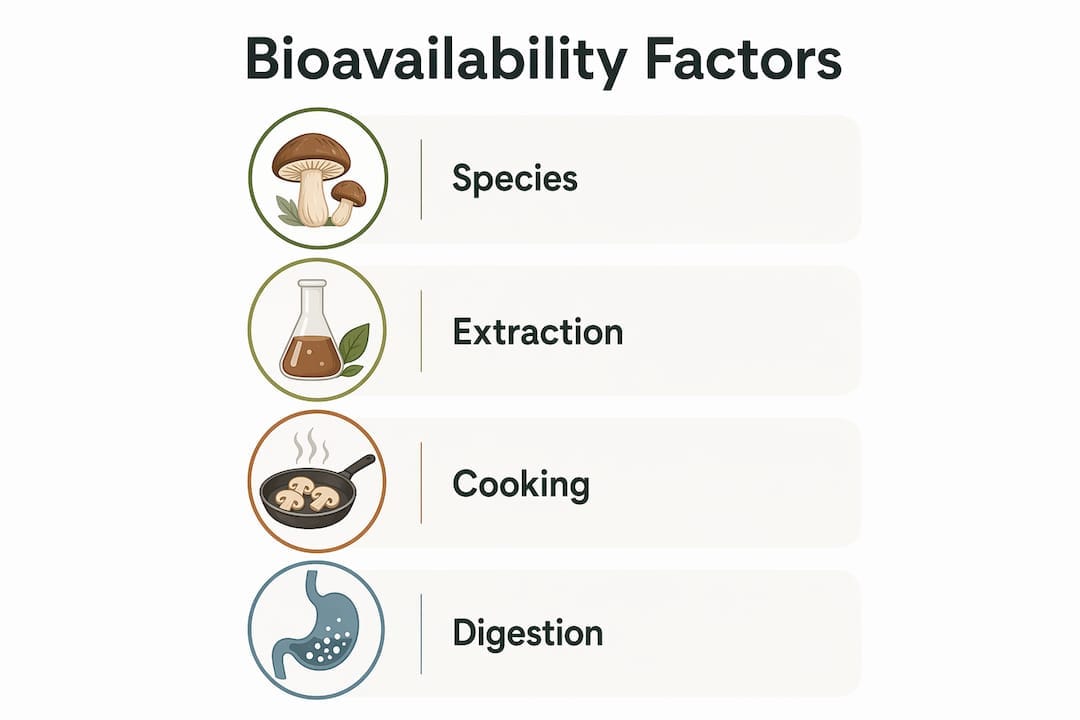
What factors influence mushroom bioavailability?
Bioavailability is not a fixed property of a mushroom species. It shifts depending on how the mushroom is grown, prepared, and consumed. Several factors interact to determine what your body ultimately absorbs.
The chitin barrier
Chitin is the single biggest limiting factor. Because human digestive enzymes cannot hydrolyse it efficiently, the bioactive compounds trapped within mushroom cells, including beta-glucans, triterpenoids, and minerals, remain largely inaccessible in raw or simply dried mushrooms. This is why whole dried mushroom powder, despite its convenience, tends to deliver far less than an extracted product.
Extraction methods
Hot water extraction, alcohol (ethanol) extraction, and dual extraction each target different compound classes. Hot water breaks down polysaccharides such as beta-glucans; alcohol extraction pulls out fat-soluble triterpenoids and sterols. Dual extraction combines both, giving the broadest compound profile. Extracted mushroom products are approximately 10 times more bioavailable than raw or ground powders because the extraction process physically disrupts the chitin matrix.
Species differences
Hypsizygus ulmarius has demonstrated particularly strong mineral delivery. Iron absorption from iron-fortified Hypsizygus ulmarius was 66.76% higher compared with control diets in animal model studies, a finding with real implications for plant-based nutrition. Shiitake and Auricularia auricula-judae carry distinct polysaccharide and triterpenoid profiles that respond differently to the same processing conditions.
Cooking and culinary processing
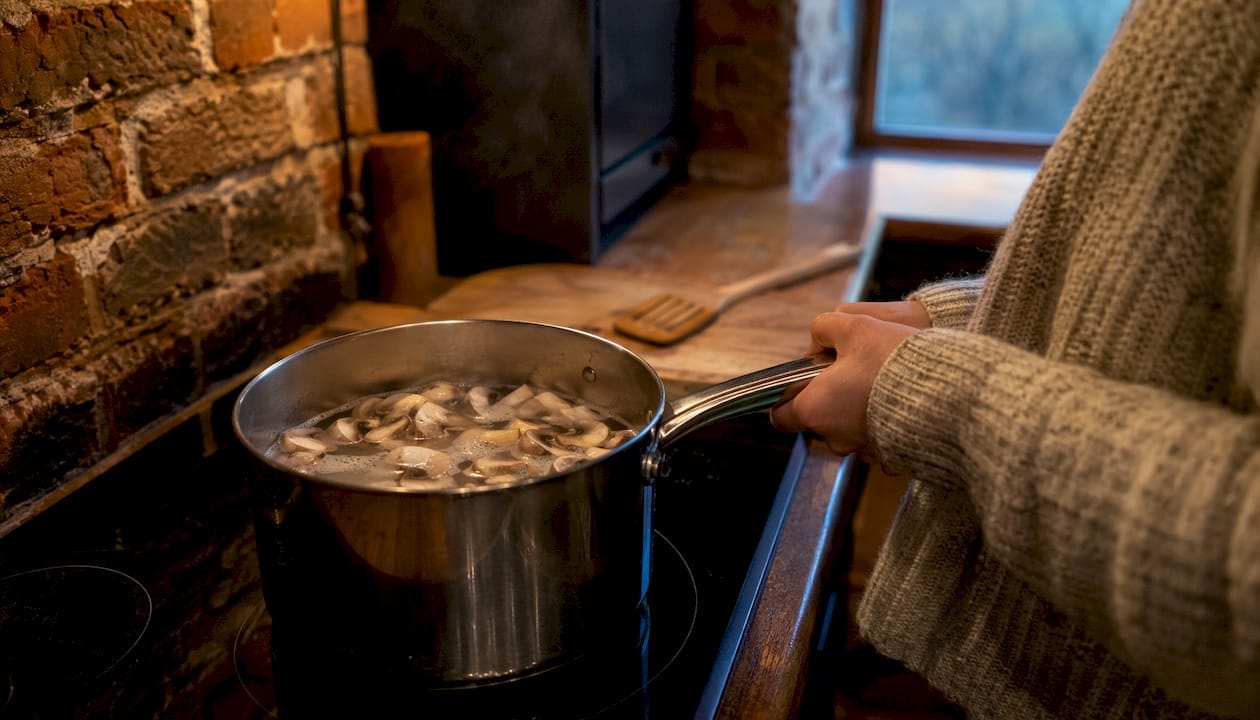
Boiling disrupts the mushroom’s cell wall and can improve protein digestibility and amino acid bioaccessibility. However, culinary processing losses such as blanching or pickling can reduce nutrient content by 41–87% by wet weight, primarily through leaching into cooking water. Boiling also reduces antinutritional factors like phytic acid and oxalic acid, which bind minerals and limit their absorption, so the net effect on bioavailability depends heavily on species and cooking time.
Digestive environment
Beta-glucans and chitin can increase gastrointestinal viscosity and form complexes with proteins and minerals, reducing enzymatic access. The type of protease active in the gut, gut pH, and individual microbiome composition all modulate how much of a released compound is ultimately absorbed. For anyone exploring mushroom nutrition science, these digestive variables are as important as the mushroom species itself.
Pro Tip: If you are boiling mushrooms, retain the cooking liquid where possible. Many water-soluble polysaccharides leach into the water during cooking, and consuming the broth recovers some of that nutritional value.
How do researchers measure mushroom bioavailability?
Measuring bioavailability accurately requires moving beyond simple nutrient analysis. Researchers use several complementary standard measurement approaches to build a reliable picture.
- In vitro gastrointestinal digestion: Laboratory simulations replicate the stomach and intestinal phases of digestion using artificial gastric and intestinal juices. The Bioaccessibility Research Group of Europe (BARGE) method is one widely used protocol, providing a quantitative estimate of compound release from the food matrix.
- Animal feeding studies: Wistar rat models are commonly used to measure serum biomarker levels after mushroom consumption. Serum 25-hydroxyvitamin D is a well-validated biomarker for vitamin D bioavailability, for example.
- Caco-2 cell permeability assays: These intestinal cell line models assess how well a compound crosses the gut epithelium, providing a proxy for human intestinal absorption without requiring in vivo trials.
- Pre- and post-processing nutrient analysis: Comparing nutrient content before and after cooking or extraction quantifies bioaccessibility fractions and processing losses.
- Biomarker tracking in vivo: Measuring serum mineral levels, vitamin concentrations, or immune markers in live subjects after controlled mushroom consumption links dietary intake directly to physiological response.
One challenge is that mushroom matrices are chemically complex. Polysaccharide interactions, compound variability between batches, and species-specific cell wall architecture all introduce variability that makes standardised measurement difficult. Results from in vitro models do not always translate directly to human outcomes, which is why well-designed animal studies and, where available, human clinical trials carry greater weight.
What health benefits come from bioavailable mushroom compounds?
When mushroom compounds are genuinely absorbed, the health effects are well-supported by research. The key is that absorption, not just consumption, drives these outcomes.
Immune modulation is one of the most studied benefits. Beta-glucans and polysaccharides from shiitake and Auricularia auricula-judae interact with immune receptors in the gut and bloodstream, supporting immune surveillance. The hepatoprotective and immunomodulatory activity of bioactive compounds in Auricularia auricula-judae depends directly on successful intestinal absorption, as confirmed by cell permeability assays.
Vitamin D2 from UV-irradiated shiitake is one of the clearest demonstrations of mushroom bioavailability in action. In an animal model study, serum 25-hydroxyvitamin D levels reached 129.42 nmol/l in the group consuming UV-irradiated Lentinula edodes, compared with just 6.06 nmol/l in controls. Femur bone mineral density was also significantly higher in the experimental group. For UK consumers, where dietary vitamin D is a recognised public health concern through the winter months, UV-treated mushrooms or mushroom-derived vitamin D2 supplements represent a practical, plant-based option.
Mineral delivery, particularly iron, is another area where species selection matters. The 66.76% improvement in iron absorption from Hypsizygus ulmarius noted earlier points to mushrooms as a credible vehicle for addressing mineral deficiencies in plant-based diets.
Antioxidant and anti-inflammatory effects are linked to bioavailable triterpenoids and phenolic compounds. Boiling has been shown to enhance antioxidant activity in Auricularia auricula-judae, likely through the release of ergothioneine and related compounds. These effects only materialise when the compounds are absorbed, which is why consuming extracted or properly prepared forms matters. You can explore more about these connections on the mushroom health and wellness pages at Sporebuddies.
UK market: choosing mushroom supplements with real bioavailability
For UK consumers, the supplement market is largely unregulated in terms of bioavailability claims. A product labelled “1,000 mg mushroom extract” may contain very different levels of actual bioavailable compounds depending on the extraction method, the species used, and the quality of the raw material.
Practical considerations when selecting a supplement:
- Confirm the extraction method. Look for products specifying hot water, ethanol, or dual extraction. Whole mushroom powder without extraction is unlikely to deliver the same bioavailable compound levels as an extracted product.
- Check beta-glucan content. Beta-glucan percentage is the most meaningful marker of polysaccharide potency. A product listing only “polysaccharides” without specifying beta-glucans may be including starch, which has no equivalent immunomodulatory effect.
- Look for third-party testing. Certificates of analysis from independent UK-accredited laboratories confirm that label claims match actual compound levels.
- Consider species specificity. Shiitake, Hypsizygus ulmarius, and Auricularia auricula-judae each offer distinct bioactive profiles. A blend may not deliver the same targeted effect as a single-species extract.
- Growing your own is a genuine option. Home cultivation of species like shiitake and oyster mushrooms gives you control over freshness and preparation method, both of which directly influence bioavailability. Sporebuddies supplies legal mushroom spores and cultivation equipment to UK growers, making it straightforward to start with well-documented species.
Pro Tip: UV-exposing fresh shiitake gills-down in direct sunlight for 15–30 minutes before cooking can meaningfully increase their vitamin D2 content, giving you a bioavailable nutrient boost from a simple preparation step.
Key takeaways
Mushroom bioavailability is a dynamic outcome shaped by species, extraction method, cooking, and digestion, not a fixed property of any single mushroom.
| Point | Details |
|---|---|
| Chitin is the main barrier | Human enzymes cannot digest chitin, so raw mushrooms release only a fraction of their bioactive compounds. |
| Extraction raises bioavailability tenfold | Extracted products are approximately 10 times more bioavailable than raw or ground mushroom powder. |
| Species selection matters | Iron absorption from iron-fortified Hypsizygus ulmarius was 66.76% higher than control diets in animal studies. |
| Cooking cuts and boosts simultaneously | Blanching or pickling can reduce nutrient content by 41–87% through leaching, yet boiling also reduces antinutrients that limit mineral absorption. |
| UV exposure unlocks vitamin D2 | Serum 25-hydroxyvitamin D levels were substantially elevated in subjects consuming UV-irradiated shiitake compared to controls. |
FAQ
What does mushroom bioavailability mean?
Mushroom bioavailability is the proportion of a mushroom’s beneficial compounds that your body absorbs and uses after digestion. It differs from nutrient content because chitin cell walls and digestive limitations mean only a fraction of what a mushroom contains actually reaches your bloodstream.
Are mushroom supplements bioavailable?
Extracted mushroom supplements are significantly more bioavailable than whole mushroom powders, with extracted products approximately 10 times more bioavailable due to chitin breakdown during extraction. Always check that a supplement specifies its extraction method and provides beta-glucan content figures.
What organ benefits most from bioavailable mushroom compounds?
The immune system and liver are the most studied beneficiaries. Beta-glucans support immune function through gut and systemic receptors, while compounds from Auricularia auricula-judae show hepatoprotective activity, though both effects depend on adequate intestinal absorption.
Does cooking mushrooms affect their bioavailability?
Yes, significantly. Boiling can improve protein digestibility and reduce antinutritional factors, but culinary processing such as blanching or pickling can reduce nutrient content by 41–87% through leaching. The net effect depends on the species and the cooking method used.
How can I improve mushroom nutrient absorption at home?
Use extraction-based supplements where possible, expose fresh shiitake to UV light before cooking to boost vitamin D2, and retain cooking liquids to recover water-soluble polysaccharides. Growing species like shiitake from quality spores also gives you control over freshness, which directly affects the bioactive compound content of your harvest.