
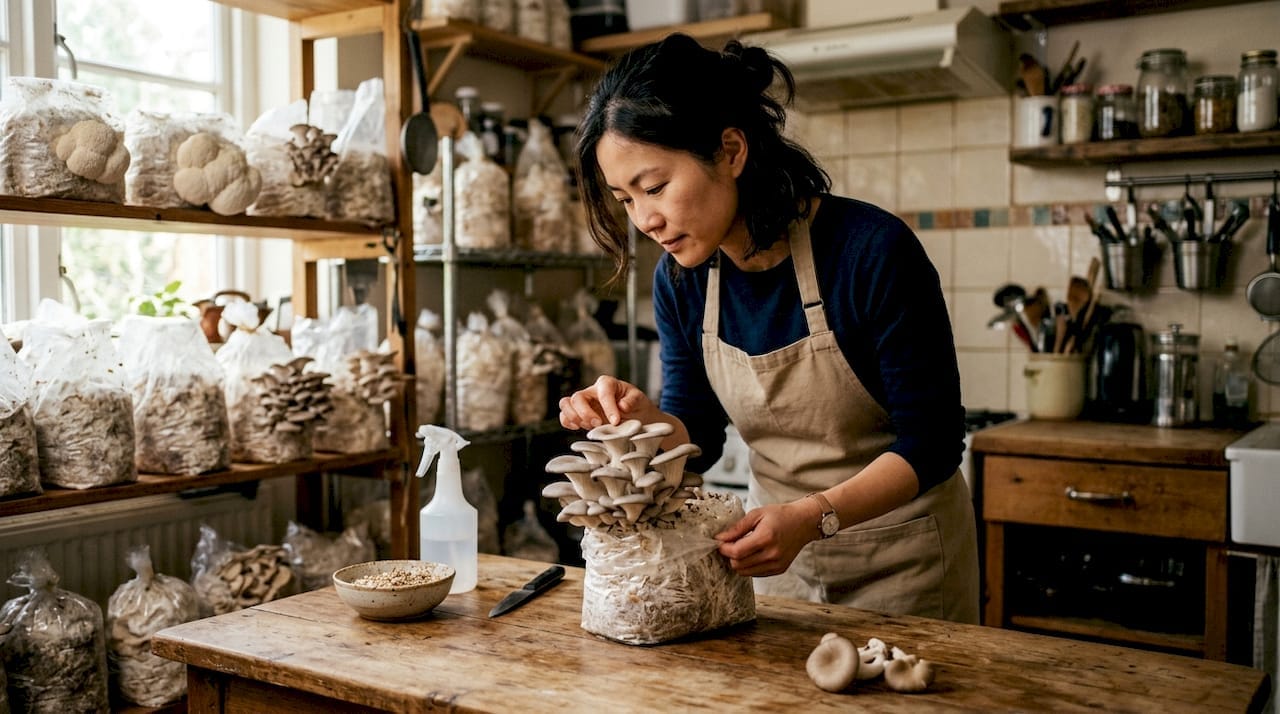
Mushroom cap cracking is a physiological reaction to moisture loss, caused primarily by relative humidity dropping below 80% during the fruiting phase. When ambient humidity falls outside the ideal 85–95% range, the outer cap tissue dries and shrinks faster than the mycelium can supply water, producing the radial fissures you see on affected fruits. Fresh air exchange (FAE) compounds this problem when it strips humid air from the growing chamber without replacement. Understanding these mechanisms is the first step toward preventing cap damage and improving your yields. Some species, such as shiitake and Inocybe rimosa, also crack naturally as part of their development, which makes it worth knowing the difference between stress and biology.
Why mushrooms crack caps: the humidity connection
Mushroom fruiting bodies are approximately 90% water, and that figure explains almost everything about cap cracking. The cap surface depends entirely on ambient humidity to stay hydrated. When the air around your fruiting chamber dries out, the outer tissue loses moisture faster than the mycelium beneath can replenish it. The result is shrinkage, then splitting.
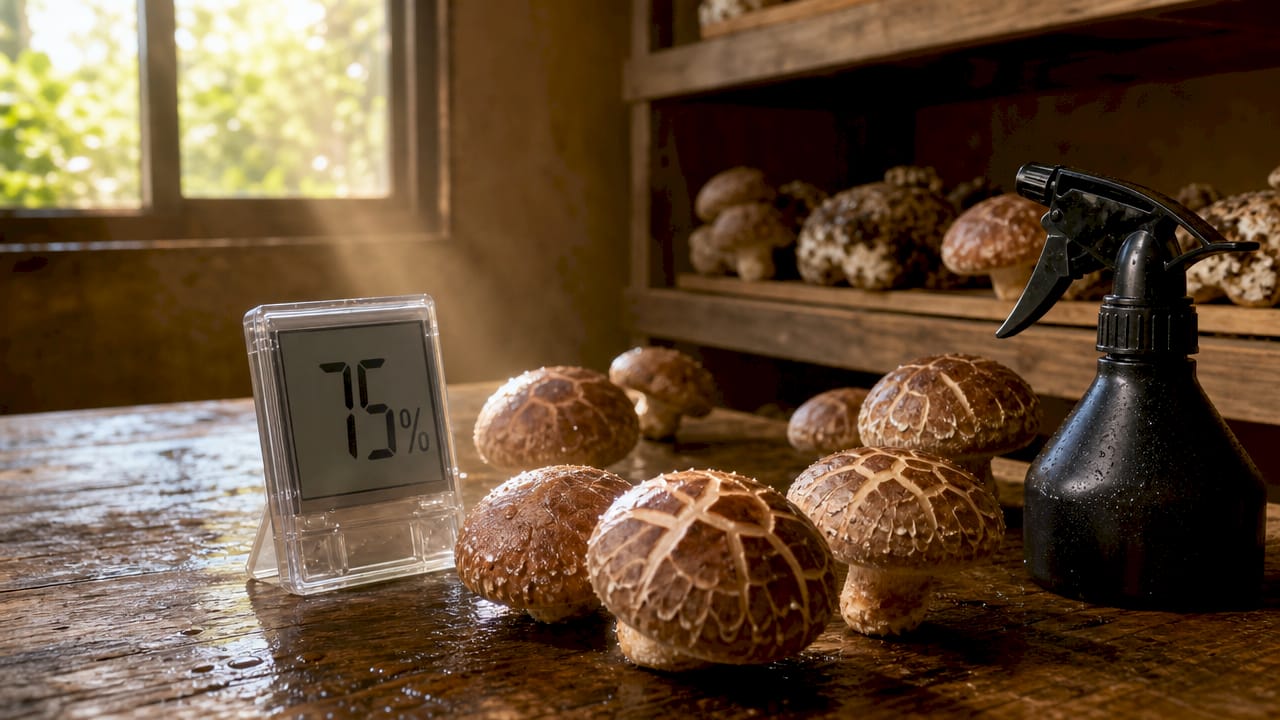
Relative humidity below 80% causes the outer cap tissue to dry, shrink, and split. That threshold is not a rough guideline. It is the point at which moisture loss outpaces supply, and the cap surface begins to fail structurally. Most species fruit best between 85% and 95% RH, and anything below that range puts caps at risk.
The symptoms are easy to read once you know what to look for. Radial fissures appear first at the cap margin and spread inward. The cap surface takes on a dry, scaly texture rather than the smooth or slightly moist appearance of a healthy fruit. Species with large, flat caps, such as shiitake, show these patterns most visibly because there is more surface area exposed to the air.
| Humidity level | Effect on cap tissue | Typical symptom |
|---|---|---|
| 85–95% RH | Optimal hydration maintained | Smooth, intact cap surface |
| 80–85% RH | Mild moisture stress | Minor surface dryness, early fissures |
| Below 80% RH | Rapid moisture loss | Radial cracks, scaly texture, brittle caps |
Monitoring humidity accurately is non-negotiable. A digital hygrometer placed at fruiting body height gives you a reliable reading. Wall-mounted units positioned at the top of a chamber often read higher than the actual humidity at cap level, so placement matters.
Pro Tip: Place your hygrometer at the same height as your developing pins, not at the top of the chamber. Humidity stratifies, and the reading at cap level is the one that actually matters.
How does fresh air exchange cause cap splitting?
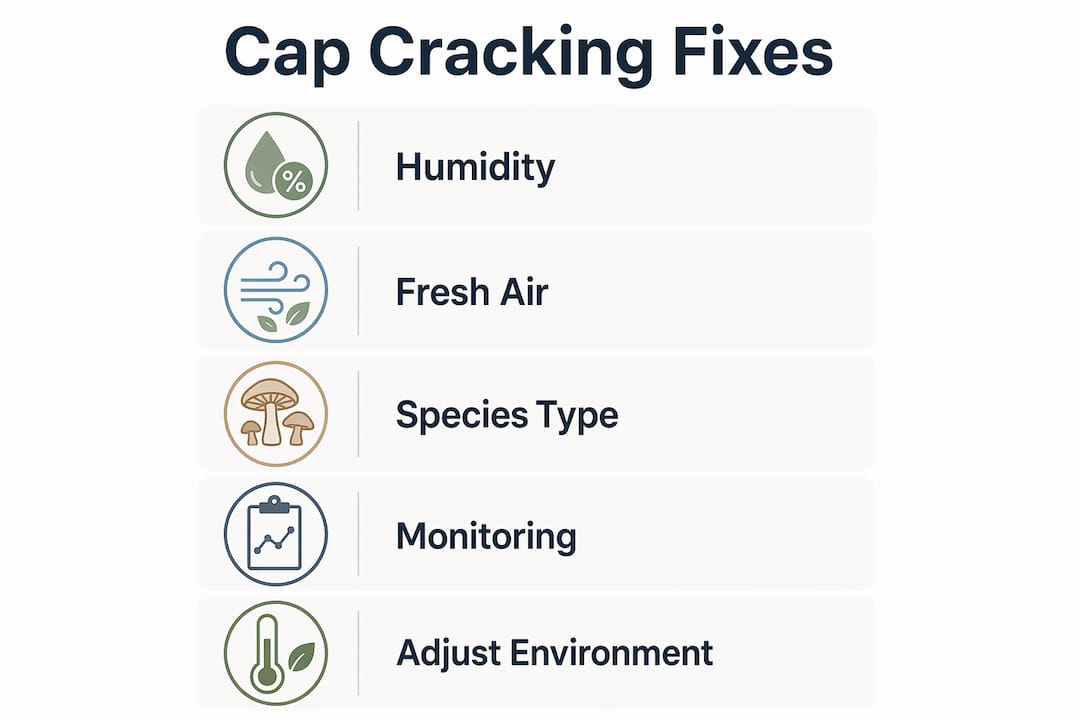
Fresh air exchange is necessary for healthy mushroom development, but too much of it is one of the most common mushroom cap splitting reasons in home cultivation. Excessive FAE accelerates moisture loss by continuously replacing humid chamber air with drier ambient air. The mushrooms cannot keep up, and the caps begin to crack.
The symptoms of over-ventilation are distinct from pure humidity failure, though the two often occur together:
- Brittle, papery caps that crack at the slightest touch
- Stunted or aborted primordia that fail to develop past pinning
- Dry substrate edges pulling away from the container walls
- Rapid surface drying between misting sessions
- Reduced overall yield from a flush that looked promising at pinning
Cracking caps accompanied by dehydrated substrate pulling away from container edges is a reliable sign of environmental stress rather than a species trait. If you see both symptoms together, FAE is almost certainly the culprit.
Temperature swings make this worse. When temperature drops, the air holds less moisture. When it rises, evaporation from the cap surface accelerates. Either shift stresses the cap tissue, and combined with high FAE, the effect compounds quickly. Aim for stable temperatures within the fruiting range for your species, typically 18–24°C for most common cultivated varieties.
Balancing FAE and maintaining 85–95% RH is about ensuring consistent, humid air rather than simply more air. Reducing fan speed, adding a polyfill filter to slow airflow, or switching to passive FAE through small holes rather than active fans all help retain humidity while still clearing CO2. The goal is gentle, steady air movement, not a constant breeze.
Which mushroom species crack naturally?
Not all cap cracking signals a cultivation problem. Certain species crack as a normal part of maturation, and recognising this distinction saves you from chasing an environmental issue that does not exist.
Inocybe rimosa, the Split Fibrecap, shows deep radial splits as it matures from a conical to a convex shape. This is anatomical, not environmental. The cap is straw-coloured, dry, and radially fibrous, and the splits deepen as the mushroom expands. Crucially, Inocybe rimosa is heat-stable toxic and poisonous. Foragers who use cap cracking as a positive identification feature risk serious harm. Cap splitting alone is never a safe basis for identification.
Shiitake tells a very different story. Controlled humidity stress in shiitake cultivation produces the donko cracked cap pattern, which commands premium market value. Donko caps are thick, deeply cracked, and pale at the fissures. They are produced deliberately by exposing developing fruits to a period of lower humidity, then restoring optimal conditions. The result is a visually distinctive product that sells at a higher price point than standard shiitake. This is the opposite of accidental cracking: it is a technique applied with precision.
| Cracking type | Species example | Cause | Grower action needed |
|---|---|---|---|
| Natural anatomical | Inocybe rimosa | Genetic development | None (toxic, do not cultivate) |
| Deliberate stress | Shiitake (donko) | Controlled humidity dip | Intentional technique |
| Environmental stress | Oyster, lion’s mane | Low RH or excessive FAE | Correct humidity and airflow |
Understanding which category your cracking falls into changes your response entirely. If you are growing shiitake and see cracking after a humidity dip, you may have accidentally produced a premium product. If you are growing oyster mushrooms and see the same pattern, you have an environmental problem to fix. Knowing your species and its natural cap development traits is foundational to accurate diagnosis.
How to prevent mushroom cap cracking in your grow
Prevention comes down to controlling three variables: humidity, airflow, and humidification technology. Getting all three right removes the most common causes of mushroom cap cracks from your growing environment.
- Install a reliable digital hygrometer. Place it at fruiting body height and check it at least twice daily. Log your readings so you can spot trends before they cause damage. A single reading during misting tells you nothing useful about average conditions.
- Choose the right humidifier. Proper humidification requires a dry fog with droplet size of 5 microns or less to remain suspended in the air and hydrate the cap surface effectively. Larger droplets fall immediately, soaking the substrate but leaving the air dry. That is the worst outcome: wet substrate encourages bacterial blotch while the caps still crack from dry air.
- Avoid standard household ultrasonic humidifiers. Household ultrasonic humidifiers commonly fail in mushroom grow rooms because spore buildup clogs internal components, reducing output over time. Most home units also cannot sustain 90% humidity in spaces with constant fresh air exchange. If you are using one and seeing cracked caps, the humidifier is likely the weak point.
- Use a perlite tray for passive humidity. A layer of moistened perlite at the base of a sealed grow chamber releases moisture slowly and steadily. It does not replace active humidification for larger setups, but for small monotubs or shotgun fruiting chambers it provides a reliable humidity buffer between misting sessions.
- Seal your chamber appropriately. Gaps in lids, loose polyfill, or oversized FAE holes all allow humid air to escape faster than you can replace it. Tape, foam seals, or purpose-built lids reduce uncontrolled moisture loss. You can always add more FAE holes; it is harder to recover humidity once the chamber has dried out.
- Adjust FAE gradually. If you suspect over-ventilation, reduce airflow in small steps rather than sealing the chamber entirely. CO2 buildup causes its own problems, including long, thin stems and delayed pinning. The target is the minimum FAE needed to keep CO2 at acceptable levels while retaining humidity.
Pro Tip: If you are seeing mild cracking on the first flush but healthy caps on the second, your chamber humidity is likely recovering between flushes. Increase misting frequency during the first flush rather than changing your entire setup.
Mild cracking is not always a failure. On shiitake, it can be a feature. On oyster or lion’s mane, a small amount of surface cracking on mature caps near harvest is acceptable if the rest of the fruit is firm and well-formed. The point at which cracking becomes a problem is when it appears on young pins, spreads across the entire cap, or is accompanied by brittle tissue. Reviewing factors affecting mushroom yield alongside your humidity logs gives you a clearer picture of whether cracking is costing you weight and quality.
Key takeaways
Mushroom cap cracking is caused by humidity dropping below 80% RH, excessive fresh air exchange, or natural species development, and each cause requires a different response.
| Point | Details |
|---|---|
| Humidity is the primary driver | Keep relative humidity between 85–95% during fruiting to prevent cap tissue drying and splitting. |
| FAE must be balanced, not maximised | Excessive airflow strips humid air and causes brittle caps; reduce fan speed or switch to passive FAE. |
| Some species crack naturally | Shiitake donko and Inocybe rimosa crack by design, not environmental failure. |
| Humidifier choice matters | Use a dry fog unit producing droplets of 5 microns or less; household ultrasonic models often fail in grow rooms. |
| Mild cracking can be acceptable | On mature caps near harvest, minor fissures are not always a problem; young pin cracking always signals an issue. |
Sporebuddies: supplies built for growers who want results
Growing mushrooms without cracked caps starts with the right environment, and that starts with quality materials. Sporebuddies stocks a full range of mushroom grow kits designed for home growers who want consistent fruiting conditions from the first flush. Whether you are cultivating shiitake, oyster, or lion’s mane, each kit is built to support the humidity and airflow requirements that prevent cap damage. For growers ready to go further, the mycology equipment range includes the monitoring and humidification tools that make environmental control straightforward. Browse the full mushroom spore catalogue to find strains suited to your setup and experience level.
FAQ
What is the main cause of mushroom cap cracking?
The primary cause is relative humidity dropping below 80% during the fruiting phase. When ambient humidity falls, the outer cap tissue loses moisture faster than the mycelium can supply it, causing the surface to shrink and split.
What humidity level prevents cap splitting?
Most cultivated species require 85–95% relative humidity during active fruiting to maintain cap integrity. Readings below 80% RH consistently produce radial fissures and dry, scaly cap surfaces.
Can too much fresh air exchange cause caps to crack?
Yes. Excessive FAE strips humid air from the growing chamber and accelerates moisture loss at the cap surface. Symptoms include brittle caps, stunted growth, and dry substrate edges pulling away from container walls.
Why do some mushrooms crack naturally?
Certain species crack as part of normal maturation. Inocybe rimosa splits radially as it expands from a conical shape, and shiitake develops the premium donko cracked cap pattern when exposed to deliberate humidity stress during cultivation.
Are cracked mushroom caps safe to eat?
Cracking caused by environmental stress does not make a mushroom unsafe to eat, provided it is otherwise healthy and harvested at the right time. Never use cap cracking alone to identify wild mushrooms, as toxic species such as Inocybe rimosa also exhibit fissured caps.