

Mycology is the scientific study of fungi and sits at the centre of sustainable food production, from alternative proteins to crop nutrition and fermentation technology. The role of mycology in food production spans three critical areas: mycoprotein development using organisms like Fusarium venenatum, symbiotic relationships with arbuscular mycorrhizal fungi that reduce chemical fertiliser dependency, and solid-state fermentation (SSF) techniques that preserve nutritional quality in whole-food products. For food industry professionals and agricultural scientists, understanding these mycological processes is no longer optional. Fungi are reshaping how we grow, process, and consume food at scale.
What is the role of mycology in food production?
Mycology contributes to food production across the entire supply chain, from soil to shelf. Fungi fix nutrients, protect crops, ferment substrates, and generate proteins with a lower environmental footprint than conventional animal agriculture. The discipline covers both macrofungi (mushrooms) and microfungi (yeasts, moulds, and filamentous species), each with distinct applications in food science and agronomy.
The functional diversity of fungi makes them uniquely suited to food system challenges. A single fungal species can simultaneously improve soil structure, suppress plant pathogens, and serve as a direct food ingredient. That combination of roles is rare in biology and explains why mycological research has accelerated sharply since 2021.
How does mycoprotein production offer a sustainable protein source?
Mycoprotein is a high-protein food ingredient derived from filamentous fungi, most notably Fusarium venenatum, and is the basis of products sold under the Quorn™ brand. It delivers a complete amino acid profile, meaning it contains all essential amino acids in proportions suitable for human nutrition. That profile rivals animal proteins without the associated resource costs.
Mycoprotein production offers lower greenhouse gas emissions and significantly reduced land and water use compared to conventional livestock farming. Those savings compound at scale, making fungal proteins one of the most credible routes to decarbonising the food system.
Key advantages of mycoprotein for food manufacturers include:
- Complete amino acid profile suitable for meat analogue formulation at industrial scale
- Lower GHG emissions per kilogram of protein compared to beef, pork, and poultry
- Reduced land and water requirements, freeing agricultural capacity for other uses
- Textural versatility, allowing mycoprotein to mimic fibrous meat structures in finished products
- Scalable continuous fermentation, enabling consistent output for large retail supply chains
The 322 patents filed for mushroom and mycelia processing between 2021 and 2026 reflect the pace of commercial investment in this space. Applications now include nutraceuticals, fermented dairy alternatives, and AI-assisted bioreactor automation, signalling that fungal protein is moving from niche to mainstream.
How do symbiotic fungi improve crop yields and reduce chemical inputs?
Symbiotic fungi form partnerships with plant roots that directly improve nutrient uptake, stress tolerance, and long-term soil health. Two categories matter most to agricultural scientists: arbuscular mycorrhizal fungi (AMF) and endophytic entomopathogenic fungi (EEPF).
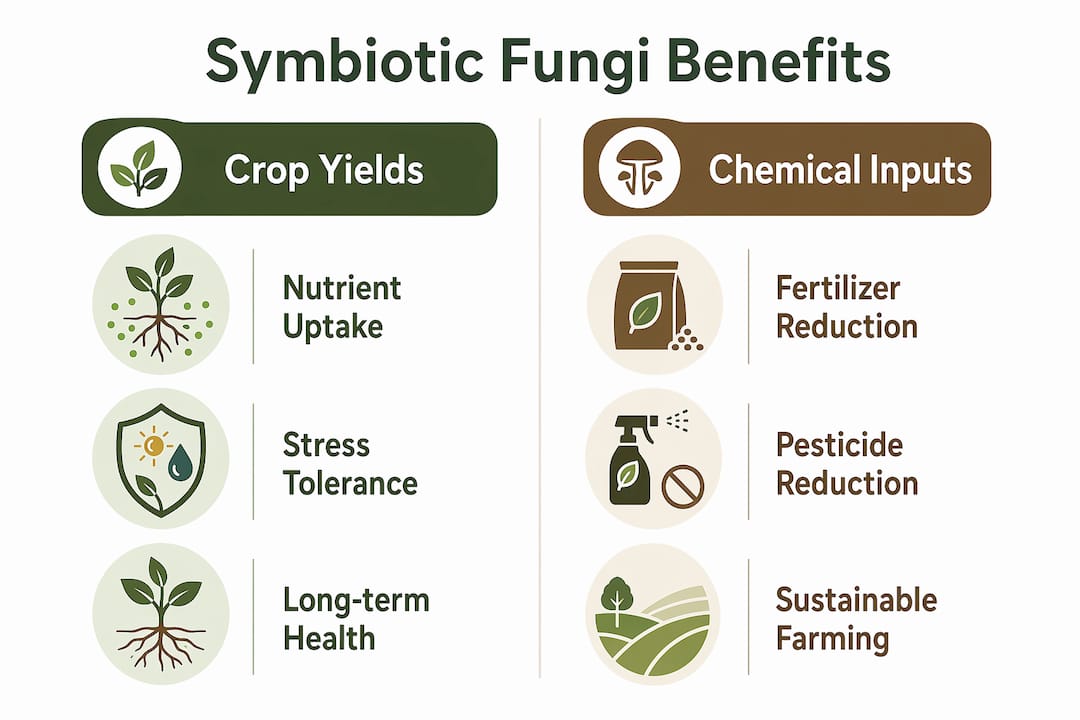
AMF colonise plant root systems and extend their hyphal networks far beyond the root zone, accessing phosphorus, nitrogen, and micronutrients that roots alone cannot reach. AMF and endophytic fungi enhance nutrient uptake, root development, and crop stress tolerance including drought and salinity. That means fewer synthetic inputs and more resilient crops under climate pressure.
EEPF take a different approach. Rather than living in the soil, endophytic entomopathogenic fungi colonise crops internally, providing persistent pest protection and enhancing plant resistance to stress without external pesticide applications. The method offers season-long biocontrol, though scaling it to commercial field conditions remains a technical challenge.
Trichoderma species add a third layer of benefit. Trichoderma fungi contribute to improved nutrient cycling and systemic resistance in plants, suppressing pathogens through secondary metabolites. Their secondary metabolites are effective, but they require careful management to avoid unintended effects on broader soil microbial communities.
Pro Tip: Tailor fungal biofertiliser applications to site-specific soil monitoring data. Repeated Trichoderma application without ecological monitoring risks disrupting soil microbial diversity, undermining the long-term gains you are trying to achieve.
The practical takeaway for agronomists is that symbiotic fungi work best as part of a monitored, site-specific programme rather than a blanket input. Fungi in agriculture deliver the most consistent results when their application is matched to local soil biology, crop species, and seasonal conditions.
Solid-state fermentation vs liquid fermentation: which produces better food?
Fermentation is one of the oldest mycological processes in food production, but the method you choose determines the nutritional outcome, processing cost, and sensory quality of the final product. The two dominant approaches are solid-state fermentation (SSF) and submerged liquid fermentation (SmF), and they differ fundamentally in how fungal biomass is grown and harvested.
| Feature | Solid-state fermentation (SSF) | Submerged liquid fermentation (SmF) |
|---|---|---|
| Substrate form | Solid or semi-solid edible substrate | Liquid nutrient broth |
| Water activity | Low | High |
| Nutritional retention | High, minimal processing loss | Lower, extraction steps reduce quality |
| Sensory qualities | Preserved in whole-food form | Often lost during downstream processing |
| By-product use | Agricultural waste streams usable | Requires refined inputs |
| Scalability | Emerging at commercial scale | Well-established industrially |
SSF is emerging as a standalone method producing minimally processed, nutrient-rich whole fungal foods that preserve sensory qualities. It uses edible substrates and agricultural by-products, creating economic and environmental benefits that extraction-based protein production cannot match.
Traditional SSF products like tempeh (made with Rhizopus oligosporus) and oncom (made with Neurospora sitophila) demonstrate the principle at a household level. Modern applications scale that logic to produce mycelium-bound meat analogues, fermented grain products, and functional mushroom ingredients for the food industry.
Pro Tip: When evaluating SSF for commercial production, assess your available agricultural by-products first. Spent grain, soybean hulls, and rice bran are all viable SSF substrates that reduce input costs while supporting mycelium growth and improving the nutritional density of the finished product.
What cultivation techniques are critical for commercial fungal food production?
Successful commercial mushroom cultivation depends on three non-negotiable controls: sterile technique at inoculation, substrate selection matched to the target species, and precise environmental triggering at the fruiting stage. Getting any one of these wrong collapses yield and contaminates batches.
- Sterile inoculation protocol. Poor hygiene at the inoculation stage causes the majority of early cultivation failures. Laminar flow hoods, still-air boxes, and 70% isopropyl alcohol wipe-downs are the baseline. Any breach in sterility introduces competing bacteria or moulds that outcompete your target fungal species before colonisation completes.
- Substrate matching. Substrate choice is critical; hardwood sawdust blends favour wood-loving species like Shiitake (Lentinula edodes), while softwoods inhibit mycelial growth due to resin content. Oyster mushrooms (Pleurotus ostreatus) tolerate straw, cardboard, and coffee grounds. Lion’s Mane (Hericium erinaceus) performs best on supplemented hardwood. Matching substrate to species is not a preference. It is a biological requirement. You can explore detailed substrate performance data to refine your formulations.
- Environmental fruiting triggers. Fruiting requires a simultaneous temperature drop, fresh air exchange, and high relative humidity to stimulate mushroom formation effectively. These three conditions must occur together. A humidity spike without adequate fresh air exchange produces aborted pins. A temperature drop without humidity control desiccates developing primordia.
- Contamination monitoring throughout the grow cycle. Green or black patches indicate Trichoderma or Aspergillus contamination. Pink or red discolouration suggests bacterial wet rot. Identifying contamination early and isolating affected blocks prevents cross-contamination across an entire production run.
- Harvest timing and post-harvest handling. Mushrooms harvested just before the veil breaks retain maximum nutritional density and shelf life. Post-harvest, rapid cooling to 2–4°C slows respiration and extends marketable life by several days.
Key takeaways
Mycology drives sustainable food production through protein innovation, crop symbiosis, and fermentation technology, and each application requires precise scientific management to deliver consistent results.
| Point | Details |
|---|---|
| Mycoprotein as protein alternative | Fusarium venenatum delivers a complete amino acid profile with lower emissions than animal proteins. |
| Symbiotic fungi reduce chemical inputs | AMF and EEPF improve nutrient uptake and pest control, reducing synthetic fertiliser and pesticide use. |
| SSF preserves nutritional quality | Solid-state fermentation retains sensory and nutritional properties better than extraction-based methods. |
| Sterile technique prevents production loss | Contamination at inoculation is the leading cause of cultivation failure and must be controlled rigorously. |
| Ecological monitoring protects soil health | Site-specific fungal biofertiliser programmes avoid microbial imbalance and protect long-term soil productivity. |
How Sporebuddies supports your mycology and food production work
Whether you are scaling a commercial mushroom operation, researching fungal fermentation, or developing new food ingredients, Sporebuddies provides the supplies and knowledge to support your work. The platform stocks a full range of mushroom spores including species relevant to food production such as Shiitake, Oyster, and Lion’s Mane, alongside sterilised substrates, agar plates, and microscopy equipment suited to both research and production environments. For operations working at volume, Sporebuddies offers wholesale mycology supplies with bulk grow bags and ready-to-use kits designed for professional growers. The educational resources on the site cover contamination prevention, substrate optimisation, and cultivation protocols, giving your team a reliable reference point as you develop or refine production systems.
FAQ
What is mycoprotein and which fungi produce it?
Mycoprotein is a protein-rich food ingredient derived from filamentous fungi, most commonly Fusarium venenatum. It provides a complete amino acid profile and is used in meat analogues including products sold under the Quorn™ brand.
How do mycorrhizal fungi reduce fertiliser use in agriculture?
Arbuscular mycorrhizal fungi extend plant root systems through hyphal networks, accessing phosphorus and nitrogen beyond the root zone. This reduces the need for synthetic fertilisers and improves crop resilience to drought and salinity stress.
What is solid-state fermentation and why does it matter for food production?
Solid-state fermentation grows fungi on solid or semi-solid substrates rather than in liquid broth. It preserves nutritional and sensory qualities better than extraction-based methods and can use agricultural by-products as low-cost inputs.
Why does substrate choice matter in mushroom cultivation?
Substrate must match the digestive biology of the target fungal species. Hardwood sawdust suits Shiitake, while softwoods inhibit mycelial growth due to resin content. Mismatched substrates reduce yield and increase contamination risk.
What are the main contamination risks in commercial fungal cultivation?
The primary risks are competing moulds such as Trichoderma and Aspergillus, and bacterial wet rot. Sterile inoculation technique and early visual monitoring are the most effective controls for preventing batch-wide losses.