
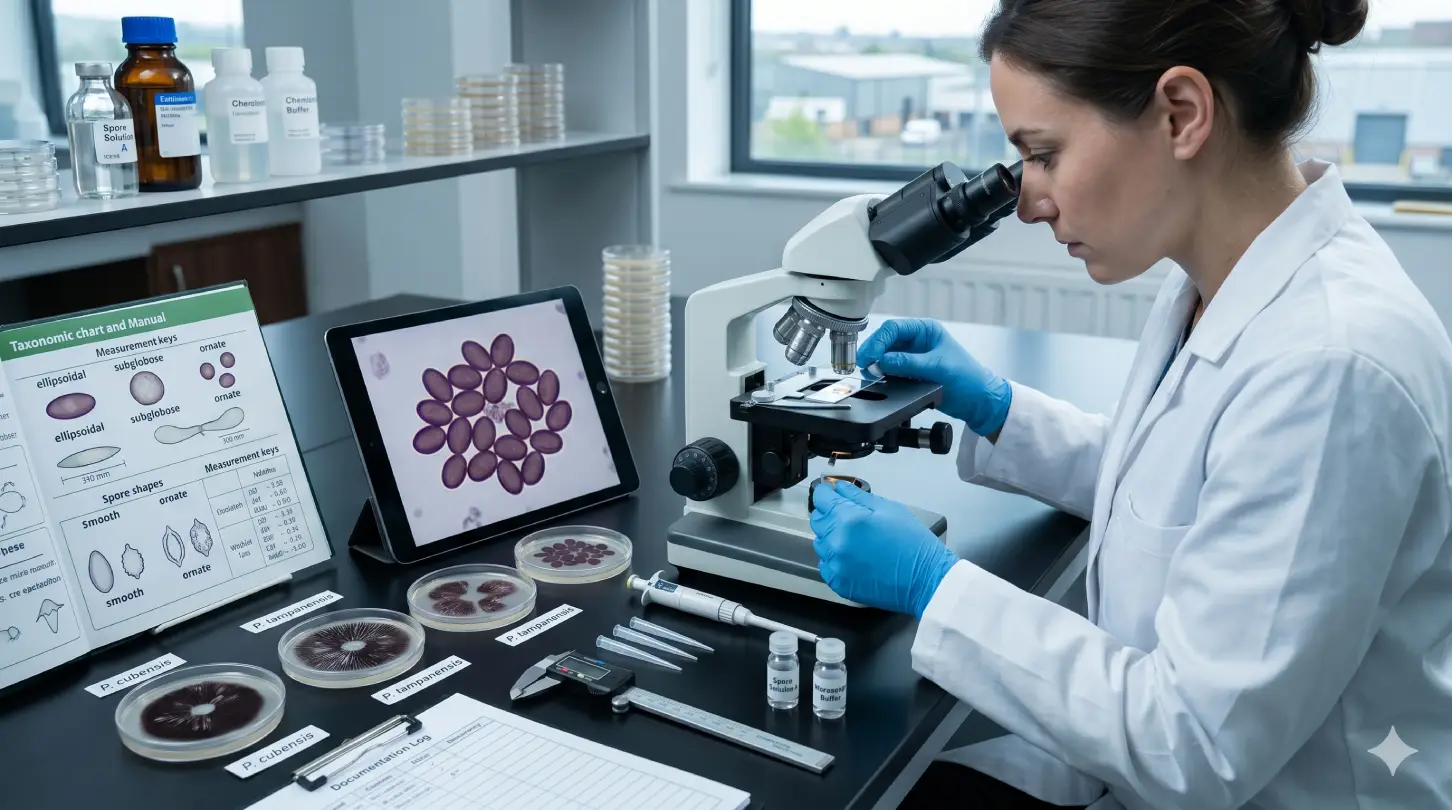
Quick Answer
Mushroom spore identification relies on five key characteristics: spore size (measured in micrometres using an eyepiece graticule), spore shape (ellipsoid, oblong, spherical, or angular), spore colour in deposit (purple-brown, black, white, or other), surface ornamentation (smooth, warted, or spiny), and germ pore presence. For psilocybe cubensis identification, look for 12-15 × 8-10μm ellipsoid spores with smooth surfaces, purple-brown colour, and distinct apical germ pores visible at 400x magnification. Always measure 10-20 spores to account for natural variation. Quality spore syringes ensure accurate identification practice with pure, viable specimens.
Introduction
Identifying mushroom species through spore morphology is genuine detective work.
Each characteristic you observe narrows the possibilities. The purple-brown colour eliminates hundreds of white-spored species. The 13μm size rules out smaller-spored genera. The distinct germ pore confirms you’re looking at a psilocybe rather than an agaricus.
Piece by piece, the evidence accumulates until identification becomes certain.
This skill separates casual microscopy hobbyists from serious mycology researchers. Anyone can view spores. Identifying them accurately requires systematic observation, precise measurement, and detailed documentation.
This guide teaches the specific characteristics used in scientific spore identification, with particular focus on psilocybe cubensis and related species legal for UK microscopy research. You’ll learn what to measure, how to measure it, and how to document findings for reference.
Whether you’re verifying specimens from your collection or building identification expertise, these fundamentals apply universally. The same observation techniques used by professional mycologists work equally well for amateur researchers with basic microscopy equipment.
Let’s develop your identification skills systematically.
The Five Key Identification Characteristics
Spore Size and Shape
Why it matters
Spore dimensions provide the first-line species identifier. A 6μm spore and a 14μm spore cannot be the same species, regardless of other similarities.
Size narrows identification significantly before you examine other characteristics.
How to measure
Accurate measurement requires an eyepiece graticule (also called eyepiece micrometer or reticle). This glass disc fits inside your microscope eyepiece and displays a calibrated scale over your specimen.
Calibration process: Use a stage micrometer (slide with known measurements) to determine how many graticule divisions equal one micrometre at each magnification.
At 400x magnification, one graticule division might equal 2.5μm. Measure spore length in divisions, multiply by your calibration factor.
Common shapes terminology
- Ellipsoid: Oval or egg-shaped, longer than wide
- Oblong: Elongated with parallel sides
- Cylindrical: Tube-shaped with rounded ends
- Spherical: Round, equal dimensions in all directions
- Angular: Having distinct corners or facets
- Lemon-shaped: Pointed at one or both ends
Psilocybe cubensis specifics
Size: 12-15μm long × 8-10μm wide (measure at widest points)
Shape: Subellipsoid to ellipsoid with rounded apex, not sharply pointed
Documentation tip
Always measure 10-20 spores minimum. Natural variation means individual spores vary by 1-2μm even within pure samples.
Record the range, not just average: “12.5-14.5μm” is more accurate than “13.5μm average.”
Spore Colour
Why it matters
Spore colour represents a major taxonomic division in mycology. White-spored, black-spored, pink-spored, and purple-brown-spored families rarely overlap.
Colour identification eliminates entire groups immediately.
Viewing technique
Spore colour appears most accurately in mass, not individually.
Single spores under transmitted light appear much lighter than their true colour. A purple-brown spore may look amber or yellowish when light passes through it individually.
Best observation: Dense spore deposit on slide or complete spore print shows true colour.
Psilocybe family characteristics
Purple-brown to purple-black deposit colour is diagnostic for psilocybe species.
This rich, dark purple-brown distinguishes psilocybe from similar genera.
Strain variations
Standard psilocybe cubensis strains show consistent purple-brown colour.
Leucistic or albino varieties may appear slightly lighter in deposit, though individual spores still show purple tones under magnification.
Common mistake
Never judge spore colour from single spores under high magnification with transmitted light. Always observe dense deposits for accurate colour determination.
Ornamentation and Surface Texture
Why it matters
Surface texture differentiates closely related species that share similar size and colour.
Some species have smooth spores. Others display warts, spines, ridges, or net-like patterns (reticulation).
Types of ornamentation
- Smooth: Completely unmarked surface (psilocybe cubensis)
- Warted/verrucose: Small bumps or warts on surface
- Spiny/echinulate: Spine-like projections
- Reticulated: Net-like pattern of ridges
- Striate: Parallel lines or grooves
Psilocybe cubensis characteristics
Completely smooth spore walls with no ornamentation whatsoever.
This smooth surface is a clean identification feature. Any visible texture or patterning suggests a different genus.
Viewing requirements
Fine ornamentation requires 1000x magnification with oil immersion for reliable observation.
At 400x, subtle ornamentation may be invisible. Only obvious spines or warts show clearly at lower magnifications.
Germ Pore
What it is
A germ pore is a thin spot in the spore wall where germination occurs. It appears as a lighter, sometimes slightly raised area at one end of the spore.
Not all mushroom species have visible germ pores.
Significance in identification
Germ pore presence or absence divides many genera cleanly.
Psilocybe species possess distinct germ pores. Many look-alike genera lack them entirely.
Psilocybe cubensis specifics
Distinct apical germ pore (at the pointed end of the ellipsoid spore).
Visible at 400x magnification as a lighter circular or oval area.
Becomes very clear at 1000x, appearing as a definite pale spot or slight protrusion.
Viewing tip
Germ pores show most clearly when spores rest at the edge of clusters. Spores buried in dense deposits may have obscured germ pores due to overlapping.
Adjust focus carefully. The germ pore exists at a slightly different focal plane than the main spore body, so fine focus adjustment reveals it.
Basidia Attachment Scar
Advanced feature
The hilum (attachment scar) shows where the spore connected to the basidium (spore-producing cell) before discharge.
This appears as a small, often slightly lighter area, typically opposite the germ pore.
Visibility
Requires careful focus at 400x minimum, better at 1000x.
Appears as a lighter spot, small depression, or subtle marking.
Taxonomic value
Confirms genuine mushroom spores rather than contaminants or other organisms.
Indicates sample purity when all spores show consistent attachment scars.
When relevant
Particularly useful for verifying pure spore samples and ruling out contamination by other spore types or particulates.
Identifying Psilocybe Cubensis: A Complete Profile
This definitive reference covers the most important species for UK microscopy research.
Visual Characteristics Summary
Size: 12-15μm long × 8-10μm wide (measure multiple specimens)
Shape: Subellipsoid to ellipsoid, smoothly rounded at apex, not sharply pointed
Colour: Purple-brown to dark purple-brown in deposit, individual spores appear lighter under transmitted light
Surface: Completely smooth, no ornamentation of any kind
Germ pore: Present, distinct, apical position (at spore apex), visible at 400x magnification
Wall thickness: Moderately thick compared to many species, contributes to spore visibility
Confirmation Protocol
Follow this systematic approach to confirm psilocybe cubensis identification:
Step 1: Measure dimensions
Select 10-20 well-separated spores across your slide. Measure length at longest point, width at widest point.
Record each measurement: 13.2μm, 12.8μm, 14.1μm, 13.5μm, etc.
Calculate range. Psilocybe cubensis should fall within 12-15 × 8-10μm consistently.
Step 2: Verify smooth surface
Switch to 1000x magnification (with oil immersion if available).
Examine multiple spores for any surface texture, warts, spines, or patterns.
Psilocybe cubensis should show absolutely smooth walls.
Step 3: Locate germ pore
At 400x minimum, carefully focus on the apex (pointed end) of ellipsoid spores.
Look for a distinct lighter circular or oval area.
This should be consistently present and clearly visible across multiple spores.
Step 4: Confirm colour in mass
Observe dense spore clusters or deposits on your slide.
True purple-brown colour (not black, not chocolate brown, not grey-brown) confirms psilocybe characteristics.
Step 5: Document findings
Photograph representative spores showing clear germ pores.
Record measurements with date and specimen source.
Compare against authenticated reference specimens.
Strain Variations
An important clarification for microscopy researchers:
Most psilocybe cubensis strains are indistinguishable by spore morphology alone.
Golden Teacher, B+, Penis Envy, Ecuador, and dozens of other cultivated strains all show the same basic spore characteristics: 12-15 × 8-10μm, ellipsoid, smooth, purple-brown, with apical germ pores.
Slight variations observed
Some strains trend towards the larger or smaller end of the size range. Penis Envy variants occasionally show slightly larger spores (14-16μm).
Albino or leucistic strains may display slightly lighter purple-brown colour in deposits, though individual spore morphology remains identical.
Why this matters legally
Spore morphology consistency across strains is precisely why microscopy research remains legal. Spores contain no psilocybin, and strain identification requires cultivation characteristics not visible in spores themselves.
For cultivation differences between strains (growth rate, potency, appearance), see our complete strain comparison guide. These differences don’t appear under microscopy.
Comparative Identification: Other Species You Might Encounter
Understanding psilocybe cubensis identification deepens significantly through comparison with other species.
Comparison Table
| Species | Spore Size (μm) | Colour | Germ Pore | Surface | Key Identifier |
| Psilocybe cubensis | 12-15 × 8-10 | Purple-brown | Distinct, apical | Smooth | Purple-brown + clear germ pore |
| Agaricus sp. | 6-8 × 4-5 | Chocolate brown | Absent/weak | Smooth | Smaller, no clear germ pore |
| Panaeolus sp. | 11-17 × 7-10 | Dark purple-black | Present | Smooth | Darker colour, more angular |
| Stropharia sp. | 7-9 × 4-5 | Purple-grey | Present | Smooth | Smaller, grey tones |
| Coprinopsis sp. | Varies | Jet black | Present | Smooth | True black (not purple-brown) |
Agaricus (Common Button Mushroom Family)
Spore size: 6-8μm long × 4-5μm wide (significantly smaller than psilocybe)
Colour: Chocolate brown to purple-brown (similar but distinguishable under careful observation)
Germ pore: Absent or extremely indistinct
Ornamentation: Smooth
Key identification difference: Much smaller overall dimensions combined with absent or unclear germ pore separates agaricus from psilocybe definitively.
Even though colour appears similar, the size difference (nearly half the length) makes confusion unlikely with proper measurement.
Panaeolus (Close Relative)
Spore size: 11-17μm long × 7-10μm wide (overlaps significantly with psilocybe range)
Colour: Black to very dark purple-brown (noticeably darker than psilocybe)
Shape: Ellipsoid to lemon-shaped, often more pointed or angular than psilocybe
Germ pore: Present and visible
Key identification difference: Darker colour approaching true black rather than purple-brown, and more angular or pointed spore shape.
This genus requires careful observation because size overlaps with psilocybe. Colour and shape become critical differentiators.
Stropharia (Garden Species)
Spore size: 7-9μm long × 4-5μm wide (smaller than psilocybe)
Colour: Purple-brown to purple-grey
Germ pore: Present but less distinct than psilocybe
Ornamentation: Smooth
Key identification difference: Smaller dimensions and purple-grey colouration (grey tones not present in psilocybe purple-brown).
Coprinopsis (Inky Cap Species)
Spore size: Highly variable depending on species (8-18μm range across genus)
Colour: Jet black (true black, not purple-toned)
Shape: Ellipsoid with prominent germ pore
Surface: Smooth to slightly roughened depending on species
Key identification difference: Absolute jet black colour instantly separates coprinopsis from all purple-brown-spored species.
No purple tones whatsoever. This makes identification straightforward despite size variability.
Important Clarification
This comparative information serves educational purposes only.
All microscopy research should focus on legally obtained specimens from authenticated sources like SporeBuddies’ curated collection.
Field identification of wild mushrooms requires multiple characteristics beyond spores and falls outside the scope of microscopy-only research. For legal UK microscopy study, purchase authenticated specimens rather than collecting unknown samples.
Documentation and Record-Keeping for Identification
Systematic documentation transforms casual observation into scientific practice.
Why Document Findings
Builds personal reference library: Your own observations become more valuable than generic descriptions after you’ve examined dozens of specimens.
Improves accuracy over time: Comparing current observations with past records reveals patterns and sharpens identification skills.
Enables meaningful comparisons: Documented measurements allow direct comparison between specimens, strains, and species.
Develops scientific habits: Professional mycologists document everything. Amateur researchers benefit equally from this discipline.
What to Record
Basic Information
Every observation session should begin with:
- Date of observation: Standard date format
- Strain/species name: If known, include full name and strain
- Specimen source: “SporeBuddies Golden Teacher spore syringe, batch GT-2026-03” provides traceability
- Microscope details: Model and magnification used for each observation
Measurements
Length × width range: Measure 10-20 spores minimum
Record individual measurements: 12.5, 13.2, 14.1, 13.8, 12.9, 14.3μm…
Calculate range: 12.5-14.3μm
Note average: 13.4μm average
Outliers: Note any unusually large or small specimens separately
Measurement conditions: Record magnification, calibration factor used, any measurement difficulties
Descriptive Characteristics
Shape: Use standard terminology consistently (ellipsoid, oblong, cylindrical, spherical, angular, lemon-shaped)
Colour: Describe accurately, avoid subjective terms (“purple-brown” not “pretty brown” or “dark-ish”)
Ornamentation: Present or absent, type if present (smooth, warted, spiny, reticulated)
Germ pore: Present or absent, position (apical, lateral), clarity (distinct, indistinct, absent)
Wall thickness: Relative observation (thick, moderate, thin compared to other species)
Visual Documentation
Photographs at multiple magnifications: 100x overview, 400x standard view, 1000x detail shots
Labelled diagrams: Hand-drawn sketches with measurements annotated often capture details photos miss
Comparison images: Side-by-side photos of different species or strains highlight differences clearly
Observations and Notes
Distinguishing features: “Germ pore unusually clear compared to previous specimens”
Comparison with similar species: “More rounded apex than panaeolus, confirming psilocybe”
Confidence level: “High confidence – all characteristics match psilocybe cubensis definitively”
Questions for further research: “Slight size variation from previous Golden Teacher sample – batch variation or measurement error?”
Organisation System
Create a consistent filing system from the beginning:
Physical notebook: Dated entries, one page per observation session
Digital folder structure:
- 2026/
- May/
- 2026-05-18-Golden-Teacher-GT-2026-03/
- measurements.txt
- photos-400x/
- photos-1000x/
- notes.txt
- 2026-05-18-Golden-Teacher-GT-2026-03/
- May/
Spreadsheet log: Quick-reference table with key data from all sessions
Cross-referencing: Link physical notes to digital photos by consistent naming and dating
Common Identification Mistakes and How to Avoid Them
1. Relying on Single Spore Measurement
Why it’s wrong: Natural variation exists even within pure samples. One 10μm spore doesn’t mean the species averages 10μm.
Individual measurements can fall 1-2μm above or below species average due to natural developmental variation.
Solution: Always measure 10-20 spores across different areas of your slide.
Record the full range, not just one measurement.
Calculate average only after recording multiple individual measurements.
Example: Measuring one 10.5μm spore and concluding “too small for psilocybe” ignores that the next 15 spores might measure 12-14μm.
2. Confusing Transmitted Light Colour with True Spore Colour
Why it’s wrong: Individual spores appear much lighter when light passes through them under magnification.
A purple-brown spore can look amber, yellowish, or pale brown when viewed individually under transmitted light.
Solution: Observe spore colour in dense deposits or complete spore prints.
Multiple spores stacked together reveal true colour accurately.
Correct method: Purple-brown deposit colour appears almost amber when light transmits through single spores. This is normal and expected.
Judge colour from clumps and deposits, not isolated spores.
3. Assuming All Purple-Brown Spores Are Psilocybe
Why it’s wrong: Agaricus, Stropharia, and Panaeolus also produce purple-brown to chocolate-brown spores.
Colour alone never identifies species definitively.
Solution: Check all characteristics systematically – size, germ pore presence, shape, exact colour shade.
A 7μm purple-brown spore with no germ pore is agaricus, not psilocybe, despite colour similarity.
Reinforcement: Purchasing from trusted sources like SporeBuddies ensures accurate species identification from the start, providing reliable specimens for building identification skills.
4. Attempting Identification Without Proper Magnification
Why it’s wrong: Germ pores, fine ornamentation, and exact size measurements become invisible below 400x magnification.
Shape and approximate size appear at 100x, but diagnostic features require higher magnification.
Solution: Use minimum 400x for preliminary identification. Confirm with 1000x when possible.
Budget microscopes limited to 100-400x work adequately for psilocybe cubensis (germ pore visible at 400x), but advanced species identification requires higher magnification capability.
Equipment reality: Quality microscopes significantly improve identification success rate.
5. Ignoring Spore Deposit Patterns
Why it’s wrong: How spores distribute on slides provides contextual clues about sample quality and species characteristics.
Dense, even distribution versus clumpy, uneven spread reveals information about preparation quality and spore characteristics.
Solution: Observe distribution patterns alongside individual spore characteristics.
Note whether spores appear mostly individual or heavily clumped.
SporeBuddies advantage: Double-density spore syringes provide optimal concentration for observing both individual spores and natural distribution patterns without excessive clumping.
6. Not Accounting for Sample Contamination
Why it’s wrong: Foreign spores, pollen, mould spores, or debris confuse identification if you assume everything visible belongs to your target species.
Mixed samples contain multiple spore types with different characteristics.
Solution: Learn what non-spore particles look like under magnification.
Familiarise yourself with common contaminants: pollen (often larger, textured), mould spores (usually much smaller, may be coloured), debris (irregular, non-uniform).
Procurement: Quality sources ensure clean, uncontaminated specimens prepared in controlled conditions.
7. Over-Relying on Online Photos Without Direct Measurement
Why it’s wrong: Photographs lack inherent scale unless calibrated. Colours vary dramatically by monitor, lighting, and camera settings.
Two identical spores photographed under different conditions appear completely different colours.
Solution: Trust your own measurements and observations first.
Use online photos and guides as general references, not definitive comparisons.
Your calibrated measurements are more reliable than uncalibrated images.
Building Your Reference Collection
Strategic specimen acquisition accelerates identification skill development.
Foundation Strains (Start Here)
Begin with well-documented, consistent strains that establish baseline understanding:
Golden Teacher: Classic reference specimen with consistent morphology, excellent for establishing your measurement baseline.
B+: Beginner-friendly with reliable spore distribution and visibility, ideal for practising measurement technique.
Ecuador: Geographic variety providing direct comparison with Golden Teacher to observe subtle intra-species variation.
Why these three: Consistent, thoroughly documented in mycological literature, readily available from verified UK sources.
These strains establish your personal reference standard. Every future specimen gets compared against these baseline observations.
Expand to Variations
Once you’ve mastered basic identification with foundation strains:
Albino varieties: Study leucistic morphology and slight colour variations while confirming that shape, size, and germ pore remain identical.
Penis Envy variants: Observe size variation within species (typically 14-16μm rather than 12-14μm).
Exotic strains: Thai, Cambodian, Brazilian varieties demonstrate that geographic origin doesn’t alter fundamental spore morphology.
Skill building: Subtle difference detection improves significantly when comparing closely related varieties.
Cross-Species Comparison (Advanced)
After thoroughly understanding psilocybe cubensis variations:
Other UK-legal species: Study comparison species (coprinopsis, agaricus, etc.) to understand genus-level versus species-level characteristic differences.
Building comprehensive reference: A collection spanning multiple genera teaches identification principles applicable beyond single-species focus.
Research value: Understanding what characteristics remain consistent within genus (psilocybe germ pores) versus what varies between species (spore size) develops taxonomic thinking.
Pro Tip: Create a personal spore atlas by printing your best photographs with measurements annotated, organised by species and strain, and add new entries each month. Within a year, you’ll have a reference collection that surpasses most textbook illustrations, and every image comes from specimens you’ve studied personally. This becomes your most valuable identification resource.
Why This Matters
Accurate identification represents the foundation of scientific mycology.
The observational rigour required for spore identification applies far beyond microscopy. Systematic measurement, detailed documentation, and evidence-based conclusions develop critical thinking applicable to any scientific pursuit.
Your personal reference collection becomes both achievement and ongoing education. Each documented observation contributes to a growing knowledge base that makes subsequent identifications faster and more confident.
Quality specimens from trusted sources like SporeBuddies ensure identification accuracy from the very beginning. Learning identification with contaminated, mislabelled, or low-quality samples teaches errors rather than skills.
This expertise contributes to broader citizen science and mycological knowledge. Accurate observations by amateur researchers worldwide advance understanding of fungal diversity and distribution.
Most importantly, identification skills make microscopy research intellectually satisfying rather than just visually interesting. Understanding what you see, recognising diagnostic features, and confirming identity through evidence transforms passive viewing into active scientific investigation.
Common Mistakes: Quick Reminders
Top 3 critical points for identification success:
- Measure multiple spores, not just one – Natural variation requires 10-20 measurements for accurate species identification
- Confirm all characteristics, not just colour or size – Diagnostic identification requires systematic verification of size, shape, colour, germ pore, and surface texture
- Use trusted specimen sources – Contaminated or mislabelled samples make accurate identification impossible regardless of technical skill
Frequently Asked Questions
Can I identify a mushroom species from spores alone?
Spores provide critical identification information but usually insufficient evidence alone for definitive species determination.
Accurate field identification typically requires spore morphology combined with macroscopic features (cap shape and colour, gill attachment, stalk characteristics, habitat, and seasonal occurrence).
However, spore characteristics definitively rule out many species and narrow possibilities significantly. A purple-brown spore with distinct germ pore measuring 13μm eliminates hundreds of white-spored, black-spored, or germ-pore-absent species immediately.
For microscopy-only research using purchased specimens, trusted suppliers like SporeBuddies provide accurately labelled specimens, eliminating identification uncertainty and allowing focus on morphological study rather than species determination.
What magnification do I need for spore identification?
400x magnification minimum for basic identification covering size measurement, germ pore observation, and general shape determination.
1000x magnification with oil immersion for advanced features including fine ornamentation details, precise wall structure observation, and confirmation of subtle surface textures.
Most hobby-grade compound microscopes offering 100x-400x magnification work adequately for psilocybe cubensis identification specifically, as the distinctive germ pore remains clearly visible at 400x magnification.
Budget microscopes limited to 400x maximum successfully handle identification of species with obvious diagnostic features but struggle with closely related species requiring subtle differentiation.
Are all psilocybe cubensis strains identical under the microscope?
Spore morphology remains nearly identical across all psilocybe cubensis strains.
All strains show the same fundamental characteristics: 12-15 × 8-10μm size range, ellipsoid shape, purple-brown colour, smooth surface, and distinct apical germ pore.
Golden Teacher, B+, Penis Envy, Ecuador, Thai, and dozens of other cultivated strains cannot be reliably distinguished by spore morphology alone. Strain differences (potency, growth rate, fruiting body appearance) arise during cultivation and don’t manifest in spore characteristics.
This morphological consistency is precisely why spore microscopy research remains legal – spores contain no psilocybin, and strain identification requires cultivation characteristics not visible through microscopy.
For cultivation differences between strains, see our complete strain comparison guide.
How do I know if my spore sample is pure and not contaminated?
Pure psilocybe cubensis samples display uniform spore size (all specimens within 12-15μm range), consistent purple-brown colour throughout deposit, and all visible spores showing clear apical germ pores.
Contamination indicators include:
- Mixed spore sizes (some 7μm, some 14μm suggests multiple species)
- Foreign colours (green, white, or other colours indicate mould or pollen)
- Irregular shapes (highly angular, branching, or asymmetric forms suggest contaminants)
- Debris or non-spore particles visible throughout sample
Purchasing from quality suppliers like SporeBuddies minimises contamination risk significantly. Syringes prepared in controlled conditions with proper sterile technique contain pure, single-species spore suspensions ideal for identification practice and reference building.
What UK mushroom species are legal to study under microscopy besides psilocybe cubensis?
Many species remain completely legal for UK microscopy research.
Coprinopsis (inky caps), Agaricus (button mushrooms and relatives), Coprinus, Stropharia, and numerous gourmet varieties including oyster mushroom spores and shiitake spores are all legal without restriction.
Only cultivation of psilocybin-containing species faces legal restrictions. Spore study, microscopy research, and educational observation remain legal for all species without exception.
SporeBuddies focuses on psilocybe cubensis varieties as they’re most popular for microscopy research due to distinctive morphology, large spore size (easier for beginners), and clear diagnostic features (prominent germ pores).
For comprehensive legal information, see our detailed UK spore legality guide.
Build Your Reference Collection: Browse All Microscopy Strains
Ready to develop serious identification skills?
SporeBuddies offers the UK’s most comprehensive selection of authenticated, microscopy-grade spore specimens.
Every syringe includes:
- Species-verified specimens for accurate identification practice
- Double-density spore concentration revealing features more clearly
- Prepared in controlled conditions ensuring sample purity
- Detailed batch information for documentation and traceability
Build Your Foundation:
- Golden Teacher Spore Syringe – Ideal reference specimen
- B+ Spore Syringe – Consistent morphology for learning
- Starter Syringe Pack – Compare two strains directly
Expert Support Available: Questions about identification characteristics? Call our team at 0800 069 9269 for genuine mycology expertise.
All specimens supplied for legal microscopy research and educational study purposes only.