
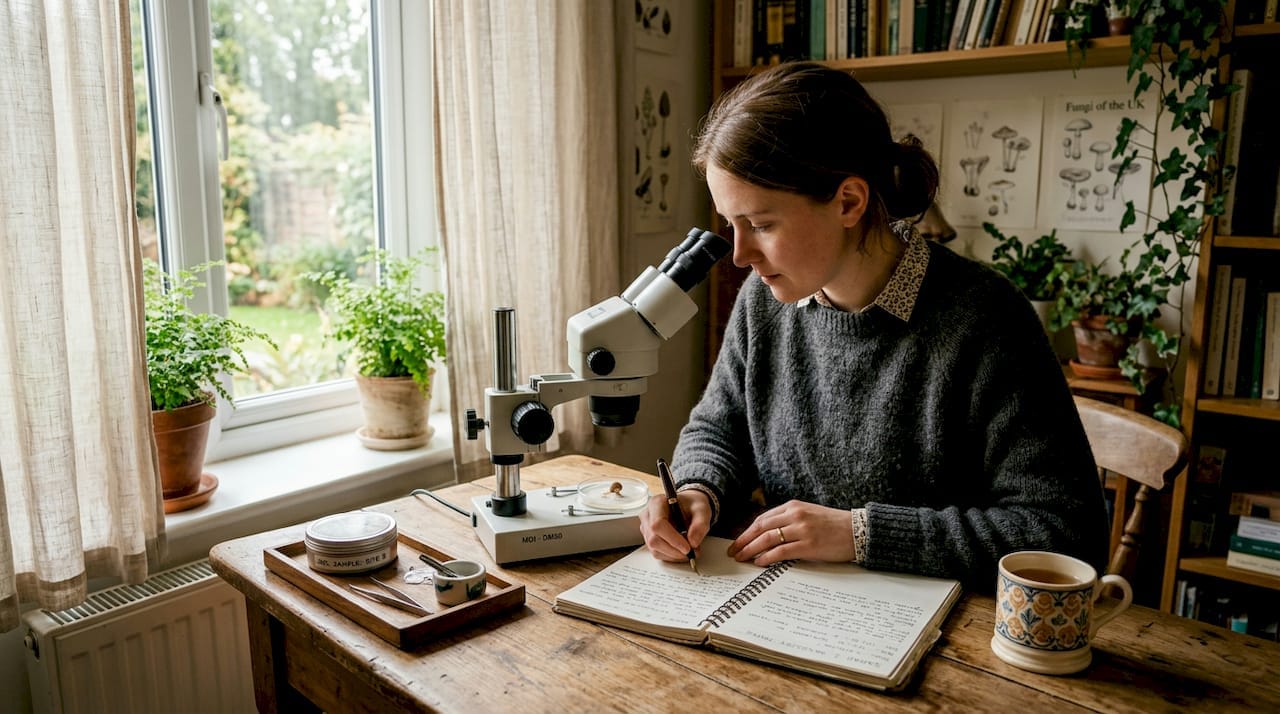
Most people see a mushroom and think of something simple. A plant, perhaps, or just a fungus that appeared after rain. Understanding what is mushroom life cycle reveals something far more extraordinary. That cap you see above ground is not the organism itself. It is the fruiting body of a vast, living network that threads through soil, logs, and leaf litter. From a single spore invisible to the naked eye, a fungus can colonise entire forest floors, cycle nutrients, and keep ecosystems functioning. This article walks you through every stage of the mushroom lifecycle, with the biology explained clearly for students and enthusiasts alike.
Table of Contents
- Key takeaways
- Stage 1: Spore release and germination
- Stage 2: Mycelium network formation
- Stage 3: Primordia formation and fruiting
- Stage 4: Spore dispersal and cycle completion
- Variations in fungal reproduction
- My perspective on the mushroom life cycle
- Start exploring with Sporebuddies
- FAQ
Key takeaways
| Point | Details |
|---|---|
| Mushrooms begin as spores | A single mature mushroom releases millions of spores daily to propagate the species. |
| Mycelium is the true organism | The visible mushroom is only the fruiting body; the mycelium network does the real biological work. |
| Environment triggers fruiting | Temperature, humidity, and light are the key signals that cause mycelium to produce mushrooms. |
| Life cycle duration varies widely | The full cycle can range from a single day to over a month depending on species and conditions. |
| Fungi have ecological roles | Mushrooms decompose organic matter, cycle nutrients, and form symbiotic partnerships with plant roots. |
Stage 1: Spore release and germination
Every mushroom life cycle begins with a spore. These microscopic reproductive units are produced in astonishing quantities. A single mature mushroom can release hundreds of millions of spores into the air from structures located on its gills, pores, or teeth, depending on the species. The sheer volume exists for one reason: survival. The vast majority of spores never reach a suitable substrate, so nature compensates with numbers.
Spores are exceptionally well adapted for dispersal. Their cell walls are thick and resistant, allowing them to survive desiccation, UV exposure, and mechanical stress. Once a spore lands on a surface, it begins to assess its environment at a biochemical level, detecting moisture, organic nutrients, and temperature. When conditions are right, germination begins.
Germ tubes emerge from spores to initiate the growth of hyphae, the thread-like filaments that form the basis of the fungal body. This germination stage is arguably the most fragile point in the entire cycle. Without sufficient moisture and a nutrient-rich substrate, the process stalls.
- Spore location: Produced on gills (Agaricales), pores (Boletales), and spines (Hydnaceae)
- Dispersal vectors: Wind, rain splash, passing insects, and larger animals
- Germination trigger: Adequate moisture, suitable temperature range, and organic substrate
- First structure formed: The germ tube, which elongates into the primary hypha
Pro Tip: If you are studying spore germination under a microscope, use a water agar plate to observe germ tubes forming within 12 to 24 hours at room temperature.
Stage 2: Mycelium network formation
Once hyphae are established, they grow by elongation at their tips through a process of mitosis. As two compatible hyphae from different spores meet, they can fuse in a process called anastomosis, forming a more genetically complex structure. This fusion creates a dikaryotic mycelium, in which cells contain two genetically distinct nuclei. It is this dikaryotic state that eventually has the potential to produce a fruiting body.
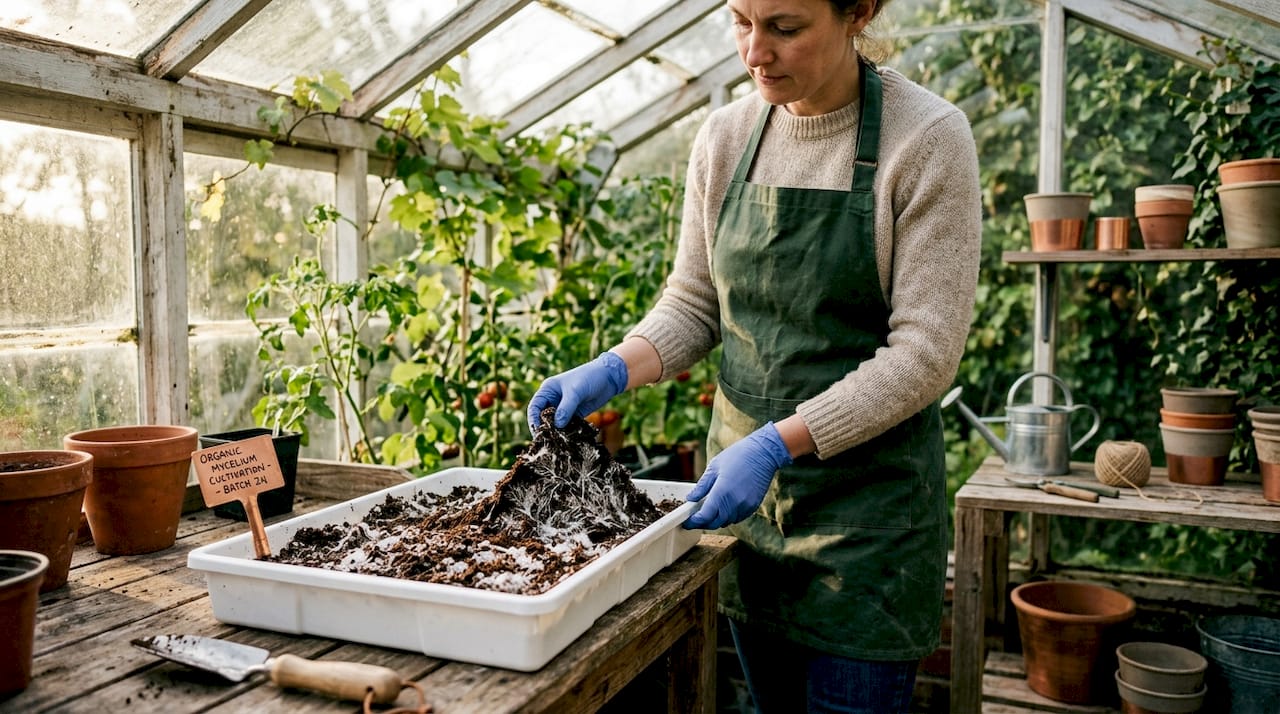
The collective mass of hyphae is called mycelium, and it expands outward through the substrate in search of nutrients. Mycelium is extraordinarily efficient at breaking down complex organic compounds, including lignin and cellulose, which very few other organisms can digest. This makes fungi the primary decomposers in most terrestrial ecosystems.
| Mycelium type | Nuclei per cell | Reproductive capacity | Key role |
|---|---|---|---|
| Monokaryotic | 1 (haploid) | Cannot produce fruiting bodies alone | Initial germination phase |
| Dikaryotic | 2 (one from each parent) | Capable of producing fruiting bodies | Main colonisation phase |
| Mycelium in mycorrhizae | 2 (dikaryotic) | Context-dependent | Symbiotic plant partnership |
Beyond decomposition, mycelium forms partnerships with plant roots known as mycorrhizal associations. In these relationships, the fungus provides the plant with phosphorus and water in exchange for sugars produced through photosynthesis. Mycelial networks connect and support forest ecosystems in ways that researchers are still mapping. Some scientists refer to these networks as the “wood wide web,” a communication and nutrient-sharing system that links individual trees across entire forests.
Mycelium also accumulates resources. Before a mushroom can form, the mycelium must store sufficient carbon, nitrogen, and other compounds. Think of this phase as the foundation being laid before construction begins.
Pro Tip: Healthy mycelium in cultivation looks bright white and feels rope-like. If you see green, black, or pink colouration, that is contamination, not the fungus itself.
Stage 3: Primordia formation and fruiting
The transition from invisible mycelium to visible mushroom is one of the most dramatic events in biology, and it does not happen randomly. Environmental signals trigger fruiting when the mycelium receives specific cues from its surroundings. A drop in temperature, an increase in relative humidity, exposure to fresh air exchange, or a shift in light levels can all act as the starting signal. In the wild, this often corresponds to seasonal change, typically the arrival of autumn rains or a warm spring flush.
The stages of mushroom development from mycelium to mature fruiting body follow a consistent sequence:
- Hyphal knot formation. Dense clusters of hyphae aggregate at specific points within the mycelium colony. These knots represent the first visible indication that fruiting is beginning.
- Primordium development. The hyphal knots differentiate into primordia, often called “pins” in cultivation. At this point the basic structure of the future mushroom is established, including the cap, stipe, and gill tissue.
- Pin maturation. Pins expand rapidly as the mycelium channels water and nutrients upward. Water uptake accounts for the majority of the physical growth at this stage. A pin can grow to full size in a matter of hours under optimal conditions.
- Veil breaking. In species with a partial veil (such as Agaricus bisporus, the common button mushroom), the thin membrane connecting the cap edge to the stipe tears as the cap expands. This exposes the gills.
- Full cap expansion. The cap flattens or opens to its species-specific form. At this point the mushroom is mature and ready to release spores.
The environmental conditions during this phase determine the quality of the fruiting body. Low humidity produces small, cracked caps. Insufficient fresh air exchange leads to elongated stipes and underdeveloped caps. This is why both wild foragers and cultivators pay close attention to what mushrooms need to grow: stable humidity above 80%, temperatures appropriate to the species, and adequate air circulation.
Stage 4: Spore dispersal and cycle completion
Once fully matured, the mushroom’s primary purpose is reproduction. The cap and gill structure serve as a precisely engineered spore delivery system. Gills hang vertically beneath the cap, maximising the surface area available for spore production and allowing released spores to fall freely downward into airflow. In a single fruiting session, the release is continuous and enormous in scale.
The ecological impact of this stage extends well beyond reproduction. Consider the following:
- Soil health: Mushrooms indicate nutrient-rich soil and actively enrich the substrate beneath them as they decompose.
- Carbon cycling: Fungal decomposition converts organic carbon in dead wood and leaf litter back into forms accessible to other organisms.
- Symbiosis: Spores from mycorrhizal species like truffles and fly agaric travel to new sites, potentially forming new partnerships with compatible tree roots.
- Food web support: Many invertebrates, small mammals, and birds feed on mushrooms, spreading spores further through their digestive tracts.
“Fungi are neither plant nor animal. They occupy their own kingdom, and understanding their life cycle means accepting that the categories we use for living things are often too simple for the complexity of nature.”
The duration of the full cycle varies considerably. Cycle duration ranges from 1 day to 1 month or more, with fast-fruiting species like ink caps completing the entire process in under 48 hours. Slower species, including some medicinal varieties, take weeks to produce mature fruiting bodies. This variability reflects adaptation to specific ecological niches and environmental conditions.
Variations in fungal reproduction
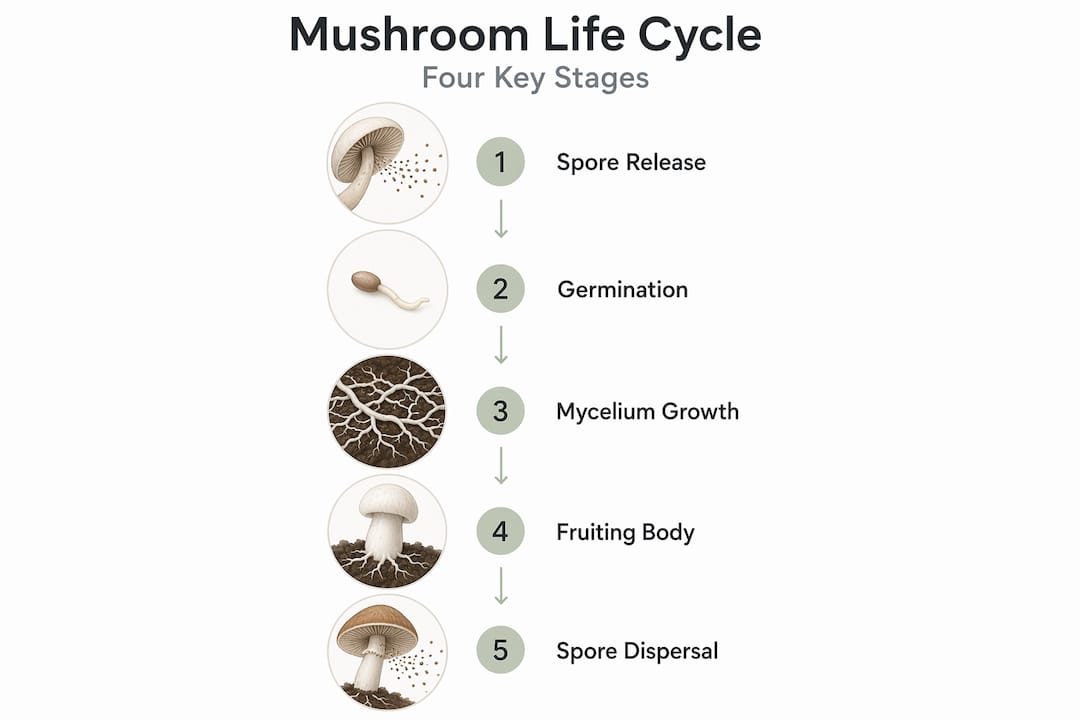
The basic four-stage cycle described above is a framework, not a fixed rule. Fungal reproduction involves a level of complexity that sets fungi apart from nearly every other group of organisms.
Most notably, fungi do not have simple male and female sexes. Instead, they operate with mating types controlled by specific genetic loci. Depending on the species, up to 23,000 mating combinations exist within the fungal kingdom, meaning that almost any two compatible individuals can mate. This generates enormous genetic diversity and contributes to the resilience of fungal populations in the face of environmental change.
Some species bypass sexual reproduction entirely. Deuteromycetes, sometimes called the “imperfect fungi,” reproduce only asexually through structures called conidia. Others can switch between sexual and asexual strategies depending on environmental stress.
| Reproductive mode | Mechanism | Genetic outcome | Example group |
|---|---|---|---|
| Sexual (dikaryotic) | Hyphal fusion and karyogamy | High genetic diversity | Basidiomycetes |
| Asexual (mitotic) | Conidial spores or fragmentation | Genetically identical clones | Deuteromycetes |
| Mixed strategy | Switches based on environment | Variable | Ascomycetes |
Fungal adaptability also extends to extreme environments. Certain species thrive in deserts, polar regions, and even highly radioactive environments. This range of adaptations makes fungi some of the most resilient life forms on Earth, and it is the lifecycle itself, particularly the resistant spore stage, that makes this possible.
Start exploring with Sporebuddies
If learning the mushroom lifecycle has sparked an interest in cultivation, Sporebuddies makes it straightforward to take the next step. Whether you are a student looking to observe spore germination under a microscope or an enthusiast ready to grow your first flush, the range at Sporebuddies covers everything from entry-level to advanced. Browse the full selection of mushroom spores including strains like Golden Teacher, B+, and Penis Envy, or explore mushroom growing kits for shiitake, oyster, and lion’s mane. All products are sourced for quality and supplied with the information you need to practise responsibly. For anyone cultivating at scale, wholesale mushroom spores are also available in the UK.
FAQ
What is the mushroom life cycle?
The mushroom life cycle is the biological process by which fungi reproduce, beginning with spore release, followed by germination, mycelium formation, fruiting body development, and further spore dispersal. The full cycle can last anywhere from one day to several weeks depending on species and environmental conditions.
How do mushrooms grow from spores?
When a spore lands on a suitable substrate, it germinates by forming a germ tube that develops into hyphae. Compatible hyphae fuse to form a dikaryotic mycelium, which colonises the substrate and eventually produces a fruiting body when environmental triggers like humidity and temperature align.
What does mycelium do in the fungal life cycle?
Mycelium is the main body of the fungus. It decomposes organic matter, absorbs nutrients, and stores resources needed to produce fruiting bodies. In mycorrhizal species, it also forms partnerships with plant roots, exchanging nutrients in a mutually beneficial relationship.
What do mushrooms need to grow?
Mushrooms require a colonised substrate with sufficient organic matter, humidity above 80%, appropriate temperature for the species, adequate fresh air exchange, and in some species a light cue. These environmental conditions trigger fruiting once the mycelium is fully established.
Are all mushroom life cycles the same?
No. While the core stages are consistent, duration, reproductive strategy, and environmental requirements vary significantly between species. Some fungi reproduce only asexually, others switch strategies depending on stress, and the fungal kingdom contains up to 23,000 mating combinations, reflecting extraordinary diversity in reproductive biology.