
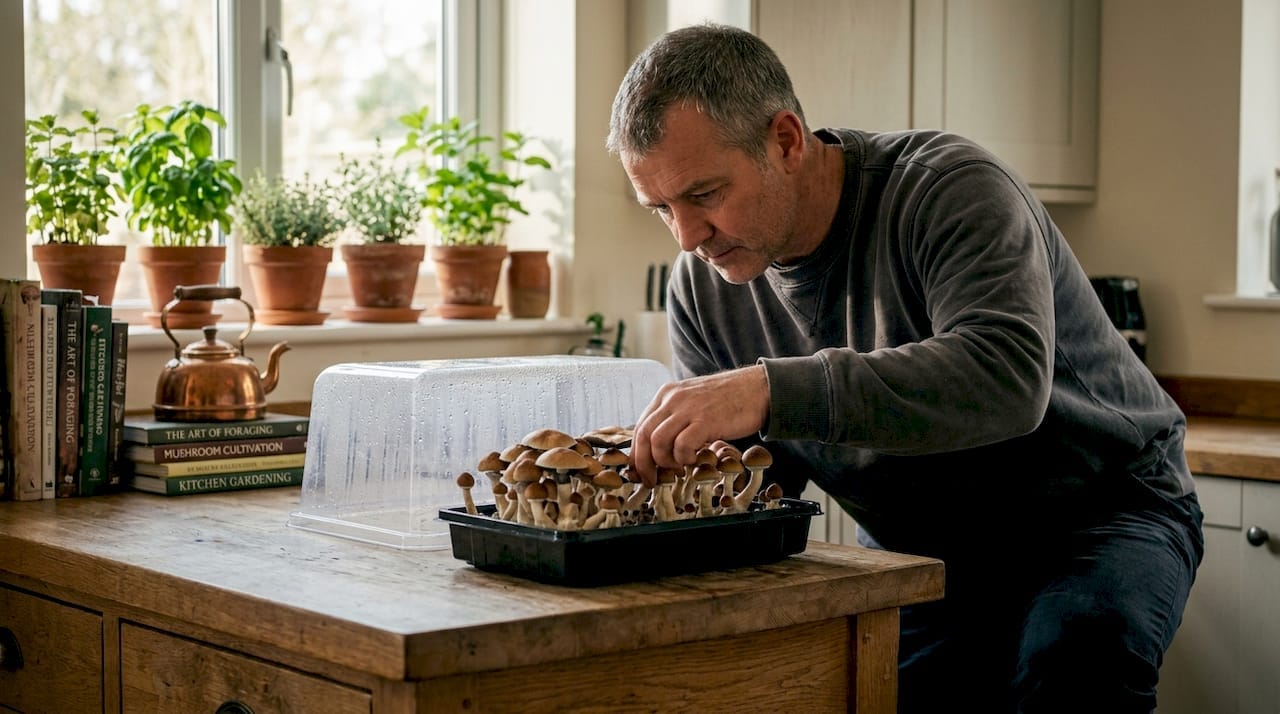
Not all Psilocybe cubensis strains behave the same way, and if you have spent any time in UK home cultivation circles, you will have noticed that B+ comes up again and again as a go-to choice for beginners and experienced growers alike. It has a reputation for being fast, forgiving, and reliably productive, but separating fact from community lore is harder than it sounds. This guide covers everything you need to know about B+ mushrooms, from their origins and growth characteristics to practical cultivation steps and what the evidence actually says about potency and effects.
Table of Contents
- What is the B+ mushroom strain?
- Unique growth characteristics of B+ mushrooms
- How to cultivate B+ mushrooms at home
- Potency, user reports, and wellness perspectives
- Why B+ mushrooms remain a favourite among UK home cultivators
- Expand your mushroom cultivation journey
- Frequently asked questions
Key Takeaways
| Point | Details |
|---|---|
| B+ mushrooms are beginner-friendly | Their fast growth and resilience make them a top choice for new cultivators. |
| Science meets community wisdom | Most B+ cultivation knowledge is based on the shared experiences of hobbyists and supported by select academic evidence. |
| Potency varies | Effects and potency of B+ mushrooms are mostly informed by user reports, so actual experience may differ. |
| UK legal rules matter | Growing for personal consumption is not legal in the UK, but research and microscopy with spores is permitted. |
| Document your experience | Keeping track of your own cultivation results helps expand collective UK knowledge about B+ mushrooms. |
What is the B+ mushroom strain?
B+ is a variety of Psilocybe cubensis, the most widely cultivated species in the amateur mycology world. Unlike formally recognised botanical varieties, B+ does not have an official scientific classification of its own. It exists primarily as a cultivar, meaning it has been selected and propagated by hobbyists over many years rather than described in peer-reviewed taxonomy. That said, its reputation is anything but informal.
Understanding B+ starts with understanding its place within the broader mushroom genetics guide for home cultivators. Psilocybe cubensis as a species is highly variable. Different cultivars can show meaningful differences in colonisation speed, fruiting body size, yield, and environmental tolerance. B+ sits at the more adaptable end of that spectrum.
The origins of B+ are murky, as is common with many cultivated strains. Community lore credits a Florida grower known as “Mr. G” with developing the strain in the 1980s or 1990s, though this has never been formally verified. What has persisted is the reputation: fast-growing mycelium that colonises substrate quickly and fruits reliably across a range of conditions.
Here is a quick overview of what defines B+ as a cultivar:
| Feature | B+ characteristic |
|---|---|
| Species | Psilocybe cubensis |
| Classification | Cultivar (not a formal botanical variety) |
| Colonisation speed | Reported as among the fastest |
| Fruiting reliability | High, even in variable conditions |
| Beginner suitability | Widely considered excellent |
| Spore availability | Widely available in the UK for research |
Key traits that make B+ stand out among P. cubensis cultivars:
- Resilience: B+ tolerates minor fluctuations in temperature and humidity better than many comparable strains.
- Yield: Growers frequently report large, caramel-capped fruiting bodies with thick, meaty stems.
- Versatility: It performs well across a range of substrates, from brown rice flour and vermiculite to more advanced grain-based options.
- Genetics: While hybridisation rumours circulate (some suggest a Psilocybe azurescens cross), these claims remain unverified.
With the basics introduced, let’s dig into what actually makes B+ stand out from the crowd.
Unique growth characteristics of B+ mushrooms
Now that you know what B+ mushrooms are, it is time to compare how they perform in the growing environment. This is where B+ genuinely earns its reputation, and where the evidence, thin as it is, starts to support what hobbyists have long reported.
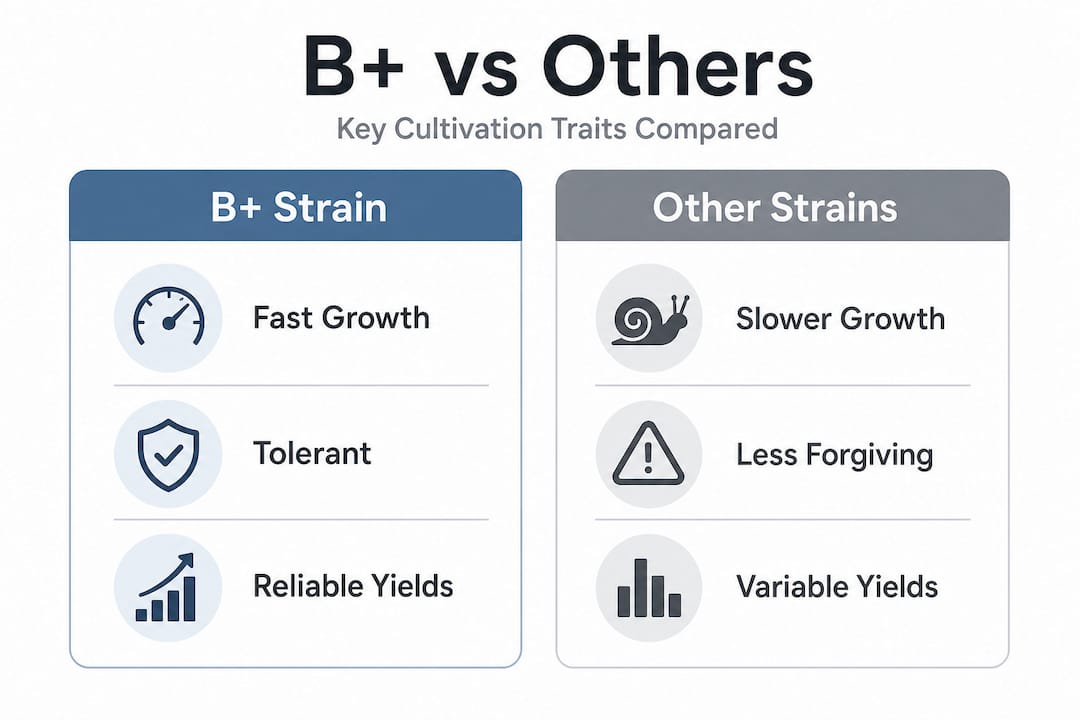
B+ mycelium grows faster than most other commonly cultured genotypes, according to user-based literature and referenced studies. In practical terms, this means you can expect colonisation of a standard substrate jar to complete noticeably quicker than with slower strains like Ecuadorian or some Penis Envy variants. For UK growers working in cooler ambient temperatures, this speed is a genuine advantage because a shorter colonisation window means less time for contamination to take hold.
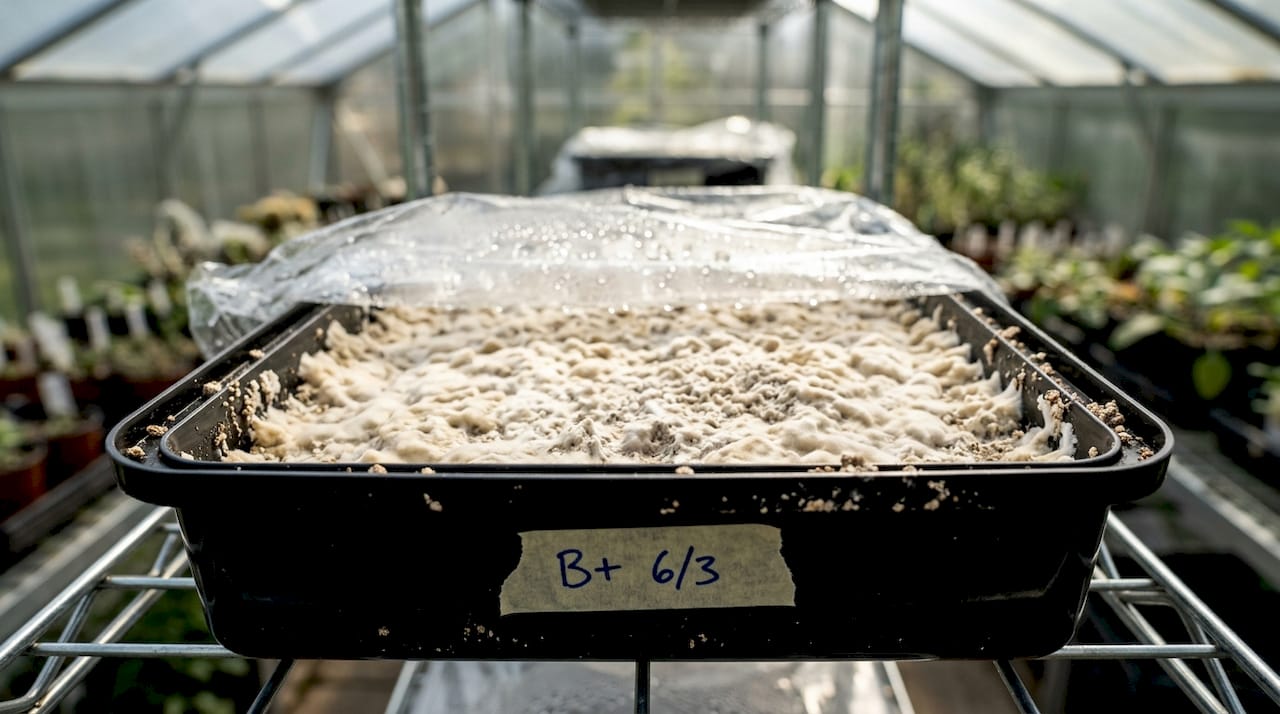
Understanding how spores drive mushroom growth helps put this into context. Once a spore germinates, the mycelium network expands through the substrate, breaking down organic material and building the biological infrastructure needed for fruiting. Faster colonisation does not just mean quicker results. It also means the mycelium establishes dominance in the substrate before competing organisms can gain a foothold.
The table below compares B+ against two other popular P. cubensis cultivars across key performance metrics:
| Trait | B+ | Golden Teacher | Penis Envy |
|---|---|---|---|
| Colonisation speed | Fast | Moderate | Slow |
| Fruiting body size | Large to very large | Medium to large | Medium, dense |
| Beginner suitability | Excellent | Excellent | Moderate |
| Environmental tolerance | High | Moderate | Lower |
| Yield per flush | High | Moderate to high | Lower but potent |
One of the most practically useful aspects of B+ is its tolerance for the kind of environmental variability that UK homes present. Central heating cycles, draughty rooms, and seasonal temperature swings can all disrupt more sensitive strains. B+ handles these conditions with considerably more grace. This adaptability is partly why it remains a staple recommendation for first-time growers.
The science of mushroom hybridisation also plays a role in understanding why B+ behaves the way it does. Whether or not the hybridisation rumours are true, the genetic consistency of well-maintained B+ spore lines contributes to its predictable performance.
Pro Tip: If you are growing in a UK home during winter, B+ is one of the most forgiving choices you can make. Its wider temperature tolerance, roughly 21 to 27 degrees Celsius for optimal fruiting, gives you more room for error than strains with narrower requirements.
How to cultivate B+ mushrooms at home
With an understanding of B+ biology and features, let us turn to practical cultivation for UK hobbyists. Growing B+ at home is genuinely achievable for beginners, but it does require attention to hygiene, patience, and a willingness to learn from each grow cycle.
Before starting, it is worth reading through the UK legal mushroom cultivation guide to make sure you understand the legal context. Spores themselves are legal to possess in the UK for research and microscopy purposes, but cultivation for consumption is a different matter.
Here is a step-by-step overview of the B+ cultivation process:
- Prepare your substrate. Brown rice flour mixed with vermiculite (BRF tek) is the most beginner-friendly option. Fill sterilised jars two-thirds full and allow them to cool completely before inoculation.
- Inoculate with a spore syringe. Using a still air box or laminar flow hood, inject your spore solution through the self-healing injection port. Use around 1 to 2 ml per jar.
- Colonise at room temperature. Store jars in a dark, stable environment between 21 and 27°C. B+ typically colonises fully within 14 to 21 days.
- Check for contamination. Any green, black, or pink discolouration signals contamination. Remove affected jars immediately and away from your grow space.
- Birth and case your cakes. Once fully colonised, remove cakes from jars and transfer to a fruiting chamber. Casing with a layer of moist vermiculite helps retain humidity.
- Maintain fruiting conditions. Target 90 to 95% relative humidity and fan lightly two to three times per day to encourage pinning. Temperatures around 23 to 25°C work well.
- Harvest before the veil tears. Pick fruiting bodies just as the veil beneath the cap begins to stretch but before it breaks fully open.
- Repeat for subsequent flushes. Rehydrate cakes by soaking in cold water for several hours between flushes. B+ is known to produce multiple reliable flushes.
The beginner’s mushroom growing guide covers many of these steps in greater depth if you want more detail on any stage.
Much practical advice for B+ cultivation is extrapolated from community and user-driven resources, due to limited peer-reviewed studies. This means your own careful documentation of each grow, including substrate ratios, temperatures, and timing, adds genuine value to the wider community’s understanding.
Pro Tip: Contamination is the single biggest threat to a successful grow. Wipe down all surfaces with isopropyl alcohol before you start, wear nitrile gloves, and work quickly during inoculation. Even a few seconds of unnecessary exposure to open air increases your risk.
Potency, user reports, and wellness perspectives
Now that you have the tools and process for growing B+, it is important to look at what users and researchers say about its effects. This is an area where honesty matters more than enthusiasm.
The reality is that B+ potency and effects are largely documented through grey literature and online user reports rather than controlled scientific trials. This is not unique to B+. Most P. cubensis cultivars lack rigorous clinical data on potency, partly because research into psilocybin has only recently regained momentum after decades of restriction.
What user communities report about B+:
- Moderate potency relative to other P. cubensis strains, though individual experiences vary considerably
- A tendency towards visual enhancement, described as gentle rather than overwhelming at moderate doses
- Reported feelings of euphoria, warmth, and increased sociability
- A generally manageable experience profile that many users describe as suitable for those new to the subject
- Variability in intensity depending on growing conditions, harvest timing, and individual biology
It is worth noting a statistical reality here: there is currently no peer-reviewed data establishing a reliable potency range for B+ specifically. Psilocybin content in P. cubensis can vary by a factor of four or more even within the same batch, depending on substrate, environmental conditions, and when the mushrooms were harvested. Any figure you see quoted online is an estimate drawn from community testing, not clinical measurement.
For those interested in the wellness dimension, resources on mushroom health and wellness and the practical mushroom microdosing guide offer more grounded reading. If you are exploring microdosing mushroom strains, B+ is frequently mentioned alongside Golden Teacher as a starting point for those curious about sub-perceptual dosing.
The key takeaway is to approach B+ with curiosity and caution in equal measure. The community evidence is genuinely interesting, but it is not a substitute for rigorous science.
Why B+ mushrooms remain a favourite among UK home cultivators
Here is something worth saying plainly: the enduring popularity of B+ is not primarily a scientific verdict. It is a collective one. Thousands of UK home cultivators have grown B+, shared their results, refined their techniques, and passed on what works. That accumulated wisdom is real, even when it lacks a journal citation.
Published peer-reviewed work about B+ is limited, so most advice is community-sourced. And yet, the consistency of that community feedback is striking. Growers across different climates, substrates, and experience levels keep arriving at the same conclusions: B+ is fast, it is forgiving, and it rewards patience.
For UK growers specifically, the forgiving nature of B+ has a particular value. British homes are not purpose-built mycology labs. You are working with central heating that clicks on and off, humidity that shifts with the weather outside, and grow spaces that might be a spare bedroom, a wardrobe, or a corner of the kitchen. B+ handles these realities better than most.
There is also something to be said for the psychological benefit of early success. When you are new to home cultivation, a strain that colonises reliably and fruits consistently builds your confidence and your skills simultaneously. B+ has introduced more people to mycology than perhaps any other cultivar, and that matters. The skills you develop growing B+ transfer directly to more demanding strains.
We would encourage you to treat each grow as a small experiment. Record your substrate ratios, inoculation dates, colonisation times, pinning dates, and harvest weights. This kind of documentation, done consistently across multiple grows, is genuinely useful data. It contributes to the community knowledge base and helps you understand your own growing environment in precise terms.
The growing body of psilocybin therapy research is beginning to close the gap between community experience and scientific understanding. As that research matures, strains like B+ may eventually receive the formal study they deserve. Until then, the hobbyist community remains the primary source of practical knowledge, and that community has spoken clearly in B+’s favour.
Expand your mushroom cultivation journey
As you consider your next steps with B+ or other mushroom types, Spore Buddies is here to support you at every stage. Whether you are just getting started or looking to refine an established practice, having reliable supplies and trustworthy guidance makes a real difference. You can explore a wide range of mushroom spore syringes including B+ and other popular P. cubensis cultivars, all sourced for quality and consistency. If you are newer to the process, the beginner mushroom grow kits guide walks you through everything you need to get your first successful flush. Spore Buddies combines quality products with educational content designed specifically for UK cultivators, so you are never left guessing.
Frequently asked questions
Is the B+ mushroom strain legal to grow in the UK?
Psilocybe cubensis spores are legal to possess in the UK for research and microscopy purposes, but cultivating them for consumption is not legal. Always ensure your activities remain within the law.
What makes B+ mushrooms different from other cubensis strains?
B+ mushrooms are especially known for their fast growth, resilience, and consistent fruiting. User-based literature consistently identifies B+ as among the fastest-colonising P. cubensis genotypes, which sets it apart from slower or more temperamental cultivars.
How fast do B+ mushrooms typically grow?
Growers frequently report full substrate colonisation within 14 to 21 days under standard conditions. Evidence from user-based literature suggests B+ mycelium is among the fastest-growing of the commonly cultured cubensis types.
What substrate works best for B+ mushroom cultivation?
Brown rice flour combined with vermiculite is the most popular choice for beginners and works very well for B+. That said, B+ is notably versatile and adapts reliably to grain-based substrates and other options as your skills develop.
Are potency and effects of B+ reliably established?
Most information on B+ potency and effects comes from enthusiast communities rather than controlled scientific studies, meaning results can vary considerably between individuals. Grey literature and user reports are the primary sources currently available, so approach any specific claims with appropriate scepticism.