0800 069 9269

The SporeBuddies Strain Project

Top 10 Magic Mushroom Strains: History, Species and Research Guide for 2026

Magic mushroom strains such as Golden Teacher, Penis Envy, B+ and Yeti are widely discussed in modern mycology. Yet these names are often misunderstood. Most refer to cultivated lineages of Psilocybe cubensis, not separate mushroom species and not scientifically proven “experience types”. This updated guide introduces ten classic lineages, explains what strain names can and cannot tell us, and examines the emerging strains attracting attention in 2026.

Updated: July 2026 Reading time: approximately 18 minutes Focus: history, taxonomy, morphology and microscopy research
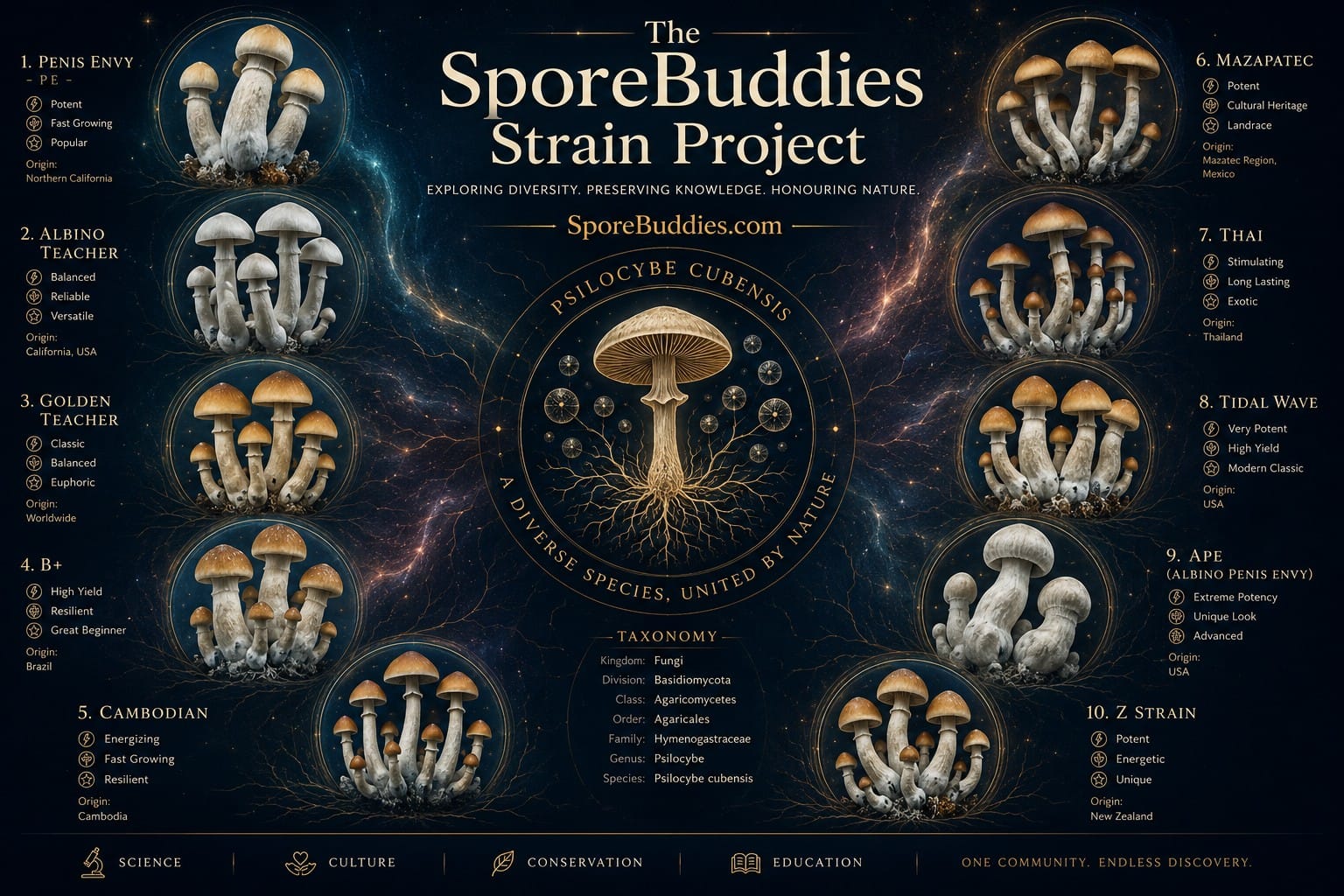
Scientific infographic showing ten recognised Psilocybe cubensis strains arranged around a central taxonomy diagram for The SporeBuddies Strain Project.
The SporeBuddies Strain Project illustrates ten historically significant Psilocybe cubensis lineages alongside taxonomy and cultural research for educational purposes.

Quick answer: what are magic mushroom strains?

In commercial and enthusiast language, a magic mushroom “strain” is usually a named lineage within a species, most often Psilocybe cubensis. Names can indicate a reported geographic origin, a selected appearance, a mutation, a hybrid lineage or a history of circulation within collecting communities.

Golden Teacher, B+, Penis Envy and Cambodian are therefore commonly treated as different strains of the same species. Liberty Cap, Wavy Cap and Flying Saucer mushrooms are different species rather than P. cubensis strains.

Strain names can be useful for discussing morphology and collection history. However, they are not formal taxonomic ranks, and current evidence does not support treating each name as a reliable predictor of a particular psychological effect.

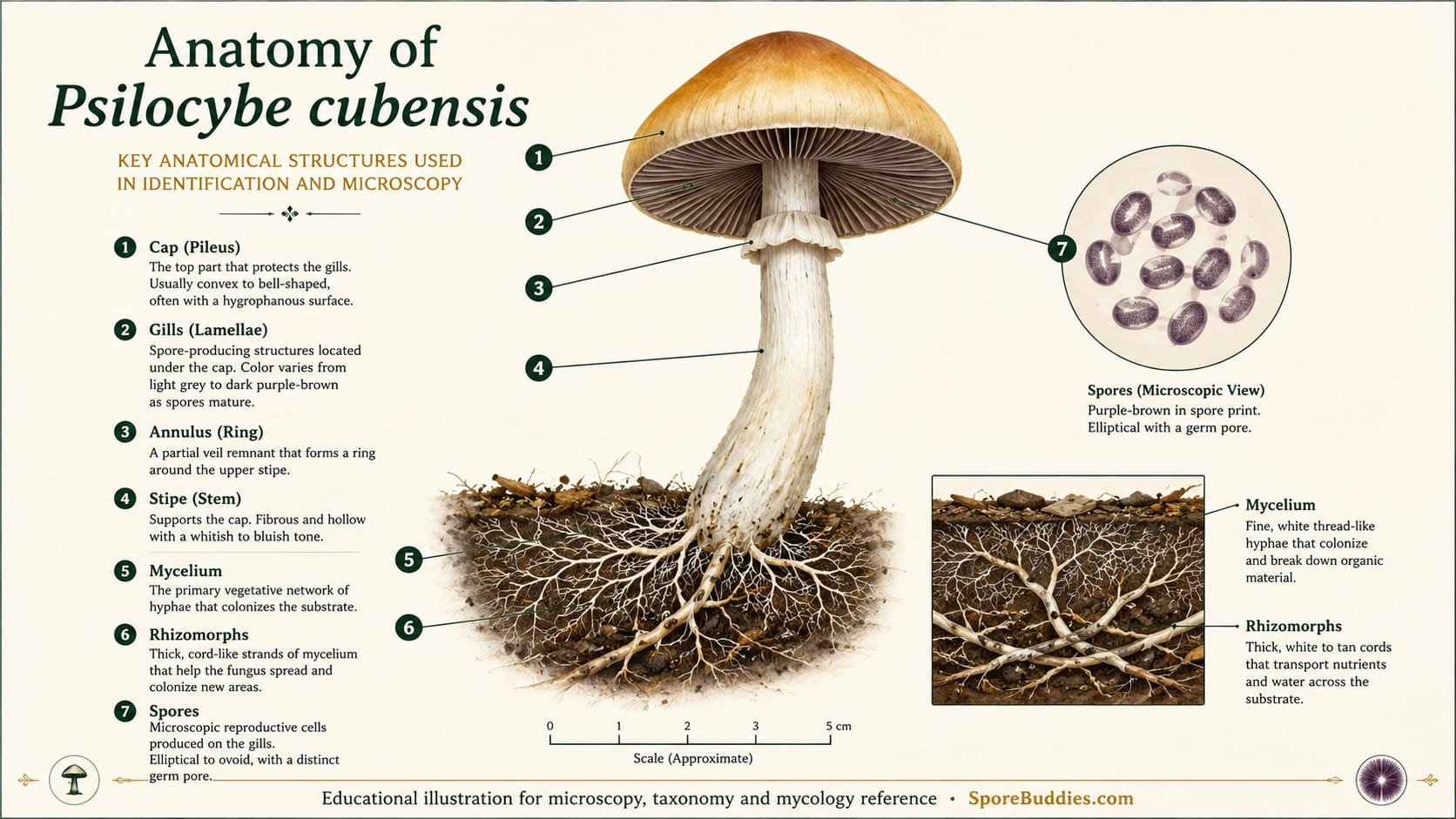
Labelled scientific anatomy illustration of Psilocybe cubensis showing the cap, gills, annulus, stipe, mycelium, rhizomorphs and microscopic spores.
Labelled anatomical illustration of Psilocybe cubensis, identifying the cap, gills, annulus, stipe, mycelium, rhizomorphs and spores for microscopy, taxonomy and educational mycology reference.

Top 10 magic mushroom strains at a glance

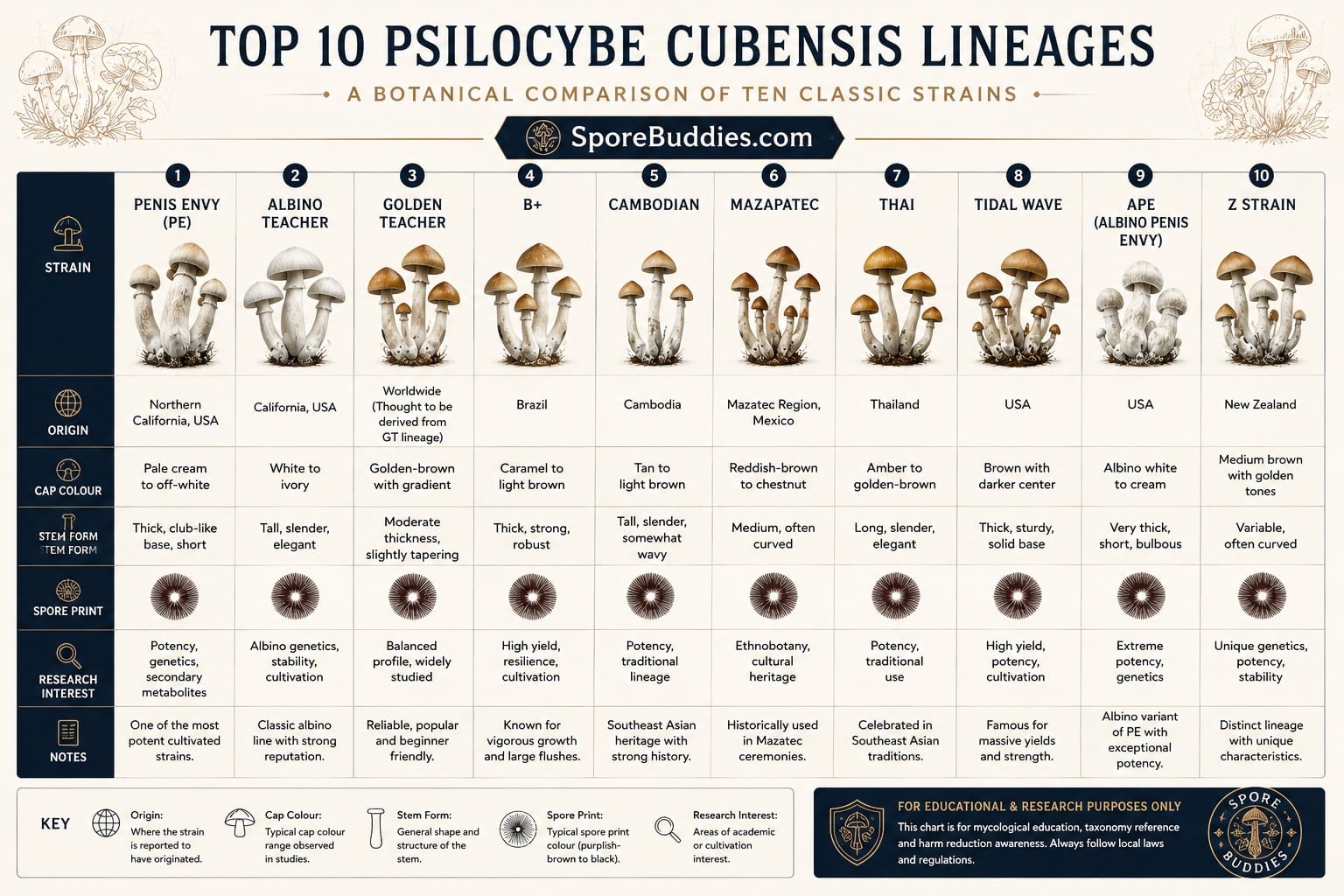
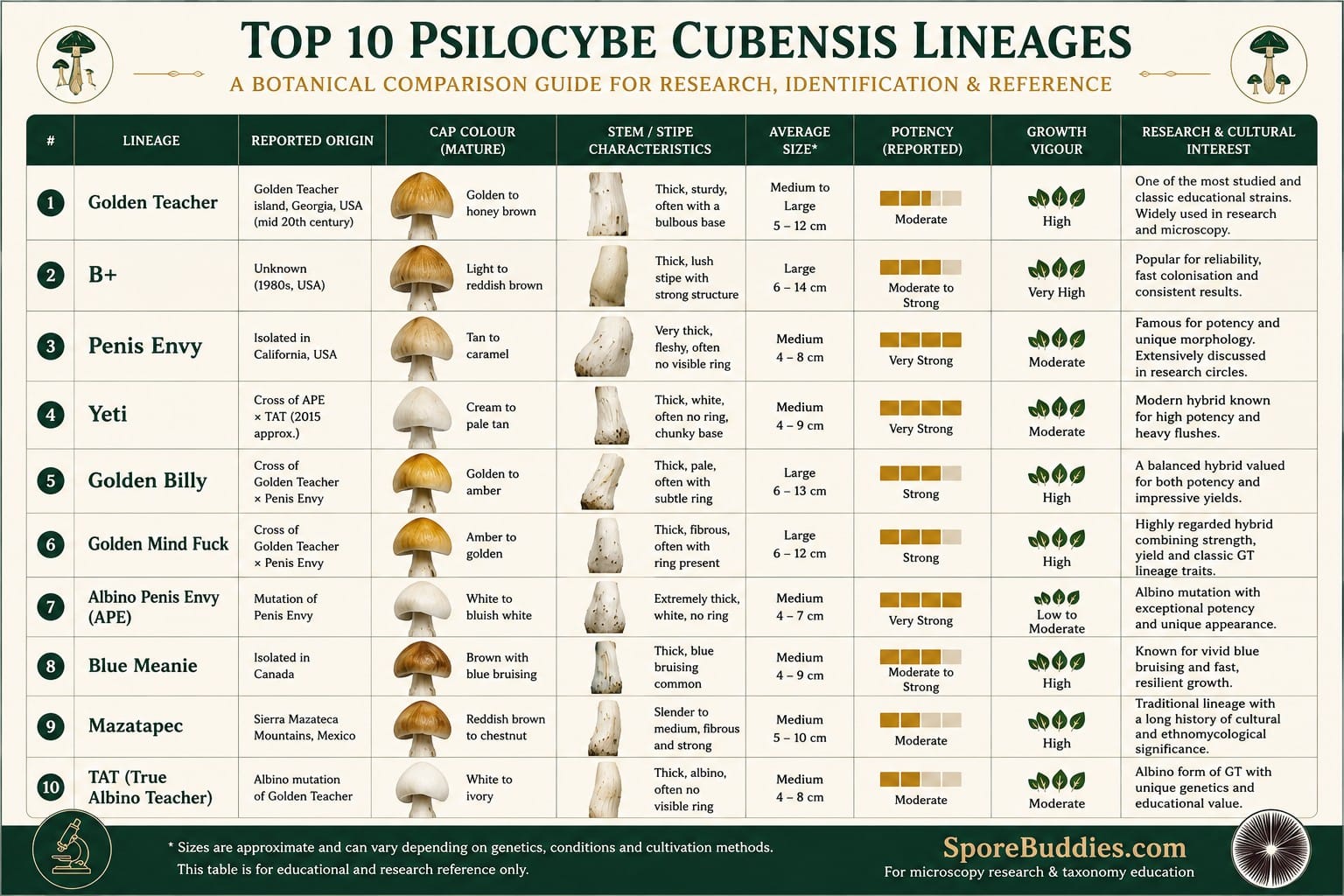
The table below summarises the historical and observable features most often associated with ten widely referenced Psilocybe cubensis lineages. Reported origins are based on community histories and should not always be treated as independently verified collection records.

LineageReported origin or historyRecognised morphologyWhy it remains notable
Golden TeacherWidely circulated from the late twentieth century; exact origin remains uncertain.Golden to caramel cap, pale stem and classic P. cubensis form.One of the most recognised names in microscopy and popular mycology.
Penis EnvyCommunity history links it to selective development in the United States.Dense stem, reduced cap expansion and highly distinctive proportions.A major example of unusual phenotype selection within P. cubensis.
B+Popularised through collector and online mycology communities during the 1990s.Broad caps and a familiar, robust cubensis appearance.Long-running popularity and wide availability.
Albino A+A pale-pigmented lineage associated with the A+ family.Leucistic appearance, pale cap and reduced pigmentation.Useful for discussing albinism, leucism and phenotype terminology.
CambodianReportedly associated with material collected near Angkor Wat.Classic tropical cubensis morphology with warm cap tones.Strong geographic story and long-standing collector interest.
EcuadorianAssociated with Ecuador and South American collection histories.Substantial stems and rounded to convex caps.Often discussed in relation to geographic diversity.
Koh Samui / KSSSAssociated with Koh Samui in Thailand and later selective lines.Compact forms, broad caps and variable phenotypes.An established Southeast Asian lineage with several named selections.
MazatapecAssociated in commercial histories with Mexico and the Mazatec region.Brown-gold cap and traditional cubensis proportions.Frequently discussed alongside the broader history of Mexican ethnomycology.
Treasure CoastLinked to Florida’s Treasure Coast.Pale to caramel caps and variable clustered forms.A familiar North American geographic lineage.
Orissa IndiaAssociated with Odisha, historically written as Orissa, in India.Large-framed cubensis morphology under suitable conditions.Broadens the geographic story of named P. cubensis collections.
A botanical comparison of ten classic Psilocybe cubensis lineages, including reported origin, cap colour, stem form and areas of research interest.
The classic lineages

The ten most referenced Psilocybe cubensis strains

This list is not a potency league table. It reflects historical recognition, cultural visibility, distinctive morphology and continued interest among microscopy collectors and mycology readers.

1

Golden Teacher

Golden Teacher remains one of the most recognisable Psilocybe cubensis names. It became widely circulated during the late twentieth century, although a single verified discovery account is difficult to establish.

Appearance: golden or caramel caps, pale stems and familiar cubensis proportions.
Historical importance: a defining name in modern microscopy catalogues and early online strain discussions.
Research value: a useful reference lineage for comparing conventional morphology with newer selected or hybrid families.

Descriptions that assign Golden Teacher a guaranteed emotional or philosophical effect should be treated as anecdotal marketing rather than established strain science.

View Golden Teacher spores for lawful microscopy research →
2

Penis Envy

Penis Envy is distinguished by its dense stem, reduced cap expansion and unusual proportions. Its origin story is surrounded by competing community accounts, including an often-repeated association with Terence McKenna that remains difficult to verify conclusively.

Appearance: thick stems and compact caps create one of the most recognisable cubensis phenotypes.
Scientific interest: selected Penis Envy-related samples have attracted attention in chemical testing, but individual results should not be generalised to every sample sold under the name.
Taxonomic position: a cultivated P. cubensis lineage, not a separate species.
View Penis Envy 6 spores for lawful microscopy research →
3

B+ (B Plus)

B+ became a major fixture in microscopy and collector catalogues during the 1990s. The precise history behind its name is disputed, but the lineage remains widely recognised because of its long circulation and classic appearance.

Appearance: broad caramel-brown caps with pale stems.
Cultural significance: one of the best-known names from the early internet era of home mycology discussion.
Comparison value: often used as a conventional reference point when discussing unusual mutations and albino families.
View B+ spores for lawful microscopy research →
4

Albino A+

Albino A+ is commonly described as a pale-pigmented member of the A+ family. Despite the commercial name, many specimens described as Albino A+ are better characterised as leucistic because some pigmentation can remain.

Appearance: pale cream to white fruit-body pigmentation with darker spores.
Terminology: true albinism and leucism are different biological conditions and should not be used interchangeably without evidence.
Research interest: visually useful for discussing pigment expression and phenotype selection.
View Albino A+ spores for lawful microscopy research →
5

Cambodian

The Cambodian lineage is widely associated with a collection story near Angkor Wat. As with many commercial strain histories, that account is repeated more often than it is independently documented.

Reported origin: Cambodia.
Appearance: conventional tropical cubensis traits with warm brown caps.
Historical value: part of the wider record of geographic names used to catalogue P. cubensis material.
View Cambodian spores for lawful microscopy research →
6

Ecuadorian

Ecuadorian is a long-circulated geographic lineage associated with South America. It is often presented as evidence of the broad climatic and geographic range in which P. cubensis has been recorded.

Reported origin: Ecuador.
Appearance: rounded caps, substantial stems and conventional purple-brown spores.
Research context: useful when discussing the limits of inferring genetics from a geographic commercial name alone.
View Ecuadorian spores for lawful microscopy research →
7

Koh Samui and Koh Samui Super Strain

Koh Samui is associated with material from the Thai island of the same name. Koh Samui Super Strain, often shortened to KSSS, refers to a later selected line within that broader naming family.

Reported origin: Koh Samui, Thailand.
Appearance: variable compact forms, broad caps and warm pigmentation.
Why it matters: demonstrates how an original geographic name can develop into several later selections.
View KSSS spores for lawful microscopy research →
8

Mazatapec

Mazatapec is a commercial lineage name associated with Mexico and the Mazatec region. It should not be used to reduce or commercialise the much broader ceremonial and cultural history of Mazatec communities.

Reported origin: Oaxaca, Mexico.
Appearance: classic brown-gold caps and pale stems.
Cultural care: modern strain branding should be kept distinct from Indigenous traditions and documented ethnomycology.
View Mazatapec spores for lawful microscopy research →
9

Treasure Coast

Treasure Coast is associated with Florida’s southeastern Atlantic coastline. It became a familiar geographic name during the expansion of microscopy catalogues and online strain collections.

Reported origin: Florida, United States.
Appearance: pale to caramel caps with familiar cubensis structures.
Historical role: one of several North American geographic lineages that remain widely recognised.
View Treasure Coast spores for lawful microscopy research →
10

Orissa India

Orissa India is associated with the Indian state now officially called Odisha. The older spelling remains widely used in the commercial lineage name.

Reported origin: Odisha, India.
Appearance: commonly described as a large-framed cubensis lineage, although phenotype remains environment-dependent.
Research value: illustrates how historical place names can persist long after official geographic terminology changes.
View Orissa India spores for lawful microscopy research →
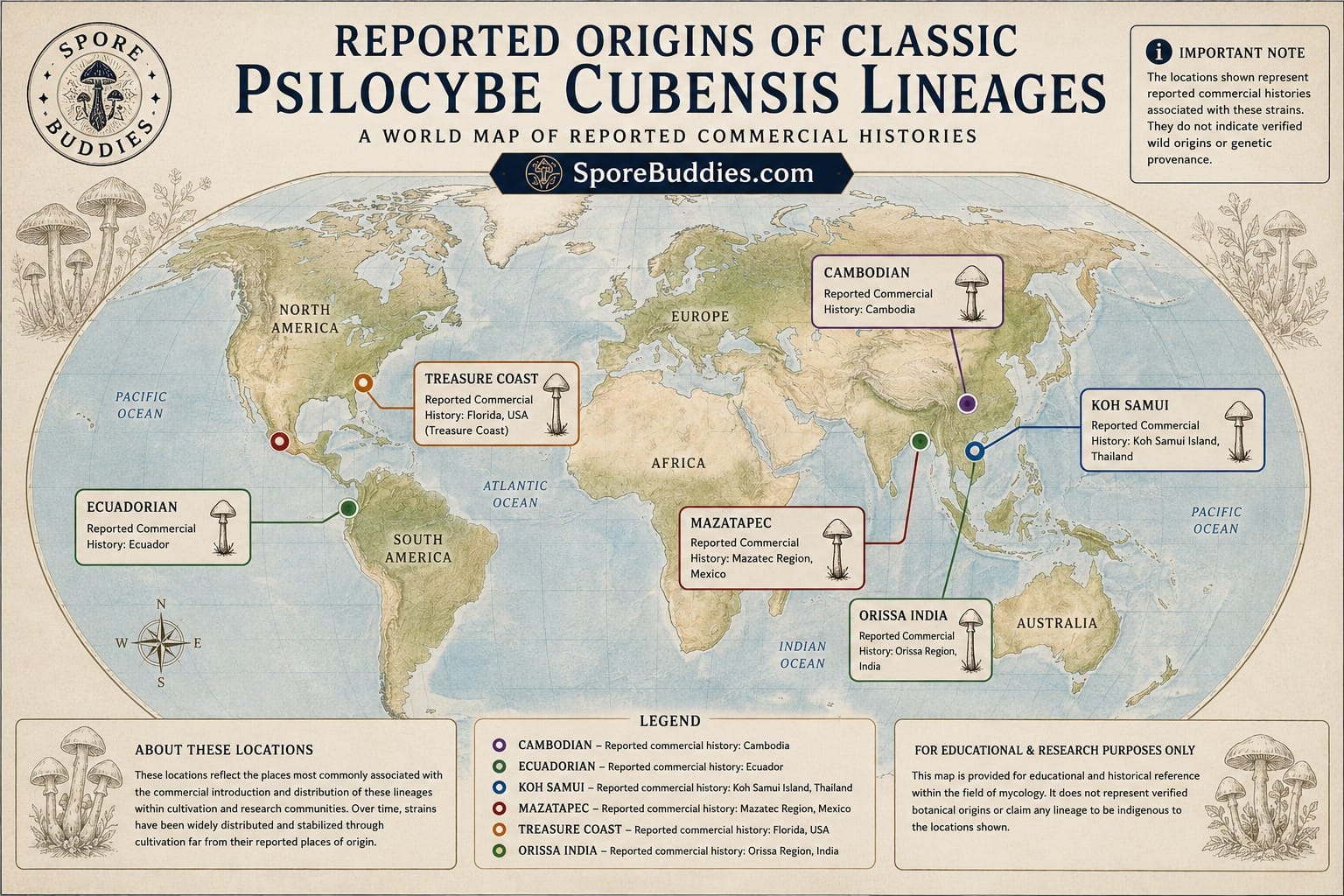
Scientific world map showing the reported commercial histories associated with Cambodian, Ecuadorian, Koh Samui, Mazatapec, Treasure Coast and Orissa India Psilocybe cubensis lineages.
Educational world map illustrating the reported commercial histories associated with several classic Psilocybe cubensis lineages. These locations represent historical reports rather than verified genetic provenance.

Do magic mushroom strains actually matter?

Yes, but not always in the way commercial descriptions suggest.

Named lineages can matter when studying observable traits such as pigmentation, cap formation, stem proportions, sporulation and unusual mutations. Genetics can also influence chemical biosynthesis. A recent standardised investigation of 42 psilocybin-producing fungal strains reported substantial metabolomic diversity, reinforcing the need for better controlled comparisons.

However, a strain name printed on a label does not guarantee an identical genome, chemical profile or phenotype across every collection. Informal naming, genetic drift, mislabelling, environmental variation and repeated selection can all complicate comparisons.

Scientific family tree diagram showing the relationship between the genus Psilocybe, Psilocybe cubensis and several named cubensis lineages including Golden Teacher, B+, Penis Envy, Yeti, Golden Billy and Golden Mind Fuck, alongside Psilocybe semilanceata, Psilocybe cyanescens and Psilocybe azurescens.
Educational family tree illustrating the relationship between the genus Psilocybe, the species Psilocybe cubensis, several well-known cultivated lineages, and related species including P. semilanceata, P. cyanescens and P. azurescens. The diagram is intended to demonstrate taxonomy rather than direct genetic ancestry.

What does “strain” mean in mycology?

The word strain is used loosely in commercial mushroom culture. In microbiology and laboratory research, a strain usually means a defined genetic line derived from a particular isolate or source. In enthusiast catalogues, the same term may be used for a geographic collection, a stable selection, a mutation, a hybrid family or simply a recognised commercial name.

TermMeaningExample of appropriate use
SpeciesA formally classified biological group.Psilocybe cubensis and Psilocybe semilanceata are different species.
Strain or lineageA genetic line, cultivated selection or recognised named family within a species.Golden Teacher is commonly described as a P. cubensis lineage.
IsolateA culture or genetic line separated from a larger population.A laboratory may compare several isolates carrying the same commercial name.
PhenotypeAn observable trait produced by genetics and environment.Pale pigmentation or an unusually compact cap can be phenotypic traits.
MutationA heritable genetic change that can alter observable characteristics.Unusual coral-like or blob-forming growth may be maintained through selective work.
HybridA lineage produced by combining genetic material from different parental lines.Modern named crosses may be presented as descendants of two recognised families.
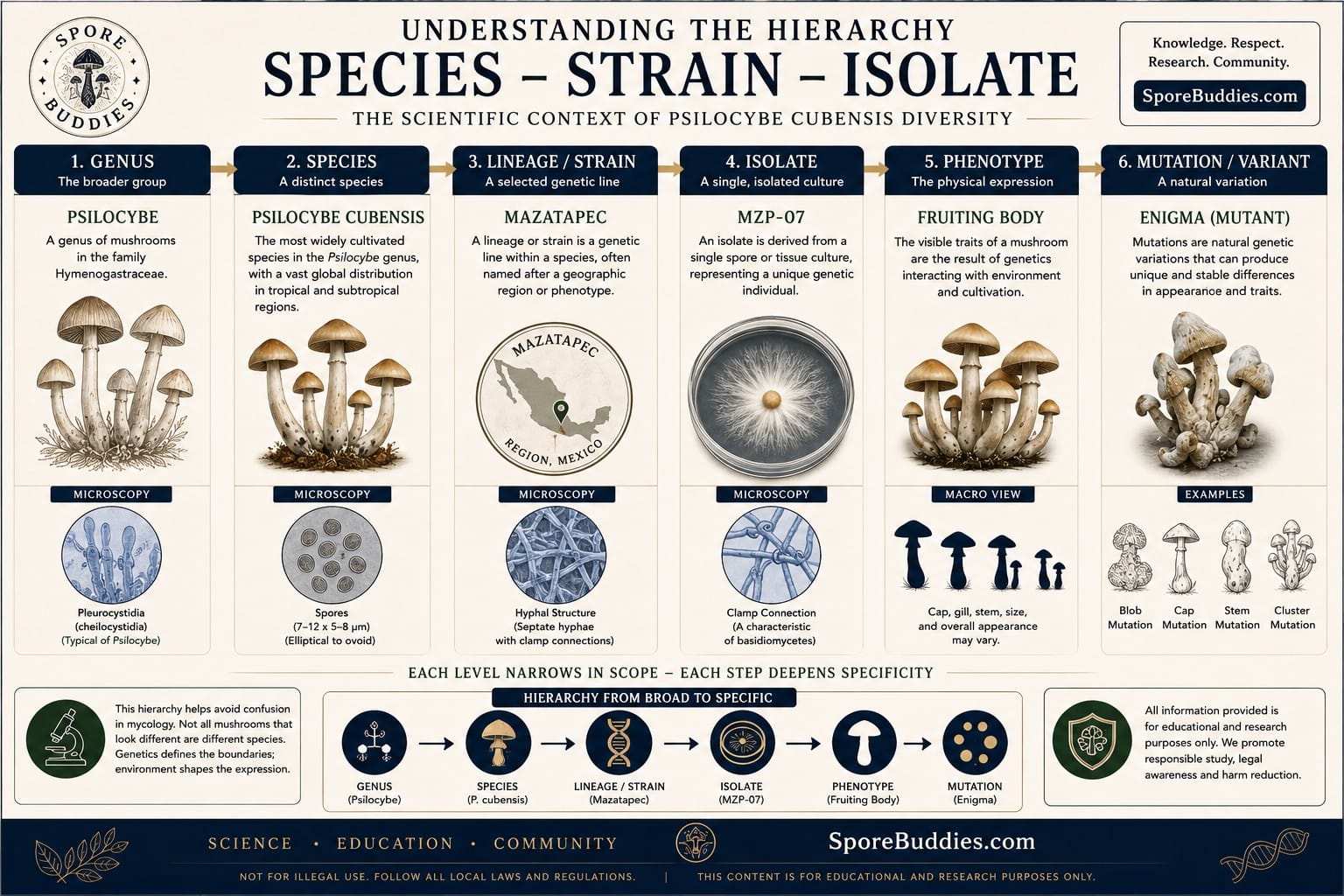
Scientific hierarchy diagram explaining the relationship between genus, species, lineage or strain, isolate, phenotype and mutation in Psilocybe cubensis.
Educational hierarchy diagram illustrating how Psilocybe cubensis is classified from genus and species through lineage (strain), isolate, phenotype and mutation, with representative microscopy and mushroom morphology.

Cultivated strains versus wild Psilocybe species

Many online lists mix strains and species together. This creates avoidable confusion. Golden Teacher and B+ are commonly treated as lineages of Psilocybe cubensis. Liberty Cap and Wavy Cap are separate species with distinct ecology, morphology and geographic distributions.

NameScientific classificationTypical ecological association
Golden TeacherNamed lineage of Psilocybe cubensisA cultivated lineage name rather than a separate wild species.
Penis EnvyNamed lineage of Psilocybe cubensisA selected cultivated phenotype.
Liberty CapPsilocybe semilanceataGrassland species associated with nutrient-rich pasture environments.
Wavy CapPsilocybe cyanescensWood-rich habitats, landscaped beds and woody debris.
Flying SaucerPsilocybe azurescensCoastal dune systems and woody substrate in suitable climates.

Explore the wider species context in our complete Psilocybe azurescens guide, our P. azurescens versus P. cyanescens comparison and our UK mushroom identification guide.

Biochemical diversity and the “entourage” hypothesis

Psilocybe mushrooms can contain psilocybin, psilocin and related tryptamine compounds, including baeocystin and norbaeocystin. Their biosynthesis involves a defined enzyme pathway, but the amounts measured in fungal samples can vary.

Researchers continue to examine whether broader metabolomic differences between fungal strains have biological importance. This is a legitimate research question, but it should not be confused with confident commercial claims that one named cubensis strain always produces a particular subjective experience.

Measured chemistry can be affected by genetics, developmental stage, storage, sample preparation and analytical method. A single laboratory result therefore describes the tested material, not every specimen carrying the same name.

Do mushroom strains matter in clinical psilocybin research?

Modern clinical trials generally investigate controlled doses of psilocybin rather than consumer strain names such as Golden Teacher or B+. Some programmes use proprietary synthetic or pharmaceutical-grade psilocybin formulations so that dose, purity and manufacturing conditions can be standardised.

That means current clinical evidence cannot be used to claim that one commercial mushroom strain is better for depression, anxiety or another medical condition. Research into psilocybin-assisted therapy is developing, but treatment decisions belong in regulated clinical settings and should not be inferred from retail strain descriptions.

This distinction will be explored in a dedicated supporting article within The SporeBuddies Strain Project: Do Mushroom Strains Matter in Clinical Psilocybin Research?

The next generation

New and emerging magic mushroom strains for 2026

The classic top ten earned recognition through years of circulation. Newer lineages now compete for attention through distinctive morphology, selective breeding and memorable family histories. The following strains are not being presented as universally established classics. They are emerging names worth documenting as the modern strain landscape develops.

New for 2026

Golden Mind Fuck

Golden Mind Fuck is presented by SporeBuddies as a Golden Teacher × Hillbilly cross. Its name connects a modern hybrid family with one of the most recognised classic cubensis lineages.

Its future significance will depend on whether the lineage develops lasting recognition, consistent documentation and sustained microscopy interest beyond its initial release.

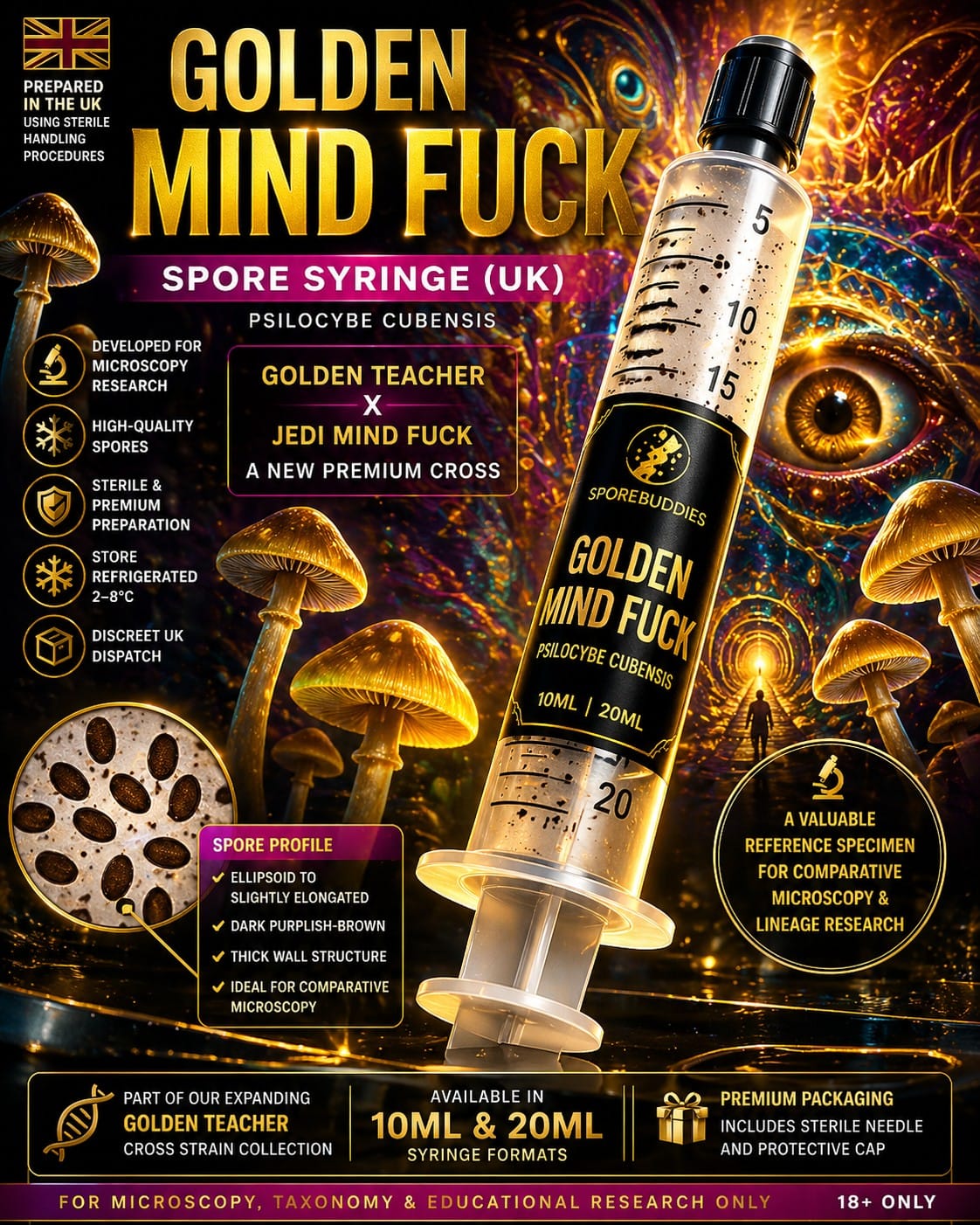
Golden Mind Fuck Psilocybe cubensis spore syringes for microscopy research.
Golden Mind Fuck Psilocybe cubensis spore syringes prepared for microscopy and taxonomy research.
Explore Golden Mind Fuck spores
Emerging lineage

Golden Billy

Golden Billy belongs to the expanding family of modern names built around Golden Teacher-associated heritage. It offers a useful case study in how newer selective lineages are introduced, documented and eventually accepted—or forgotten—by the wider community.

Only time and consistent observation can show whether it develops the cultural staying power of the classic strains.

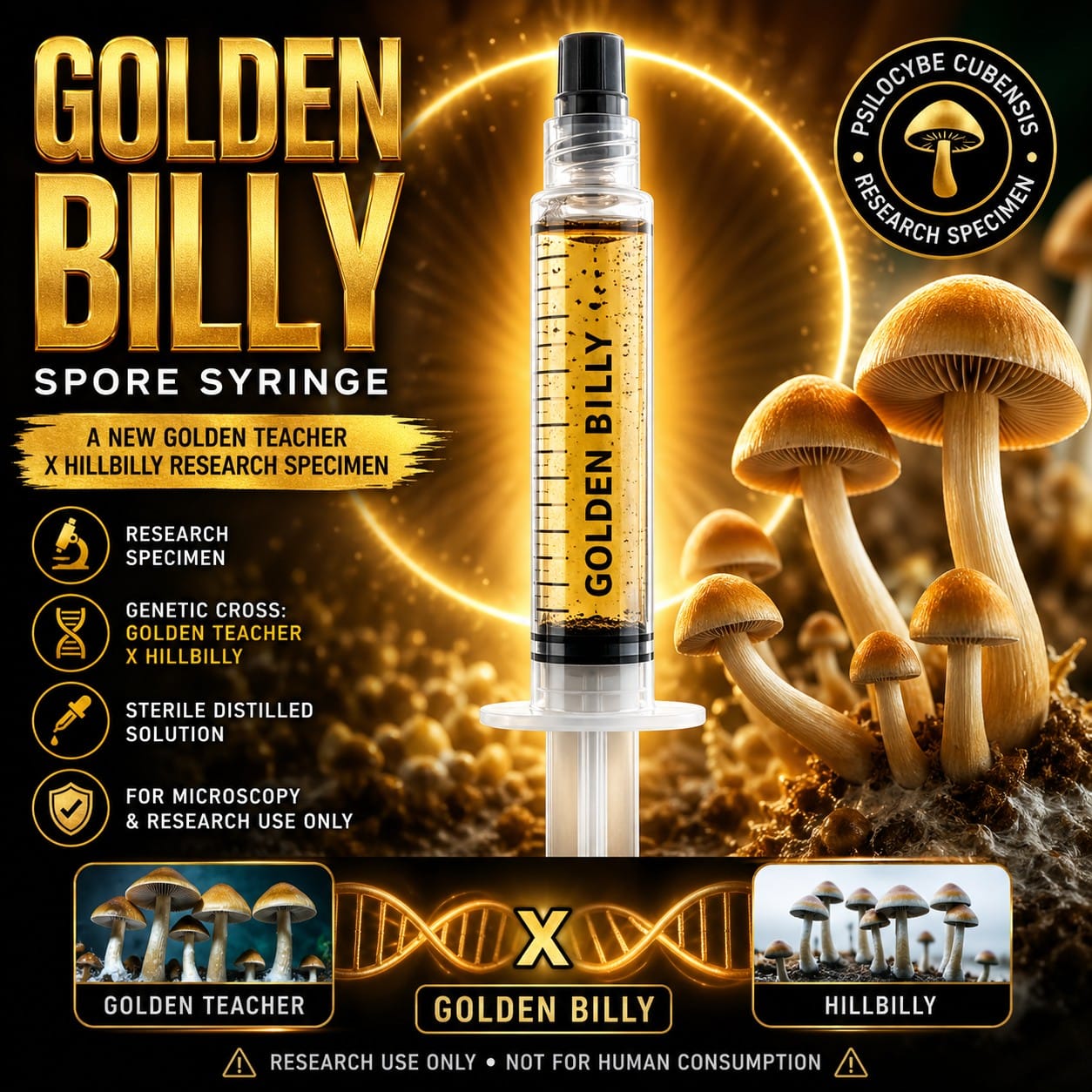
Golden Billy Psilocybe cubensis mushroom culture illustration used for educational and taxonomy reference.
Golden Billy Psilocybe cubensis, a named lineage commonly discussed within mycology communities and taxonomy-focused educational resources.
Explore Golden Billy spores
Returning favourite

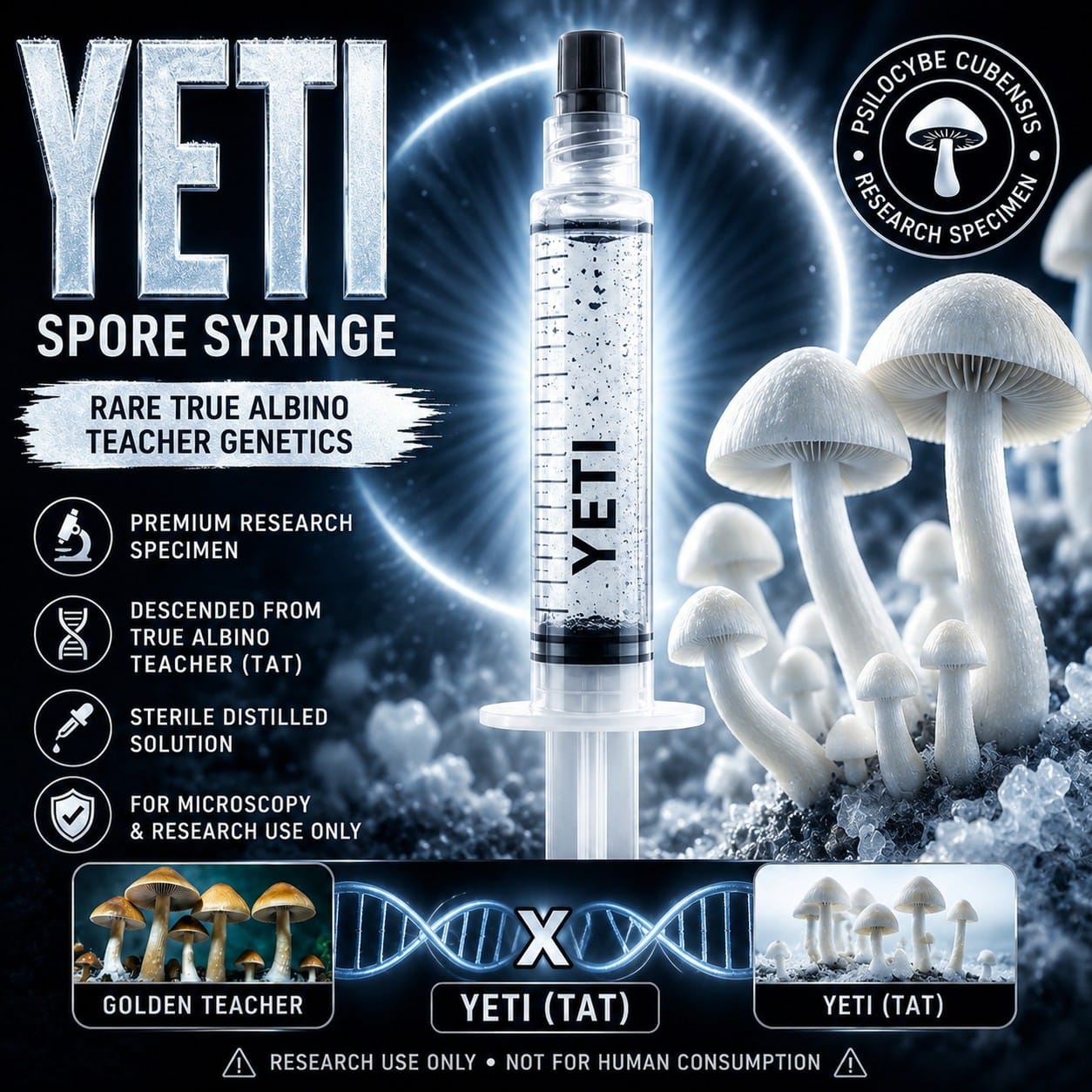
Yeti

Yeti is associated with the True Albino Teacher family and is recognised for its pale appearance and striking phenotype. It sits at the intersection of classic Golden Teacher heritage and newer albino selection.

Its return to the SporeBuddies catalogue makes it a natural candidate for renewed microscopy interest during 2026.

Yeti Psilocybe cubensis lineage shown for educational mycology and taxonomy reference.
Yeti Psilocybe cubensis, a well-known albino lineage featured in educational discussions of mushroom taxonomy, phenotypes and commercial strain history.
Explore Yeti spores
Golden Teacher Psilocybe cubensis spore products displayed for microscopy and educational mycology reference.

Readers interested in studying this lineage further can explore the Golden Teacher Family Collection Spore Syringes available from SporeBuddies.

Editor’s choice

The author’s current favourite strain: Yeti

Yeti is the current editorial favourite within The SporeBuddies Strain Project. This is a personal microscopy preference, not a scientific ranking and not a claim that Yeti is objectively “best”.

Yeti stands out because its pale True Albino Teacher heritage, compact appearance and unusual morphology make it immediately memorable under visual comparison. After its return to the SporeBuddies catalogue, it is the lineage I am most interested in observing and documenting during 2026.

View the returning Yeti spore syringe →

Could today’s emerging strains become tomorrow’s classics?

Golden Teacher, B+, Penis Envy and Mazatapec were not always permanent fixtures in popular mycology. Their recognition grew through circulation, repeated observation and cultural storytelling.

Golden Mind Fuck, Golden Billy and Yeti now occupy different positions in that continuing history. Yeti already has an established family background, while the two newer Golden Teacher-related names are still building their identities.

Will either SporeBuddies-associated release eventually enter a future top-ten list? It is too early to say. Lasting recognition requires more than a memorable name. A lineage must develop a stable history, recognisable characteristics, genuine community interest and documentation that survives beyond its first launch.

The SporeBuddies Strain Project will revisit this question as new evidence, microscopy observations and first-party catalogue data become available.

Golden Teacher Psilocybe cubensis spore products displayed for microscopy and educational mycology reference.
A collection of Golden Teacher Psilocybe cubensis spore products presented for microscopy, taxonomy and educational mycology reference.

Readers interested in studying this lineage further can explore the Golden Teacher Family Collection Spore Syringes available from SporeBuddies.

The SporeBuddies Strain Project

This pillar guide begins a larger research and educational cluster dedicated to understanding strain terminology, history, genetics, chemistry and microscopy without presenting folklore as settled science.

Planned supporting guides include:

Frequently asked questions about magic mushroom strains

What is the most popular magic mushroom strain?

Golden Teacher is among the most recognised commercial Psilocybe cubensis lineage names. Popularity varies by country, supplier, year and the way demand is measured. A future SporeBuddies report will use first-party catalogue data to examine actual customer interest.

Are Golden Teacher and Penis Envy different species?

No. Both are generally described as cultivated lineages of Psilocybe cubensis. Their reported histories and visible phenotypes differ, but they are not separate species.

Do different strains produce different effects?

Commercial descriptions often assign specific experiences to named strains, but controlled evidence supporting consistent strain-specific psychological effects is limited. Chemistry, dose, individual biology, context and sample handling introduce major variability.

Which magic mushroom strain is strongest?

No retail name guarantees a fixed potency. Some tested samples from particular lineages have produced high alkaloid readings, but one result cannot represent every sample carrying that name. A scientifically responsible comparison must identify the exact sample, analytical method and testing conditions.

Is Albino A+ a true albino?

Many specimens sold as Albino A+ are described more accurately as leucistic because some pigmentation remains. True albinism and leucism are related but distinct biological descriptions.

What is the difference between a strain and a species?

A species is a formal taxonomic group. A strain or lineage is a genetic line or selected family within a species. Golden Teacher is commonly treated as a P. cubensis lineage, while Liberty Cap is the separate species P. semilanceata.

Are commercial strain origins always verified?

No. Many origin stories come from collector histories, supplier catalogues and community accounts rather than preserved specimens with complete documentation. They can be culturally valuable without being treated as fully verified provenance.

What makes Yeti visually distinctive?

Yeti is associated with the True Albino Teacher family and is recognised for pale pigmentation and unusual morphology. The lineage is the author’s current editorial favourite for visual microscopy interest.

Are Golden Mind Fuck and Golden Billy already top-ten strains?

No. They are presented here as emerging lineages rather than established historical classics. Their future position will depend on continued recognition, documentation and genuine microscopy interest.

Are magic mushroom spores legal in the UK?

Psilocybin and psilocin are controlled Class A substances in the United Kingdom. Spore products are sold by SporeBuddies only for lawful microscopy, taxonomy and educational research. Cultivation intended to produce psilocybin-containing mushrooms is unlawful. Customers must comply with current UK law.

Scientific and legal references

  1. Comprehensive analysis of 42 psilocybin-producing fungal strains — standardised chemical and metabolomic comparison.
  2. Exploring Psilocybe cubensis strains: cultivation techniques, psychoactive compounds, genetics and research gaps — review of current evidence and unresolved questions.
  3. Iterative L-tryptophan methylation in Psilocybe — research into the psilocybin biosynthetic pathway.
  4. Enzymatic route toward methylated baeocystin and psilocybin — biochemical study of related indole alkaloids.
  5. Efficacy of psilocybin for treating symptoms of depression — systematic review of randomised clinical evidence.
  6. Psilocybin therapy for treatment-resistant depression — discussion of a proprietary synthetic psilocybin formulation.
  7. Misuse of Drugs Act 1971 — current UK legislative framework.
  8. Explanatory memorandum to the 2005 magic mushroom amendment — legislative background concerning psilocybin-containing mushrooms.