
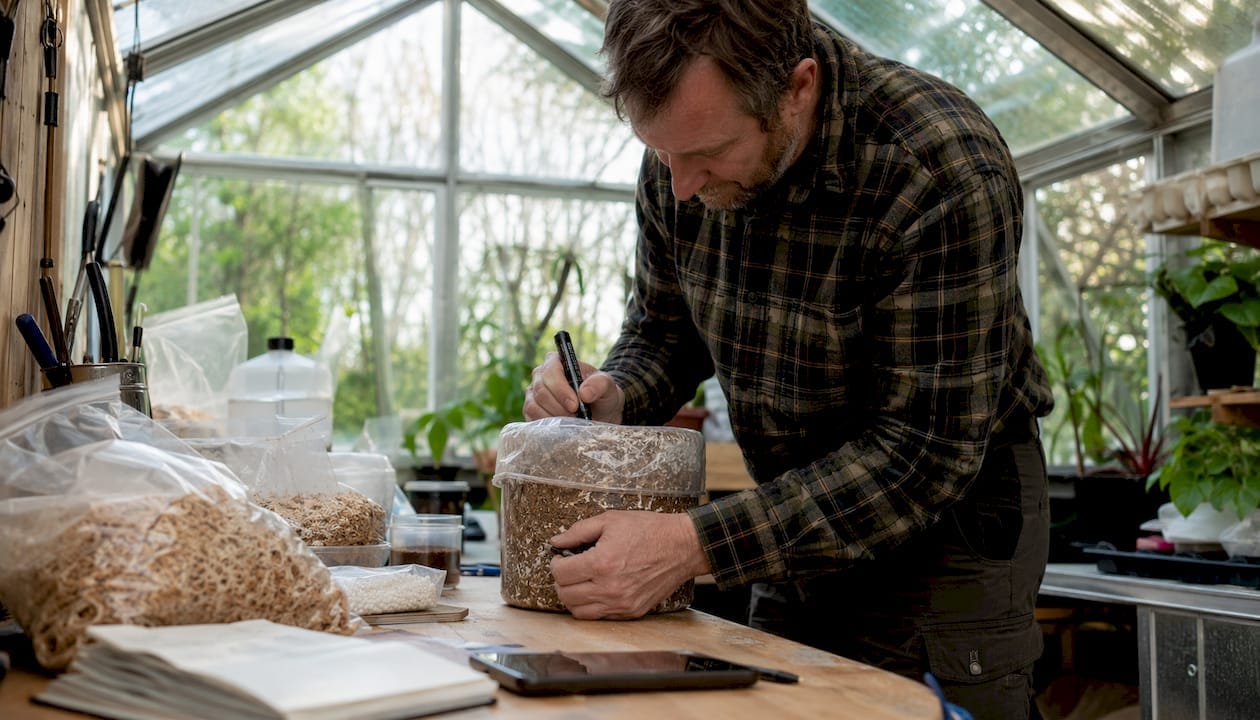
Traceability lets you link any mushroom lot back to its substrate, spawn batch and key dates, so that if something goes wrong you can contain the problem precisely rather than discarding everything you have grown. Three things you can do today: label every container with the strain name and inoculation date, keep a dated log of each substrate batch and harvest flush, and ask any supplier for a lot number or certificate of analysis (CoA) before you buy. None of this requires specialist software or commercial infrastructure. A simple notebook and a consistent labelling habit are enough to give you real safety and troubleshooting power.
- Label containers with strain and inoculation date before you move on to the next task.
- Start a dated log covering substrate batch, spawn lot, flush number and harvest date.
- Request a lot ID, harvest date and any available CoA from every supplier.
Table of Contents
- What traceability means in the mushroom supply chain
- Why traceability matters for safety and consumer confidence
- How commercial growers implement traceability in practice
- Practical traceability steps you can start today
- Tools and templates that fit a hobbyist budget
- When to stop sharing a batch and how to escalate
- UK-specific guidance: who to contact and what to ask suppliers
- Key takeaways
- Sporebuddies: traceable supplies and cultivation guidance for UK growers
- FAQ
What traceability means in the mushroom supply chain
Traceability is the ability to follow a product’s complete journey, from the substrate and spawn used to grow it, through the grow room, harvest and packaging, all the way to the end recipient. In mushroom supply chain management, that means connecting each data point into a single searchable record so you can move backwards or forwards through the chain at any moment.
A short glossary of terms you will encounter:
| Term | Plain-English meaning |
|---|---|
| Batch / lot ID | A unique code assigned to a specific production run, substrate mix or spawn order |
| Chain of custody | The documented sequence of who handled a product and when |
| Certificate of analysis (CoA) | A lab report confirming the identity, purity or safety of a product |
| Harvest / flush ID | A code or label identifying a specific picking session from a specific container or room |
| Critical Tracking Event (CTE) | A point in the supply chain where key data must be captured (growing, cooling, packing) |
For a home grower, the minimal data fields worth capturing are: substrate batch ID, spawn lot reference, inoculation date, grow location (shelf or room label), flush number, harvest date, and any notes on yield or unusual observations.
Why traceability matters for safety and consumer confidence
The most direct safety benefit is precision. When a problem appears, good records let you isolate a single grow room or spawn lot rather than disposing of your entire stock. Effective traceability connects substrate batches, spawn lots, room IDs, harvest dates and cooling records into one genealogy that supports exactly that kind of targeted response.
“Traceability supports market confidence by providing verifiable origin and safety data that reduces consumer fear about food poisoning risks. It is more than a compliance requirement — it is a direct driver of market growth.”
MDPI, Foods journal, traceability and consumer confidence research
Fewer rejections at distribution points and less waste follow naturally from that precision. When a buyer or recipient can see a harvest date and lot ID, they have a basis for trust rather than guesswork. Ready-to-eat processing such as drying or slicing raises the stakes further, because it can mask early spoilage that would be visible on a whole fresh mushroom.
Scenario: Suppose flush three from your oyster kit develops an unusual odour. With a flush ID and inoculation date logged, you can confirm that flushes one and two from the same container are unaffected, and that a second container inoculated from a different spawn lot is clean. Without those records, you face a much harder decision about what to keep and what to discard.
How commercial growers implement traceability in practice
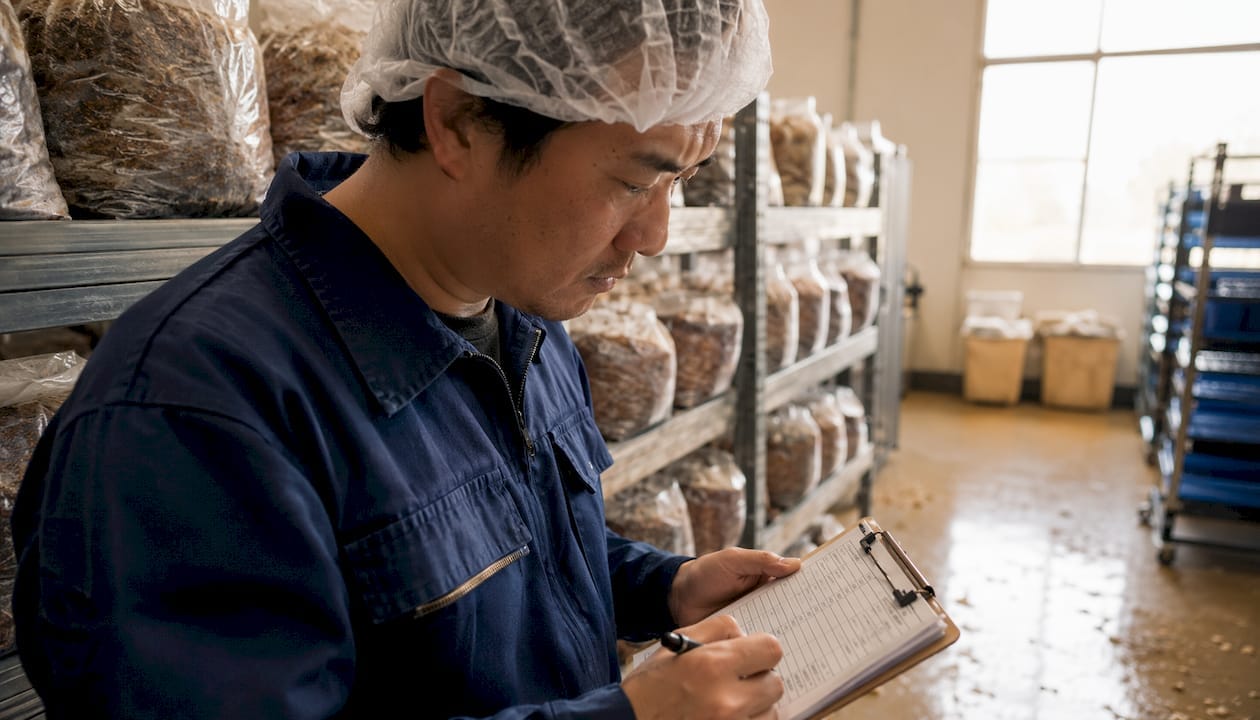
Commercial operations connect substrate and spawn mapping to room or shelf IDs, individual flush records, picker logs, PTI-style case labels and warehouse batch-to-bin mapping, all feeding into one searchable genealogy. Major retailers increasingly expect records at growing, cooling and packing stages, following the Key Data Elements and Critical Tracking Events framework that underpins modern produce traceability standards.
| Format | Best for | Limitation |
|---|---|---|
| Paper logbook | Single grow room, low volume | Hard to search; risk of loss or damage |
| Spreadsheet | Multiple strains or shelves | Requires discipline; version control issues |
| Simple database or app | Small commercial or serious hobbyist | Small learning curve; low cost |
| Enterprise traceability system | Commercial farms | Overkill and expensive for home use |
A reputable supplier should be able to show you a lot ID, harvest date, and at minimum a summary of any lab testing carried out on the batch. Provenance notes, such as where the substrate material was sourced, are a bonus but increasingly common among quality-focused UK suppliers.
Pro Tip: When you receive a new substrate or spawn order, photograph the packaging label alongside the delivery note and save both to a dedicated folder. That single habit gives you a timestamped provenance record with almost no extra effort.
Practical traceability steps you can start today
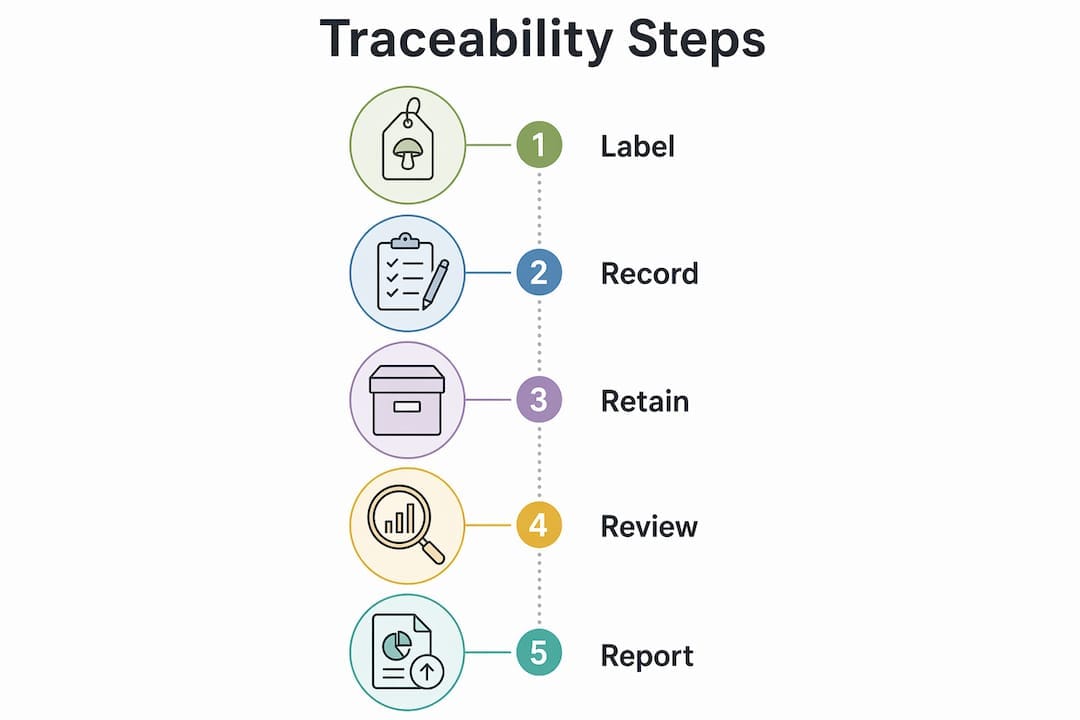
Labelling containers with inoculation date and strain or spawn batch is the single highest-impact habit you can adopt, mirroring the standard commercial practice that makes surgical recalls possible.
Step-by-step checklist:
- Write the strain name, spawn lot reference and inoculation date on a waterproof label and attach it to every container before you move it to the grow area.
- Open a grow log (paper or spreadsheet) and create one row per container, capturing: substrate batch ID, spawn lot, inoculation date, shelf or room label, flush number, harvest date and yield notes.
- At each harvest, record the flush number and date, and note any visible contamination, off-odours or unusual growth patterns.
- Retain a small, sealed sample from each flush in a labelled zip-lock bag, stored in the fridge, for at least two weeks after harvest.
- When you share or sell any product, pass on the lot ID and harvest date so the recipient has a reference point.
Mini grow log template fields:
- Substrate batch ID
- Spawn lot / strain name
- Inoculation date
- Shelf or room label
- Flush number
- Harvest date
- Yield (grams or approximate)
- Notes (contamination, odour, colour)
For guidance on preventing mould during cultivation, cross-reference your log notes with the visual signs described in Sporebuddies’ mould prevention guide.
Pro Tip: Keep retained samples for a minimum of two weeks post-harvest. If a health concern arises, a sealed, labelled sample gives an accredited lab something concrete to test. Use a sterile zip-lock bag, squeeze out the air, label it with the flush ID and date, and refrigerate at 4°C.
Tools and templates that fit a hobbyist budget
Flexible traceability systems work best when they match the user’s actual scale. A home grower running two or three containers does not need blockchain infrastructure. A grower managing multiple strains across several shelves, or anyone sharing produce outside their household, benefits from moving beyond a single paper notebook.
| Tool type | Approximate cost | What it delivers |
|---|---|---|
| Paper logbook | Under £5 | Simple dated records; no search function |
| Spreadsheet (Google Sheets or LibreOffice Calc) | Free | Searchable rows; easy to back up |
| Low-cost inventory app (e.g. Airtable free tier) | Free to ~£10/month | Filtered views, photo attachments |
| Printed QR label sheets | £5–£10 for a pack | Scannable lot IDs on containers |
| USB temperature logger | £10 | Automated cooling and storage records |
When to move from paper to digital:
- You are growing more than three strains simultaneously.
- You have more than one grow room or shelf area.
- You are sharing or selling produce outside your household.
- You want to attach photos of contamination events to specific lot records.
Enterprise options such as multi-chain blockchain models exist and do improve query efficiency at scale, but they are not relevant for home cultivation. Simple, consistent records outperform complex systems that are never actually maintained.
When to stop sharing a batch and how to escalate
Signs that require immediate action include: unusual or sour odour from a specific lot, visible mould patterns that differ from typical contamination (green or black patches spreading rapidly), sudden high spoilage across a single flush, or any health report linked to a batch you have shared. For detailed guidance on contamination signs and how to distinguish them, Sporebuddies’ contamination guide covers the most common patterns.
Immediate containment checklist:
- Isolate the affected containers from all other stock immediately.
- Stop sharing or selling any product from the same lot ID.
- Photograph the affected containers, noting the lot ID, flush number and date.
- Record the event in your grow log with a timestamp.
- If a health concern has been reported, contact your local authority environmental health team and retain your records for their reference.
- Do not discard affected material until you have documented it fully.
“Your traceability records are only useful in a crisis if they are specific enough to act on. A lot ID, an inoculation date and a list of recipients is the minimum a local authority environmental health officer needs to help you respond quickly.”
Principle drawn from Food Standards Agency incident response guidance
UK-specific guidance: who to contact and what to ask suppliers
The Food Standards Agency (FSA) is the primary body for food safety guidance in England, Wales and Northern Ireland; Food Standards Scotland covers Scotland. For any incident involving a health report linked to produce you have grown or shared, your first call should be to your local authority’s environmental health department. For CoA testing, use a UKAS-accredited laboratory, as accreditation confirms the lab meets recognised competence standards.
What to ask UK suppliers before you buy:
- Can you provide a lot number or batch ID for this substrate or spawn?
- Is there a harvest date or production date on the packaging?
- Do you have a certificate of analysis or lab test summary for this batch?
- Where was the substrate material sourced, and is it documented?
- Are your sterilisation or pasteurisation processes logged?
Substrate or spawn without provenance documentation is a known risk. Prefer suppliers who can answer at least the first two questions without hesitation.
Pro Tip: When emailing a supplier to request a CoA, keep it brief and direct: “Could you share the lot number and any available certificate of analysis for the
Golden Teacher Spore Syringe (UK) – Psilocybe cubensis Research Use
Price range: £5.99 through £25.99
Select options
This product has multiple variants. The options may be chosen on the product page
Key takeaways
Traceability in mushroom supply is a low-cost, high-impact safety habit that lets you contain problems precisely, troubleshoot faster, and share produce with confidence.
| Point | Details |
|---|---|
| Label every container | Write strain name, spawn lot and inoculation date on a waterproof label before moving to the grow area. |
| Keep a dated grow log | Record substrate batch, flush number and harvest date for every production run. |
| Retain one sample per flush | Store a sealed, labelled sample in the fridge for at least two weeks after harvest. |
| Ask suppliers for lot IDs and CoAs | A reputable UK supplier should provide a batch reference and lab summary on request. |
| Sporebuddies as your starting point | Sporebuddies supplies labelled spores, substrates and grow kits with supporting educational resources for UK hobbyists. |
Sporebuddies: traceable supplies and cultivation guidance for UK growers
Knowing what to track is only half the picture. Starting with well-documented inputs makes the whole process significantly easier. Sporebuddies supplies UK hobbyists with labelled mushroom spores and documented substrate options, alongside grow kits and mycology equipment, all backed by practical cultivation guides on the blog. If you are setting up your first grow log or want inputs you can actually trace back to a source, browsing the Sporebuddies catalogue is a sensible first step. Follow UK food safety guidance and consult your local environmental health team for any incident involving shared produce. Visit sporebuddies.com to browse supplies and read further cultivation guides.
FAQ
What is traceability in mushroom supply?
Traceability is the ability to link a mushroom lot back to its substrate, spawn batch, grow dates and handling records. It enables targeted containment when problems arise, rather than discarding an entire stock.
Do home growers in the UK need formal traceability systems?
No formal system is required for purely personal cultivation, but a simple dated log and labelled containers mirror commercial standards and are strongly recommended if you share or sell any produce.
What should I ask a UK supplier for when buying spawn or substrate?
Ask for a lot number or batch ID, a harvest or production date, and any available certificate of analysis or lab test summary. A reputable supplier should provide these without difficulty.
How long should I keep retained samples after harvest?
Keep a sealed, labelled sample refrigerated at 4°C for at least two weeks after harvest. If a health concern is reported, that sample gives an accredited lab something concrete to test.
Which UK body handles food safety incidents involving home-grown mushrooms?
The Food Standards Agency provides food safety guidance for England, Wales and Northern Ireland; Food Standards Scotland covers Scotland. For incident reporting, contact your local authority’s environmental health department directly.