
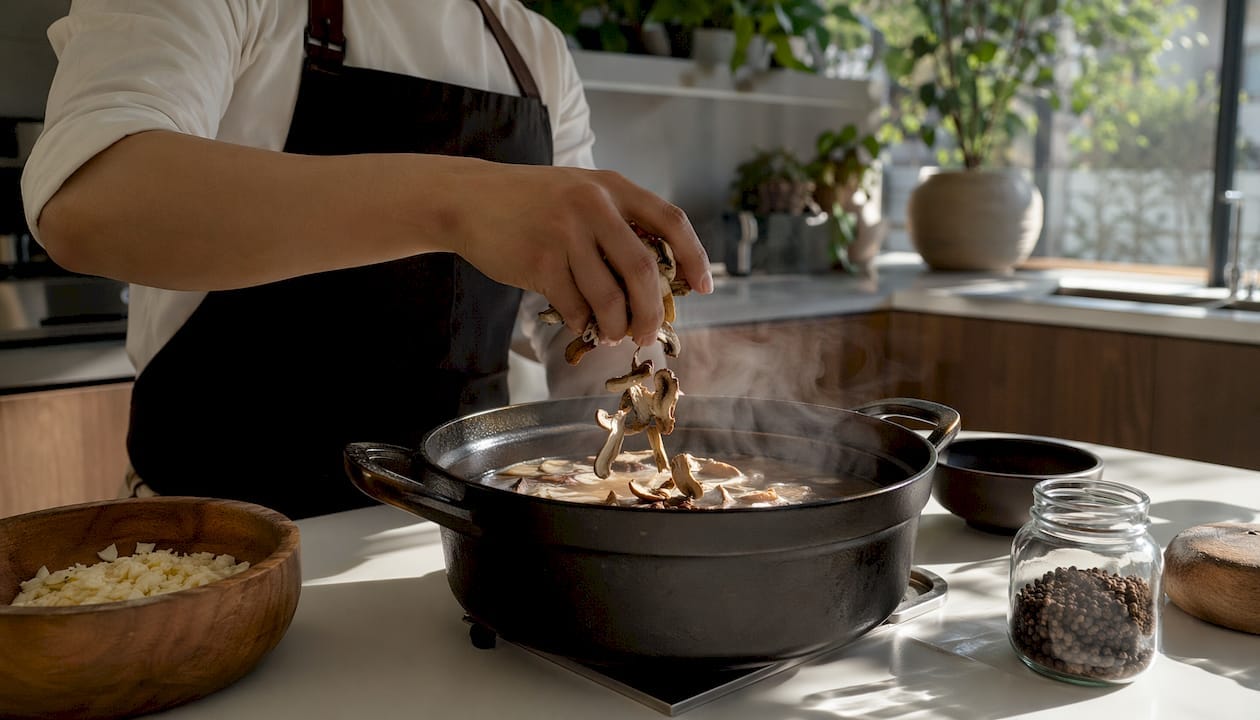
Umami is defined as the fifth basic taste, sitting alongside sweet, sour, salty, and bitter, and mushrooms are among its richest natural sources. The role of umami in mushroom foods goes far beyond simple savouriness. Mushrooms deliver umami through free glutamic acid and nucleotides such as GMP (guanosine monophosphate), which bind to receptor proteins T1R1 and T1R3 on the tongue. When glutamate and nucleotides combine, their synergistic umami effect amplifies perceived taste intensity by 7–8 times compared to either compound alone. That multiplier explains why a small amount of dried shiitake can transform an entire broth.
What compounds in mushrooms create umami and how do they work?
Mushrooms produce umami through two distinct chemical pathways: free glutamic acid and 5’-ribonucleotides. Free glutamic acid is an amino acid that occurs naturally in mushroom tissue. It delivers a baseline savoury signal the moment it contacts your tongue. The concentration varies by species, growing conditions, and harvest timing.
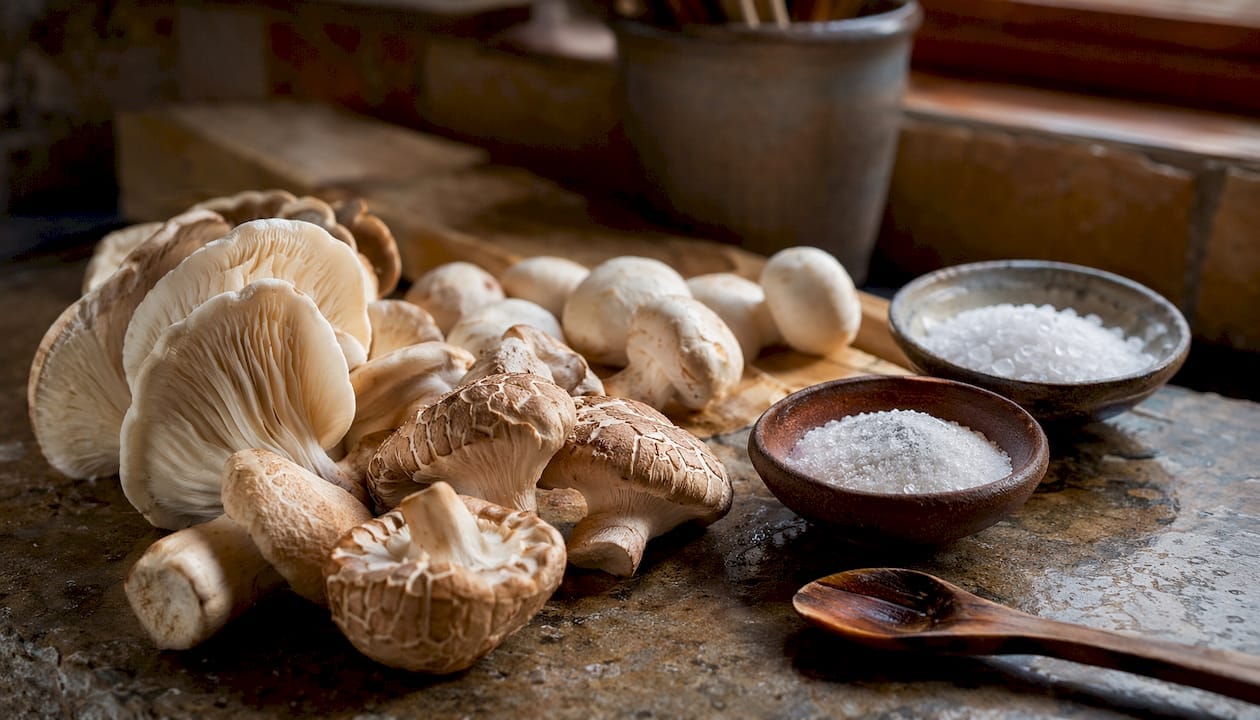
The nucleotides GMP and IMP (inosine monophosphate) are the second pathway. GMP is particularly abundant in shiitake mushrooms, while oyster mushrooms carry notable levels of free glutamic acid alongside their nucleotides. Fresh oyster mushrooms contain high concentrations of both compounds, though the exact ratio shifts with species and harvest conditions.
The real power lies in what happens when these two pathways meet. The 7–8 times amplification occurs because glutamate and nucleotides bind to the T1R1/T1R3 receptor complex at different sites simultaneously. Think of it as two keys turning one lock at the same time. The receptor fires a much stronger signal than either key could trigger alone.
Dried mushrooms outperform fresh ones in umami intensity for a clear biochemical reason. During dehydration, fungal RNA breaks down enzymatically into 5’-ribonucleotides. Dehydrating mushrooms at 49–60°C (120–140°F) activates nucleases that increase GMP content by up to 10 times compared to fresh mushrooms. That is why dried shiitake powder is one of the most efficient umami ingredients available to any cook.
Key umami compounds by mushroom type:
- Shiitake: Very high GMP; the benchmark for nucleotide-driven umami in culinary use
- Oyster mushrooms: High free glutamic acid; delivers immediate, clean savouriness
- Lion’s mane: Moderate glutamate levels; pairs well with other umami sources for additive stacking
- Porcini: Rich in both glutamate and nucleotides; widely used in European stocks and sauces
Pro Tip: When buying dried mushrooms, look for whole caps rather than broken pieces. Whole caps retain more cell structure, which means more intact nucleotides before you begin cooking.
How does cooking and preparation influence the umami taste in mushroom dishes?
Cooking technique is the single biggest variable in whether mushroom umami reaches its potential or disappears into steam. Temperature, time, and pan density all affect the final flavour. Getting these right is the difference between a dish with depth and one that tastes flat.
Temperature and the Maillard reaction
The Maillard reaction begins above 140°C (285°F) on the mushroom’s surface. This browning process creates hundreds of new flavour compounds that amplify the existing umami base. The dry-sauté technique achieves this by placing mushrooms in a dry, hot pan without oil or liquid. No oil means no barrier between the mushroom surface and the pan. The surface temperature climbs fast, browning begins quickly, and umami compounds concentrate rather than leach out.
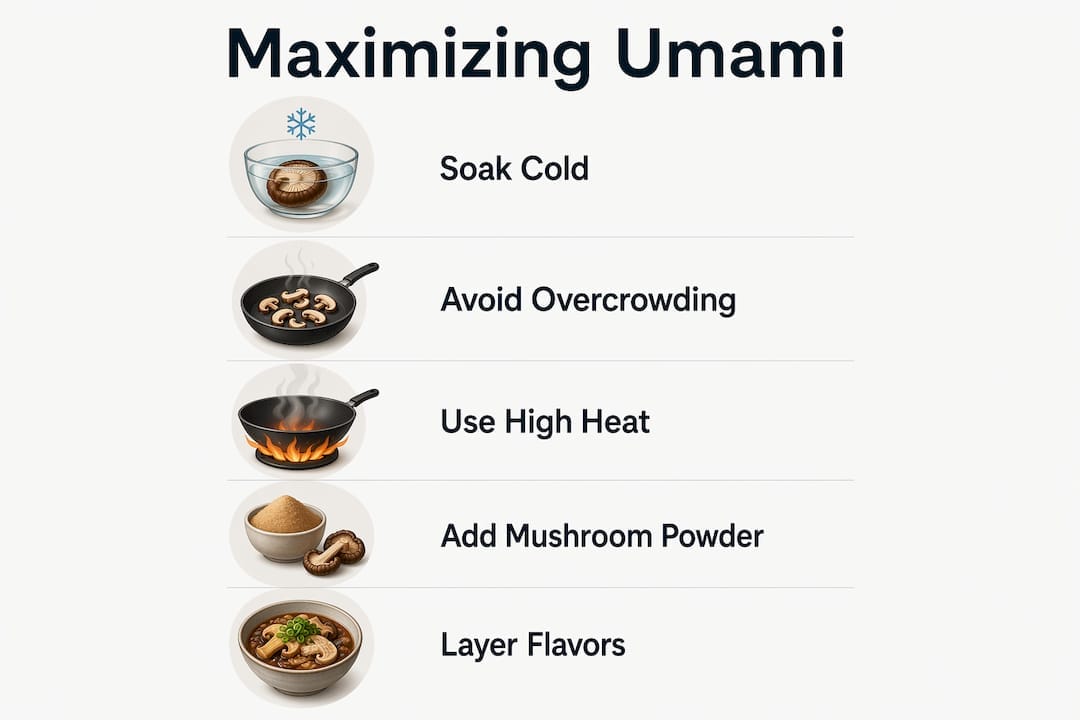
Overcrowding the pan is the most common mistake. When too many mushrooms share a pan, they release moisture faster than it can evaporate. The pan temperature drops, the mushrooms begin to boil in their own liquid, and the Maillard reaction stalls. You end up with pale, soft mushrooms that taste watery rather than savoury.
Cooking time and aroma retention
Cooking duration creates a genuine trade-off between umami depth and mushroom aroma. Research on Sarcodon imbricatus soup shows that 30-minute cooking preserves the characteristic mushroom aroma while keeping IMP above 0.35 mg/kg and AMP above 0.28 mg/kg. Extended cooking at 150 minutes increases the proportion of umami and sweet free amino acids but reduces the volatile aroma compounds that give mushroom broth its distinctive scent.
The practical takeaway: cook short for aroma-forward dishes like light broths and risottos. Cook longer for deeply savoury stocks where aroma is secondary to flavour intensity.
Four preparation steps to maximise umami
- Dry-sauté first. Place mushrooms in a hot, dry pan. Cook without stirring for 2–3 minutes per side until golden. Add fat only after browning is established.
- Dehydrate at controlled temperatures. Use a mushroom dehydrator set to 49–60°C to trigger enzymatic GMP production before storage or use.
- Time your broth carefully. For maximum aroma, keep broth cooking under 30 minutes. For maximum amino acid depth, extend to 90–150 minutes and accept some aroma loss.
- Add dried mushroom powder as a finishing seasoning. Stir a small amount into sauces, soups, or marinades at the end of cooking to layer concentrated umami without diluting aroma.
“Umami acts as a flavour glue that binds all the other tastes together, creating a sense of fullness and a prolonged aftertaste known as kokumi. In mushroom cookery, this means a well-prepared dish continues to satisfy the palate long after the last bite.”
Pro Tip: Soak dried shiitake in cold water for 30 minutes rather than hot. Cold soaking preserves more GMP in the soaking liquid. Use that liquid as a stock base rather than discarding it.
What are the culinary benefits and health advantages of leveraging umami in mushroom foods?
Umami-rich mushrooms do more than taste good. They change how you cook and what you need to add to a dish. The benefits of umami in cooking extend from flavour design all the way to nutritional outcomes.
The most measurable benefit is sodium reduction. Natural umami sources like dried mushrooms can reduce the sodium content of a dish by 30–40% without any loss of perceived savouriness. This works because umami stimulates the same satisfaction signals that salt does, but through a different receptor pathway. A mushroom-based stock can replace a significant portion of the salt in soups, stews, and sauces while maintaining the same depth of flavour.
The second benefit is kokumi, a Japanese term for the perception of fullness, roundness, and prolonged aftertaste. Kokumi enhances satisfaction and extends the flavour experience without adding calories. This is why a mushroom risotto feels more satisfying than a plain rice dish of identical caloric value. The umami compounds keep the palate engaged after swallowing.
Health and culinary benefits at a glance:
- Sodium reduction: Replace up to 30–40% of added salt with mushroom-based umami without flavour loss
- Satiety support: Umami supports satiety comparably to calorie-dense ingredients, making it useful in lower-calorie meal design
- Plant-based compatibility: Mushroom umami delivers the savoury depth that plant-based diets often lack, replacing meat-derived glutamates in stocks, sauces, and marinades
- Flavour complexity without fat: Umami adds perceived richness that would otherwise require cream, butter, or animal fat to achieve
- Low-sodium diet support: Mushroom umami fits naturally into low-sodium cooking programmes without requiring specialist ingredients
Umami in plant-based diets deserves particular attention. Animal proteins are a traditional source of dietary glutamate, so removing them from a diet often leaves dishes tasting flat. Mushrooms fill that gap directly. Shiitake, oyster, and porcini varieties all carry enough free glutamate and GMP to replicate the savoury depth of meat-based cooking. You can read more about the nutritional side of this on the mushroom health and wellness page.
How can you apply mushroom umami practically in the kitchen?
Knowing the science is useful. Knowing how to use it at the stove is what changes your cooking. The practical application of mushroom umami flavours comes down to variety selection, preparation method, and ingredient pairing.
Choosing the right mushroom variety
Different species deliver different umami profiles. Shiitake is the go-to for nucleotide-driven umami and works best in broths, ramen, and braised dishes. Oyster mushrooms provide clean, immediate glutamate-driven savouriness and suit quick sautés and stir-fries. Porcini carry both glutamate and nucleotides, making them ideal for European-style sauces and pasta dishes. Lion’s mane has a milder umami profile but pairs well with other glutamate sources through additive stacking.
You can find a range of gourmet mushroom varieties suited to culinary use at Sporebuddies, including dried options that deliver concentrated umami straight from the packet.
Additive stacking for maximum savouriness
Combining multiple glutamate sources targets the T1R1/T1R3 receptors synergistically, amplifying overall savouriness well beyond what any single ingredient achieves. Classic stacking combinations include:
- Dried shiitake stock with a parmesan rind
- Oyster mushrooms sautéed with sun-dried tomatoes
- Porcini powder stirred into a tomato-based sauce
- Lion’s mane with miso paste as a marinade base
Each pairing layers glutamate from different sources. The receptor response compounds with each addition, producing a dish that tastes far more complex than its ingredient list suggests.
Fresh versus dried: a practical comparison
| Format | Umami intensity | Best use | Notes |
|---|---|---|---|
| Fresh mushrooms | Moderate | Quick sautés, salads, stir-fries | Immediate flavour; shorter shelf life |
| Dried mushrooms | High to very high | Stocks, braises, powders, seasonings | Up to 10x GMP vs fresh; long shelf life |
| Mushroom powder | Very high | Finishing seasoning, rubs, marinades | Concentrated; use sparingly |
| Soaking liquid | High | Stock base, sauce enrichment | Retains dissolved glutamates and nucleotides |
Pro Tip: Keep a jar of dried shiitake powder in your kitchen. A half-teaspoon added to any savoury dish at the end of cooking adds umami depth without altering the dish’s texture or aroma profile.
For a deeper look at how mushroom texture interacts with cooking technique, the cook’s guide to edible mushroom textures covers the practical side in detail.
Key takeaways
Mushroom umami is most effective when you combine the right variety, preparation method, and ingredient pairing to activate the 7–8 times glutamate-nucleotide synergy.
| Point | Details |
|---|---|
| Synergy multiplies flavour | Glutamate and nucleotides together amplify umami 7–8 times more than either compound alone. |
| Drying concentrates umami | Dehydrating at 49–60°C increases GMP by up to 10 times compared to fresh mushrooms. |
| Sodium reduction is measurable | Mushroom umami can replace 30–40% of added salt without any loss of perceived savouriness. |
| Cooking time is a trade-off | Short cooking (around 30 minutes) preserves aroma; longer cooking builds amino acid depth. |
| Additive stacking amplifies results | Combining mushrooms with other glutamate sources creates significantly stronger savouriness than mushrooms alone. |
Sporebuddies: grow the mushrooms behind the flavour
Understanding umami is one thing. Growing the mushrooms that deliver it is another level entirely. Sporebuddies supplies everything you need to cultivate shiitake, oyster, and lion’s mane at home in the UK, from spore syringes to fully prepared mushroom substrates designed for consistent yields. Home-grown mushrooms give you control over harvest timing, which directly affects glutamate concentration and flavour intensity. Sporebuddies also publishes cultivation guides covering contamination prevention, substrate preparation, and species-specific growing conditions. Whether you are a food enthusiast wanting fresher ingredients or a culinary professional interested in traceability, growing your own is the most direct route to mushrooms with a known and reliable umami profile.
FAQ
What is umami and why do mushrooms have so much of it?
Umami is the fifth basic taste, produced by free glutamic acid and nucleotides such as GMP. Mushrooms are naturally high in both compounds, making them one of the richest plant-based umami sources available.
How does drying mushrooms affect their umami content?
Drying mushrooms at 49–60°C triggers enzymatic breakdown of fungal RNA into 5’-ribonucleotides, increasing GMP content by up to 10 times compared to fresh mushrooms. This is why dried shiitake delivers significantly more umami intensity than fresh.
Can mushroom umami replace salt in cooking?
Natural umami sources like dried mushrooms can reduce sodium in a dish by 30–40% without loss of savouriness. Umami stimulates satisfaction through a different receptor pathway than salt, allowing meaningful sodium reduction.
Which mushroom variety has the strongest umami flavour?
Dried shiitake is the benchmark for nucleotide-driven umami due to its high GMP content. Oyster mushrooms deliver strong glutamate-driven umami in fresh form, making them ideal for quick cooking methods.
What is additive stacking and how does it work with mushrooms?
Additive stacking means combining multiple glutamate-rich ingredients, such as mushrooms, parmesan, and tomatoes, to target the same taste receptors simultaneously. The synergistic effect produces savouriness far greater than any single ingredient achieves alone.