
Quick Answer
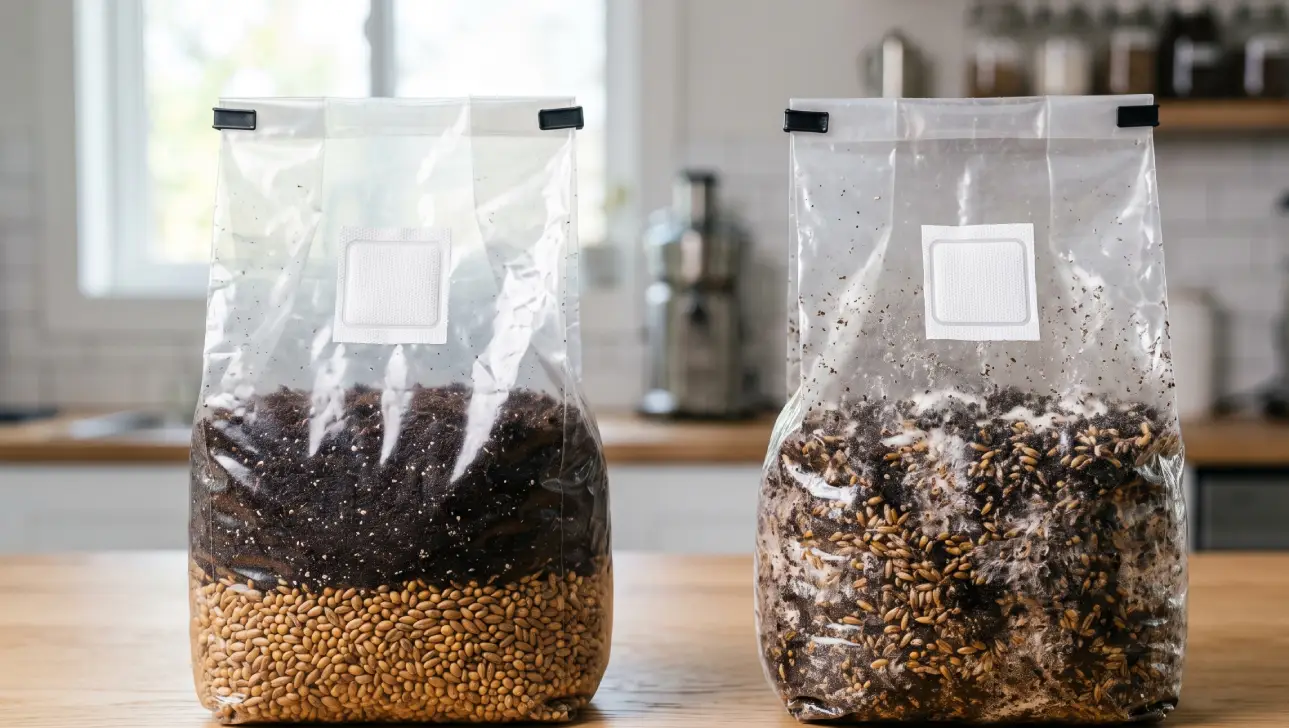
All-in-one (AIO) grow bags come pre-filled with sterilised substrate and grain spawn mixed together, ready to colonise and fruit from a single sealed bag. Inject and forget (IAF) bags separate the substrate and a spawn injection port, letting you introduce your own liquid culture or spore syringe into the sterilised substrate. AIO bags suit beginners who want the simplest possible setup, while IAF bags give more experienced growers control over spawn ratio and strain choice.
What Are Mushroom Grow Bags?
A mushroom grow bag is a sealed, sterilised bag of substrate designed to support colonisation and fruiting without needing a separate fruiting chamber for smaller-scale grows. Filter patches built into the bag allow gas exchange while keeping airborne contaminants out.
Grow bags have become one of the most accessible entry points into home cultivation precisely because most of the sterilisation work is already done for you. That’s a meaningful advantage over building substrate from scratch, where a single lapse in sterile technique can spoil an entire batch before colonisation even begins. Fully sterilised substrate consistently shows lower contamination rates than pasteurised substrate in published cultivation research, which is part of why pre-sterilised bags have become the standard starting point for home growers rather than a shortcut (PMC review of cultivation substrate and microbial communities).
Within that broad category, two bag types dominate the UK market, and choosing between them is usually one of the first decisions a new grower makes. The right choice depends less on which bag is objectively “better” and more on how much control you want versus how much complexity you’re ready to take on. Our guide to understanding mycelium is worth reading alongside this one if you’re new to what’s actually happening inside the bag during colonisation.
All-in-One (AIO) Grow Bags
An all-in-one bag arrives with substrate and grain spawn already mixed and sterilised together inside the sealed bag. There’s no separate injection step. Once the bag arrives, you’re essentially waiting for colonisation to begin on its own.
How it works. The bag is left at a stable room temperature, away from direct sunlight, while mycelium spreads through the substrate. Once fully colonised, usually indicated by the substrate turning solid white with no visible patches of unclaimed substrate remaining, the bag is opened along a perforated fruiting strip to allow pins to form and push through.
Why growers choose AIO bags. The appeal is simplicity. There’s no injection technique to learn, no liquid culture to source separately, and considerably less that can go wrong at the setup stage. For a first grow, that reduced complexity often matters more than the extra control an inject and forget bag offers. It’s also a genuinely good option if you simply want a reliable, low-maintenance harvest without getting into the finer details of spawn preparation.
The trade-off. Because spawn and substrate are already combined by the supplier, you have no say over strain selection beyond what’s offered, and no ability to adjust the spawn-to-substrate ratio yourself. If you’re hoping to compare specific strains side by side, an AIO bag won’t give you that flexibility.
Inject and Forget (IAF) Grow Bags
An inject and forget bag ships with sterilised substrate only, along with a self-healing injection port. You supply your own spawn, typically as a liquid culture or spore syringe, injected directly through the port.
How it works. Using a sterile syringe, you inject your chosen spawn through the port into the substrate, then reseal and leave the bag to colonise. From there, the process mirrors an AIO bag: wait for full colonisation, then open along the fruiting strip once pins are ready to form.
Why growers choose IAF bags. The main draw is control. You choose the strain, decide how much spawn to introduce, and can run several bags side by side with different genetics if you’re comparing strains. It’s also usually a more cost-effective route if you’re already working with liquid cultures for other projects, since you’re only paying for sterilised substrate rather than pre-spawned substrate.
Why This Matters: the injection step is also where most of the added risk sits. A non-sterile syringe, a poorly cleaned injection port, or hesitation that leaves the port open too long all introduce contamination opportunities that simply don’t exist with a pre-spawned AIO bag. Understanding that trade-off before you buy, rather than after a contaminated bag, helps you choose the right starting point for your experience level rather than assuming more control is automatically the better option.
Side-by-Side Comparison
| Factor | All-in-One (AIO) | Inject & Forget (IAF) |
| Setup difficulty | Very low, no injection needed | Moderate, requires sterile injection technique |
| Strain control | Limited to what’s supplied | Full control over spawn source |
| Contamination risk | Lower, fewer handling steps | Slightly higher, tied to injection technique |
| Cost per bag | Typically higher | Typically lower if you already have spawn |
| Time to first flush | Similar once colonised | Similar once colonised |
| Best suited to | First-time growers | Growers comparing strains or scaling up |
Cost and Colonisation: What Actually Differs
Once colonisation is under way, the two bag types behave almost identically. Mycelium doesn’t distinguish between spawn that arrived pre-mixed and spawn you introduced yourself, so speed depends far more on temperature and substrate quality than on format (our substrate recipes guide covers what makes a strong substrate mix if you’re comparing options). Where they diverge is beforehand: an AIO bag has spawn distributed evenly under controlled conditions by the supplier, while an IAF bag’s evenness depends on your own injection technique.
Price often decides between the two. AIO bags cost more per bag because the supplier has sourced and combined spawn for you. IAF bags are usually cheaper per bag, but only if you already have a spawn source such as a liquid culture, since you’ll need to factor in that cost plus basic sterile injection supplies. For growers running several bags at once, IAF tends to work out more economical at scale, as one spawn source can inoculate multiple bags.
Setting Up Either Bag Type
Regardless of which type you choose, a few practices apply across both.
- Inspect the bag on arrival. Check the filter patch is intact and there’s no visible damage to the bag itself before storing it.
- Store at a stable temperature. Avoid direct sunlight and temperature swings while colonisation takes place, ideally somewhere in the low twenties Celsius. An incubation chamber is worth considering if your growing space fluctuates more than that, since consistent warmth speeds up even colonisation.
- Watch, don’t disturb. Repeated handling or squeezing the bag to check progress increases contamination risk without giving you much useful information.
- Open along the fruiting strip only once fully colonised. Opening early exposes uncolonised substrate to airborne contaminants before mycelium has had a chance to establish dominance.
- Fan gently once pins appear. A light fanning motion a few times a day supports healthy fruiting body development without over-drying the substrate surface.
Pro Tip: if you’re using an IAF bag, let the injection site sit for a moment after removing the needle before moving the bag. This gives the self-healing port a chance to close properly and reduces the chance of contaminants slipping in through a still-open puncture.
Pro Tip: whichever bag you choose, keep a simple log of fill date, strain, and any observations. It sounds unnecessary for a single bag, but it becomes genuinely useful once you’re running several bags at once and want to compare outcomes across strains or batches.
Colonisation time for most gourmet species falls somewhere between two and four weeks under stable conditions, though this varies meaningfully by species, ambient temperature, and how evenly spawn was distributed through the substrate.
Which Should You Choose?
If this is your first grow, an all-in-one bag removes the riskiest step in the process and gives you the best odds of a clean first harvest, letting you learn colonisation and fruiting basics without also troubleshooting injection technique. If you’ve grown successfully before, want to compare strains, or want lower cost at scale, an inject and forget bag is worth moving to once you’ve built sterile handling habits.
Common Mistakes
Choosing an IAF bag without prior sterile technique experience. If this is your first grow, the added injection step is often more risk than it’s worth. Start with an AIO bag and build technique before moving to IAF.
Injecting too much liquid culture at once. Oversaturating the substrate at the injection site can create a waterlogged pocket that struggles to colonise evenly. A modest, well-distributed injection works better than one large dose.
Opening the bag too early. Whether AIO or IAF, opening before colonisation is complete exposes the substrate to contamination risk it doesn’t need to face.
Storing bags somewhere too warm. Excess heat can encourage competing moulds to outpace your mycelium. A stable room temperature, generally in the low twenties Celsius, suits most species well.
Forgetting to check the filter patch. A damaged or missing filter patch defeats the purpose of the bag’s sterile design, so it’s worth checking on arrival before you commit to using it. Airborne contact through a compromised filter is one of the most commonly cited contamination pathways in cultivation research, alongside handling and equipment hygiene (PMC review on microbial contamination in mushroom cultivation).
FAQ
Which grow bag type is better for a complete beginner? An all-in-one bag is generally the better starting point. It removes the injection step entirely, which is where most early contamination issues tend to originate.
Can I reuse a grow bag for a second batch? Most grow bags are designed for a single substrate fill. Once a batch is finished, the bag itself typically isn’t reused, though the substrate can sometimes be transferred into a monotub for further flushes depending on condition.
How long does an unopened grow bag last before use? Most sterilised bags remain viable for several weeks to a few months if stored correctly, though it’s best to use them as soon as reasonably possible after arrival for the most reliable results.
Do I need any special equipment for an inject and forget bag? You’ll need a sterile syringe and either a liquid culture or spore-based inoculant, along with basic sterile handling practices such as wiping the injection port with alcohol before and after injecting.
Can I move substrate from a grow bag into a monotub? Yes, this is a common approach once a bag is fully colonised, particularly if you want more flushes than a smaller bag comfortably supports. Our monotub buyer’s guide covers how to set one up.
Related Guides
- Mushroom Grow Bags Explained: Types & Buying Guide
- How to Use Inject and Forget Mushroom Grow Bags
- Growing Mushrooms at Home: A Beginner’s Guide
- Bulk Substrate Recipe for Mushrooms: Ultimate Guide
- Sterilised Grain Spawn Bags
About This Guide
SporeBuddies has supplied grow bags, substrate, and cultivation equipment to UK home growers for years, drawing on practical experience with both all-in-one and inject and forget formats. This guide reflects that hands-on background, helping new and returning growers choose the bag type that best matches their experience and goals.
In Summary
Choosing between an all-in-one and an inject and forget grow bag comes down to how much control you want versus how much complexity you’re ready to take on. All-in-one bags offer the simplest path to a first successful grow, while inject and forget bags reward growers who’ve built sterile technique and want a say in strain and spawn ratio. Either way, careful handling, stable storage conditions, and patience through colonisation make the real difference to your results.
Browse our full range of mushroom grow bags, or check our monotub buyer’s guide if you’re ready to scale up your next grow.