

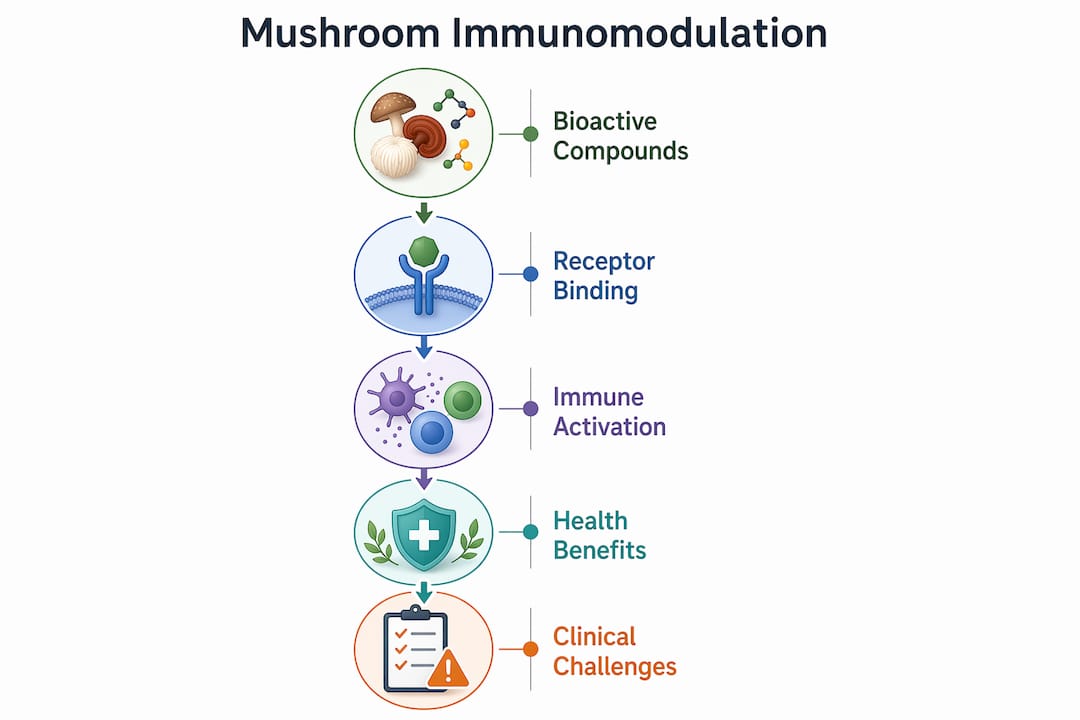
Mushroom immunomodulation is defined as the regulation of immune system function by bioactive compounds found in fungi, restoring balance rather than simply stimulating a response. These compounds, principally β-glucans, triterpenoids, and polysaccharides, interact with immune cells including macrophages and natural killer (NK) cells through signalling pathways such as NF-κB and MAPK. Unlike a crude “immune boost,” mushroom immune support works by calibrating the immune response up or down depending on what the body needs. Research published in 2025 and 2026 across species including Ganoderma lucidum, Lentinula edodes, and Grifola frondosa confirms this regulatory mechanism at a molecular level, making it one of the most studied areas in functional food science today.
What is mushroom immunomodulation and which compounds drive it?
Mushroom immunomodulation is best understood through its key molecules. The most studied are β-glucans, a class of polysaccharides found in the cell walls of fungi. Their three-dimensional structure, whether linear or branched, determines how strongly they interact with immune receptors.

β-glucans bind receptors like Dectin-1 and toll-like receptor 2 on the surface of immune cells. This binding triggers the production of cytokines, the chemical messengers that coordinate the immune response. Prebiotic effects in the gut also contribute, as β-glucan fermentation produces short-chain fatty acids that further regulate immune activity.
Triterpenoids, found in high concentrations in Ganoderma lucidum (reishi), add a second layer of action. They suppress excessive inflammation by interfering with pro-inflammatory gene expression. Phenolic compounds and bioactive peptides from species like Lentinula edodes (shiitake) round out the picture, each contributing to what researchers describe as multi-pathway immune modulation.
The signalling pathways involved include:
- NF-κB: a master regulator of inflammation; mushroom bioactives can suppress its overactivation in chronic disease states
- MAPK: involved in cell survival and cytokine production; modulated by β-glucans to fine-tune immune cell activity
- NLRP3 inflammasome: a protein complex linked to inflammatory diseases; triterpenoids and polysaccharides reduce its excessive activation
- Nrf2/HO-1: an antioxidant pathway that protects immune cells from oxidative damage during an active response
Different species target these pathways with different emphasis. Grifola frondosa (maitake) shows particular activity on macrophage activation via MAPK, while Cordyceps militaris is noted for its effects on NK cell function. This species-specific targeting means the choice of mushroom matters as much as the dose.
Pro Tip: If you are reading research on mushroom immune effects, check which pathway the study focuses on. A paper studying NF-κB suppression is measuring anti-inflammatory action, not the same thing as a paper measuring NK cell activation. These are related but distinct effects.
What evidence supports the health benefits of mushroom immunomodulation?
The clinical evidence for mushroom immune system benefits has grown substantially in 2025 and 2026. The most credible findings come from controlled trials and peer-reviewed mechanistic studies across several well-characterised species.
Key findings from recent research include:
- Vaccine adjunct potential: A randomised, placebo-controlled trial found that supplementation with Trametes versicolor and Fomes fomentarius mycelia alongside COVID-19 vaccination reduced side effects without affecting antibody levels. This is the first trial of its kind using fungal products as vaccine adjuncts over a six-month period.
- Cancer and chronic disease support: Clinical trials and in vitro studies confirm that mushroom extracts improve immune markers and reduce inflammation, with applications in cancer care, inflammatory bowel disease, and respiratory infections.
- Pharmacological safety: Mushroom compounds are pharmacologically safe even at high doses. Efficacy, however, depends on compound structure, bioavailability, and extraction method. Standardised dosing remains an open challenge in clinical translation.
- Immune homeostasis, not overstimulation: Mushrooms act as immunomodulators by restoring immune homeostasis rather than pushing the immune system into overdrive. This distinction matters for people with autoimmune conditions who have historically been cautious about immune-active supplements.
- Species studied: The most researched species are Ganoderma lucidum, Lentinula edodes, Grifola frondosa, Cordyceps militaris, and Trametes versicolor (turkey tail). Each has a distinct bioactive profile and clinical evidence base.
“Mushroom bioactives function to modulate immune balance rather than overstimulate, a key concept that addresses common misconceptions among users and researchers alike. They modulate NF-κB and MAPK pathways to balance underactive or overactive immune responses, making them relevant across a wide range of immune conditions.”
The limitations are real and worth acknowledging. Most trials use small sample sizes. Bioavailability varies significantly depending on how the extract is prepared. Dose-response data is inconsistent across studies, partly because the concentration of active compounds differs between products. The functional mushroom research update for 2025 to 2026 reflects both the promise and the ongoing gaps in this field.
What challenges affect clinical use and standardisation?
The greatest barrier to widespread clinical adoption of mushroom immunomodulators is not safety. It is consistency. The standardisation gap means that two products labelled identically can contain vastly different concentrations of active compounds.
Extraction method determines efficacy
Extraction method is the single most important variable in product quality. Water extraction isolates β-glucans effectively. Ethanol extraction targets triterpenoids. Using the wrong solvent for the target compound, or using no extraction at all, produces a product with poor bioavailability and diminished effects. Many consumers unknowingly purchase non-extracted mushroom powders that contain minimal active compounds.
Cultivation and substrate variability
The concentration of bioactives in a mushroom depends heavily on the substrate it grows on, the growing conditions, and the stage of harvest. A shiitake grown on oak sawdust will have a different β-glucan profile than one grown on supplemented straw. This natural variability makes it difficult to set universal dose recommendations.
| Factor | Effect on immunomodulatory potency |
|---|---|
| Extraction method (water vs ethanol) | Determines which bioactives are preserved and their bioavailability |
| Cultivation substrate | Influences β-glucan concentration and structural diversity |
| Harvest timing | Early or late harvest alters triterpenoid and polysaccharide ratios |
| Third-party testing | Verifies actual β-glucan content vs label claims |
Label claims and consumer confusion
Labels stating “total polysaccharides” can be misleading. Polysaccharides include starch and other non-active molecules. The relevant measure is verified β-glucan content, which is the key active immunomodulatory molecule. Rigorous third-party testing is the only reliable way to confirm what a product actually contains.
Pro Tip: When evaluating a mushroom supplement, look for a certificate of analysis (COA) from an independent laboratory that specifies β-glucan content as a percentage of dry weight, not just total polysaccharides. This single check separates quality products from marketing noise.
Emerging approaches aim to close this gap. Nanodelivery systems are being studied to improve bioavailability of poorly absorbed compounds. Computational biology and AI are being applied to map β-glucan structures to immune signalling, with the goal of enabling precision immunotherapy tailored to individual immune profiles.
How can mushroom immunomodulation be applied in practice?
Practical application of mushroom immune support requires understanding both the form of the product and the context of use. The science is clear on mechanisms. The gap lies in translating that into consistent, real-world outcomes.
Common consumption forms and what to know about each:
- Standardised extracts: The most reliable form for immunomodulatory effects. Look for dual-extraction products (water and ethanol) that capture both β-glucans and triterpenoids. These are available as capsules, tinctures, and liquid extracts.
- Whole mushroom powders: Convenient but often under-dosed in active compounds. Suitable for culinary use but not equivalent to a standardised extract for therapeutic purposes.
- Mushroom tinctures: Alcohol-based preparations that concentrate triterpenoids well. Useful for Ganoderma lucidum specifically, where triterpenoid content is a primary marker of quality.
- Functional food products: Teas, coffees, and blended powders that include mushroom extracts. Bioactive concentration is typically lower and less consistent than standalone supplements.
For wellness practitioners and individuals using mushrooms for immune and inflammation support, the most important practical steps are:
- Prioritise products with verified β-glucan content from third-party testing
- Match the species to the intended effect (Cordyceps for energy and NK cell activity, Ganoderma for anti-inflammatory action, turkey tail for gut-immune support)
- Treat mushroom immunomodulators as complementary to, not replacements for, conventional care
- Allow adequate time for effects to accumulate; most clinical trials run for eight to twelve weeks minimum
For mycology students and researchers, the nutrition science findings around β-glucan structure and receptor binding offer a productive area for further study. Growing your own medicinal mushrooms also gives you direct control over substrate and harvest timing, two of the biggest variables affecting bioactive concentration.
Sporebuddies: resources for cultivation and research
Sporebuddies supports the growing community of growers, researchers, and wellness enthusiasts who want to work directly with mushroom species known for their immunomodulatory properties. Whether you are cultivating shiitake, lion’s mane, or oyster mushrooms at home, starting with quality materials makes a measurable difference to your results.
The Sporebuddies catalogue includes mushroom spore syringes for a range of species, along with substrates, grow kits, and mycology equipment suited to both beginners and experienced cultivators. For those interested in the research side, the mycology science and education section provides structured resources to deepen your understanding of fungal biology and immune science. Growing your own mushrooms puts you in control of the variables that matter most: substrate, growing conditions, and harvest timing.
FAQ
What is mushroom immunomodulation in simple terms?
Mushroom immunomodulation is the process by which bioactive compounds in fungi, particularly β-glucans and triterpenoids, regulate the immune system to restore balance. Rather than simply stimulating immunity, these compounds can increase or decrease immune activity depending on what the body requires.
Which mushrooms are best known for immune modulation?
The most researched species are Ganoderma lucidum (reishi), Lentinula edodes (shiitake), Grifola frondosa (maitake), Cordyceps militaris, and Trametes versicolor (turkey tail). Each has a distinct bioactive profile and a body of clinical evidence supporting its immune effects.
Are mushroom immunomodulators safe to use?
Mushroom compounds are pharmacologically safe even at high doses, according to current research. The main variables affecting outcomes are bioavailability and extraction quality, not toxicity.
What are immunomodulators in mushrooms, exactly?
Immunomodulators in mushrooms are specific molecules, primarily β-glucans, triterpenoids, and phenolic compounds, that interact with immune receptors and signalling pathways including Dectin-1, NF-κB, and MAPK to regulate immune cell activity.
Can people with autoimmune conditions use mushroom extracts?
Mushroom bioactives restore immune homeostasis rather than overstimulate the immune system, which reduces concerns about worsening autoimmune conditions. Anyone with an autoimmune diagnosis should consult a medical professional before adding any immunomodulatory supplement to their routine.
Key takeaways
Mushroom immunomodulation works by restoring immune balance through β-glucans, triterpenoids, and polysaccharides that act on multiple signalling pathways, not by uniformly stimulating immune activity.
| Point | Details |
|---|---|
| Core mechanism | β-glucans bind Dectin-1 and toll-like receptor 2, activating macrophages and NK cells via NF-κB and MAPK pathways. |
| Balance over stimulation | Mushroom bioactives restore immune homeostasis, making them relevant for both underactive and overactive immune states. |
| Extraction method matters | Water extraction targets β-glucans; ethanol extraction targets triterpenoids. Wrong method means poor bioavailability. |
| Standardisation gap | Variability in cultivation and extraction makes consistent dosing difficult; third-party β-glucan testing is the most reliable quality check. |
| Future direction | AI and computational biology are being applied to map β-glucan structures to immune signalling for precision immunotherapy applications. |