
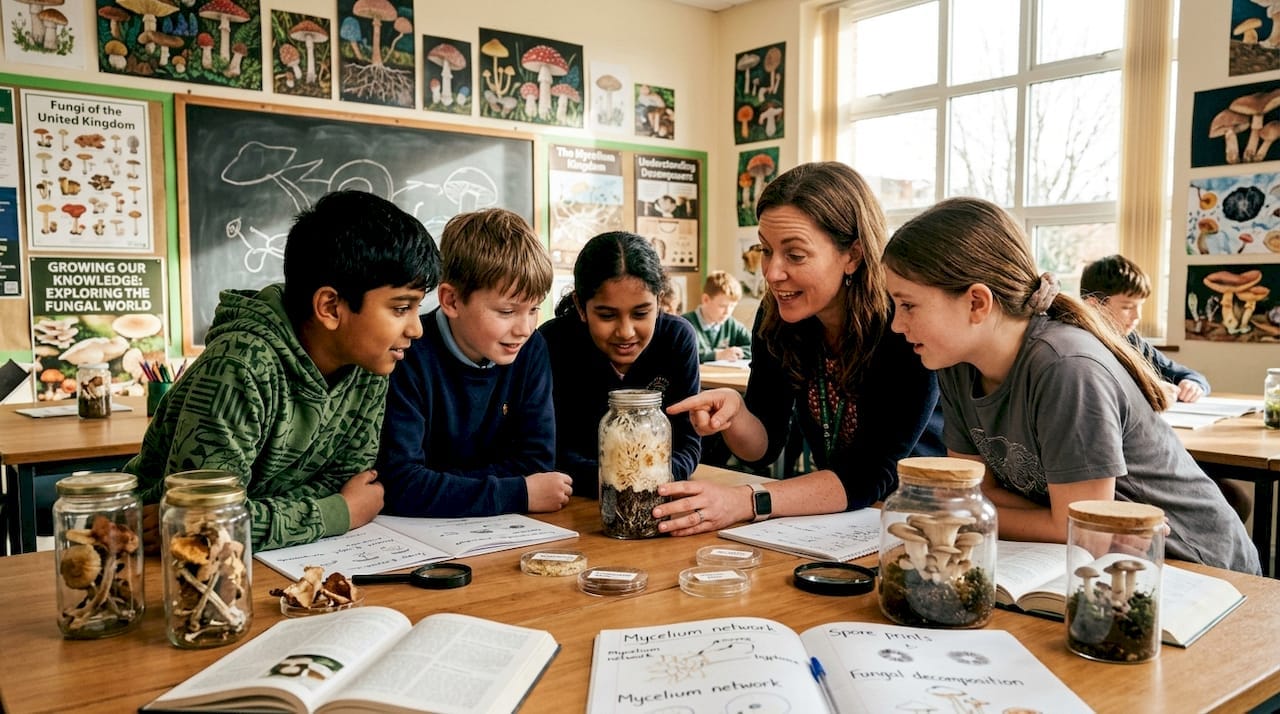
Mushrooms are defined as the fruiting bodies of fungi, and their educational uses for mushrooms span biology, environmental science, sustainable agriculture, and nutrition. Far from being a niche science topic, fungi offer educators and students a hands-on route into some of the most pressing subjects of our time, from ecosystem health to food security. The Mushroom Council’s classroom resources treat mushrooms as cross-curricular tools linking science, mathematics, and language arts through sensory exploration, classification activities, and cooking challenges. Whether you are designing a secondary school biology module or running an independent mycology study, fungi deliver genuine, measurable learning outcomes.
1. How mushrooms enhance biology education
Mushroom biology lessons give students direct access to concepts that are notoriously difficult to teach from a textbook alone, including taxonomy, lifecycle stages, and cellular structure. Fungi sit in their own kingdom, separate from plants and animals, which makes them an ideal case study for teaching biological diversity and classification. When students observe spore prints, examine gill structure, or track mycelium colonisation on agar plates, they are practising the same identification techniques used by professional mycologists.
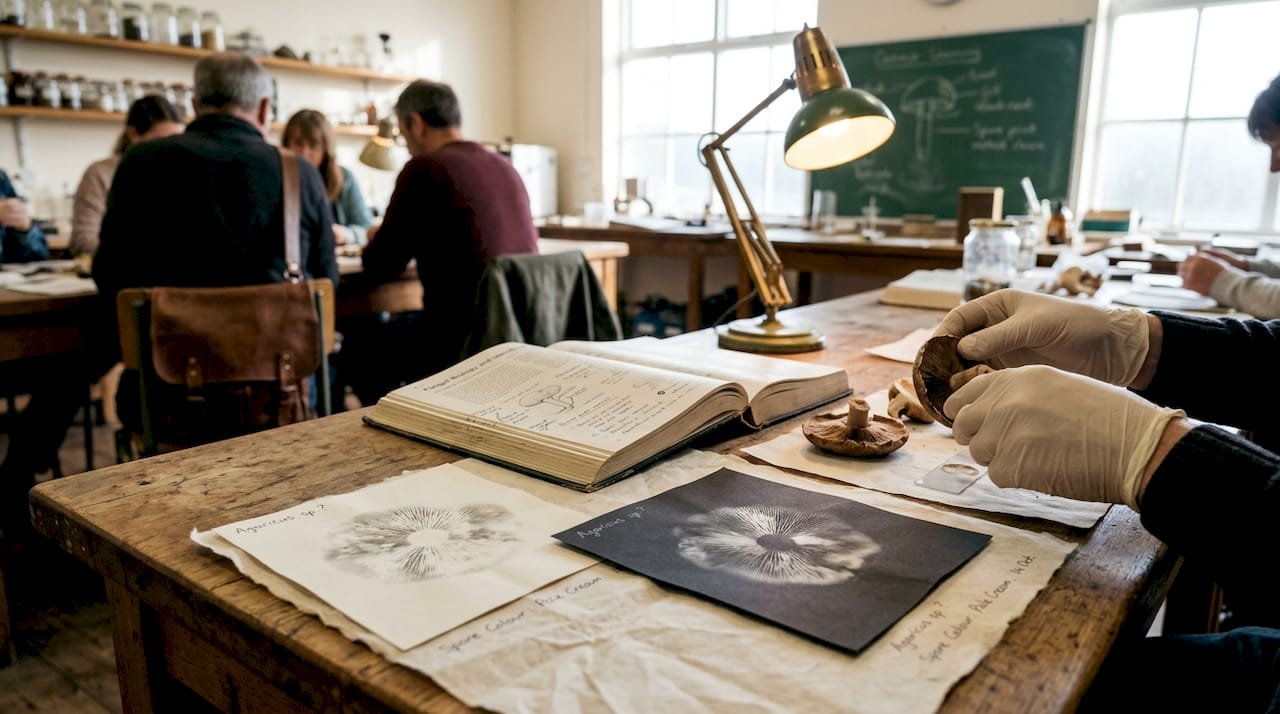
NMBU’s BOT210 course on fungi, lichens, and bryophytes demonstrates what structured fungi education looks like at degree level. The course combines daily lectures with four lab exercises, a field excursion, and a species identification assessment, mirroring the professional mycology workflow. You can adapt this structure for secondary or further education by pairing a classroom identification session with a local woodland walk, then asking students to write a short species report.
Lifecycle studies are particularly effective because they are visible in real time. Oyster mushrooms (Pleurotus ostreatus) colonise substrate within days, and students can photograph and record each stage from inoculation to pinning to harvest. This creates a natural data collection exercise that reinforces scientific method alongside biology content.
- Spore print activities teach spore colour, shape, and dispersal mechanisms
- Microscopy sessions reveal hyphal networks and spore morphology at cellular level
- Field excursions build species identification skills using macroscopic features such as cap shape, gill attachment, and stipe texture
- Virtual farm tours from the Mushroom Council extend access for schools without outdoor space
Pro Tip: When running a spore print activity, use both white and dark paper simultaneously. Many species produce spores that are only visible against one background, and the contrast teaches students to think critically about observation conditions. Sporebuddies has a detailed guide on teaching mushroom microscopy that covers equipment and technique.
2. Teaching sustainable agriculture through mushroom cultivation
Mushroom cultivation is one of the most accessible sustainable agriculture projects available to schools and colleges because it requires minimal space, low cost, and produces results within weeks. Students learn substrate preparation, spawn management, humidity control, and harvest timing, all of which are transferable skills in food production and agronomy.
Penn State Extension’s guidance on growing Agaricus bisporus makes the scientific rigour of cultivation clear. Substrate temperature probing after spawning, before and during heat surges, is recommended to manage crop variation. This single practice teaches students that assuming colonisation timing alone suffices ignores crucial temperature dynamics, and that real agricultural science depends on continuous monitoring rather than fixed recipes.
Rancocas Valley Regional High School in New Jersey ran a greenhouse mushroom cultivation project that engaged students in genetics, cell biology, sustainability, and community impact through farm-to-table activities. The project connected classroom theory directly to food systems and community nutrition, demonstrating that mushroom growing scales from a single fruiting block on a windowsill to a full greenhouse operation.
A practical cultivation unit might follow this sequence:
- Research substrate options (straw, hardwood sawdust, coffee grounds) and select one based on availability
- Sterilise or pasteurise substrate and inoculate with spawn
- Record temperature, humidity, and CO₂ levels daily in a growth log
- Photograph colonisation progress at 48-hour intervals
- Harvest at the correct stage and calculate yield per kilogram of substrate
- Compost spent substrate and measure nutrient return to soil
Pro Tip: Spent mushroom substrate is rich in nitrogen and beneficial microbes. Composting it at the end of a cultivation project adds a soil science component and reinforces circular economy principles without adding cost.
The UK home grower’s guide for 2026 from Sporebuddies covers current cultivation techniques that translate directly into classroom project design.
3. Environmental science teaching with fungi: mycoremediation and ecosystem roles
Mycoremediation is defined as the use of fungi to degrade or detoxify environmental pollutants, and it is one of the most compelling topics in modern environmental science education. Teaching it effectively means going beyond vague claims about “fungus cleaning” and connecting students to specific fungal species, target pollutants, and measurable outcomes.
Research published in Environmental Sciences Europe confirms that fungal species biodegrade heavy metals, pesticides, and hydrocarbons through enzymatic processes, making mycoremediation a scalable and scientifically credible approach to ecosystem restoration. This means students can design controlled experiments around real-world pollution scenarios rather than hypothetical case studies.
“Effective fungi education requires a combination of field excursions, lab work, and microscopic and macroscopic identification techniques to mimic professional mycology practice.” — NMBU BOT210 course design
Practical environmental science modules built around fungi might include:
- Designing a simulated bioremediation experiment using contaminated soil samples and white rot fungi such as Trametes versicolor
- Mapping local ecosystems to identify decomposer fungi and their role in nutrient cycling
- Studying mycorrhizal relationships between fungi and tree roots to teach symbiosis and nutrient exchange
- Analysing case studies of mycoremediation projects at industrial sites to connect lab learning to real-world application
The mushroom ecology guide from Sporebuddies provides a student-friendly entry point into these topics, covering decomposition, symbiosis, and ecosystem function in accessible language.
Fungi also illustrate nutrient recycling in a way no other organism does as clearly. When students observe a log being broken down by bracket fungi over a season, they are watching carbon, nitrogen, and phosphorus return to the soil in real time. This makes abstract biogeochemical cycles tangible and memorable.
4. Nutritional education and food science through mushrooms
Mushrooms are a practical gateway to nutritional education because they are affordable, widely available, and nutritionally complex. A Springer Nature review confirmed that mushrooms contain high energy value and bioactive compounds including lentinan, beta-glucans, and ergosterol, which is the precursor to vitamin D. This means a single cooking lesson can cover macronutrients, micronutrients, and bioactive compounds simultaneously.
The Mushroom Council’s cooking and nutrition resources are structured to connect food preparation with science literacy. Students identify vitamins and minerals in different species, compare nutritional profiles between shiitake, oyster, and lion’s mane, and experiment with recipes that substitute mushrooms for meat to explore sustainable diet principles.
Nutritional education activities built around mushrooms include:
- Calculating the vitamin D content of UV-exposed mushrooms and comparing it to dietary reference values
- Comparing the protein content of lion’s mane (Hericium erinaceus) with common animal proteins using food composition databases
- Designing a week’s meal plan that meets recommended dietary allowances using mushrooms as a primary protein source
- Exploring fermentation by making mushroom-based stocks or umami pastes and discussing preservation science
The mushroom health and wellness section at Sporebuddies provides background on bioactive compounds that supports these lessons with reliable, accessible information.
5. Comparing mushroom education tools and approaches
Choosing the right mushroom education technique depends on your setting, age group, and learning objectives. No single approach covers every outcome, so understanding the strengths of each method helps you build a more effective programme.
| Approach | Best for | Limitation |
|---|---|---|
| Virtual farm tours (Mushroom Council) | Remote or urban classrooms with no outdoor access | Limited sensory engagement |
| Hands-on cultivation projects | Secondary and further education; project-based learning | Requires space, equipment, and time |
| Field excursions (NMBU BOT210 model) | Species identification and ecology; higher education | Weather-dependent; requires expert supervision |
| Microscopy and lab sessions | Cellular biology; spore morphology; taxonomy | Equipment cost; technical skill required |
| Cooking and sensory activities | Nutrition education; primary and secondary school | Less rigorous as a standalone science activity |
Hands-on cultivation consistently produces the deepest learning because students encounter real variables: contamination, temperature fluctuation, and substrate variation. These are not problems to avoid but teaching moments that mirror authentic scientific practice. Virtual tools and cooking activities work best as complementary components rather than primary methods.
Cross-disciplinary integration is where mushroom education techniques gain their greatest value. A single cultivation project can generate data for mathematics lessons, writing for language arts, and ethical discussion for PSHE or citizenship. The mycology science and education resources at Sporebuddies are designed with this interdisciplinary approach in mind.
Pro Tip: Scale lesson complexity by starting with macroscopic identification before introducing microscopy. Students who can confidently name cap shape, gill type, and spore print colour are far better prepared to interpret what they see under a microscope.
Key takeaways
Mushrooms are the most versatile hands-on teaching tool available to educators across biology, environmental science, agriculture, and nutrition, and their value increases when activities combine observation, data collection, and real-world application.
| Point | Details |
|---|---|
| Biology education | Lifecycle studies, spore prints, and microscopy teach taxonomy, cellular structure, and scientific method. |
| Sustainable agriculture | Cultivation projects teach substrate management, temperature monitoring, and circular economy principles. |
| Environmental science | Mycoremediation modules connect fungal biodegradation to real pollution control and ecosystem restoration. |
| Nutritional education | Mushrooms teach bioactive compounds, dietary reference values, and sustainable food systems through cooking activities. |
| Tool selection | Match the teaching method to your setting; hands-on cultivation produces the deepest and most transferable learning. |
Start your educational mushroom project with Sporebuddies
Sporebuddies supplies everything educators and self-learners need to bring mushroom cultivation and mycology into practical study. From mushroom growing kits designed for hands-on classroom projects to a full range of mushroom spores suitable for microscopy and research, the catalogue covers beginner to advanced needs. Shiitake, oyster, and lion’s mane kits are ready to use with no specialist equipment, making them ideal for school projects and independent study. The Sporebuddies blog also provides cultivation guides, contamination prevention advice, and mycology education resources to support your learning at every stage.
FAQ
What are the main educational uses for mushrooms?
Mushrooms are used to teach biology, sustainable agriculture, environmental science, and nutrition. Their hands-on nature makes them effective for lifecycle studies, cultivation projects, mycoremediation modules, and food science activities.
How do mushrooms support environmental science lessons?
Fungi biodegrade heavy metals, pesticides, and hydrocarbons through enzymatic processes, making mycoremediation a practical and evidence-based topic for environmental science curricula. Students can design controlled experiments around specific pollutants and fungal species.
Can mushroom cultivation be used as a school project?
Yes. Schools including Rancocas Valley Regional High School have run successful greenhouse cultivation projects covering genetics, cell biology, and sustainability. A basic grow kit and growth log are sufficient to start a rigorous project.
What subjects can mushrooms be taught across?
Mushrooms connect biology, mathematics, language arts, environmental science, and nutrition, making them one of the few topics that genuinely supports cross-curricular teaching without forcing the connection.
Do you need specialist equipment to teach mycology?
No. Spore print activities, macroscopic identification, and grow kit cultivation require minimal equipment. Microscopy and lab-based identification add depth but are not necessary for introductory or project-based learning.