
Mushroom cultivation in the UK is growing fast, but the rules around which species you can legally grow or forage are genuinely confusing. Some edible mushrooms are protected by law. Others sit in grey areas depending on whether you cultivate them indoors or pick them wild. Get it wrong and you could face a fine, ecological damage, or worse. This guide cuts through the confusion by covering exactly which mushroom species are legal to cultivate or forage in the UK, what the relevant laws actually say, and how to start growing with confidence and compliance.
Table of Contents
- How to identify legal mushroom species in the UK
- Top legal mushroom species for UK cultivation
- Wild edible mushrooms: What you can forage legally
- Comparison of popular legal mushroom species
- Why choosing the right mushroom matters more than you think
- Grow your legal mushrooms with confidence
- Frequently asked questions
Key Takeaways
| Point | Details |
|---|---|
| Strict species rules | You must choose approved species such as oyster, shiitake, and cultivated Lion’s Mane for legal UK cultivation. |
| Legal foraging limits | Wild mushrooms can only be foraged in permitted locations for personal use and never commercially. |
| Check protected status | Some native species, like wild Lion’s Mane, are protected and illegal to forage even for personal use. |
| Use trusted suppliers | Buy spores and grow kits from reputable sources to ensure you comply with UK law. |
| Cook wild finds | Always cook wild mushrooms thoroughly to neutralise natural toxins before consumption. |
How to identify legal mushroom species in the UK
Before looking at specific mushroom types, you need to understand what makes a mushroom legal to grow or gather in the UK. The legal status of a species depends on several overlapping factors, not just whether it is edible.
The key criteria are:
- Species identity: Some species, such as wild Lion’s Mane (Hericium erinaceus), are protected under Schedule 8 of the Wildlife and Countryside Act 1981, making it a criminal offence to pick, uproot, or destroy them in the wild. Cultivated strains of the same species may be entirely legal.
- Origin: There is a significant difference between cultivating a mushroom from purchased spawn and picking it wild. Cultivation from approved substrates or spores is generally permitted for personal use. Wild foraging operates under a separate set of rules.
- Personal versus commercial use: UK cultivation regulations draw a clear distinction between growing for yourself and selling commercially. Personal foraging is broadly legal for personal use under the Theft Act 1968, but commercial harvesting from land you do not own is not.
- Location: In England and Wales, foragers are expected to stay on public footpaths unless they have landowner permission. Scotland’s Land Reform Act grants a wider right to roam, but even there, Sites of Special Scientific Interest (SSSIs) and Royal Parks are off limits.
- Novel Foods regulations: The Food Standards Agency regulates certain fungi extracts and novel food products under UK law derived from the EU Novel Foods Regulation. This primarily affects commercial sellers rather than home growers.
Important: Cook all wild mushrooms before eating them, even species you are confident about. Cooking neutralises many natural toxins and significantly reduces the risk of gastrointestinal illness. This applies even to common edibles like oyster mushrooms picked from the wild.
Safe foraging also requires a reliable identification guide, ideally a printed field guide specific to British species. Photography apps can support identification but should never be your only tool.
Top legal mushroom species for UK cultivation
Now that the rules are clearer, here are the best legal mushroom species for your home or research project. Each of these has strong cultivation records in the UK and poses minimal legal risk when grown from purchased spawn or a kit.
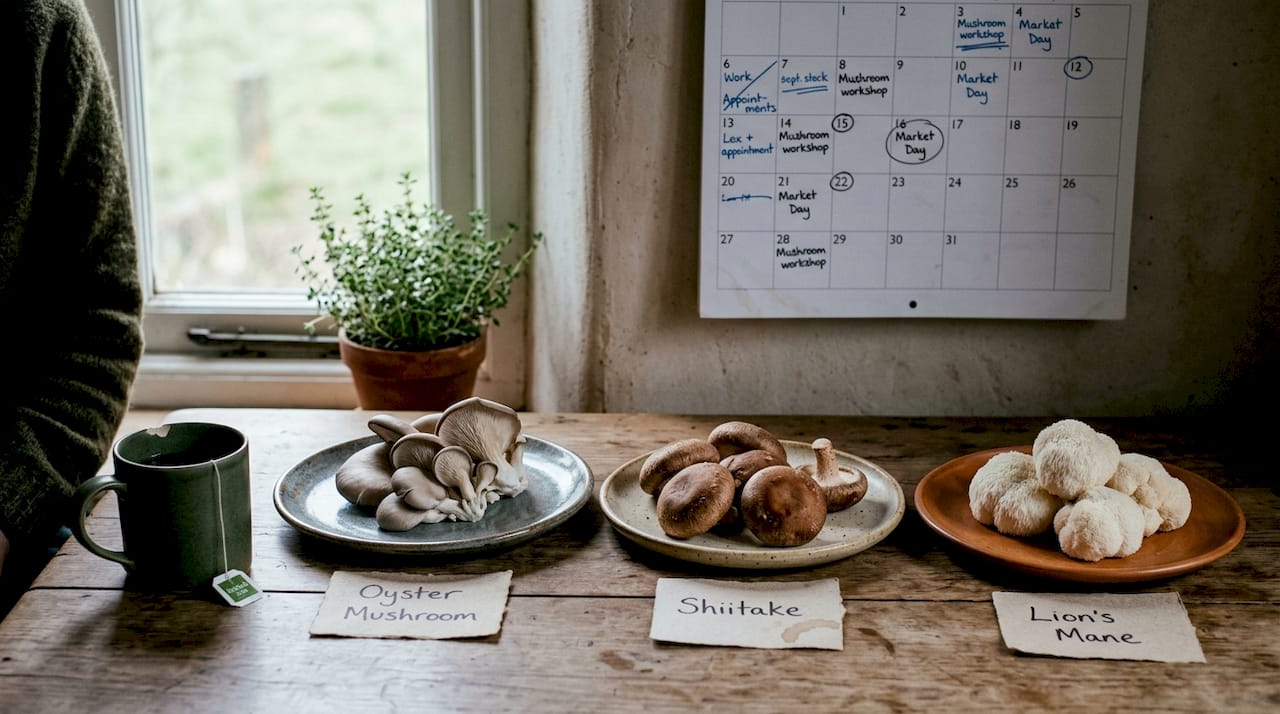
- Oyster mushrooms (Pleurotus ostreatus and relatives): Oyster mushrooms are legal to cultivate in the UK for personal use. They come in several popular varieties including blue-grey, tarragon, branched, and summer oysters. They are ideal for beginners because they colonise quickly, tolerate a wide range of temperatures, and fruit abundantly on pasteurised straw, cardboard, or coffee grounds. Expect your first flush within two to four weeks of inoculation.
- Shiitake (Lentinula edodes): Shiitake mushrooms are legal and widely cultivated across the UK. They are a culinary favourite with a rich, savoury flavour and a firm texture that holds up well in cooking. Shiitake grow best on hardwood logs or supplemented sawdust blocks. Colonisation takes longer than oysters, often several months on logs, but the yields are consistent and flushes can continue for several years from a single log.
- Lion’s Mane (Hericium erinaceus): Cultivated Lion’s Mane is legal to grow indoors or from kits for personal use. This is where the distinction between cultivation and wild foraging really matters. Wild Lion’s Mane is protected under Schedule 8 of the Wildlife and Countryside Act, so picking it in nature is a criminal offence. Grow it instead from a quality indoor kit and you will enjoy its celebrated benefits without any legal risk. Many growers explore the lion’s mane benefits for cognitive support and nerve health, which has driven its popularity enormously in recent years.
- King Oyster (Pleurotus eryngii): Another excellent legal option. It produces thick, meaty stems and has a longer shelf life than regular oyster varieties. It performs well on supplemented sawdust and is a good step up for growers who have already completed a few successful oyster flushes.
- Chestnut mushrooms (Cyclocybe aegerita, also known as Black Poplar mushroom): These are legal to cultivate and produce clusters of firm, nutty-flavoured fruiting bodies on hardwood substrates or logs. Less common than oyster or shiitake but worth trying once you are comfortable with the basics.
Pro Tip: If you are just starting out, choosing a grow kit takes away most of the guesswork. Pre-inoculated kits come with colonised substrate ready to fruit, so you can focus on humidity and light rather than sterile technique. Explore grow kit basics before purchasing to match the kit to your space and ambition.
Wild edible mushrooms: What you can forage legally
While cultivated mushrooms are popular, many enthusiasts also forage wild species. Here is what you can pick legally, and just as importantly, where and how.
The following species are common, well-documented, and legal to forage for personal use under the Theft Act 1968, provided you respect access laws and do not intend to sell them commercially:
- Penny Bun or Cep (Boletus edulis): One of the most prized wild edibles in Britain. Found under oak, beech, and pine from late summer through autumn. Firm and nutty when fresh.
- Chanterelle (Cantharellus cibarius): A golden-yellow funnel-shaped fungus with a faintly fruity scent. Common in broadleaf and mixed woodland. Excellent in butter and cream sauces.
- Hedgehog Fungus (Hydnum repandum): Named for the spines (teeth) on the underside of its cap instead of gills. Mild, slightly sweet flavour and easy to identify safely.
- Chicken of the Woods (Laetiporus sulphureus): A shelf fungus that grows in striking orange and yellow brackets on oak, cherry, and yew. Hard to miss and hard to misidentify.
- Giant Puffball (Calvatia gigantea): Unmistakable when fully grown and pure white inside. Slice it open to confirm the interior is completely white before cooking. Pink or purple flesh indicates it is too old or a different species.
These wild edibles are legal to forage for personal use throughout the UK under the conditions described above.
Where foraging is not permitted: Royal Parks such as Richmond Park and Kew explicitly prohibit foraging. SSSIs (Sites of Special Scientific Interest) are also off limits. Always check local bylaws before you go, particularly in National Parks where individual rules can vary. If in doubt, seek legal foraging advice specific to your region.
General safe foraging practices include carrying a printed identification guide, never tasting unknown species raw, collecting only what you will eat within a day or two, and leaving the majority of any patch undisturbed to support regeneration.
Comparison of popular legal mushroom species
To help you decide which mushroom fits your needs, here is a clear summary of the key legal species, covering their source, difficulty level, and any important caveats.
| Species | Legal source | Cultivation method | Difficulty | Key consideration |
|---|---|---|---|---|
| Oyster (Pleurotus ostreatus) | Cultivated or wild forage | Straw bags, cardboard, coffee grounds | Beginner | Fast fruiting, multiple flushes |
| Shiitake (Lentinula edodes) | Cultivated | Hardwood logs, sawdust blocks | Intermediate | Slow colonisation, long yield |
| Lion’s Mane (Hericium erinaceus) | Cultivated only | Hardwood sawdust blocks | Intermediate | Wild picking is illegal (Schedule 8) |
| King Oyster (Pleurotus eryngii) | Cultivated | Supplemented sawdust | Beginner/Intermediate | Longer shelf life than standard oysters |
| Chanterelle (Cantharellus cibarius) | Wild forage only | Cannot be cultivated reliably | N/A (forage) | Mycorrhizal, personal use only |
| Giant Puffball (Calvatia gigantea) | Wild forage only | Cannot be cultivated | N/A (forage) | Check interior is pure white |
For indoor cultivation, maintain 85 to 95% humidity and temperatures between 15°C and 20°C, misting your substrate daily. Outdoor log cultivation suits shiitake and oysters particularly well in sheltered, shaded areas. Multiple flushes are possible with proper aftercare, meaning one block or log can yield several productive harvests over weeks or months.
If you are new to indoor growing, start with the beginner’s guide to mushroom growing before investing in equipment. Understanding the basics of colonisation, fruiting conditions, and contamination prevention will save you time and money from the outset.
Why choosing the right mushroom matters more than you think
We want to share something that goes beyond species lists and legal summaries. The choice of mushroom you grow or forage has consequences that many beginners do not consider until something goes wrong.
The law around mushroom cultivation in the UK is not static. Regulations around Novel Foods, protected species, and commercial growing are updated periodically, and guidance that was accurate two years ago may not reflect the current position. Lion’s Mane is a good example. Wild Lion’s Mane remains protected under Schedule 8 of the Wildlife and Countryside Act, yet cultivated strains are perfectly legal. The line between the two is clear in law but easily missed by those who assume all edible means all legal.
There is also an ecological risk that rarely gets discussed. Non-native strains of oyster mushrooms, particularly some commercially produced varieties, can establish themselves outdoors and outcompete native woodland fungi if introduced carelessly through spent substrate. Always dispose of spent grow bags responsibly. Do not add them to garden compost heaps near woodland edges or wild habitats.
We also see growers drawn to novelty species like Turkey Tail (Trametes versicolor) or rarer mycelium cultures without fully checking their status under UK Novel Foods rules for any intended consumption or sale. For personal home growing and research use, most of these present minimal legal risk, but it is always worth cross-referencing against current FSA guidance before you commit.
Our honest advice: stick to proven, widely approved species when you are starting out. Oyster, shiitake, and cultivated Lion’s Mane have clear legal status, well-documented cultivation requirements, and a strong track record in UK homes and research spaces. Once you understand the fundamentals, you can explore less common species with a much clearer head. Follow legal best practices and you will avoid the pitfalls that catch out even experienced growers.
Grow your legal mushrooms with confidence
Ready to start growing? The best first step is sourcing your materials from a reliable UK supplier who understands the legal landscape and offers species-appropriate products. At Spore Buddies, we stock UK-legal spore syringes for research and educational use, along with starter kits for oyster, shiitake, and Lion’s Mane that are ready to fruit with minimal setup. Whether you are interested in personal cultivation or want to explore mycology more deeply, our mycology cultivation guide walks you through every stage from inoculation to harvest. Everything we supply is designed to support legal, safe, and successful growing in the UK.
Frequently asked questions
Can I grow psilocybin mushrooms legally in the UK?
No, psilocybin mushrooms are classified as Class A substances under the Misuse of Drugs Act 1971, and cultivating them in the UK is prohibited regardless of intent.
Is foraging wild mushrooms legal everywhere in the UK?
Personal foraging is permitted for personal use under the Theft Act 1968, but it is not allowed in protected areas such as SSSIs or Royal Parks, and commercial harvesting requires landowner permission.
Are all edible mushrooms legal to grow at home?
Not all edible species are legal to grow. Only approved varieties such as oyster mushrooms, shiitake, and cultivated Lion’s Mane are clearly permitted for personal use in the UK.
What risks come with wild foraging mushrooms?
Misidentifying species can cause serious poisoning, and cooking all wild fungi before eating them reduces the risk significantly. Foraging in restricted areas may also result in fines or prosecution.
Can I buy legal mushroom spores online in the UK?
Yes, spores of legal edible species such as oyster or shiitake are available to purchase from reputable UK suppliers, but spores of prohibited species cannot legally be sold or purchased for cultivation purposes.