
If you’ve ever stared at a fully colonised block of white mycelium and wondered why no mushrooms are appearing, you’re not alone. Many UK home growers confuse general mushroom growth with the specific stage called fruiting, and that confusion leads to missed harvests and real frustration. Fruiting is not simply “growing” — it is a distinct biological event triggered by precise environmental cues. Understanding this distinction is the single most useful thing you can do to improve your results at home. This guide walks you through what fruiting actually is, what conditions it needs, and how to troubleshoot when things go wrong.
Table of Contents
- What does ‘fruiting’ mean in mushroom cultivation?
- Essential conditions for mushroom fruiting at home
- Indoor versus outdoor fruiting: What UK growers should know
- Common problems and troubleshooting tips
- The misunderstood art of mushroom fruiting: What most guides leave out
- Your next step: Grow more, learn smarter
- Frequently asked questions
Key Takeaways
| Point | Details |
|---|---|
| Fruiting is a key stage | Mushroom fruiting refers to the emergence of harvestable mushrooms after mycelium colonisation. |
| Environmental triggers are vital | High humidity, fresh air, gentle light, and steady temperatures prompt successful fruiting at home. |
| Kits simplify the process | Grow kits offer controlled, rapid fruiting for beginners, especially in UK indoor environments. |
| Adapt for UK conditions | Weather, species choice, and basic DIY tools make the UK a great place for both indoor and outdoor fruiting—if you follow the essentials. |
| Troubleshoot smartly | Most fruiting issues can be solved by adjusting humidity, air flow, or temperature before restarting a grow. |
What does ‘fruiting’ mean in mushroom cultivation?
Mushroom cultivation has two clearly separate phases: colonisation and fruiting. During colonisation, mycelium — the white, thread-like network of fungal cells — spreads through the substrate (your growing medium). The block looks increasingly white and fuzzy. This is healthy and necessary, but it is not fruiting. Fruiting is the emergence of the visible mushroom body from that vegetative mycelium, requiring key environmental triggers to begin.
Think of mycelium as the root system of the fungus. Fruiting bodies — the caps and stems you actually harvest — are the equivalent of fruit on a tree. The tree must be established before it can produce fruit, and the conditions must be right. The same logic applies here.
So what does the fruiting process actually look like step by step?
- Colonisation completes: The substrate is fully covered or permeated by mycelium.
- Environmental triggers are introduced: Humidity rises, temperature may shift, fresh air exchange increases, and indirect light is introduced.
- Pinning begins: Tiny primordia (the earliest, pin-sized mushroom formations) appear on the surface.
- Pins develop into fruiting bodies: These grow rapidly, sometimes doubling in size within hours.
- Harvest: Fruiting bodies are harvested just before or as the veil beneath the cap begins to tear.
A common misconception is that a fully white block means mushrooms are imminent. Not necessarily. The block is ready to fruit, but without the correct triggers, it will simply sit there. Another misconception is that small, patchy growth everywhere means success. In reality, scattered pinning is often a sign of poor air exchange or inconsistent humidity.
“A white block is not a fruiting block. It is a block that is ready to be asked.” The fungi need specific signals before they invest energy in producing fruiting bodies.
For beginners, the easiest way to skip past the colonisation stage entirely and jump straight to managing fruiting is by using mushroom growing kits, which arrive pre-colonised and ready to trigger.
Essential conditions for mushroom fruiting at home
With fruiting defined, understanding its precise triggers helps prevent frustration. The four main variables you need to control are humidity, temperature, fresh air exchange (FAE), and light. Get these right for your chosen species and fruiting will follow.
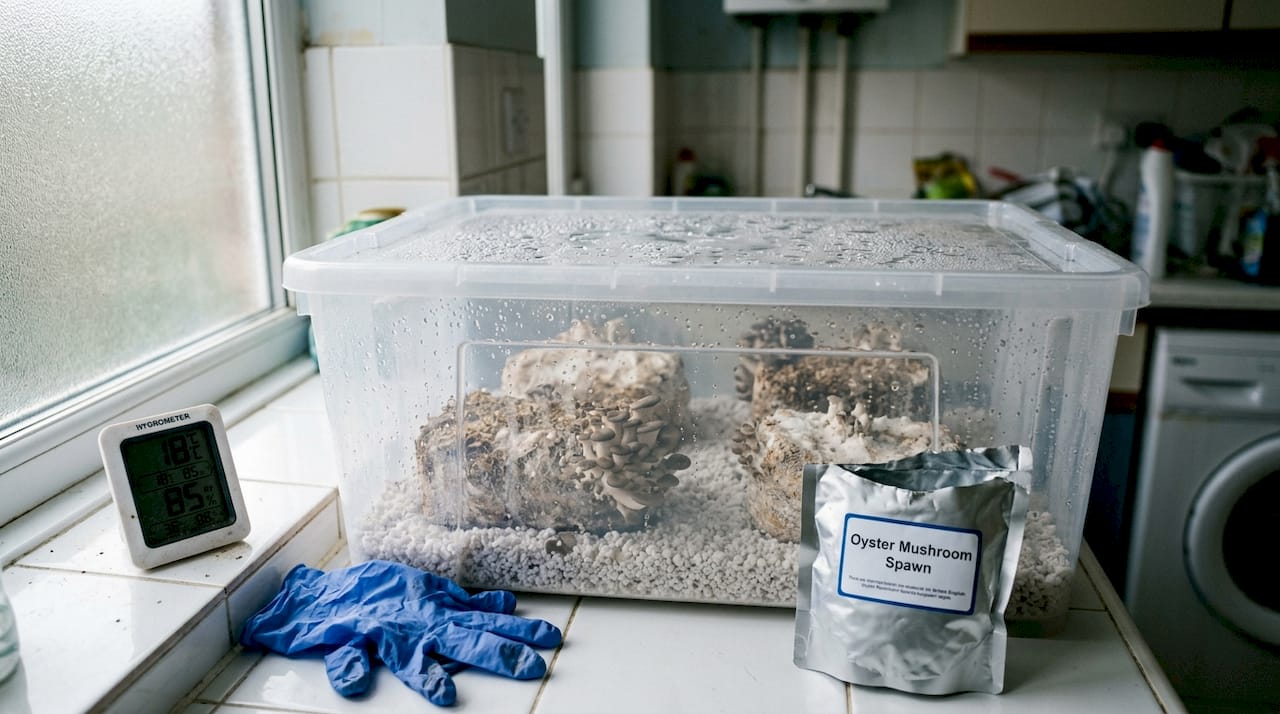
Key fruiting conditions include 85 to 95% relative humidity, fresh air exchange to keep CO2 levels low, indirect light for orientation cues, and species-specific temperatures. Here’s how those figures break down by species:
| Species | Humidity | Temperature | Light |
|---|---|---|---|
| Oyster mushroom | 85 to 95% | 15 to 24°C | Indirect, 12 hrs/day |
| Button mushroom | 85 to 90% | 16 to 18°C | Low or none |
| Shiitake | 85 to 95% | 15 to 21°C | Indirect, 12 hrs/day |
| Lion’s mane | 90 to 95% | 18 to 24°C | Indirect, 12 hrs/day |
In a typical UK home, temperature is rarely an issue for oysters or shiitake during spring and autumn. Summer can push temperatures too high, and winter may require supplemental heating. Humidity is the bigger challenge, since British homes are often dry, especially with central heating running.
Pro Tip: A simple humidity tent made from a clear plastic bag placed loosely over your kit, misted twice daily with a clean water spray, keeps humidity high without specialist equipment. Cut two or three small slits in the bag for air exchange.
Here is a quick list of simple fixes UK growers use:
- Use a clean plant mister filled with dechlorinated or filtered water
- Place your kit on a pebble tray with water beneath it to raise ambient humidity
- Fan the fruiting chamber for 30 to 60 seconds, two to three times daily, to exchange air
- Keep kits away from radiators and direct sunlight
- Use a hygrometer (a cheap humidity gauge) to monitor actual humidity rather than guessing
If you are still finding your setup difficult to manage, choosing a grow kit that suits your space and species preference is a great starting point. Our beginner’s guide to growing mushrooms also covers equipment setup in detail.
Indoor versus outdoor fruiting: What UK growers should know
You’ve learned the indoor requirements, but outdoor cultivation presents fresh benefits and challenges. Both methods work well in the UK — the right choice depends on your goals, your space, and how much time you want to invest.
UK growers can use kits or outdoor logs and straw for natives; greenhouses are ideal for winter fruiting, and you should avoid introducing non-native species outdoors to prevent invasives from establishing.
| Factor | Indoor (kit or DIY) | Outdoor (logs or straw) |
|---|---|---|
| Setup time | Hours | Days to weeks |
| Time to first harvest | 1 to 3 weeks | 6 to 18 months |
| Maintenance | Daily misting, FAE | Seasonal watering |
| Yield control | High | Variable |
| Species options | Wide | Native species recommended |
| Cost | Low to moderate | Low (once established) |
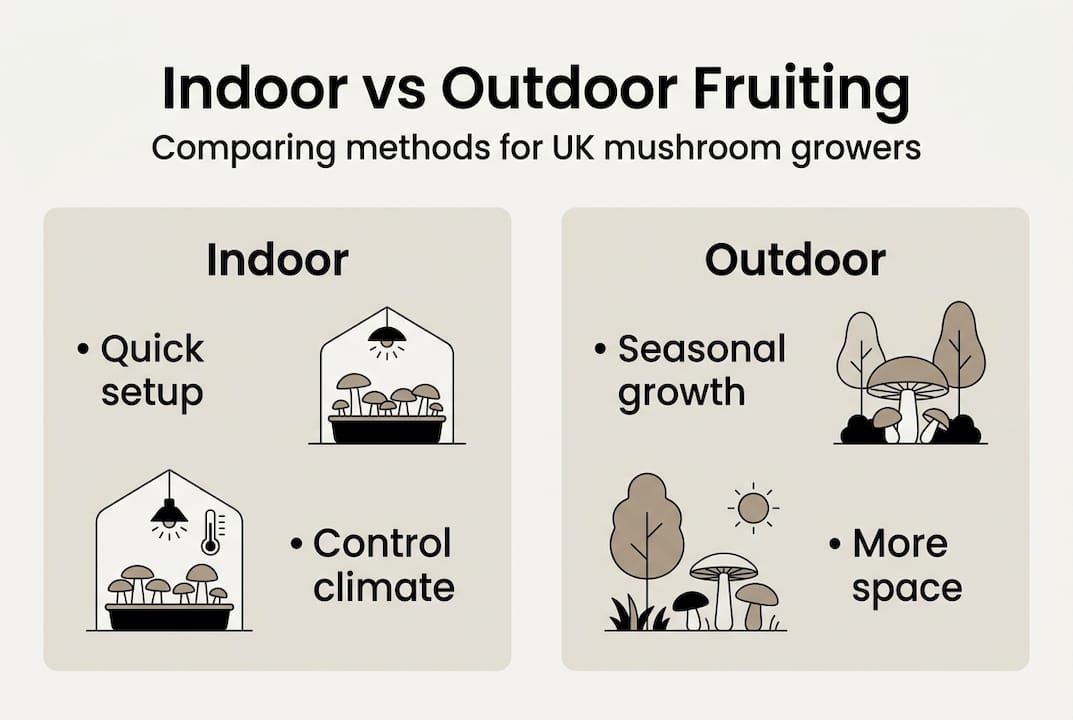
Outdoor cultivation using inoculated logs or straw beds suits species like oyster mushrooms, king stropharia, and garden giant. These methods require patience but reward you with years of repeated flushes from a single log. Indoors, kits provide controlled, predictable results — perfect for beginners or those with limited outdoor space.
Choose indoor cultivation if you:
- Want results within a few weeks
- Live in a flat or have no garden
- Are growing species like lion’s mane or button mushrooms that need controlled conditions
- Are new to cultivation and want minimal complexity
Choose outdoor cultivation if you:
- Have garden space and prefer a low-maintenance approach after initial setup
- Want to grow native UK species like oyster mushrooms on logs
- Are comfortable with seasonal cycles and variable harvests
Pro Tip: A garden shed or unheated greenhouse extends your outdoor fruiting season significantly. In winter, the shelter protects logs from hard frosts while keeping humidity naturally higher than indoors.
For a practical walkthrough of both methods, our UK step-by-step guide covers everything from inoculation to harvest.
Common problems and troubleshooting tips
Even after careful setup, UK growers sometimes hit snags — let’s fix the most common fruiting issues. Most problems come back to one of four causes: humidity, airflow, temperature, or contamination.
- No pins forming after two weeks. Check your humidity first. If it is below 80%, your block is too dry. Increase misting frequency and consider a humidity tent. Also fan the chamber more often — elevated CO2 from poor air exchange actively suppresses pinning.
- Pins forming but dying off before developing. This is called aborting, and it usually means humidity dropped during a critical growth window. Pins are extremely sensitive to drying out. Mist more frequently and check for draughts near your fruiting area.
- Long, thin stems with tiny caps. This classic “leggy” growth is caused by too much CO2 and not enough fresh air. Fan your fruiting chamber for longer periods, two to three times daily. Mushrooms grow tall stems to reach fresh air when it is scarce.
- Green, black, or pink patches on the substrate. This is contamination, almost certainly mould. Contamination and sluggish fruiting often result from incorrect environmental conditions or poor hygiene during setup. Remove the affected kit from your growing area immediately to prevent spread.
Pro Tip: Check your kit every morning at the same time. Early contamination spots are small, pale, and easy to miss — but catching them within 24 hours can sometimes allow you to salvage the flush by removing the affected area cleanly.
“Kits are easiest for beginners, producing harvests within days to weeks, while from-scratch outdoor methods offer higher long-term yields. Outdoor logs typically take 12 to 18 months before first fruiting.”
If you want detailed help on identifying and managing contamination, our contamination FAQ covers the most common causes and solutions for UK growers.
The misunderstood art of mushroom fruiting: What most guides leave out
Most fruiting guides hand you a checklist: hit these humidity figures, maintain this temperature, fan this many times per day. Follow the formula and mushrooms appear. That framing is useful for beginners, but it misses something important.
Fungi are not machines. Two blocks of the same species, in the same room, on the same substrate, can behave completely differently. One fruits aggressively within ten days. The other stalls for three weeks and then produces a spectacular flush. The difference is rarely a missed number on a chart.
Experienced growers learn to read their fruiting blocks. They notice the texture of the mycelium surface, the speed of pinning, the smell of the substrate. Our cultivation process tips touch on this observational approach, and it genuinely separates consistent growers from frustrated ones.
The uncomfortable truth is that rigid adherence to formulas often causes more problems than it solves. Growers who obsessively mist to hit 95% humidity end up with waterlogged blocks. Those who over-fan trying to eliminate CO2 dry their pins out. The skill is in understanding why each variable matters, so you can adapt when your environment is not textbook-perfect — and in the UK, it rarely is.
Trust the process, observe carefully, and adjust gradually. Small, patient tweaks almost always outperform drastic corrections.
Your next step: Grow more, learn smarter
If you’re ready to deepen your fruiting journey, trusted resources and supplies can make all the difference. At Spore Buddies, we’ve put together everything UK home growers need to move from confusion to confident cultivation. Browse our range of starter kits if you’re new to fruiting and want reliable results quickly. Not sure which species suits you best? Use our guide to find your ideal grow kit and match your setup to the right variety. For those ready to scale up or experiment further, our bulk mycology supplies cover everything from sterilised substrates to agar plates. We’re here to support every stage of your growing journey.
Frequently asked questions
What triggers mushroom fruiting?
Mushroom fruiting is triggered by high humidity between 85 and 95%, fresh air exchange, moderate indirect light, and species-specific temperatures. Introducing these conditions after full colonisation signals to the mycelium that it is time to produce fruiting bodies.
How long does it take to fruit mushrooms from a kit at home?
Most kits produce their first flush within one to two weeks of setup. Outdoor logs, by contrast, take considerably longer — typically 12 to 18 months before the first significant harvest.
Can I fruit non-native mushrooms outdoors in the UK?
You should avoid it. Fruiting non-native species outdoors risks establishing invasive fungi in British ecosystems. Stick to native or well-established cultivated species for any outdoor growing.
What are common problems during mushroom fruiting?
The most frequent issues are slow or absent pinning, mould contamination, and leggy or misshapen fruiting bodies. Each of these typically points to an imbalance in humidity, CO2 levels, or temperature rather than a problem with the species itself.