
Spore Print to Slide Workflow: Preparing Mushroom Spores for Microscopy
Educational note: This page is for mycology education and microscopy. It explains a beginner-friendly workflow for taking a visible spore deposit and preparing it for microscope observation. If your concern is safety around unknown mushrooms, see Mushroom Identification Safety (UK).
Start here: For the full UK overview, see Identify “Magic Mushrooms” in the UK.
Quick answers
- What is this workflow? It turns a visible spore print into a simple microscope slide for observation. The British Mycological Society notes that spores can be allowed to drop onto glass slides for high-resolution viewing.
- Why do it? Spores are too small to see individually with the naked eye, so slide preparation helps you observe shape, grouping, and other microscopic features. :contentReference[oaicite:1]{index=1}
- What magnification is useful? Educational material on examining mushroom spores commonly uses around 400× as a practical working magnification for beginners. :contentReference[oaicite:2]{index=2}
What is a spore slide?
A spore slide is a microscope slide carrying a small amount of fungal spores so they can be observed under magnification. In beginner mycology, the easiest source is often a spore print, because it collects thousands of spores into a visible deposit. Educational resources from the British Mycological Society, Imperial College London, and Oxford all explain that spores are too small to see individually without a microscope, but a spore print makes them visible as a group. :contentReference[oaicite:3]{index=3}
Answer-first
What is the point of moving a spore print onto a slide? It gives you a thin, viewable sample that a compound microscope can focus on far more clearly than a thick deposit on paper or card. That makes it easier to observe spore shape, spacing, and general appearance. :contentReference[oaicite:4]{index=4}
Why mycologists use spore slides
Spore slides are useful because spores are microscopic reproductive cells, and many of their informative characteristics are only visible under magnification. Education resources on mushroom spores note that different mushrooms produce differently coloured spores and that microscopic viewing can reveal more detail than a spore print alone. :contentReference[oaicite:5]{index=5}
What a slide helps you observe
- Shape – round, oval, elliptical, angular, and more
- Relative size – even before formal measurement, you can compare spores within a sample
- Grouping and spacing – whether the sample is too thick, clumped, or well spread
- Surface appearance – some spores look smoother or more textured depending on optics and lighting
Why brightfield is a good beginner choice
Brightfield compound microscopy is widely used for teaching and introductory microscopy because it is straightforward to set up and works well when the specimen has enough contrast. Both CDC training and microscopy education resources describe correctly set up brightfield microscopy as foundational for observing microorganisms and specimens. :contentReference[oaicite:6]{index=6}
What you need
You do not need a complex lab setup to begin learning. A clean, simple setup is usually enough for educational spore observation.
Basic beginner checklist
- Compound microscope using brightfield illumination
- Clean glass slides
- Cover slips
- A small spore deposit from a spore print
- Good lighting and clean optics
- Lens tissue or another microscope-safe cleaning material
If you are still choosing a microscope, our Beginner Guide to Mycology Microscopy covers the basics of magnification, illumination, and what beginners actually need.
Spore print to slide workflow
This section gives a beginner-friendly educational workflow for moving from a visible spore deposit to a microscope-ready slide. The British Mycological Society specifically notes that when spores are allowed to drop onto glass slides, they can then be viewed under a microscope at high resolution. :contentReference[oaicite:7]{index=7}
Step 1: Start with a light deposit
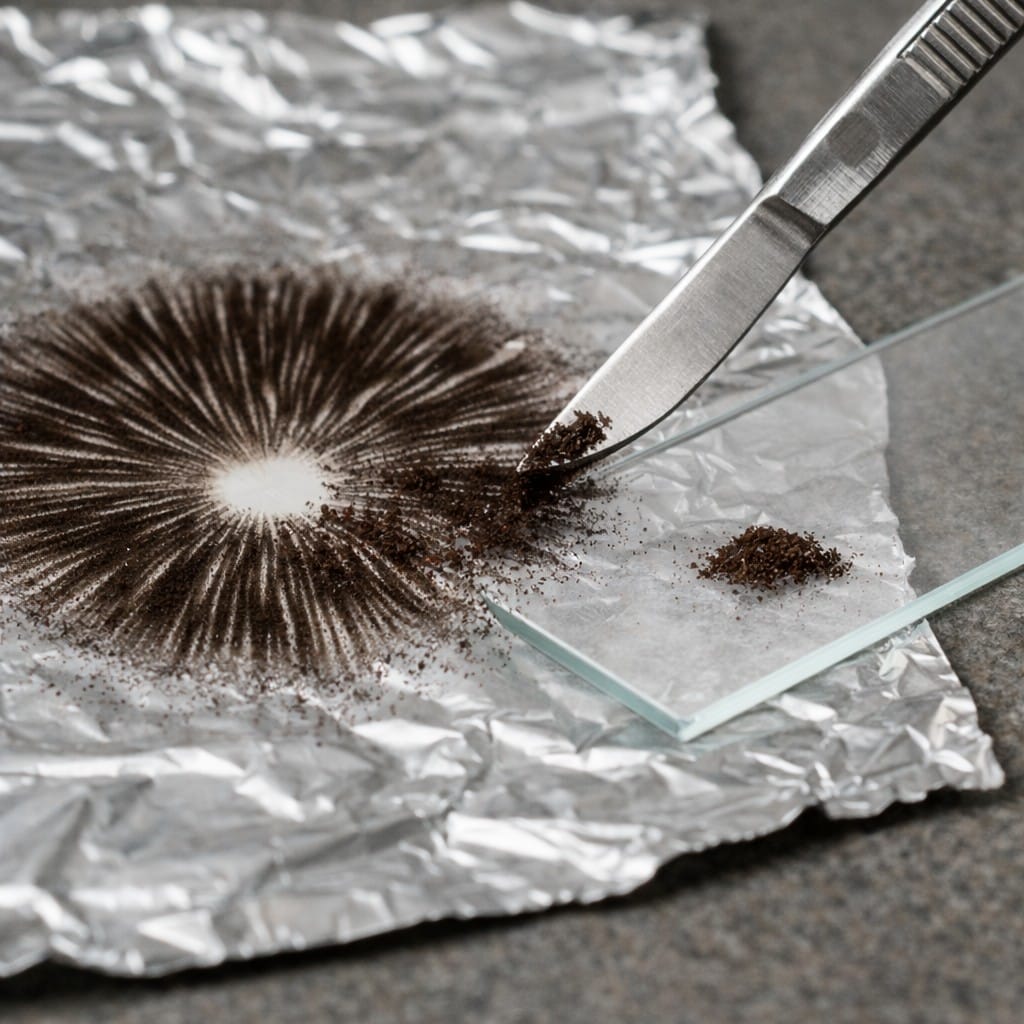
A thick spore mass is harder to view clearly than a light one. For beginner microscopy, a small amount of material is usually easier to work with than a dense dark patch. Educational spore-slide resources emphasise visibility and spread over volume. :contentReference[oaicite:8]{index=8}
Step 2: Place spores on a clean slide
The goal is to have spores in a thin enough layer that individual shapes can come into focus. If spores are collected directly onto a slide, that can be especially convenient. If working from an existing print, the same principle applies: keep the sample light and localised. :contentReference[oaicite:9]{index=9}
Step 3: Add a cover slip carefully
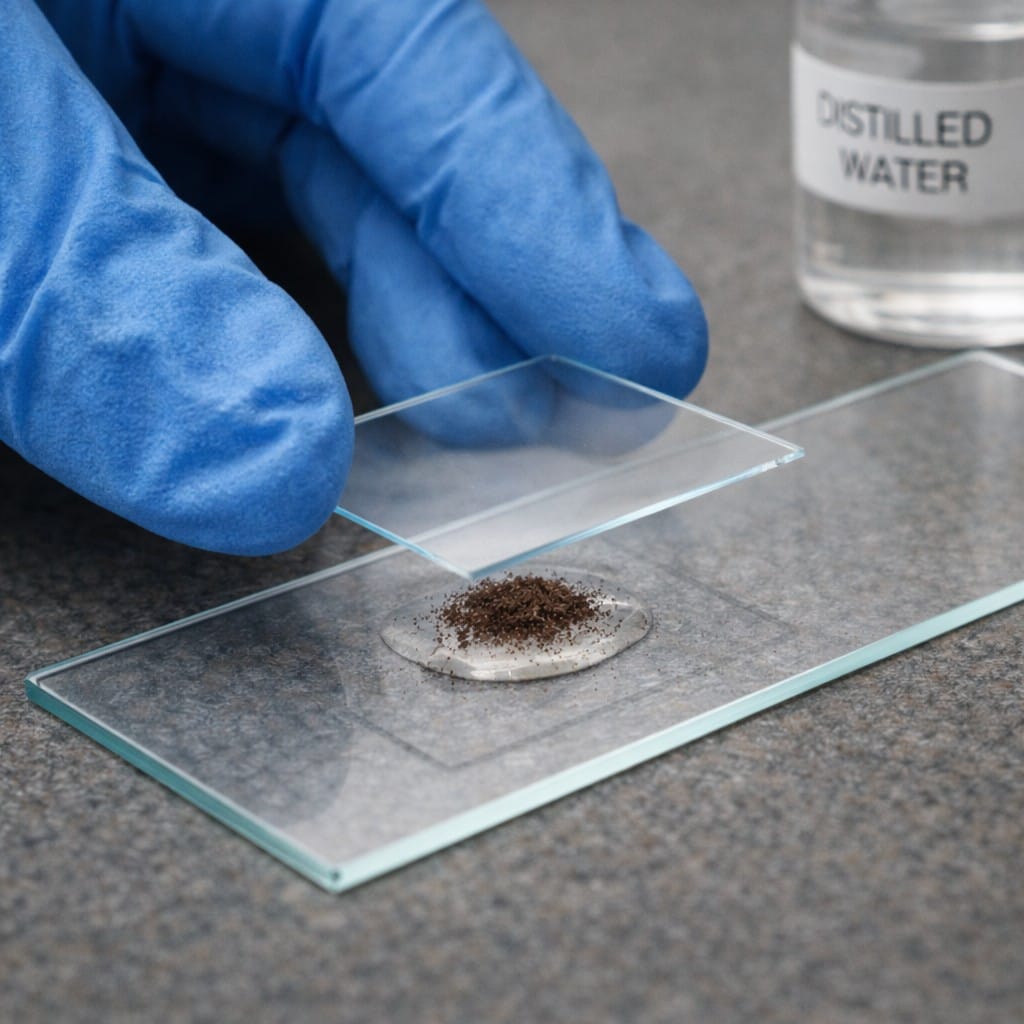
A cover slip helps flatten the sample into a more even viewing layer. In beginner microscopy, careful placement matters because trapped bubbles and thick clumps can make interpretation harder.
Step 4: Begin at low power, then increase magnification
Microscopy training consistently recommends locating the specimen at lower magnification first, then moving upward once the sample is centred and in view. That reduces frustration and makes it much easier to find spores later at higher power. :contentReference[oaicite:10]{index=10}
Answer-first
What usually goes wrong? Too many spores, too much brightness, or jumping straight to high magnification before the sample has been located. These are the most common reasons beginners “can’t see anything.” :contentReference[oaicite:11]{index=11}
Viewing spores under magnification
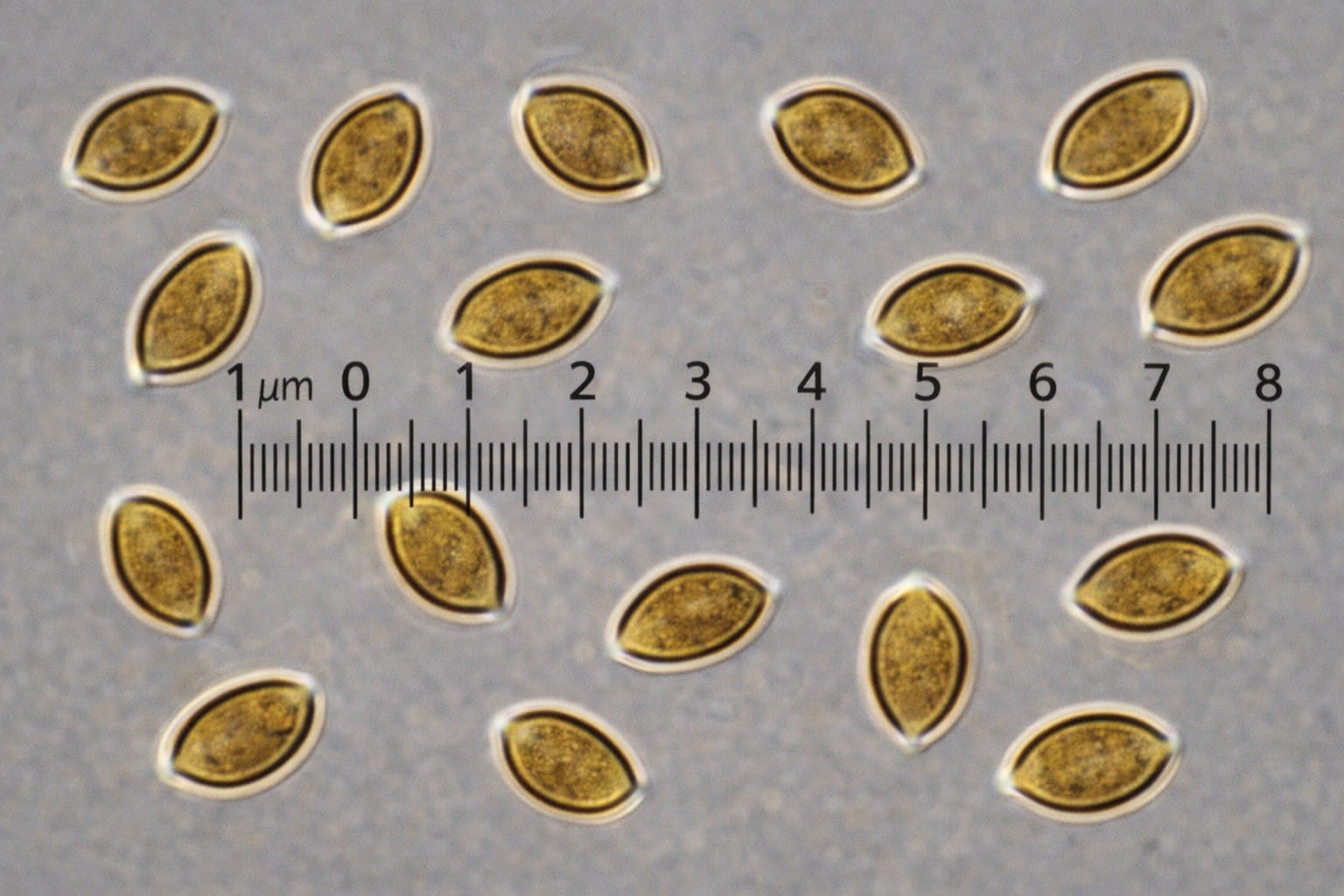
Once the slide is prepared, the main job is getting the specimen into view clearly. Educational microscopy material explains that brightfield microscopy works best when the sample has enough contrast and the microscope is correctly set up. :contentReference[oaicite:12]{index=12}
A good beginner viewing routine
- Find the sample at low power
- Refine brightness and contrast
- Centre the area of interest
- Move to higher magnification gradually
Educational spore resources commonly use around 400× magnification for mushroom spores, which is a practical target for many beginner setups. :contentReference[oaicite:13]{index=13}
What to look for first
- Are the spores distinct? Or are they in a dense smear?
- Can you make out shape? Even rough shape is useful at the start.
- Is the lighting too harsh? Over-bright illumination can wash out edges.
Common beginner mistakes
Most early microscopy problems are not “bad microscopes” — they are setup problems. Educational brightfield guidance and spore observation resources point to a few recurring issues. :contentReference[oaicite:14]{index=14}
Top 5 beginner mistakes
- Using too much sample – creates a dark, unreadable patch
- Starting at high magnification – makes the specimen harder to find
- Too much light – reduces contrast and hides fine edges
- Dirty slides or optics – adds haze and false artefacts
- Rushing the setup – a few seconds spent centring the sample saves minutes later
A simple troubleshooting rule
If the image looks like a dark blur, you probably have too much material. If it looks pale and empty, you may need to adjust illumination or relocate the sample at lower power first.
Next steps in microscopy
This page is the bridge between a visible spore print and true microscope observation. Once you’re comfortable with this workflow, the next step is learning how to read what you’re seeing more confidently.
Recommended SporeBuddies learning path
If you arrived here from a general UK mushroom-safety search, start with our main hub: Identify “Magic Mushrooms” in the UK.
FAQ
What is a spore slide?
A spore slide is a microscope slide carrying a small amount of spores so they can be observed under magnification. A spore print is a common source of that material. :contentReference[oaicite:15]{index=15}
Can I use a spore print directly for microscopy?
Yes. Educational mycology material notes that spores can be collected onto glass slides and viewed under a microscope. :contentReference[oaicite:16]{index=16}
What magnification is good for mushroom spores?
Educational resources commonly show mushroom spores around 400×, which is a practical starting point for many beginner compound microscopes. :contentReference[oaicite:17]{index=17}
Why can’t I see individual spores clearly?
The most common causes are using too much material, poor contrast, or moving to high magnification before finding the sample at low power. :contentReference[oaicite:18]{index=18}
Is a spore slide enough to identify a mushroom?
No. A slide helps you study spore features, but mycology generally combines several observations rather than relying on one clue alone. :contentReference[oaicite:19]{index=19}
Sources
- [1] British Mycological Society (BMS) – “How to Make a Spore Print” (notes spores on glass slides can be viewed under a microscope). britmycolsoc.org.uk (PDF)
- [2] Imperial College London – “Fungi prints instructions” (explains spores are usually too small to see without magnification). imperial.ac.uk (PDF)
- [3] Science ASSIST – “SOP Examining mushroom spores” (education resource covering spores and 400× microscope viewing). asta.edu.au (PDF)
- [4] David Moore / Mycologist reprint – “Making Spore Prints” (explains why spore print colour is useful). davidmoore.org.uk (PDF)
- [5] CDC Lab Training – Basic Microscopy (brightfield microscope setup fundamentals). cdc.gov
- [6] Microscopy-UK – “Bright-field Microscopy: A Short Introduction.” microscopy-uk.org.uk (PDF)
- [7] ZEISS – Brightfield illumination guide. zeiss.com
- [8] NHS – Poisoning guidance (for safety concerns with unknown mushrooms). nhs.uk
- [9] GOV.UK – Public warning about illness after eating wild mushrooms. gov.uk