
Spore Prints Explained: What They Are and Why Mycologists Use Them
Educational note: This page is for mycology education and microscopy. It explains what a spore print is, what spore print colour can tell you, and how spore prints connect to microscope study.
Start here: For the full UK overview, see Identify “Magic Mushrooms” in the UK.
Quick answers
- What is a spore print? A visible deposit of spores left when a mushroom cap releases spores onto a surface.
- Why is it useful? Spore print colour can help narrow down mushroom groups and support microscopy study. [1][2]
- Is it enough on its own? No. Spore print colour is helpful, but mycologists use multiple features together for reliable identification. [1][4]
What is a spore print?
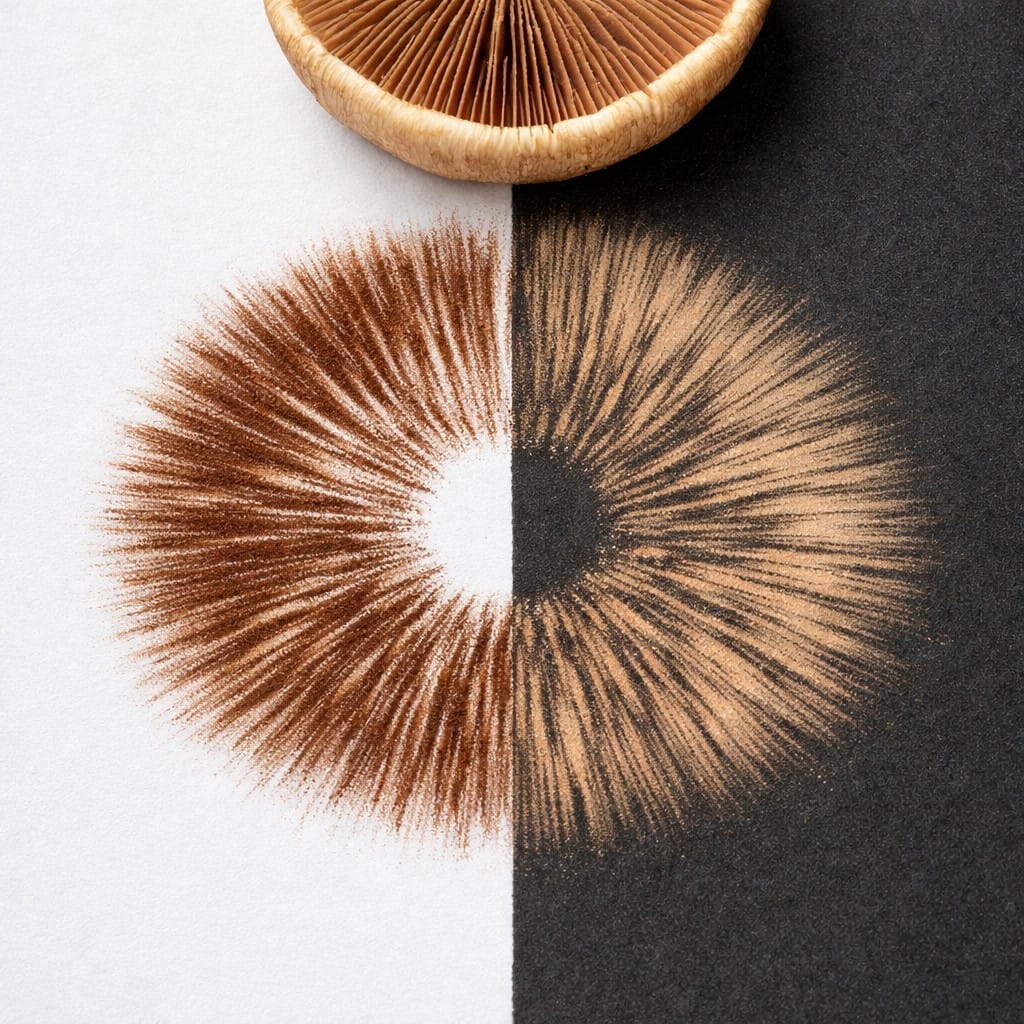
A spore print is the visible deposit left behind when a mushroom releases spores onto a surface such as paper, foil, glass, or another smooth material. Because individual spores are microscopic, the print lets you see their colour in mass, which is one reason spore prints are such a classic mycology tool. The British Mycological Society explains that spores are too small to see without magnification, but a spore deposit can be collected and examined. [1]
Answer-first
What does a spore print show? Most importantly, it shows the colour of the spores as a group. That colour can help mycologists compare mushroom groups and decide what to examine next. [1][2]
Why spore prints matter in mycology
Spore prints matter because they turn something microscopic into something you can compare. In field guides and education resources, spore print colour is often used as an early sorting feature before deeper examination. The NHBS beginner guide notes that spore prints can be helpful in mushroom identification, although they are not reliable enough on their own to confirm a species. [4]
What spore prints are good for
- Comparing groups: some genera are strongly associated with certain spore print colours.
- Planning microscopy: a print provides material that can later be examined on a slide. [1]
- Learning fungal biology: they help beginners understand that mushrooms reproduce through spores.
A useful mindset
Think of a spore print as a clue, not a final answer. It supports observation and comparison, but mycologists usually combine it with other features such as cap, gills, stem, habitat, and microscopic detail. [1][4]
How spore prints are made
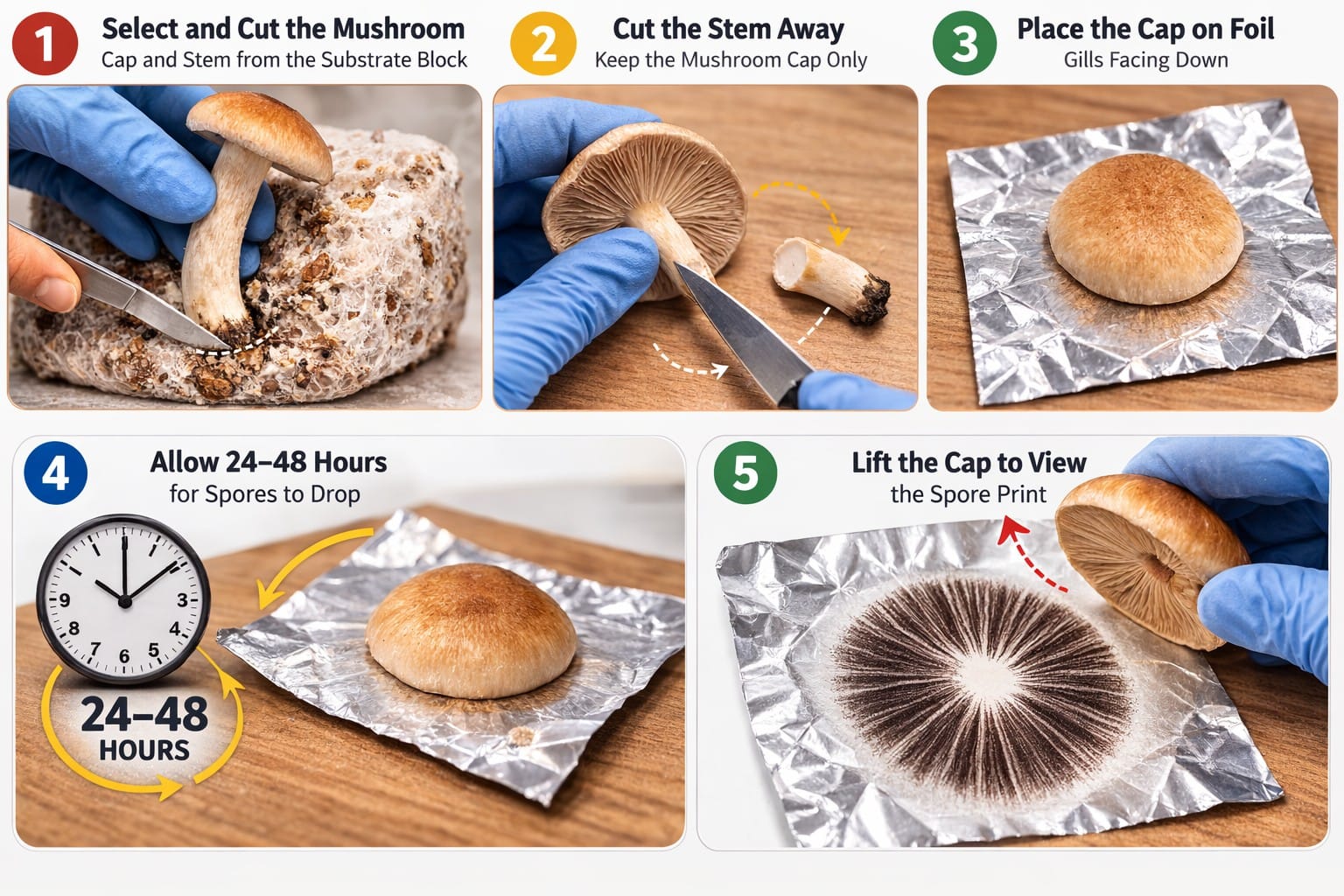
A spore print is usually made by placing a mushroom cap on a suitable surface and allowing spores to fall naturally over time. Educational resources from the British Mycological Society and Imperial College London describe this as a simple way to collect spores for observation. [1][2]
High-level overview
- The cap is placed on a surface so spores can drop from the gills or pores.
- Time is allowed for release so a visible deposit forms.
- The resulting print is observed for colour and, if needed, used as a source for microscope study. [1]
Answer-first
How long does a spore print take? It varies depending on the specimen and conditions, but educational guides commonly leave the cap long enough for a visible deposit to form rather than expecting an immediate result. [1][2]
For a concise definition-focused version of this topic, see our Glossary: Spore Print.
Common spore print colours
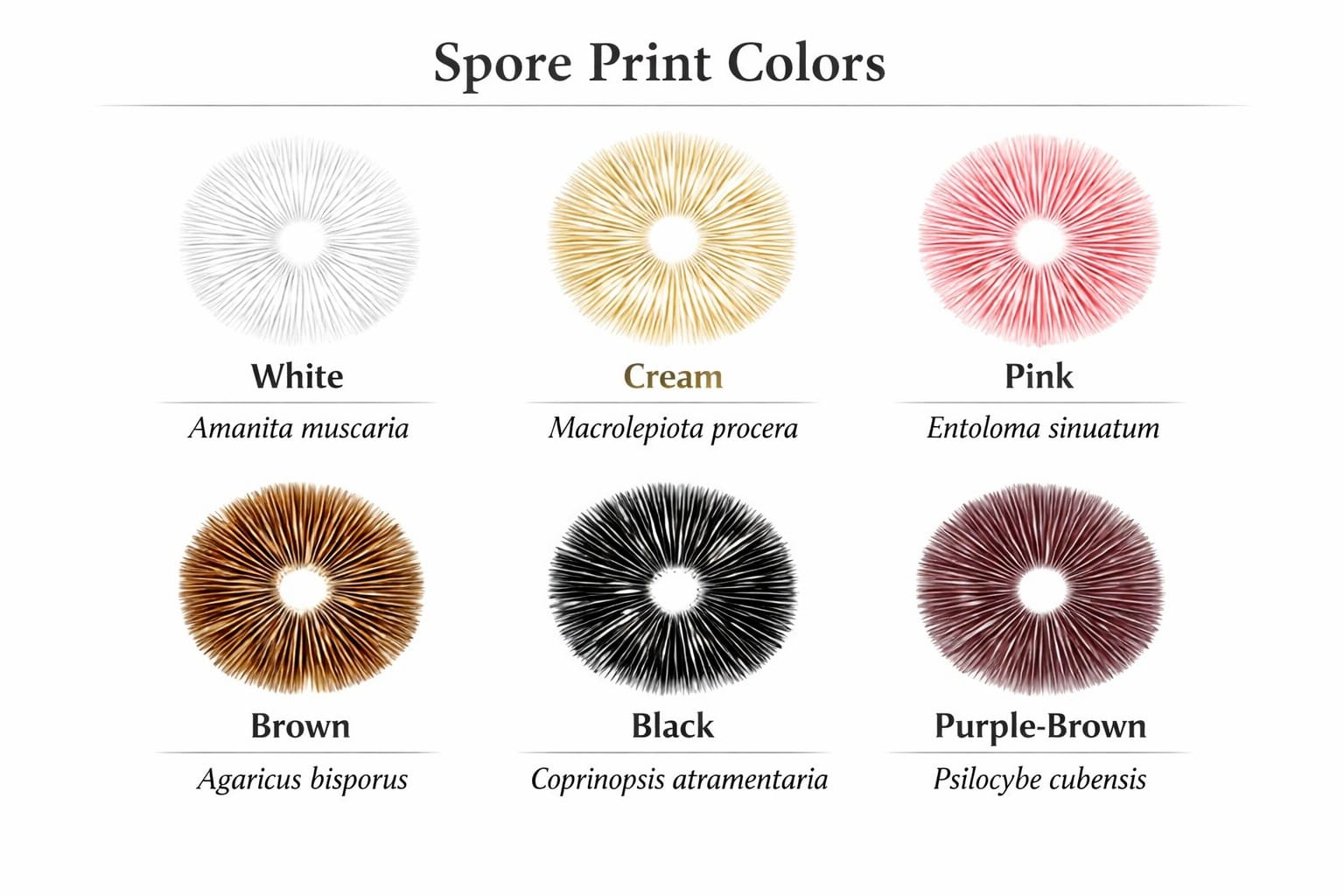
One of the main reasons spore prints are useful is that different mushrooms can produce noticeably different spore print colours. Common guide categories include white, cream, pink, brown, black, and purple-brown. [1][3][4]
Examples of common colour groups
- White spores – often associated with certain well-known genera in field guides.
- Cream spores – close to white, but with a warmer tone.
- Pink spores – important in several classic groups.
- Brown spores – a broad category that appears in many mushrooms.
- Black spores – often striking and easy to recognise in mass.
- Purple-brown spores – a common educational example in mycology discussions.
Why colour still needs context
Colour can narrow possibilities, but many mushrooms share the same broad spore print colour. That’s why mycologists use spore colour together with other characteristics rather than by itself. [1][4]
What spore prints can and cannot tell you
Spore prints are useful, but they have limits. They can show colour and provide material for microscopy, but they usually cannot confirm a mushroom species on their own. NHBS notes that even though spore prints are often helpful, they are not fully reliable as a single method of identification. [4]
What a spore print can tell you
- The general colour group of the spores
- Whether the mushroom is releasing a visible deposit
- A possible next step for microscope study
What it cannot tell you by itself
- The exact species in most cases
- Every microscopic feature needed for comparison
- Whether a mushroom is “safe” or suitable for any kind of use
Safety note
If your concern is poisoning risk or mushrooms appearing around pets or children, treat unknown fungi as a hazard and use safety guidance rather than trying to rely on a spore print alone. See: Mushroom Identification Safety (UK).
How spore prints connect to microscopy
Spore prints are a natural bridge to microscope study. The British Mycological Society notes that spores can be allowed to drop onto glass slides so they can then be viewed at high resolution under a microscope. [1] That makes the spore print one of the simplest ways to move from visual observation into basic mycology microscopy.
Answer-first
Can a spore print be used for microscope study? Yes. A spore deposit can provide material for a microscope slide, which is one reason spore prints are so useful in beginner mycology education. [1]
Next steps in the SporeBuddies education path
This page sits in the middle of your mycology learning path. Once you understand what a spore print is and what it can show, the next logical step is learning how that print connects to microscope observation and slide preparation.
FAQ
What is a mushroom spore print?
A mushroom spore print is the visible deposit left when spores fall from a mushroom cap onto a surface. It helps show the colour of the spores in mass. [1][2]
Why do mycologists use spore prints?
They use them because spore colour can help narrow down groups of fungi and because the spore deposit can be used for microscope study. [1][4]
Can a spore print identify a mushroom by itself?
Usually not. A spore print is useful, but it is only one clue among several and normally needs to be considered alongside other features. [1][4]
What colours can a spore print be?
Common spore print colours include white, cream, pink, brown, black, and purple-brown, among others used in field guides and mycology resources. [1][3][4]
Can a spore print be used under a microscope?
Yes. Educational resources note that spores can be collected on glass slides and then examined microscopically. [1]
Sources
- [1] British Mycological Society (BMS) – “How to Make a Spore Print” (spore colour and microscopic viewing on slides). britmycolsoc.org.uk (PDF)
- [2] Imperial College London – “Fungi prints instructions” (education activity explaining spores and prints). imperial.ac.uk (PDF)
- [3] Mycological Society of Toronto – Spore prints and spore colour overview. myctor.org
- [4] NHBS – Beginner’s guide to fungal spore printing (usefulness and limitations). nhbs.com
- [5] British Mycological Society – educational resources hub for fungi identification and learning. britmycolsoc.org.uk