
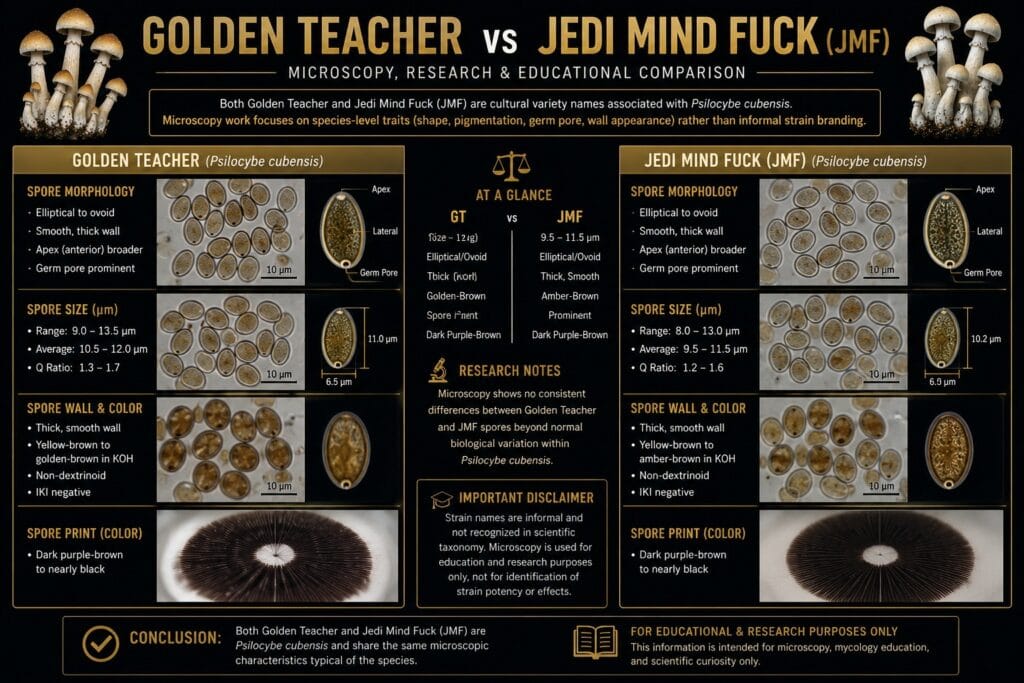
Golden Teacher vs Jedi Mind Fuck (JMF) spores is a common comparison in mycology education and microscopy research. Both are widely discussed cultural variety names associated with Psilocybe cubensis, but microscopy work focuses on species-level traits (shape, pigmentation, germ pore, wall appearance) rather than informal strain branding.
Ready to explore something new? Try the Golden Mind Fuck Spore Syringe and enjoy the best of both worlds with this exciting Golden Teacher × Hillbilly cross.
Educational Notice: This page is written for legal microscopy, taxonomy, and educational study. No cultivation guidance, dosing, or therapeutic instructions are provided. Readers are responsible for compliance with local laws.
Contemporary clinical and academic research evaluates psilocybin as a compound under regulated protocols. Outcomes in the literature are associated with dose standardisation, study design, and context, not with informal variety names such as “Golden Teacher” or “Jedi Mind Fuck (JMF)”.
In educational mycology, these names are best treated as cultural labels. Under the microscope, spores commonly overlap within standard P. cubensis morphology ranges, which limits strain-level conclusions.
Source links and data context appear in the Alkaloid Content section below.
Quick Comparison: Golden Teacher vs JMF Spores
| Feature | Golden Teacher Spores | Jedi Mind Fuck (JMF) Spores |
|---|---|---|
| Species (commonly associated) | Psilocybe cubensis | Psilocybe cubensis |
| Spore colour | Dark purplish-brown | Dark purplish-brown |
| Spore shape | Ellipsoid to sub-ovoid | Ellipsoid to sub-ovoid (overlapping range) |
| Best use in microscopy | Baseline reference, teaching collections | Comparative study, documenting intraspecies variation |
| Key takeaway | Microscopy supports species-level identification; it is not reliable for “strain-level” confirmation without provenance and/or genetics. | |
What Are Golden Teacher Spores?
Golden Teacher spores are microscopic reproductive cells commonly catalogued for legal mycology education and reference microscopy. In educational contexts, “Golden Teacher” is often treated as a widely recognised label, useful for building baseline observation skills such as spore measurement, morphology notes, and slide preparation consistency.
What Are JMF Spores?
JMF (Jedi Mind Fuck) spores are typically discussed as a cultural variety label associated with P. cubensis. In microscopy and educational study, they’re used for comparative documentation and for illustrating how intraspecies variation can appear across different labelled samples.
Alkaloid Content Comparison: Golden Teacher vs JMF (Biological Reference)
This section is provided for educational and biochemical context only. Alkaloid content varies widely due to genetics, environment, harvest timing, drying/storage, and laboratory methodology. The values below are drawn from publicly presented potency summaries, and should not be treated as fixed “strain standards”.
| Compound / Metric | Golden Teacher (Reported Range) | JMF (Reported Figure) | Notes |
|---|---|---|---|
| Total tryptamines | ~0.7% – 1.2% (summary presented as Psilocybin Cup range) | ~0.64% (single “potency panel” style figure) | Best used as a high-level reference; overlap between samples is expected. |
| Psilocybin | Often reported within typical P. cubensis mid-range depending on sample | ~0.50% | Presented as an informational potency figure; not a guarantee of labelled material. |
| Psilocin | Highly variable; sensitive to handling and storage | ~0.04% | Psilocin stability can be influenced by processing and degradation factors. |
| Minor alkaloids | Compounds such as baeocystin / norbaeocystin may appear in extended panels, but are not consistent or reliable for confirming cultural labels without provenance/genetics. | ||
Sources & Data Context
- Golden Teacher potency range summary (states “Psilocybin Cup” range): tripsitter.com/magic-mushrooms/strains/golden-teacher
- JMF potency panel figures: tripsitter.com/magic-mushrooms/strains/jedi-mind-fuck
Microscopic Comparison: Golden Teacher vs JMF Spores
This comparison focuses on microscopy-relevant characteristics commonly used in legal mycology education: shape class, pigmentation, wall appearance, apiculus, and germ pore visibility. These features support species-level study rather than strain confirmation.
Spore Size & Shape (Educational Range)
- Golden Teacher: commonly observed as ellipsoid to sub-ovoid.
- JMF: commonly observed as ellipsoid to sub-ovoid (overlapping appearance with other P. cubensis labelled samples).
Note: Measured dimensions can shift with preparation method, calibration, spore maturity, and sample age.
Microscopic Diagnostic Features Compared
Shared Species-Level Traits (Typical for P. cubensis)
- Dark purplish-brown spore deposit appearance
- Ellipsoid to sub-ovoid spores with smooth walls
- Distinct apiculus (attachment point)
- Single germ pore may be visible at high magnification depending on optics and preparation
Preparation Effects (Why Slides “Look Different”)
- Dry vs wet mounts can change contrast and perceived wall thickness
- Spore density can obscure germ pores and edge definition
- Illumination, condenser height, and focus depth strongly affect optical density
Diagnostic Limitations (Important)
Golden Teacher vs JMF cannot be reliably distinguished by spore microscopy alone. These are cultural variety names, and spores usually overlap within standard Psilocybe cubensis morphology ranges. Reliable strain attribution requires provenance controls and/or genetics, not visual spore traits.
People Also Ask: Golden Teacher vs JMF (Featured Snippets)
What’s the difference between Golden Teacher and JMF mushrooms?
Golden Teacher and JMF are cultural variety names commonly associated with Psilocybe cubensis. Golden Teacher is often used as a baseline reference label in education, while JMF is used for comparative documentation. Under microscopy, spores commonly overlap, so differences are not reliably “strain-diagnostic.”
Is JMF more potent than Golden Teacher?
Public potency summaries report Golden Teacher in a ~0.7%–1.2% total tryptamine range, while one JMF potency panel lists ~0.64% total tryptamines. These figures can vary widely by sample and testing method, so potency should be treated as “reported data,” not a fixed strain rule.
Can you identify Golden Teacher vs JMF spores under a microscope?
Not reliably. Both labels typically fall within standard P. cubensis spore morphology ranges. Microscopy supports species-level study (shape, pigmentation, germ pore visibility), but “strain-level” certainty generally requires provenance controls and/or genetic testing rather than spore appearance.
What should students compare under the microscope?
Compare consistent, measurable traits: overall shape class, apiculus visibility, pigment density under standard illumination, and germ pore appearance at high magnification. Record slide preparation variables too, because mounting medium, spore density, and optics often explain apparent differences more than the label does.
Frequently Asked Questions
What are Golden Teacher spores?
Golden Teacher spores are microscopic reproductive cells commonly studied for legal mycology education, taxonomy context, and microscopy observation. They’re frequently used as a baseline reference label for learning spore morphology, measurement, and slide preparation principles.
What are JMF spores?
JMF (Jedi Mind Fuck) spores are commonly discussed as a cultural variety label associated with Psilocybe cubensis. In educational microscopy, they’re used for comparative documentation and illustrating natural intraspecies variation across labelled samples.
Can Golden Teacher and JMF spores be reliably distinguished under a microscope?
No. These are cultural labels, and spores typically overlap within standard Psilocybe cubensis size and shape ranges. Microscopy alone is not sufficient for reliable strain-level identification without provenance controls and/or genetics.
What is a germ pore and why is it mentioned in spore microscopy?
A germ pore is a thin-walled region of the spore wall where germination begins. It may be visible under high magnification, but visibility varies with lighting, focus depth, and slide preparation. Germ pore appearance is not a definitive “strain marker.”
Does slide preparation affect what you see under the microscope?
Yes. Mounting medium clarity, spore density, sample age, and microscope settings can change perceived colour, contrast, and apparent wall thickness. Many “differences” between samples are preparation artifacts rather than true biological variation.
Are alkaloid tables reliable for strain identification?
Not on their own. Public potency summaries can be useful as educational biochemical context, but values vary by sample and laboratory method. Potency data should be treated as “reported figures” rather than definitive identifiers for cultural variety names.
Related Products (Microscopy Formats)
Choose from a fantastic selection of Golden Teacher, Jedi Mind Fuck or Our brand new Cross strain Called Golden Mind Fuck.

Golden Teacher Spore Syringe
A popular baseline reference format for microscopy observation, cataloguing, and comparative study.
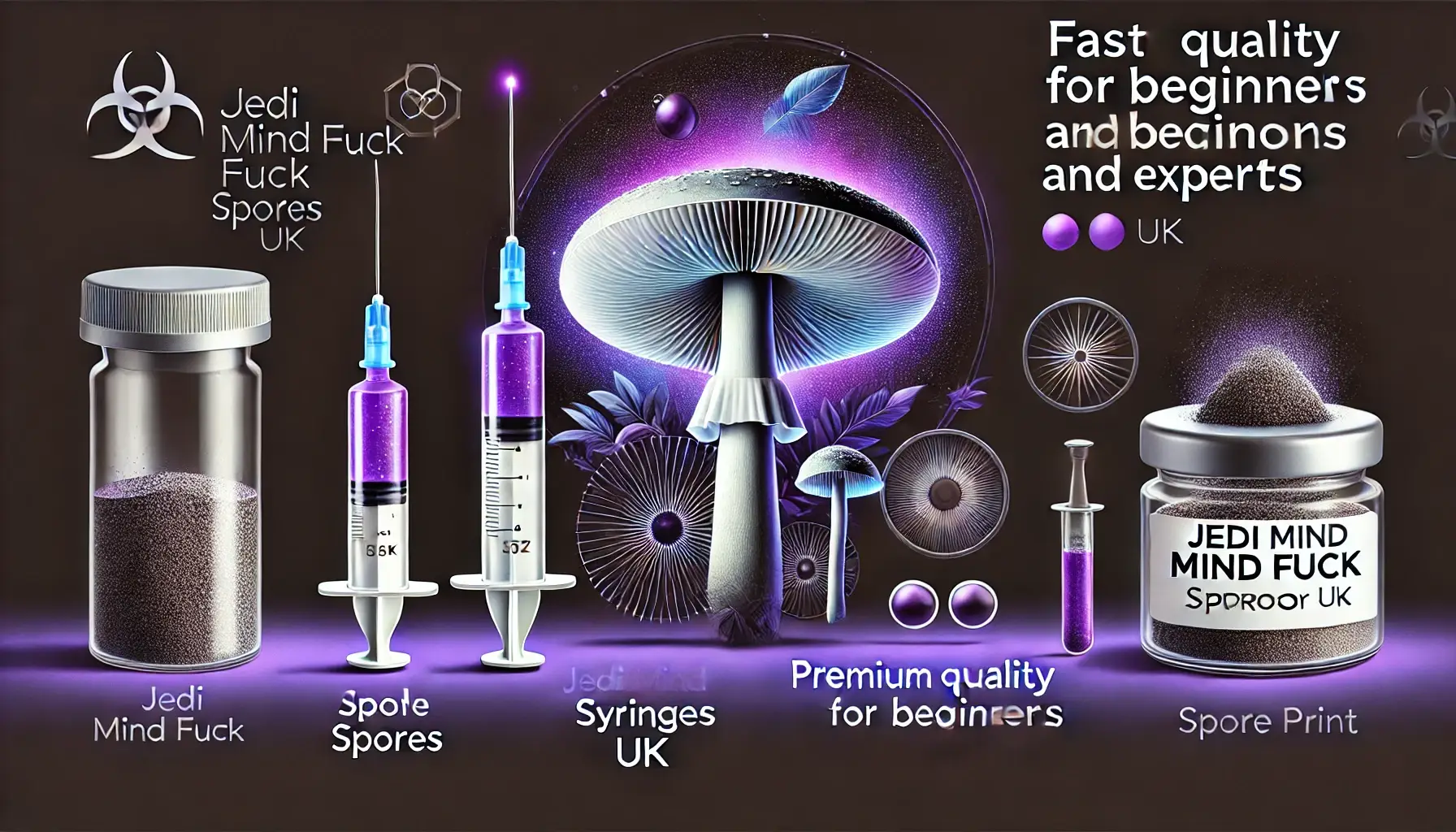
Jedi Mind Fuck Spore syringe
Jedi Mind Fuck (JMF) is a highly regarded strain within the Psilocybe cubensis species, known for its unique genetics.
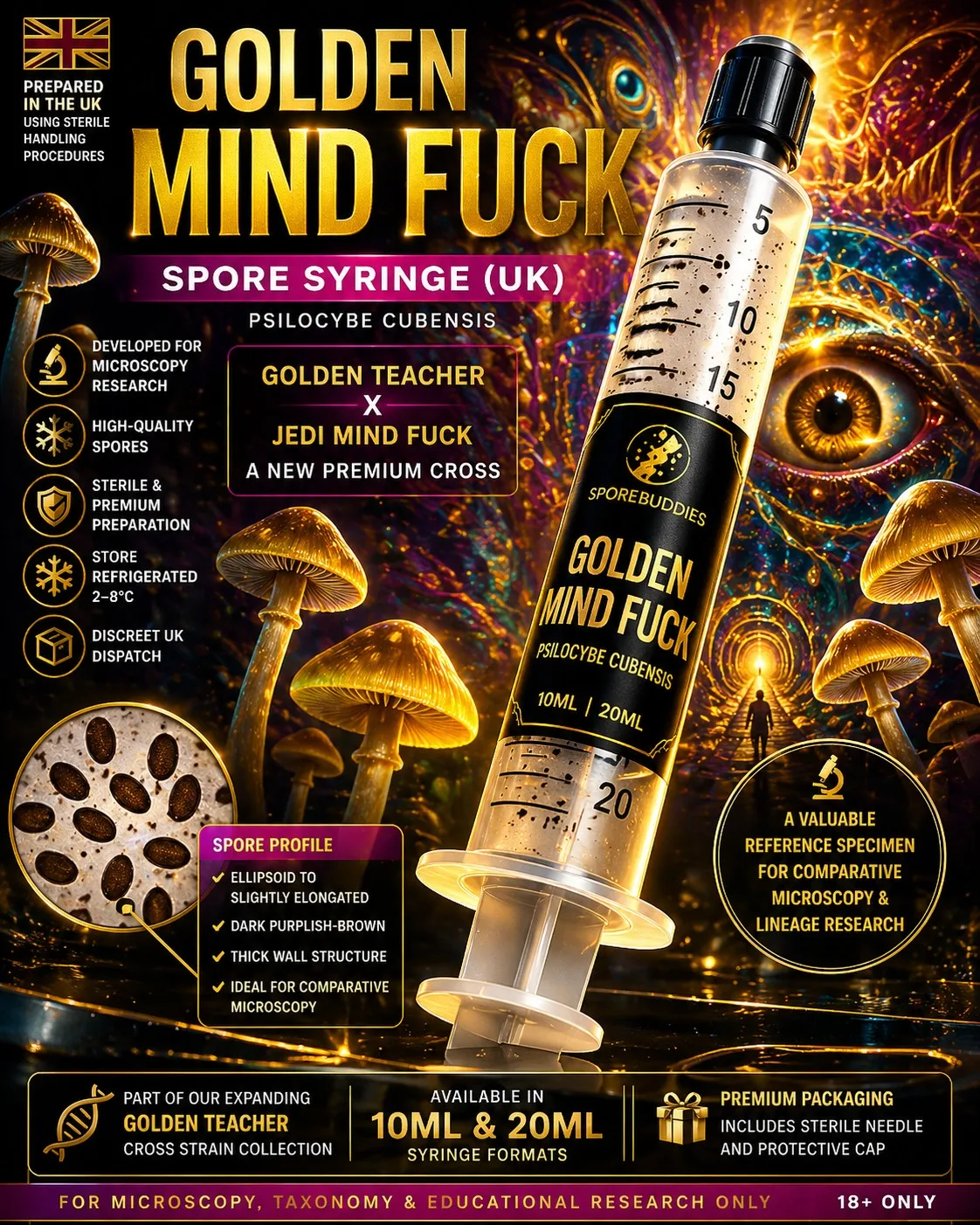
Golden Mind Fuck
Try the next step in mycology study with Golden Mind Fuck. A varient of the world famouse Golden Teacher and Jedi Mind Fuck