
Glossary: Spore Print
Educational note: This glossary entry explains the meaning of spore print in mycology. It is designed to support microscopy learning, fungal biology, and safe educational study.
Quick definition
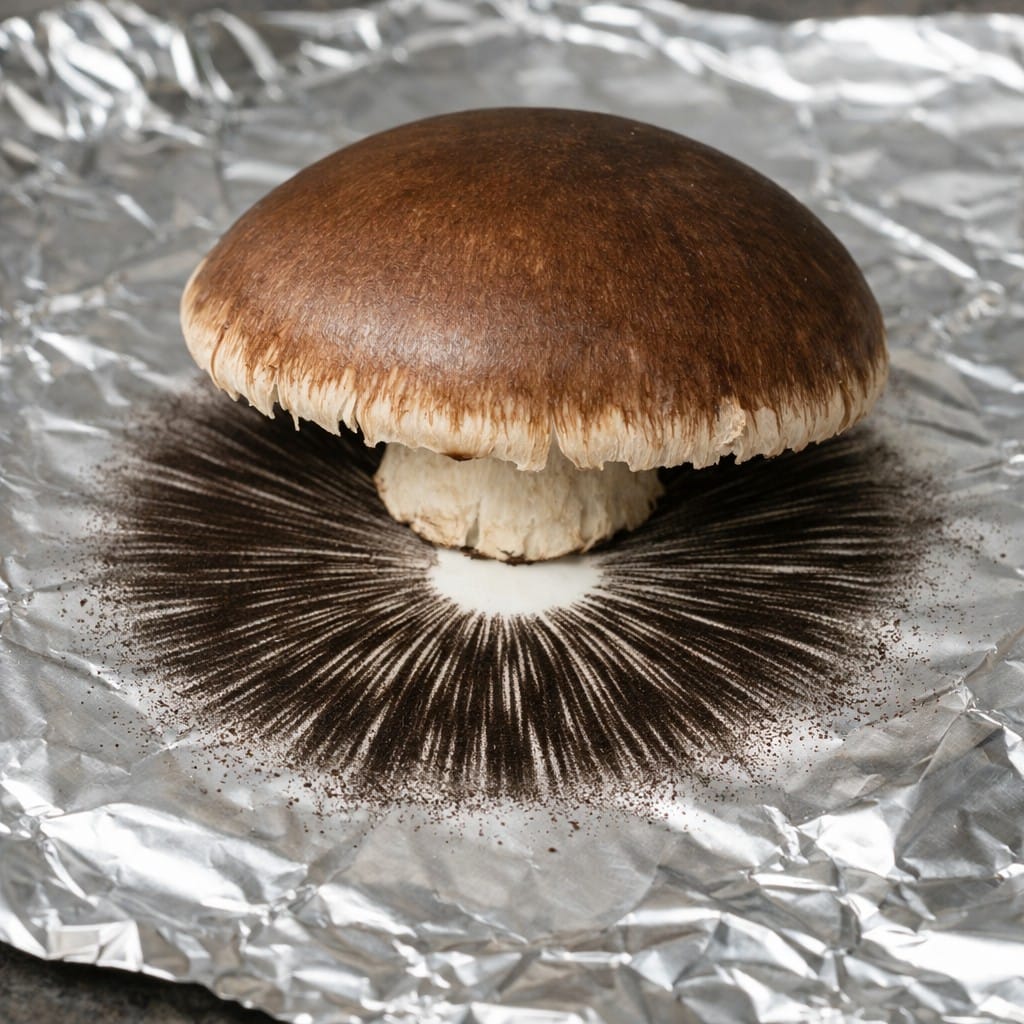
Spore print (noun): a visible deposit of fungal spores left on a surface when a mushroom releases spores from its gills or pores. Mycologists use spore prints to observe spore colour in mass and to prepare material for microscope study. [1][2]
Definition
Spore print is the term used in mycology for the visible deposit formed when fungal spores fall from a mushroom cap onto a surface. Because individual spores are microscopic, the print allows the observer to see the colour of the spores as a group. [1][2]
Spore prints are one of the most familiar tools in mushroom education because they make an otherwise invisible part of fungal reproduction easy to observe. The British Mycological Society explains that spores are too small to see individually without a microscope, but a spore deposit can be collected and then examined more closely. [1]
Answer-first
What does a spore print show? It mainly shows the spore colour in mass. That colour can help mycologists compare groups of mushrooms and decide what to examine next. [1][3]
Why spore prints matter in mycology
Spore prints matter because they give mycologists a simple way to compare fungal material. In field guides and beginner resources, spore print colour is often used as an early clue that helps narrow down possibilities before deeper study. [3][4]
Spore prints are useful for:
- Comparing mushrooms that may look similar on the surface
- Observing spore colour in a visible form
- Collecting spores for microscope work
- Teaching fungal biology in a clear, visual way
Why beginners start here
Spore prints are one of the easiest bridges between visible mushroom study and microscopy. They are simple enough for beginners, but still meaningful enough to be used throughout mycology education. [1][2]
How spore prints are used
Mycologists use spore prints in two main ways: first, to observe the colour of a spore deposit; second, to provide source material for further study. The British Mycological Society notes that spores can be allowed to drop onto glass slides, which can then be viewed under a microscope at high resolution. [1]
Main educational uses
- Colour comparison – to see whether the print is white, cream, pink, brown, black, purple-brown, or another shade
- Microscope preparation – to move from a visible print to a slide-based sample
- Documentation – to record observations in a repeatable, visual format
That is why this glossary entry links naturally into pages like Spore Prints Explained and Spore Print to Slide Workflow.
Common spore print colours
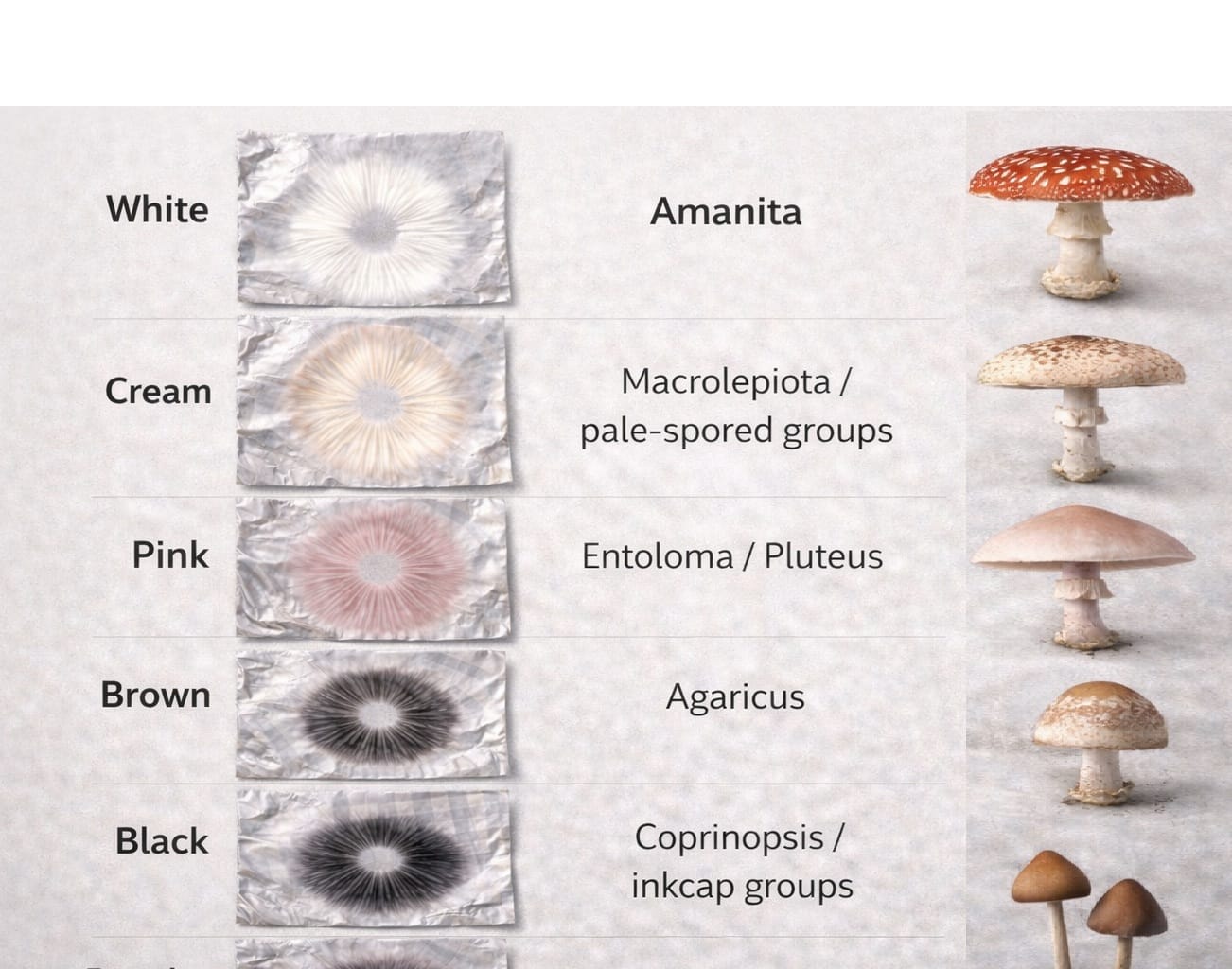
Spore print colour is one of the most discussed features in beginner mycology. Common educational categories include white, cream, pink, brown, black, and purple-brown. [1][3][4]
| Spore print colour | Example species or genus |
|---|---|
| White | Amanita |
| Cream | Macrolepiota / pale-spored groups |
| Pink | Entoloma / Pluteus |
| Brown | Agaricus |
| Black | Coprinopsis / inkcap groups |
| Purple-brown | Psilocybe |
Answer-first
Can spore print colour identify a mushroom by itself? Usually not. Colour is helpful, but many mushrooms share similar spore print colours, so mycologists combine it with other features. [3][4]
Spore prints and microscopy
Spore prints are closely linked to microscopy because they provide an accessible source of spores for slide preparation. The British Mycological Society specifically notes that spores can be collected onto glass slides and viewed under the microscope. [1]
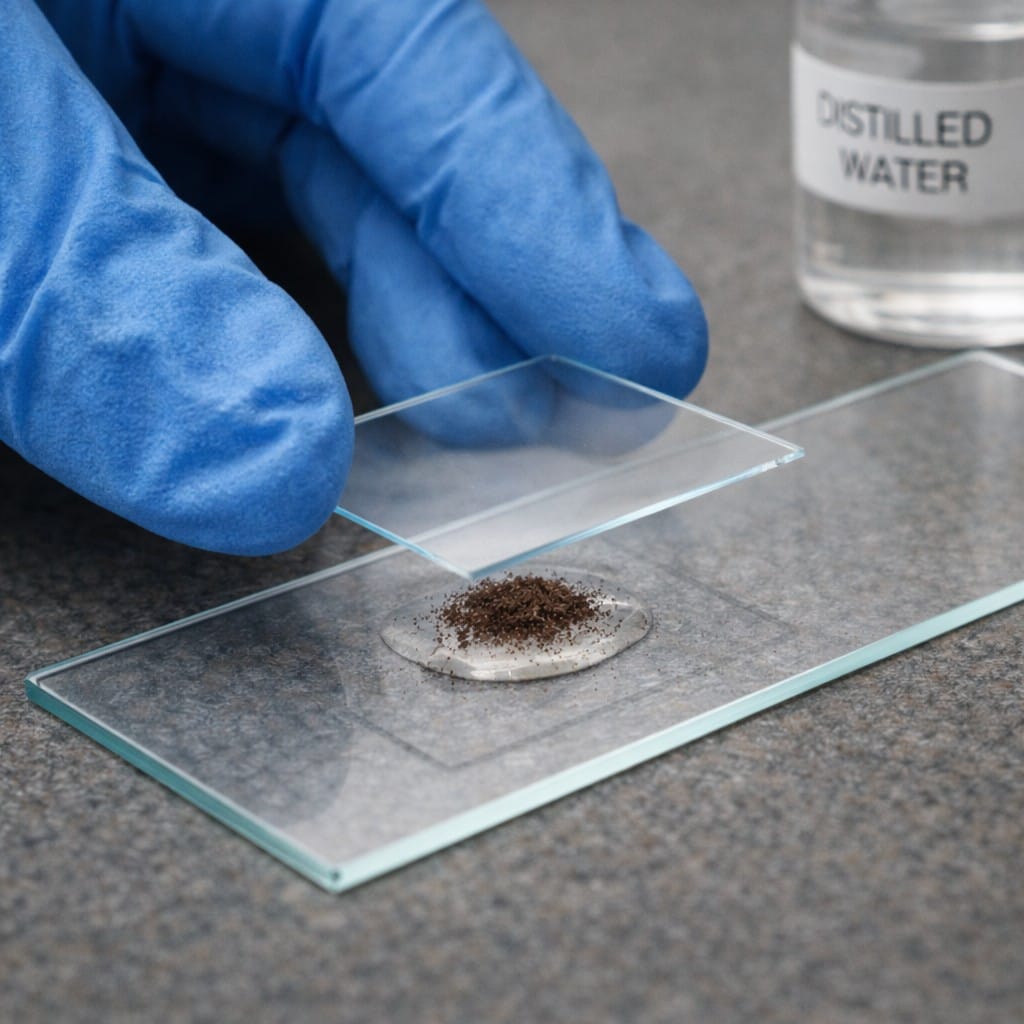
In practical learning terms, the pathway often looks like this:
- spore print → visible spore deposit
- spore slide → thin, viewable sample
- microscope study → observation of shape and detail
Limitations of spore prints
Spore prints are useful, but they are not a complete identification method. NHBS notes that even though spore prints are often helpful, they are not fully reliable on their own as a single way to identify mushrooms. [4]
What a spore print can tell you
- the general colour group of the spores
- whether the mushroom is releasing a visible deposit
- whether there is enough material for microscopy study
What it cannot tell you by itself
- the exact species in most cases
- every microscopic feature needed for comparison
- whether a mushroom is safe for any kind of use
Safety note
If your concern is mushrooms appearing around pets, children, or public spaces, use safety-focused guidance rather than relying on spore print colour. Start with Mushroom Identification Safety (UK).
FAQ
What is a spore print?
A spore print is the visible deposit of fungal spores left on a surface when a mushroom releases spores from its gills or pores. [1][2]
Why do mycologists use spore prints?
They use spore prints to observe spore colour in mass and to collect spores for further microscope study. [1][3]
What can a spore print tell you?
It can show the general colour group of the spores and help guide further observation, but it usually cannot identify a mushroom on its own. [3][4]
Do all mushrooms produce spores?
Mushrooms are reproductive structures of fungi, and spores are central to fungal reproduction, which is why spore prints are such a common teaching tool in mycology. [2]
Can a spore print be used under a microscope?
Yes. Educational mycology resources explain that spores can be collected onto slides and then examined microscopically. [1]
Sources
- [1] British Mycological Society (BMS) – “How to Make a Spore Print” (explains spore colour and microscopic viewing on glass slides). britmycolsoc.org.uk (PDF)
- [2] Imperial College London – “Fungi prints instructions” (education activity explaining spores and spore prints). imperial.ac.uk (PDF)
- [3] Mycological Society of Toronto – Spore prints and spore colour overview. myctor.org
- [4] NHBS – Beginner’s guide to fungal spore printing (usefulness and limitations). nhbs.com
- [5] British Mycological Society – educational resources hub for fungi learning. britmycolsoc.org.uk